⚡️NEW⚡️Computational Art B.A. Degree @ UCLA
Computational Art at UCLA is for students who want to make creative work with code, systems, data, interaction, and emerging technologies...
Ben and I have worked on Processing for nearly 17 years. How and why did we start? Here’s “The History of Processing” in ~3600 words: medium.com/@ProcessingOrg…@ben_fry
We don't have "generative art" in 2022 without long and rich histories of computer art, video synthesis, cybernetics, experimental film and animation, conceptual art, collage, centuries of drawing and painting... +++++ it's all on the table, all the time...
"Generative art refers to any art practice where the artist uses a system, such as a set of natural language rules, a computer program, a machine, ... which is set into motion with some degree of autonomy contributing to or resulting in a completed work of art." —Galanter, 2003
I'm teaching a ten-week introduction to coding with Processing for artists and designers. All of the materials are online if you'd like to follow: classes.dma.ucla.edu/Fall20/28/
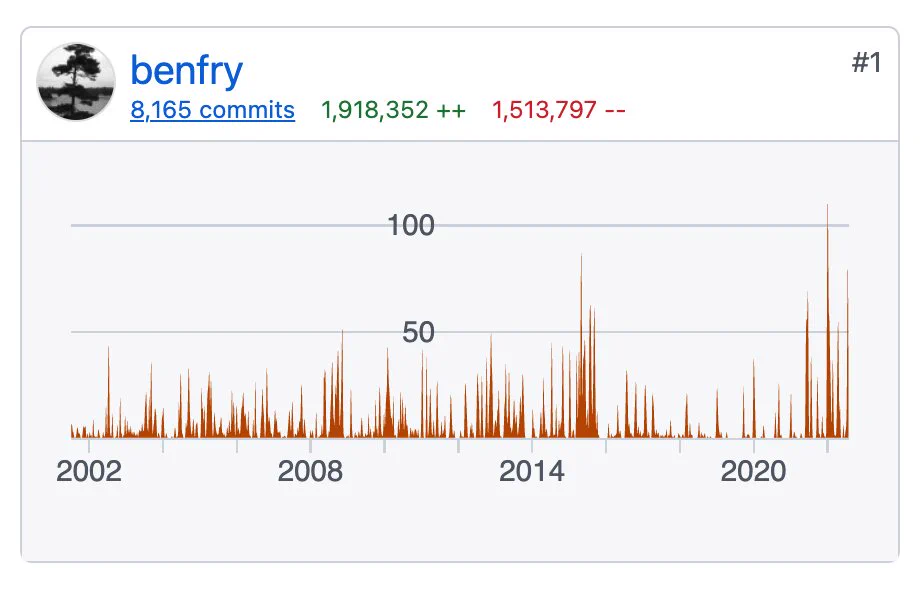
🙌 Ben has written and maintained the core Processing source code (libraries and editor) for 21+ years now. He has created free and open software that is used by students, artists, technologists, and +++ around the 🌏 @ben_fry@ProcessingOrgprocessing.org
My Software Structures (2004) is on display at the Whitney Museum of American Art in "Programmed: Rules, Codes, and Choreographies in Art, 1965–2018" whitney.org/exhibitions/pr…@whitneymuseum
New processing.org! I'll be forever grateful to @designsystemsin for donating their time to make this happen. It's been a beautiful collaboration and my Perl scripts from the early 2000s are finally retired!
I'm researching "generative art" on "social media" with a focus on the ~present. Who's doing the most interesting work in this space? Twitter, Instagram, Tumblr, OpenProcessing, etc. What do you think?
#generativeart#generative#creativecoding#p5t