1. X
  2. Ruohan Zhang
Log inSign up
Ruohan Zhang
191 posts
user avatar
Ruohan Zhang
@RuohanZhang76
Incoming Assistant Professor @NorthwesternCS, Postdoc @StanfordSVL; robot, brain, art; soccer, cooking, dance
Stanford University
ruohanzhang.com
Joined September 2021
1,064
Following
3,136
Followers
RepliesRepliesMediaMedia

New to X?

Sign up now to get your own personalized timeline!

Create account

By signing up, you agree to the Terms of Service and Privacy Policy, including Cookie Use.

Terms·Privacy·Cookies·Accessibility·Ads Info·© 2026 X Corp.
Don't miss what's happening
People on X are the first to know.
Log inSign up
  • Pinned
    user avatar
    Ruohan Zhang
    @RuohanZhang76
    21h
    The 2nd BEHAVIOR Challenge is here! As embodied AI models advance at a rapid pace, it's more important than ever to understand where the field stands on generalizable solutions. With high-quality teleoperation data and strong pre-trained baselines including π₀ and GR00T, we
    user avatar
    Fei-Fei Li
    @drfeifei
    Jul 13
    1/N Long horizon, complex tasks that truly matter in everyday life are not solved problems by today’s robotics, requiring planning, object detection, object manipulation, and failure recovery. That's why Stanford's BEHAVIOR Challenge is back for year 2! Last year, the winning
    Image
    00:00
    2.6K
  • user avatar
    Ruohan Zhang
    @RuohanZhang76
    Nov 9, 2025
    I will join Northwestern University Computer Science as an Assistant Professor in Fall 2026! I am actively recruiting PhD students and seeking collaborations in robotics, human-robot interaction, brain-computer interfaces, cognitive science, societal impact of AI & automation,
    Image
    612K
  • user avatar
    Ruohan Zhang
    @RuohanZhang76
    Nov 3, 2023
    Introducing our new work @corl_conf 2023, a novel brain-robot interface system: NOIR (Neural Signal Operated Intelligent Robots). Website: noir-corl.github.io Paper: arxiv.org/abs/2311.01454 🧠🤖
    Image
    00:00
    288K
  • user avatar
    Ruohan Zhang
    @RuohanZhang76
    Sep 2, 2024
    I believe in big data for robotics. But in this work with @wenlong_huang , he taught me this important lesson again: the right representation + foundation models + constrained optimization can enable robots to perform very challenging tasks without task-specific training data.
    user avatar
    Wenlong Huang
    @wenlong_huang
    Aug 29, 2024
    What structural task representation enables multi-stage, in-the-wild, bimanual, reactive manipulation? Introducing ReKep: LVM to label keypoints & VLM to write keypoint-based constraints, solve w/ optimization for diverse tasks, w/o task-specific training or env models. 🧵👇
    Image
    00:00
    21K
  • user avatar
    Ruohan Zhang
    @RuohanZhang76
    Sep 9, 2025
    Thanks to everyone’s interest in BEHAVIOR so far! We have received several questions, and I am trying to answer some of them here: 1. 📜How are tasks defined in BEHAVIOR? BEHAVIOR tasks are written in BDDL (BEHAVIOR Domain Definition Language). Unlike geometric, image/video, or
    user avatar
    Fei-Fei Li
    @drfeifei
    Sep 2, 2025
    (1/N) How close are we to enabling robots to solve the long-horizon, complex tasks that matter in everyday life? 🚨 We are thrilled to invite you to join the 1st BEHAVIOR Challenge @NeurIPS 2025, submission deadline: 11/15. 🏆 Prizes: 🥇 $1,000 🥈 $500 🥉 $300
    Image
    00:00
    17K
  • user avatar
    Ruohan Zhang
    @RuohanZhang76
    Mar 22, 2024
    BEHAVIOR is my first project since I join Stanford and the largest academic research project I co-lead. I am grateful to be among 50+ students, engineers, and faculty who contributed. Please stay tuned for the next step of BEHAVIOR!
    user avatar
    Fei-Fei Li
    @drfeifei
    Mar 22, 2024
    One year ago, we first introduced BEHAVIOR-1K, which we hope will be an important step towards human-centered robotics. After our year-long beta, we’re thrilled to announce its full release, which our team just presented at NVIDIA #GTC2024. 1/n
    Image
    00:00
    8.2K
  • user avatar
    Ruohan Zhang
    @RuohanZhang76
    Oct 24, 2025
    One advantage of collecting human demonstration data in simulation is that, we can effectively use motion planning to generate 1000x more data. MoMaGen is a follow-up of the X-Gen series, enabling data augmentation in long-horizon mobile manipulation tasks. See Eric's post
    user avatar
    Chengshu Li
    @ChengshuEricLi
    Oct 23, 2025
    We are excited to release MoMaGen, a data generation method for multi-step bimanual mobile manipulation. MoMaGen turns 1 human-teleoped robot trajectory into 1000s of generated trajectories automatically.🚀 Website: momagen.github.io arXiv: arxiv.org/abs/2510.18316
    Image
    00:00
    7.2K
  • user avatar
    Ruohan Zhang
    @RuohanZhang76
    Mar 4, 2025
    Please stay tuned for our upcoming release for this fun project!
    user avatar
    Yunfan Jiang
    @YunfanJiang
    Mar 4, 2025
    🚀Two weeks ago, we hosted a welcome party for the newest member of our Stanford Vision and Learning Lab—a new robot! 🤖✨Watch as @drfeifei interacts with it in this fun video. Exciting release coming soon. Stay tuned! 👀🎉
    Image
    00:00
    3.3K
  • user avatar
    Ruohan Zhang
    @RuohanZhang76
    Nov 3, 2023
    Replying to @RuohanZhang76
    Envisioned by many, brain-robot interface (BRI) stands out as a thrilling but challenging research topic. It is an exciting time for BRI research. Brain signal decoding and robot intelligence are improved a lot by modern machine learning algorithms.
    3.8K
  • user avatar
    Ruohan Zhang
    @RuohanZhang76
    Nov 10, 2024
    We have seen many exciting robotics works leveraging LLMs. How good are they at solving robotic tasks? What's needed is a powerful tool that allows us to perform controlled experiments and in-depth analyses. Embodied Agent Interface is exactly what you need to achieve this, 👇
    user avatar
    Manling Li
    @ManlingLi_
    Nov 6, 2024
    [NeurIPS D&B Oral] Embodied Agent Interface: Benchmarking LLMs for Embodied Agents A single line of code to evaluate your model! 🌟Standardize Goal Specifications: LTL 🌟Standardize Modules and Interfaces: 4 modules, 438 tasks, 1475 goals 🌟Standardize Fine-grained Metrics: 18
    Image
    00:00
    3.5K
  • user avatar
    Ruohan Zhang
    @RuohanZhang76
    Nov 3, 2023
    Replying to @RuohanZhang76
    NOIR is a general-purpose, intelligent BRI system that enables humans to command robots to perform 20 challenging everyday activities using their brain signals, such as cooking, cleaning, playing games with friends, and petting a (robot) dog.
    Image
    00:00
    5K
  • user avatar
    Ruohan Zhang
    @RuohanZhang76
    Mar 13, 2025
    Since we released BEHAVIOR, some critical questions remain: 1) To accomplish 1000 household tasks, what key capabilities should a robot have? 2) What hardware designs are necessary? 3) How do we efficiently collect demo data for such hardware? 4) How do we learn from such data?
    user avatar
    Yunfan Jiang
    @YunfanJiang
    Mar 10, 2025
    🤖 Ever wondered what robots need to truly help humans around the house? 🏡 Introducing 𝗕𝗘𝗛𝗔𝗩𝗜𝗢𝗥 𝗥𝗼𝗯𝗼𝘁 𝗦𝘂𝗶𝘁𝗲 (𝗕𝗥𝗦)—a comprehensive framework for mastering mobile whole-body manipulation across diverse household tasks! 🧹🫧 From taking out the trash to
    Image
    00:00
    4.3K
  • user avatar
    Ruohan Zhang
    @RuohanZhang76
    Apr 3, 2024
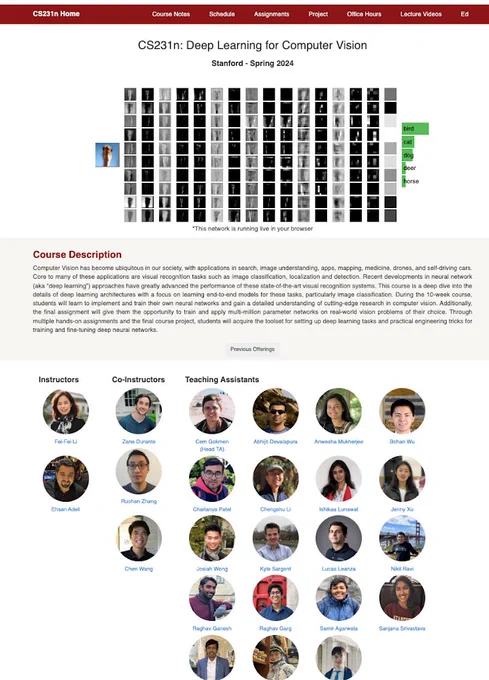
    It’s a great honor to be an co-instructor for 231n, the course that I have watched so many times on YouTube. Looking forward to working with the team and giving lectures!
    user avatar
    Fei-Fei Li
    @drfeifei
    Apr 3, 2024
    It’s that time of the year - first lecture of @cs231n !! It’s the 9th year since @karpathy and I started this journey in 2015, what an incredible decade of AI and computer vision! Am so excited to this new crop of students in CS231n! (Co-instructing with @eadeli this year 😍🤩)
    Image
    Image
    Image
    3.4K
  • user avatar
    Ruohan Zhang
    @RuohanZhang76
    Nov 3, 2023
    Replying to @RuohanZhang76
    With 10-minute calibration for each session, 3 human participants successfully accomplished 20 long-horizon tasks (4-15 subtasks). On average, each task requires 1.8 attempts to succeed with an average task completion time of 20 minutes.
    Image
    1.7K
Advertisement
Advertisement