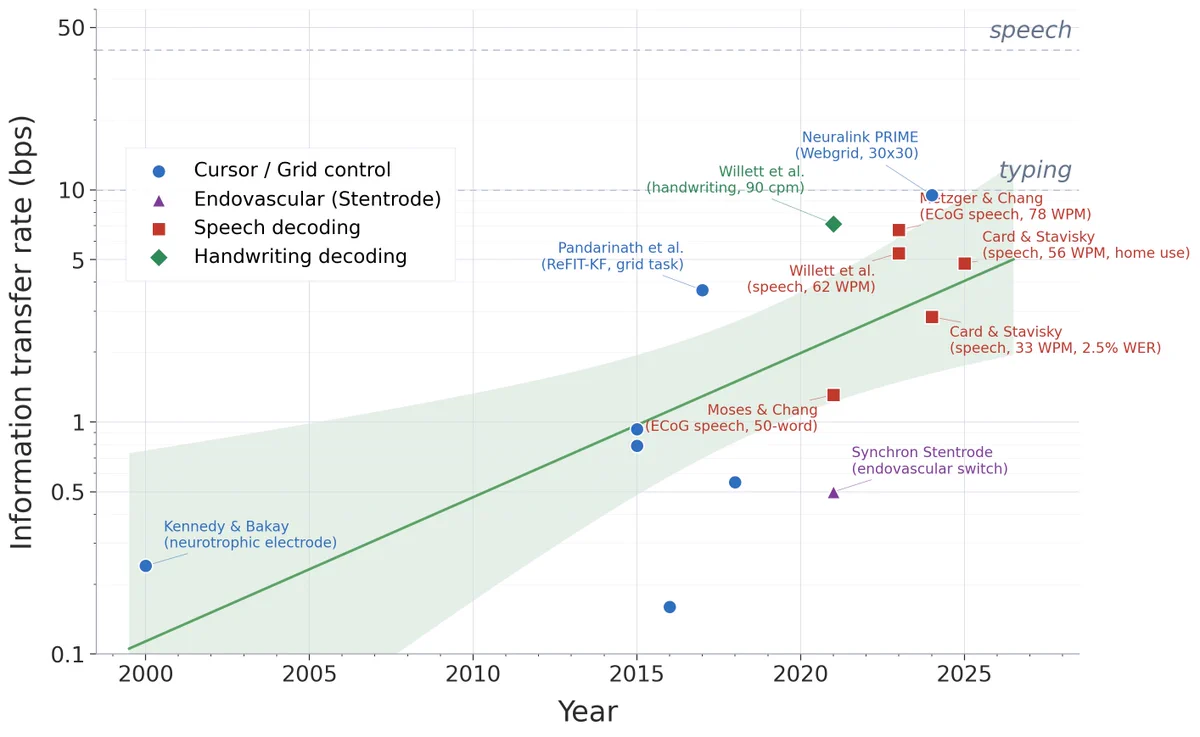
Implanted Brain-Computer Interfaces are getting fast!
They're approaching speeds that match unimpaired people typing.
But... more electrodes won't be enough to break through the "motor barrier."
One of my favorite scientific findings:
Some languages are very information dense and some less so. Some languages are spoken fast and some slow.
And it turns out that people around the world speak at about the same information rate (~39 bps) regardless.
It can be tempting to extrapolate the increasing capabilities of electrode-based motor BCIs and claim they’ll enable superhuman performance in a few years.
This paper is one reason to suggest there is a “speed limit” to consider.
So excited to finally share this work on @biorxivpreprint demonstrating transcranial functional ultrasound brain imaging through a transparent skull prosthetic!
biorxiv.org/content/10.110…
Our work made the cover @ScienceTM!
In this latest #ultrasound🫱🏽🫲🏻#neurotech work, we demonstrate functional ultrasound imaging (fUSI) of human brain activity through an acoustically transparent cranial window, opening new doors for non-invasive, high-resolution neuroimaging. 🧵
New Ultrasound BCI results are out!
"I remember how impressive it was when this kind of predictive decoding worked with electrodes two decades ago, and it's amazing now to see it work with a much less invasive method like ultrasound," -@mikhailshapiro .
"China's brain-computer interface technology is catching up to the US. But it envisions a very different use case: cognitive enhancement."
Interesting perspective from @emilylmullin in @WIRED
📰 Featured in The Guardian: With support from @ARIA_research investment in precision neurotechnologies, we’re thrilled to announce @ForestNeurotech's role in the UK’s first NHS clinical trial of an ultrasound-powered whole-brain interface. 🧠
This is the most succinct and clearly written primer on whole brain emulation
Includes the various approaches and how they might be combined more effectively
Love this post from @patrickmineault!
h/t @allisondman
Thrilled to share our latest work on #biorxiv@biorxivpreprint using functional ultrasound neuroimaging to decode movement intention from single trials in non-human primates 🐒
Now, my first attempt at a #tweetprint! 1/n