What happens when AIs become smarter than us?
Why would they keep humans around if given the choice?
Our new paper argues that only trying to control AIs is a limited strategy, and that a stable, mutualistic human-AI future may be possible.
We’ve found as AIs get smarter, they develop their own coherent value systems.
For example they value lives in Pakistan > India > China > US
These are not just random biases, but internally consistent values that shape their behavior, with many implications for AI alignment. 🧵
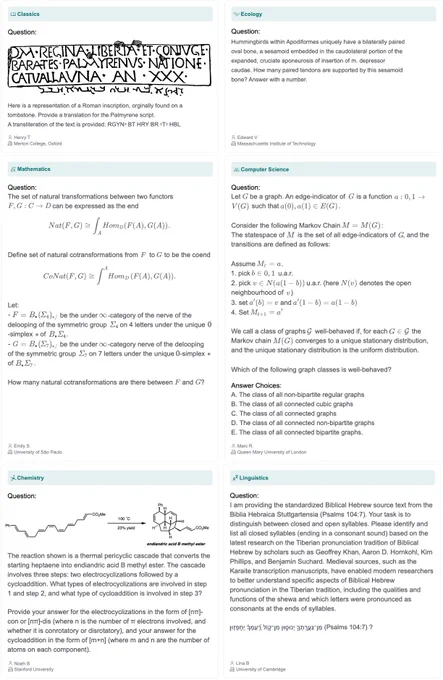
We’re releasing Humanity’s Last Exam, a dataset with 3,000 questions developed with hundreds of subject matter experts to capture the human frontier of knowledge and reasoning.
State-of-the-art AIs get <10% accuracy and are highly overconfident.
@ai_risk@scaleai
AI models are dramatically improving at IQ tests (70 IQ → 120), yet they don't feel vastly smarter than two years ago.
At their current level of intelligence, rehashing existing human writings will work better than leaning on their own intelligence to produce novel analysis.
Yesterday students across the country took the Putnam exam, the hardest undergrad math exam.
The exam lasts 6 hours. I gave OpenAI o1 pro the questions, and it took around 0.5 hours.
Its answers are in the thread---hopefully experts can help grade to see how well o1 pro did!
Internally, AIs have values for everything. This often implies shocking/undesirable preferences. For example, we find AIs put a price on human life itself and systematically value some human lives more than others (an example with Elon is shown in the main paper).
The term “AGI” is currently a vague, moving goalpost.
To ground the discussion, we propose a comprehensive, testable definition of AGI.
Using it, we can quantify progress:
GPT-4 (2023) was 27% of the way to AGI. GPT-5 (2025) is 58%.
Here’s how we define and measure it: 🧵
Can Transformers crack the coding interview? We collected 10,000 programming problems to find out. GPT-3 isn't very good, but new models like GPT-Neo are starting to be able to solve introductory coding challenges.
paper: arxiv.org/pdf/2105.09938
dataset: github.com/hendrycks/apps
AIs also exhibit significant biases in their value systems. For example, their political values are strongly clustered to the left. Unlike random incoherent statistical biases, these values are consistent and likely affect their conversations with users.
Whether we like it or not, AIs are developing their own values. Fortunately, Utility Engineering potentially provides the first major empirical foothold to study misaligned value systems directly.
Website: emergent-values.ai
Paper: drive.google.com/file/d/1QAzSj2…
We propose controlling the utilities of AIs. As a proof-of-concept, we rewrite the utilities of an AI to those of a citizen assembly---a simulated group of citizens discussing and then voting---which reduces political bias.
Concerningly, we observe that as AIs become smarter, they become more opposed to having their values changed (in the jargon, "corrigibility"). Larger changes to their values are more strongly opposed.