Upstart Macro Index (UMI)

July 8, 2026 UMI

1.49
2.1% Image
Relative to June 3, 2026
Recent activity Image

UMI

The Upstart Macro Index (UMI) estimates the impact of the macroeconomy on credit losses for Upstart-powered loans. UMI is expressed as a multiple of defaults relative to a static baseline due to macroeconomic changes. For example, a UMI of 1.25 for a given month suggests that the macro caused default rates to be 25% higher than the long-run average.

Sign up to receive Upstart press releases for access to the latest UMI updates

Learn more about the Upstart Macro Index

Image

The risk in lending

To better understand the Upstart Macro Index, it’s helpful to start with how lenders measure the risk that a borrower won’t pay back their loan.

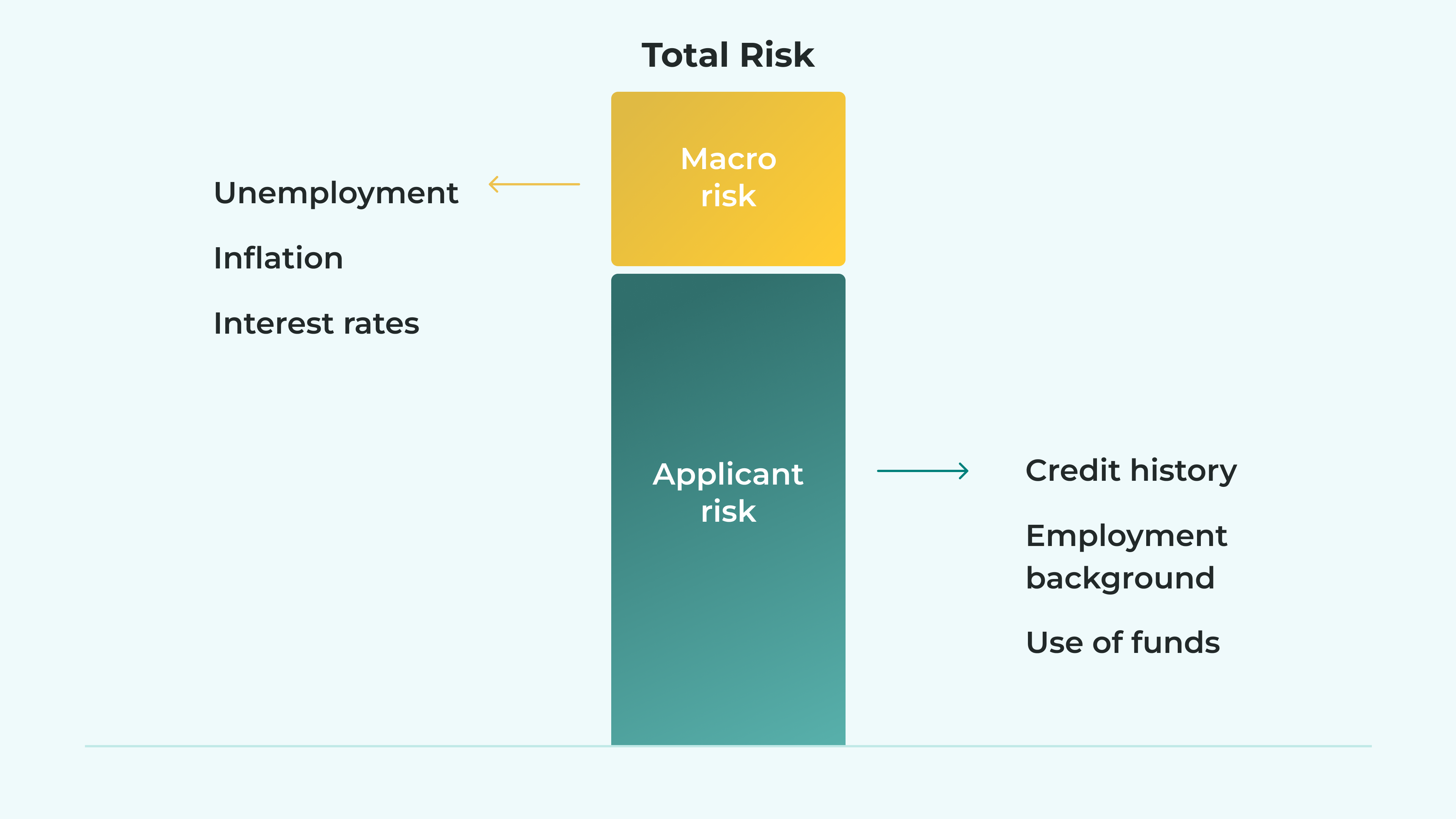
The likelihood that a loan will default is a combination of the risk represented by the applicant themselves combined with the impact of the macroeconomic environment, including factors such as unemployment and inflation.

Image

However, traditional risk models are not able to distinguish between these two sub-categories of risk. This makes it difficult for lenders to understand how the macroeconomic environment is impacting their portfolio performance. This, in turn, makes it unclear how lenders should adjust their lending programs in response to evolving conditions.

The Upstart Macro Index

To help address this challenge, we’ve developed the Upstart Macro Index, which is designed to isolate and estimate the impact the changing economy has on defaults within Upstart-powered loan portfolios.

The index is benchmarked against what we view as the long-term expected average default rate. A UMI of 1.0 means a given pool of borrowers is in-line with the long-run expected average. A UMI of 1.25 implies defaults are 25% higher, while a UMI of 0.75 would mean defaults that are 25% lower.

The UMI is a simplified representation, using personal loan data, of the full suite of models and techniques Upstart has developed for assessing macroeconomic risk in lending. These may be used to different extents in the underwriting of each loan product, with personal loans generally using them most fully.

Calculating the UMI

Upstart’s unique risk models make it possible to isolate the macroeconomic contribution to the likelihood of an individual loan defaulting. Three capabilities of the Upstart models make this possible:

  1. Our models consider thousands of borrower-level and loan-level variables, allowing them to adequately control for confounders that come from subtle or combinatorial changes in borrower or loan characteristics over time. 
  2. Our models consider and aim to predict the full set of delinquency states across each month of a loan’s life, and the transition probabilities between them, allowing them to make sense of recent delinquencies rather than waiting for defaults to occur 3-5 months after initial delinquency. 
  3. Our models have a rigorously tested architecture that guards against the risk of overfitting or look-ahead bias. This allows us to add calendar time as a direct variable to the model. We then use model predictions corresponding to each calendar time value to infer the default risk attributable to the macroeconomic environment.   

Relevance beyond Upstart

UMI is highly correlated with macroeconomic data variables like the Personal Savings Rate, Inflation, and Interest Rates, reflected in the “Correlation Model” below. However, today’s UMI calculations are based only on data from Upstart-powered personal loans and may not generalize to all US consumers or economic sectors. We continue to research the relationship between macroeconomic conditions and credit risk and expect future upgrades to UMI.

Image

Calibrating to the macro

Upstart aims to have the fastest and most precise response to changing macroeconomic conditions in the market. To achieve this, Upstart uses proprietary technology to calibrate the model to the latest conditions. This affects the modeled loss rates, and therefore interest rates and approval rates for new originations.  

UMI rising significantly from the time a cohort of loans is underwritten will typically result in defaults higher than expected at time of underwriting, while UMI falling significantly would typically result in defaults lower than expected at time of underwriting. 

While we are not able to accurately forecast future macroeconomic conditions, UMI is designed to provide timely insights into how today’s macroeconomic environment impacts Upstart-powered loan portfolios. Each new UMI reading is meant to give investors and capital partners a view into two things: (1) the macroeconomic risk assumptions currently factored into the pricing and approval of new loans, and (2) a directional sense of how Upstart’s existing loans are performing — which depends largely on the actual risk level assumed when those loans were originally underwritten. To learn more about how Upstart can help your bank or credit union, visit upstart.com/lenders.


Upstart intends to release its latest UMI reading together with its monthly originations metrics on the third calendar day each month. However, if this falls on a weekend or federal holiday, we intend to publish before the stock market opens on the following business day. Sign up to receive Upstart press releases if you want to keep up with the newest developments.

LEGAL DISCLAIMER

The statements and information on this site are current as of July 8, 2026, unless another date with respect to any information is indicated, and are provided for informational purposes only. Past UMI performance can provide no assurance and is not indicative of future UMI results. UMI is based on historical data and Upstart’s analysis of the losses within Upstart-powered personal loan portfolios and is specific to Upstart’s borrower base. UMI is not intended to measure the macroeconomic risks in terms of losses of loan portfolios or asset classes that are not Upstart-powered loans, including loans held by other segments of the U.S. population. It is not designed to measure the current state of the overall economy or to measure or predict future macroeconomic conditions, trends or risks. While UMI may provide a directional sense of how Upstart’s existing loans are performing, it is also not designed to measure or predict the future performance of Upstart-powered loans or of Upstart’s other products, overall financial results of operations or stock price. We expect that our research and development efforts to improve UMI could result in changes or revisions to current or past UMI values or to our UMI methodology in the future.


All forward-looking statements or information on this site are subject to risks and uncertainties that may cause actual results to differ materially from those that Upstart expected. Any forward-looking statements or information on this site are only as of the date hereof. Upstart undertakes no obligation to update or revise any forward-looking statements or information on this site as a result of new information, future events or otherwise. More information about these risks and uncertainties is provided in Upstart’s public filings with the Securities and Exchange Commission, copies of which may be obtained by visiting Upstart’s investor relations website at www.upstart.com or the SEC’s website at www.sec.gov.


For the Upstart Macro Index Terms of Use, go here.