

Twenty-six years ago, for the 35th New York Film Festival, curators Gavin Smith and Mark McElhatten introduced the festival's experimental sidebar, Views from the Avant-Garde.
While their inaugural program featured names like Stan Brakhage, Gregory Markopoulos, and Nathaniel Dorsky, it also opened a space where voices experimenting with cinema's language might meet new audiences. In the festival's intervening years, the vocabulary around this type of cinema evolved and Views from the Avant-Garde has since transformed, first into Projections and then into its most recent incarnation, Currents.
When Currents was first announced in 2020, it was also the first year of Docs in Orbit, and every year since, it’s been where we have encountered gems of the festival to bring into conversation, such as My Mexican Bretzel (NYFF58), A Night of Knowing Nothing (NYFF59), and Rewind & Play (NYFF60).
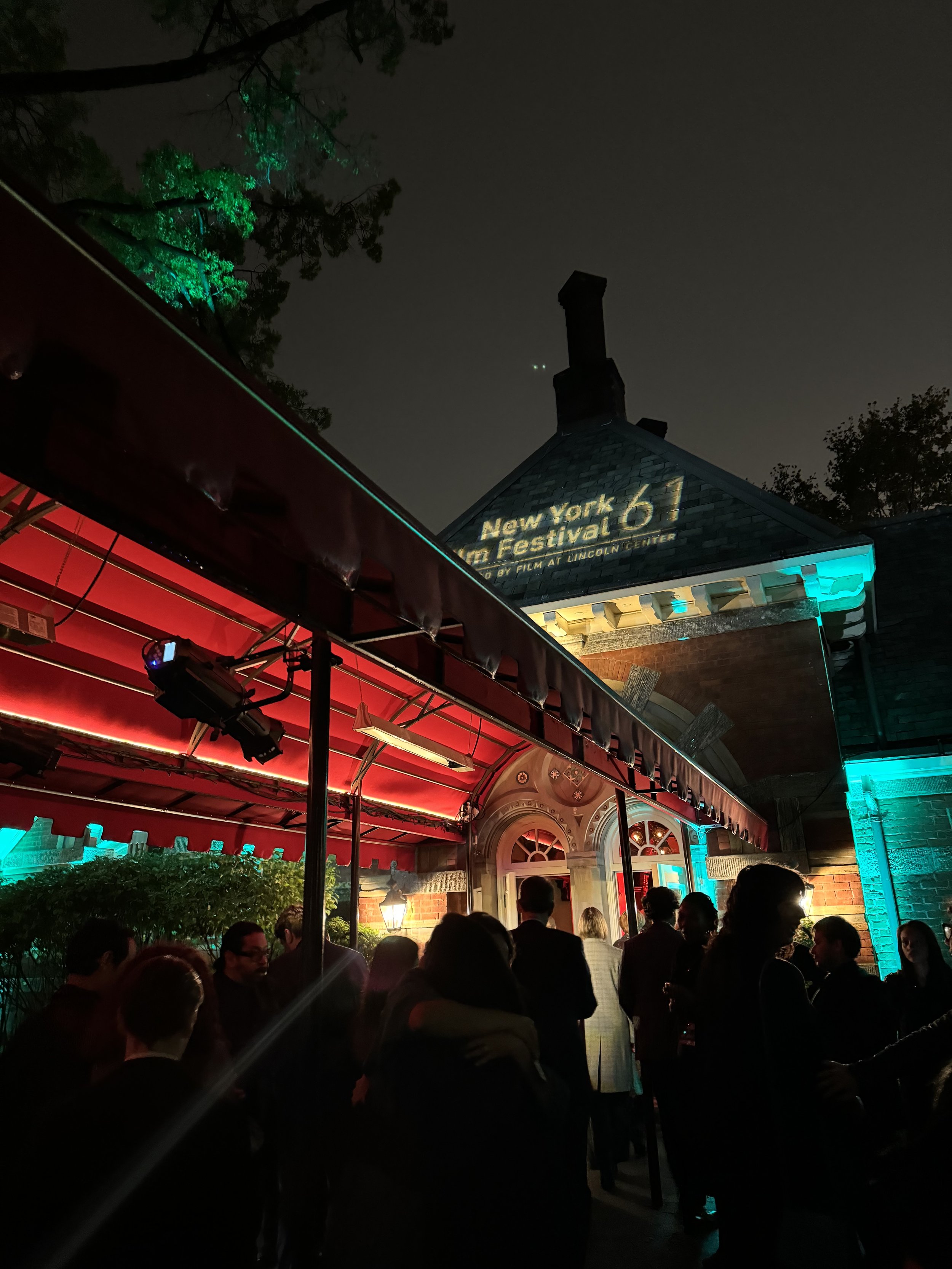
So, for this year’s 61st edition of the New York Film Festival, we focused more intently on Currents to get a behind-the-scenes look at their curatorial approach.
This episode features all three curators of Currents: Aily Nash, Rachael Rakes, and Tyler Wilson. They put together an exciting collection of films, which we'll explore, as well as what sets Currents apart from other programs in New York and abroad.
NYFF61 CURRENTS PROGRAM with curators Aily Nash, Rachael Rakes, and Tyler Wilson
-
Man in Black by Wang Bing
Last Things by Deborah Stratman
The Human Surge 3 by Eduardo Williams
Slow Shift by Shambhavi Kaul
A Prince by Pierre Creton
The Night Visitors by Michael Gitlin
The Fist by Ayo Akingbade
Nowhere Near by Miko Revereza
Live from the Clouds by Mackie Mallison
Inside the Yellow Cocoon Shell by Thien An Pham
Mangosteen by Tulapop Saenjaroen
Bold Eagle by Whammy Alcazaren
Coral by Sonia Oleniak
ALLENSWORTH by James Benning
Ungentle by Huw Lemmey and Onyeka Igwe
Film as a Subversive Art by Amos Vogel (revised edition with new forward by Herb Shellenberger)
-
Aily Nash is a curator and educator based in New York. She is a programmer at the New York Film Festival, where she co-curated the Projections section from 2014–2019, and is currently head of short films and programmer for the Currents section. She is a program advisor to the International Film Festival Rotterdam’s Short Film section. She served as a Biennial advisor and co-curator of the film program for the 2017 Whitney Biennial and was Head of Programming for the 2018 Images Festival in Toronto. She curated the Basilica Screenings series at Basilica Hudson from 2012-2016. She has curated programs and exhibitions for MoMA PS1 (New York), Brooklyn Academy of Music (New York), Anthology Film Archives (New York), SAIC’s Sullivan Galleries (Chicago), Institute of Contemporary Art (London), Kiasma Museum of Contemporary Art (Helsinki), Tabakalera Centre for Contemporary Culture (San Sebastian), Doc’s Kingdom (Portugal), FACT (Liverpool), Tokyo Photographic Art Museum (Tokyo), Ghost:2561 (Bangkok) and others. She has taught at CalArts, Dartmouth, and Bard Microcollege.
-
Rachael Rakes is a curator, writer, editor, film programmer, and educator. She is the Curator of Public Practice at BAK basis voor actuele kunst in Utrecht, an Editor at Large for Verso Books, and a Programmer at Large for Film at Lincoln Center, where she co-curates the annual festival Art of the Real. Recent exhibitions and programs include No Linear Fucking Time (Bak/Utrecht), Practing tactical Solidarities (BAK/Utrecht), Counter-Encounters (Centre Pompidou, Paris), DECODERS/RECORDERS: Steffani Jemison and Samson Young (De Appel/Looiersgracht 60, Amsterdam), Relational Capacities (Frame Contemporary, Helsinki), On Watching Men (SAIC, Chicago), Uncontained Energy and Contained Fear (Tabakerlara, San Sebastian), CAMP: In Cameras Res (De Appel), The Health Show II (A.I.R., NYC), In Between: Tacita Dean (Centre Pompidou, Paris). Rakes has taught at Zine Ezkola, The New School, KASK, the New Centre for Research & Practice.and Harvard University. She is the co-editor of the books Toward the not-Yet: Art as Public Practice (BAK/MIT), and Practice Space (De Appel/NAME).
-
Tyler Wilson is an Assistant Programmer at Film at Lincoln Center. He has played a leading role in the organization’s shorts programming since 2017, serving on the selection committees for the New York Film Festival and New Directors/New Films. He is a co-programmer of FLC’s new releases and has co-organized numerous programs including International Melodrama (2017) and retrospectives of Jane Campion (2017), Jacques Tourneur (2018), Agnès Varda (2019), and Wong Kar-wai (2020). His writing has appeared in Film Comment and The Brooklyn Rail.
-
Emile Klein is a collaborative artist, sometimes journalist, exploring the formal and ideological transferals between painting and non-fiction durational media. His subject is simple–creating space to observe the structural implication of audio-visual language. His collaborations have been presented by institutions such as SFMoMA, NYFF, UnionDocs, Visions Du Reel, NPR, the New School, Radiophrenia, Veggie Cloud, and covered by publications including the NYTimes, the New Yorker, Vice, Mother Jones, and GQ. Klein currently lives in California.
NYFF60 CURRENTS: Rewind & Play with Alain Gomis
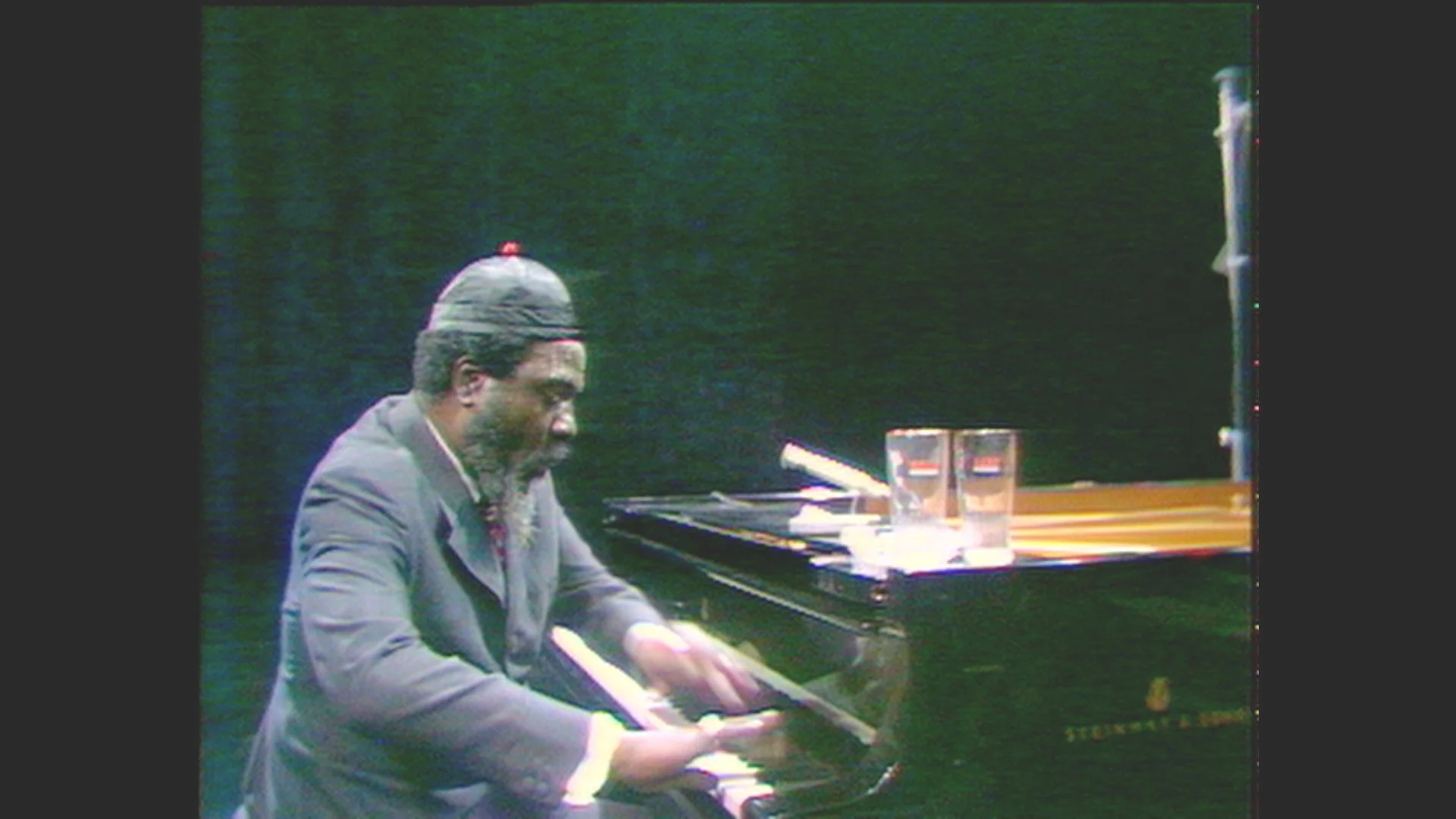
Nnenna Onuoha speaks with Alain Gomis about his latest film, Rewind & Play (2022). The film follows American jazz pianist Thelonius Monk on a 1969 trip to Paris to perform at the Salle Pleyel. Along the way, Monk becomes the subject of a French television program. Rewind & Play unfolds exclusively from the recovered rushes of this recording, and from this single event, the film unravels complex subjects, including the media’s objectification of Monk’s celebrity, and its simultaneous refusal to recognize his full humanity.
Throughout the interview, we witness painfully how Monk’s responses, unsatisfactory to his interviewers, are dismissed, spoken over, and edited out. Yet, with a masterful delicacy, the film inter-cuts shots of him playing the piano, allowing his music to assert itself and interrupt the unbearable media machine that has attempted to enfold him.
In the conversation, Gomis shares his interest in Thelonius Monk and how he handled the challenges of representation in the making of this film.
-
Alain Gomis is a French-Senegalese filmmaker. He studied cinematography at the Sorbonne. After graduating he organized and facilitated video production workshops for immigrant youth in Nanterre. By the age of twenty-six, he had already made three short films: Tourbillons, Tout le monde peut se tromper, and the documentary Caramels et chocolats. In 2001, Gomis directed his first feature film, L’Afrance. Gomis' 2012 film, Tey, was awarded the Etalon de Yenenga at FESPACO in 2012. His films often fall under the subject of young immigrants from Sub-Saharan Africa. His 2017 film Félicité won the grand jury prize at the Berlinale and the Étalon d’or again at FESPACO. It was also selected as the Senegalese entry for the Best Foreign Language Film at the 90th Academy Awards, making the December shortlist. Alain Gomis regularly gives production and writing workshops, and, in 2019, he and Aissatou Diop created the Yennenga Center in Dakar to promote independent film production in Senegal and Africa.
-
Nnenna Onuoha is a Ghanaian-Nigerian researcher and artist based in Berlin, Germany. Her films and videos centre Afrodiasporic voices to explore monumental silences surrounding the histories and afterlives of colonialism across West Africa, Europe and the US. A second strand of her work focuses on archiving Black experience in the present to chronicle the practice of care and repair for ourselves and each other.
Nnenna is currently a doctoral researcher in Media Anthropology at Harvard University and Global History at the University of Potsdam. She holds a BA in History, Literature, and Anthropology from Harvard College, an MPhil in World History from the University of Cambridge, and an MA in Documentary Filmmaking from DocNomads.
She was a 2021 participant of the Goldrausch Künstlerinnen Projekt and Berlin Program for Artists. She is also a 2021 fellow in the project “Global Memories of German Colonialism” at the University of Hamburg.
NYFF59 Currents: A Night of Knowing Nothing with Payal Kapadia
A conversation with Payal Kapadia about her remarkably brave and powerful film, A Night of Knowing Nothing (2021), which took home awards at Cannes and TIFF.
The film is structured around a series of love letters written by a university student in India to her estranged lover, who were separated because of caste differences. Read in voiceover from an unseen protagonist; the letters provide an intimate glimpse into a young woman's life and the drastic changes taking place around her in contemporary India.
Composed mostly of grainy black-in-white analog film and mixed with newspaper clippings, family archives, and viral videos found off the internet, A Night of Knowing Nothing takes on an amorphous form, merging reality with fiction, dreams with memories, fantasies with anxieties.
Aylin Gökmen facilitates a conversation with Kapadia to learn more about her artistic approach, sources of inspiration, and the freedom she finds in documentary filmmaking.

-
Payal Kapadia is a Mumbai based filmmaker and artist. A graduate of the Film and Television Institute of India, Kapadia’s 2017 short “Afternoon Clouds” premiered at Cannes as a Cinéfondation selection. And her short film, And What Is The Summer Saying premiered at the Berlinale. She is a Berlinale Talents alumna and participated in 2019 at the Cinéfondation – Résidence du Festival de Cannes. Her next project, All We Imagine As Light, for which she received support from Ciclic and Hubert Bals Fund, is currently in development.
-
Aylin is a filmmaker whose work combines documentary and experimental approaches, often revolving around themes of memory, imagination and landscape. Her short film SPIRITS AND ROCKS: AN AZOREAN MYTH (2021) has been screened internationally, including Sundance, Locarno, and Telluride.
She holds a B.A. in Arts from Lausanne University and an M.A. in Documentary Filmmaking from the DocNomads program. Aylin is also a member of the Executive Committee of SWAN (Swiss Women’s Audiovisual Network) and participated in other filmmaking programs such as the Aristoteles Workshop, the Salzburg Summer Academy of Fine Arts and the Zurich Film Festival Academy.
-
Apichatpong Weerasethakul, Mysterious Object at Noon (2000)
Miguel Gomes - Arabian Nights (2015)
Jean Rouch
Chris Marker
José Luis Guerín and Jonas Mekas, Correspondence (2011)
John Berger (2005), And Our Faces, My Heart, Brief as Photos
Chantal Ackerman
NYFF58 MAIN SLATE: GUNDA with Victor Kossakovsk
We have been a fan of Kossakovsky’s work since we were first introduced to “The Belovs” (1993), a portrait of his family members that live in an isolated Russian village. Capturing the tender and harsh aspects of domestic life on a small farm, the film unfolds patiently from a steady observational gaze until the final scene that abruptly jolts the film from its static perspective to capture a sensational moment of vertigo.
One could read this moment in the film as the filmmaker’s remark on observational cinema, beautifully mastering the grammar of this mode of filmmaking while also acknowledging issues of perspective. Or it could just be a fun little trick he came up with to end the film. Either way, it’s a moment pregnant with meaning, which has become common across most of Kossakovsky’s films, “Gunda” included.
“Gunda” is also set on a remote farm and filmed with stark black and white cinematography, as was “The Belovs”, only this time Victor chronicles the life of a farm pig. The film unfolds at a meditative pace, grounded in the perspective of a farm animal and adopting their sense of time, until an emotionally spinning final sequence.
We sat with Kossakovsky to learn more about how his strong convictions about life and cinema led him to this film and his sources of inspiration along the way.

-
Victor Kossakovsky was born in Saint Petersburg (Leningrad at the time) on July 19, 1961. An innovative documentary filmmaker, his films have been honored with more than 100 awards in national and international festivals. His distinctive filmography spans many different subjects but always explores the interplay of reality and poetic moments.
He began his career in motion pictures at the Leningrad Studio of Documentaries as assistant cameraman, assistant director and editor in 1978. He studied screenwriting and directing at Moscow HCSF and in 1992 made his name with international critics and audiences with his documentary THE BELOVS, which won both the VPRO Joris Ivens Award and the Audience Award at IDFA and dozens of other awards at international festivals around the world. In 2011, Kossakovsky’s ¡VIVAN LAS ANTIPODAS! was selected as the opening film of the Venice Film Festival. AQUARELA, his technologically groundbreaking and globe-spanning documentary on the shapes of water also premiered in Venice in 2018 before being shortlisted for the Oscar® for Best Documentary, among other honors.
In many of his films Kossakovsky has served simultaneously as director, editor, cinematographer and writer. Currently based in Berlin, he continues to serve as a teacher and mentor to aspiring filmmakers and documentarians globally.
-
Story of a Horse by Leo Tolstoy
Paulus Potter’s painting, The Young Bull
In this episode, we feature a conversation with Nuria Giménez, the director of My Mexican Bretzel (2020).
My Mexican Bretzel is Nuria’s debut feature-length film made entirely from her grandfather's home footage; Super 8 and 16mm films from the 1950s and 1960s are juxtaposed with excerpts from a diary to reveal the inner thoughts of Vivian Barrett.
The film is a personal reflection where love, desire, and death are explored. Through personal archives, we become privy to Vivian's seemingly aspirational lifestyle - skying in the Alps during winter and sailing the Mediterranean during the Summer. The footage is contrasted with her journal entries, where she reveals her concerns and observations, allowing a nuanced and intimate reading of the images.
It is an excellent film; one of those rare experiences with cinema when as soon as the film ends, you feel compelled to re-watch again from the beginning. Out of pure admiration, we invited the filmmaker to speak with us about her process. In addition to her generous insight into the making of My Mexican Bretzel, we also discuss her previous short film, Kafenio (2017), which the filmmaker kindly made available to stream on Docs in Orbit.

-
Born in 1976, Spain, Giménez studied Journalism, International Relations and Documentary Film. After her studies, she improved her knowledge of filmmaking by attending masterclasses and seminars of filmmakers such as Virginia García del Pino, Wang Bing and Stephen Frears. She directed her first documentary short, KAFENEIO, in 2017. It screened at Documenta Madrid and Bogota Documentary IFF. MY MEXICAN BRETZEL (2019) is her first feature.
NYFF58 CURRENTS: The Plastic House with Allison Chhorn
In this episode, we feature a conversation with Allison Chhorn about her film THE PLASTIC HOUSE (2020). THE PLASTIC HOUSE is a highly immersive film that occurs almost entirely inside and around her Cambodian family’s dilapidated greenhouse in South Australia. Economical yet expansive, Chhorn filters and displaces her fears about her parents’ deaths and a precarious future onto an intensely moving narrative of ritual, physical labor, and isolation.

-
Born in Adelaide, Australia, to Cambodian migrant parents, Allison Chhorn holds an Honours Degree in Visual Arts from UniSA. As a filmmaker and multi-disciplinary artist incorporating video, installation, photography, painting, and music composition, Chhorn’s work explores themes of migrant displacement, trauma, and the repetition of memory through screens of visual media. In 2015, Chhorn co-founded the Port Film Co-op, collaborating as producer/ editor of the feature films Stanley’s Mouth (2015) and Youth on the March (2017) and directing numerous short films.
