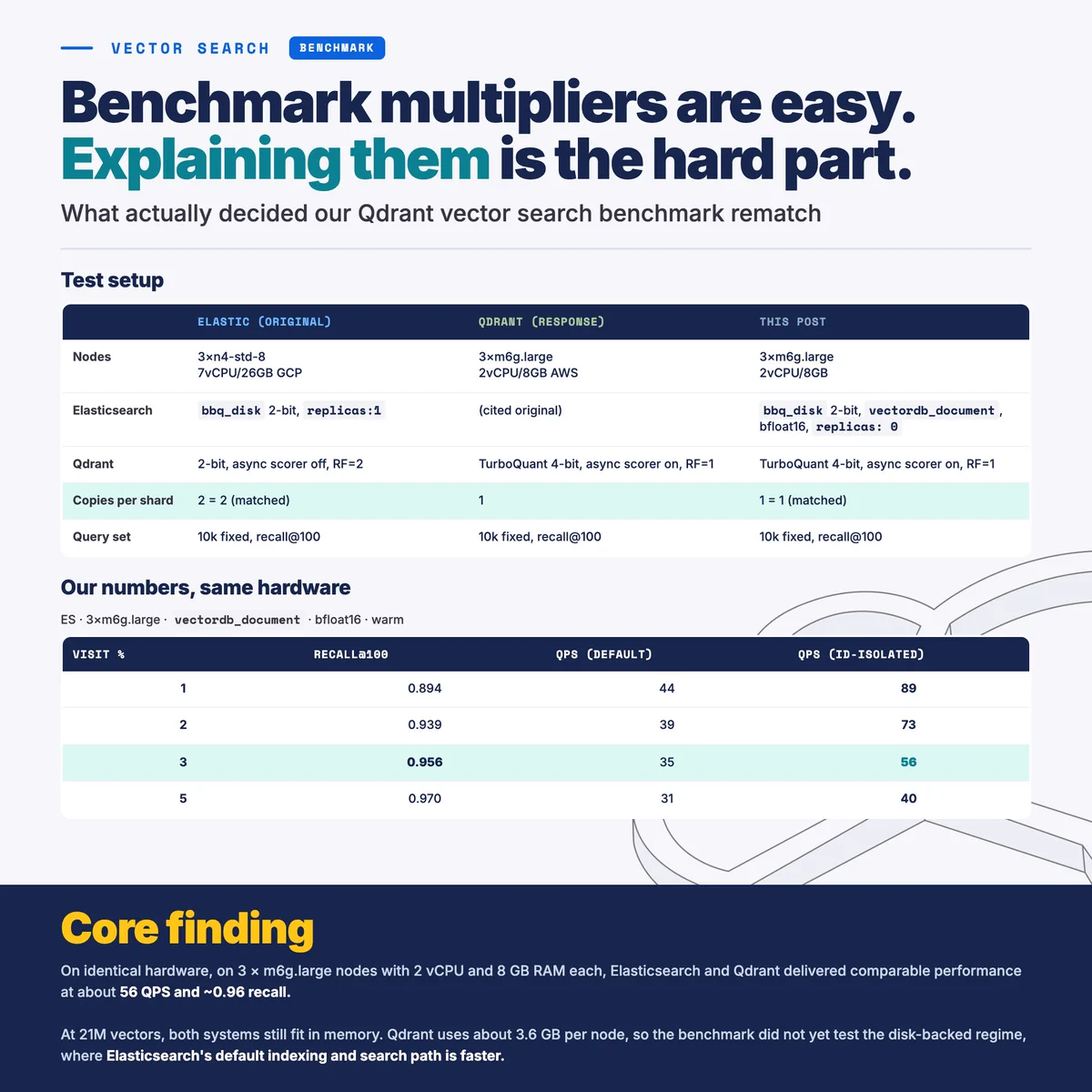
We went back to the full Elasticsearch vs Qdrant benchmark exchange. Traced every number to a cause.
Same hardware. 21M vectors. The disk sat at 0 IOPS the entire run.
io_uring and prefetch got the headline. Neither moved the number. You can't be bottlenecked on a device you
Search feels simple until you start getting back irrelevant results.
Know which of these 3 retrieval strategies to reach for a furniture store site:
- BM25 matches exact terms. Finds an ottoman from "Product ID 43926".
- Vector matches meaning. Figures out what "padded stool for
We're introducing Elasticsearch Columnar Mode:
A new index mode that stores data once, in columnar form, with no redundant copies and no indexes the workload doesn't need.
Not replacing the document model. Adding a second way to organise data alongside it, for the workloads
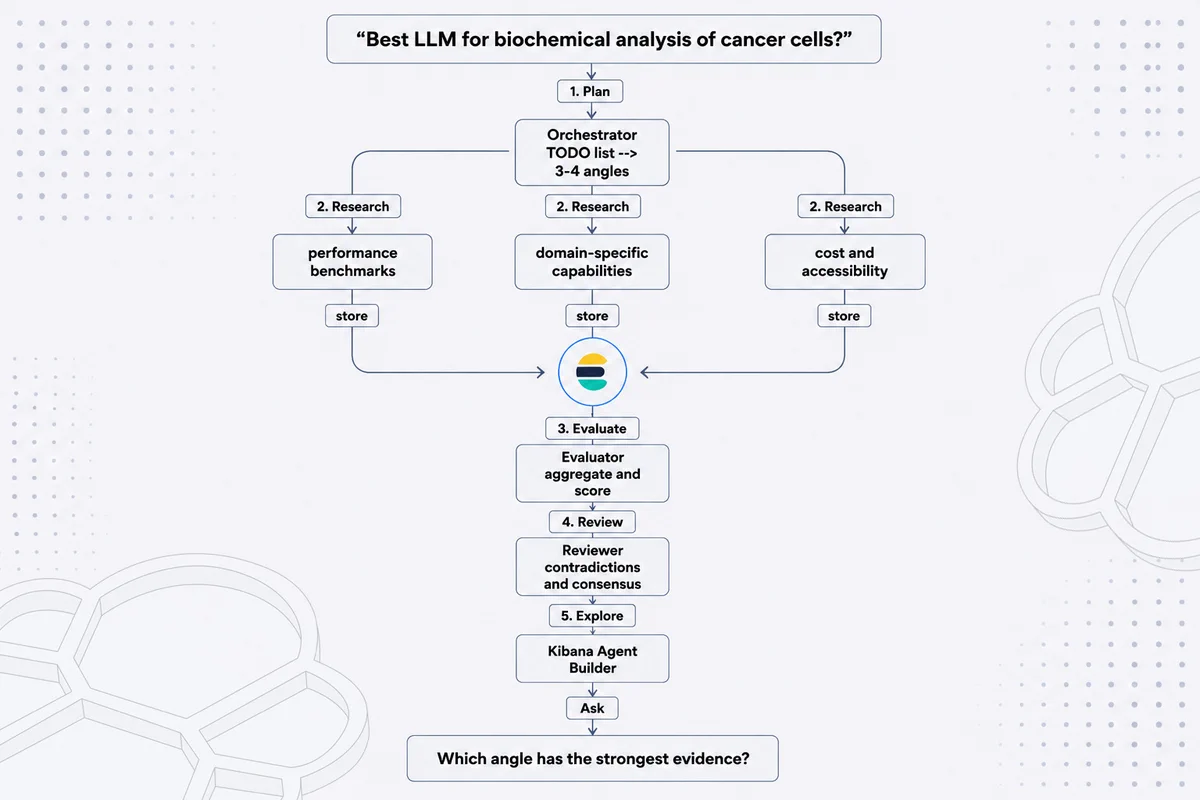
Your research agent returns confident answers from a single source. That's not research. That's a summary with extra steps.
Cross-checking needs structure: multiple angles, independent findings, a way to compare them.
@LangChain Deep Agents with Elasticsearch give you that
We tracked a new activity cluster targeting Mexican banking customers.
Elastic Security Labs discovered REF6045, an operator-assisted banking fraud campaign targeting customers of Mexican banks, fintechs, and cryptocurrency platforms through ClickFix fake-CAPTCHA lures.
The
Your Claude API bill shouldn't be a monthly surprise.
The Elastic Anthropic Metrics integration polls Anthropic's Admin API and routes org-wide usage, cost, and rate limit data into Elasticsearch.
One Admin API key. Zero application code changes. 6 alert templates out of the
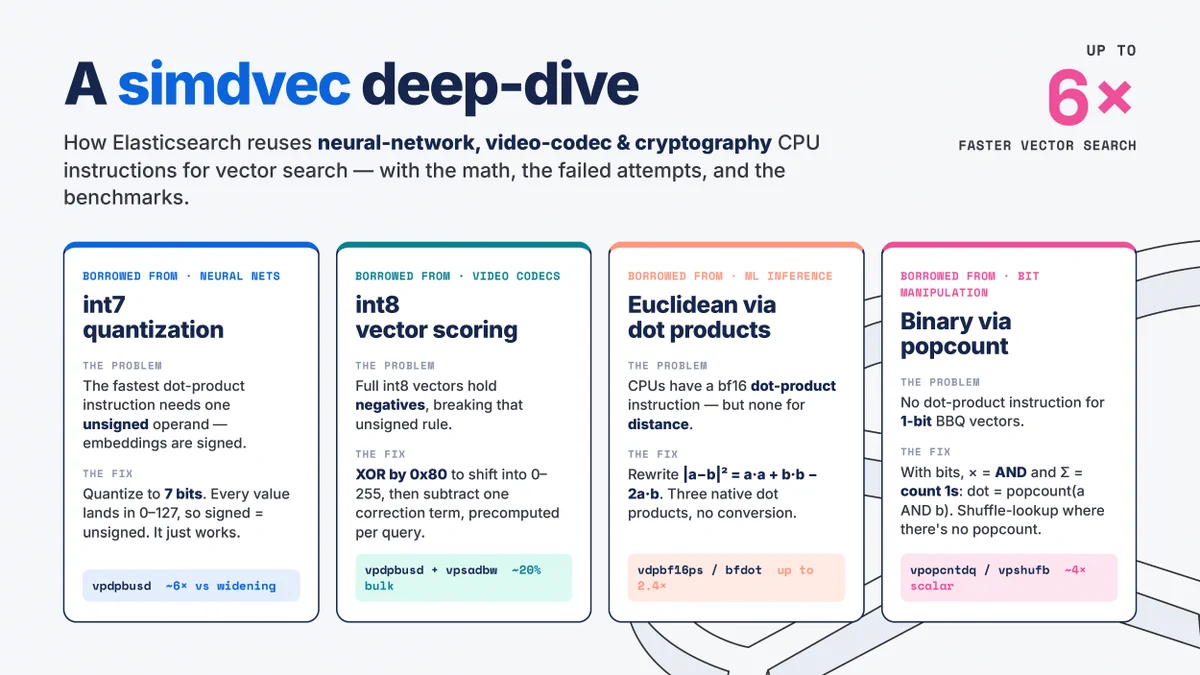
CPUs don't have vector search instructions. You borrow from neural nets and video codecs instead.
Elasticsearch's simdvec engine reformulates vector math to fit whatever the CPU already runs fast. Four recent examples:
- int7 quantization: fit unsigned-only multiply-accumulate
Four ways Elasticsearch's vector search engine reuses neural-network, video-codec and cryptography CPU instructions for up to 6x speedups; with the math, the failed attempts and the benchmarks.
Here's a story about 3 engineers - Cora, Samantha and Ben, configuring vector search.
For the same task, they end up with completely different setups. Who's right, and who's wrong?
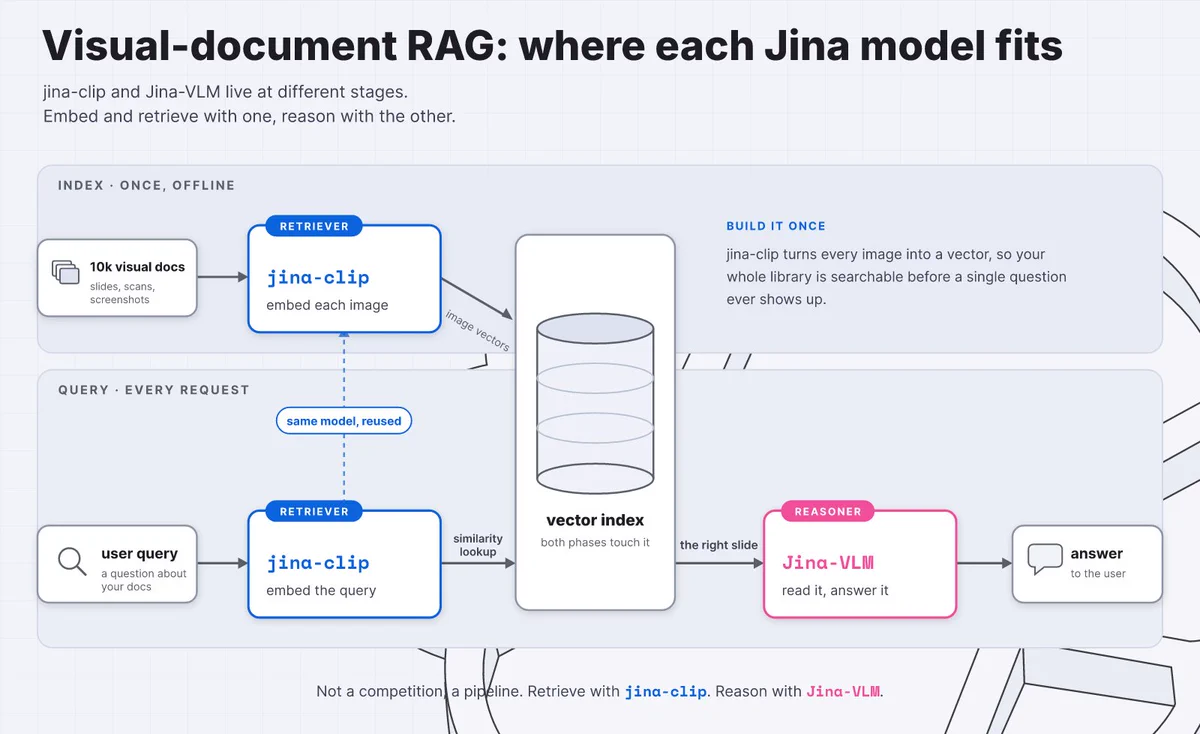
You've got 10k slides, scans, and screenshots to search.
Your first instinct is to throw a VLM at it. But a VLM reads one image at a time. Running it across your whole corpus on every query doesn’t scale.
Split the pipeline instead. jina-clip embeds every image into a vector
7x higher vector search throughput at comparable recall.
Elasticsearch 9.4.1 DiskBBQ vs Qdrant 1.18.1, tested on network-attached persistent storage.
The storage topology most K8s and managed-cloud deployments actually run on. Not local NVMe.
The gap is disk access. DiskBBQ
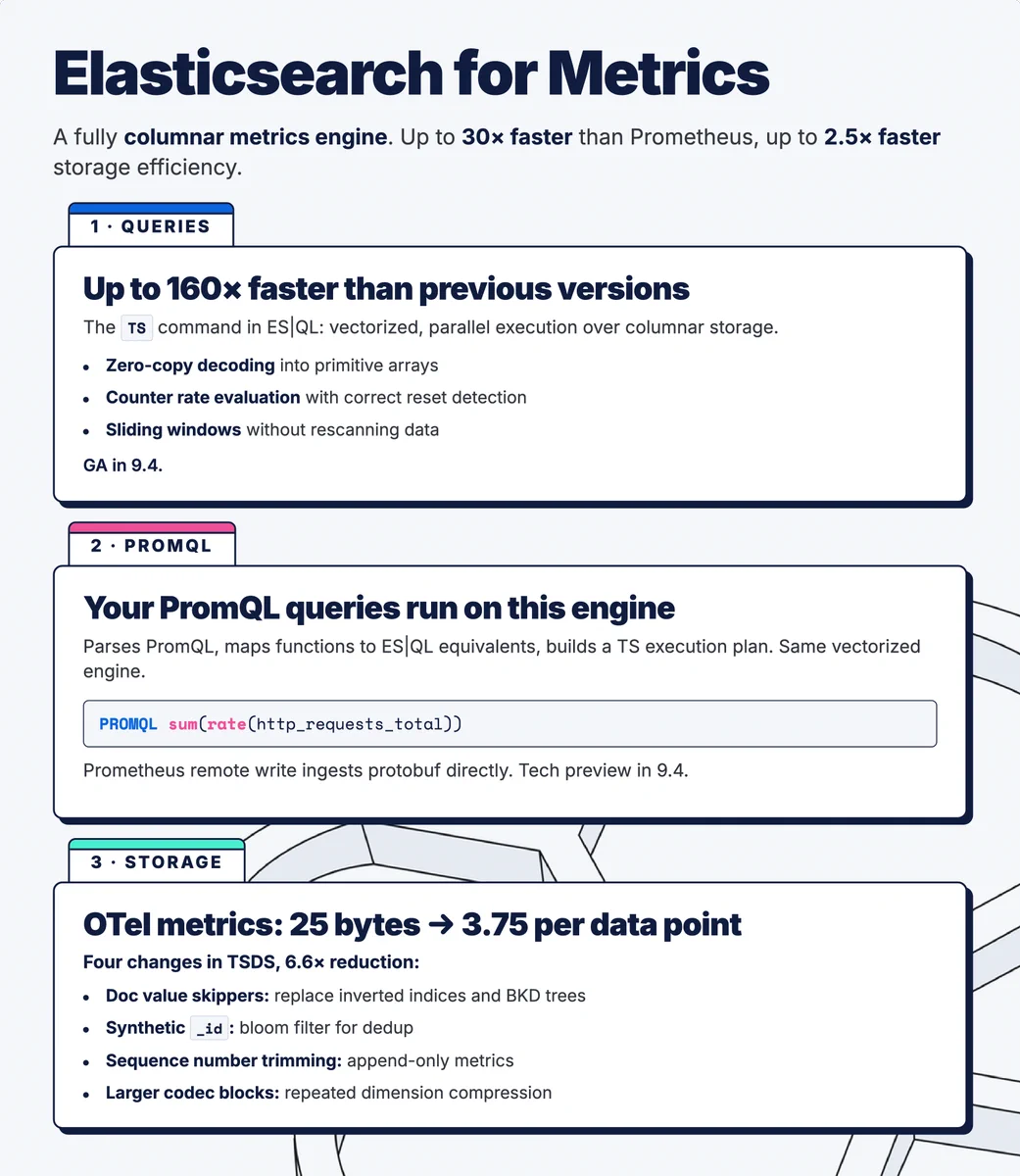
🧵 Elasticsearch now queries time series metrics up to 160x faster than previous versions.
TSDS and ES|QL were rebuilt over the past year.
Three areas changed: storage, queries, and Prometheus compatibility.
The result:
- A fully columnar metrics engine.
- OTel indexing
3/ Storage - OTel metrics: 25 bytes down to 3.75 per data point.
Four TSDS changes cut storage by 6.6x:
- Doc value skippers: replace inverted indices and BKD trees
- Synthetic _id: derived from _tsid and @ timestamp, bloom filter dedup
- Sequence numbers: trimmed at merge time
TL;DR:
- Queries: up to 160x faster
- PromQL runs inside ES|QL, same engine
- Storage: 6.6x more efficient for OTel metrics
- One platform: metrics, logs, traces, documents
Full architecture deep dive with benchmarks in the blog: