Eco now supports @trondao.
TRON holds more $USDT than any other chain. $185B in circulation. The rail exchanges & payment processors run on.
Real-time transfers between TRON & every Eco-connected chain, built into your existing stack.
For teams moving volume at scale:
The stablecoin economy on @trondao continues to be a powerhouse.
From 2019 – 2026:
– Supply scaled 800x from $107M to $90.6B
(a new high)
– Active addresses climbed from 141 to 834K
(peaking at 855K)
TRON remains one of the largest settlement layers for stablecoins.
Data:
Eco now supports @trondao.
TRON holds more $USDT than any other chain. $185B in circulation. The rail exchanges & payment processors run on.
Real-time transfers between TRON & every Eco-connected chain, built into your existing stack.
For teams moving volume at scale:
Most stablecoin routing can't tell you who actually fulfilled your order. Unverified liquidity providers, opaque routing, and unquantifiable counterparty risk. For a regulated desk, that's a non-starter.
Eco Verified Liquidity changes that. Every fulfillment comes from a
.@eco, a leading provider of programmable cross-chain stablecoin liquidity, today integrates the TRON network. Through this integration, TRON becomes part of Eco's unified stablecoin network, allowing users to deposit stablecoins directly into TRON applications in seconds.
As
Routing large stablecoin transfers through AMM-based bridges means paying slippage. The bigger the transfer, the more it costs.
Add manually tracking and rebalancing your positions across chains, plus the tail risk of a bridge failing and stranding capital on a chain or in an
Why does splitting a large trade across pools cost treasury operators more, not less?
@strao_, Head of Product at Eco, on the failure cases hidden in multi-step execution, and what routing pooled liquidity in a single transaction fixes.
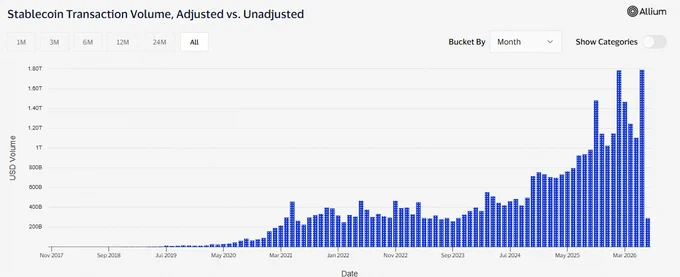
Stablecoin transaction volume hit an all-time high last month.
$𝟏.𝟕𝟖𝐓
Up nearly 2x from last year.
Centralized exchange volume compressed from ~28% of the total a year ago to ~13% last month.
Decentralized exchange volume fell from ~19% to ~2% over the same stretch.
The
.@Uniswap and @binance dominate stablecoin trading volume. That's the secondary market where retail trades.
The primary market is where institutions should operate: direct minting and redeeming with issuers at zero spread. No slippage or MEV. Just par value settlement.
Treasury teams manage 8+ banking relationships on average across currencies. Each needs separate integration, reconciliation, approval flows.
Eco Routes replaces this fragmentation with one orchestration layer. Configure execution rules once for atomic settlement across 15
Banks spent three years implementing T+1 settlement to save one day on equity trades. Meanwhile stablecoin orchestration already settles cross-border payments in seconds.
The infrastructure decision becomes obvious when you compare implementation timelines to actual settlement
Better output, less leakage.
That is what treasury operators get if their transactions can see the chain state while they run.
@strao_, Head of Product at Eco, on why predictable flows and thin single-venue liquidity make execution quality the real cost.
Most stablecoin metrics measure supply. How much exists, across issuers and chains.
Supply tells you the market is large. It doesn't tell you whether a specific dollar can settle a specific obligation at the moment it comes due.
Those are separate properties.
In
Move any supported stablecoin across any supported chain into @global_dollar's USDG on @jumperapp, through Eco Routes.
USDG you can put to work in Robinhood's Earn program.
USDG is the first stablecoin natively issued on Robinhood Chain.
It's also the lending asset in @RobinhoodCrypto's Earn program, where you can hold USDG via a self-custodial wallet, and earn rewards through decentralized lending vaults.