Things to do in advance: make a plan & be ready to throw it away; keep some secrets & reveal others; get some rest.
A pal asked me how to prepare for a meeting they were facilitating. Here’s my response.
No. 0001. Know the purpose, rational aim & experiential aim of the meeting
The purpose and rational aim are good to share during the conversation. Keep the experimental aim to yourself. This gives everyone a chance to understand what purpose they’re working towards. A decent rational aim answers questions like ‘what will we make or decide?’ or ‘what’s different after this time together?’ and serves as evidence that people should engage and take things seriously.
No. 0002. Focus on the rational aim, less so on the rest
Things might go slow or swerve from your plan. That is fine, so long as you believe it will still lead toward the rational aim. If you need to guide attention, pointing out the rational aim to participants can be an easy way to reveal a path back to the outcomes you have planned. But the group will find its own way.
Instead, sweep people into action by organizing papers, real or virtual whiteboards, or other elements of the workspace. Ask people to do something right away and begin the shared work.
Talking about methods is always a temptation for me. So I indulge in it here, on Improve Something Today, instead of during time with clients or their teams or in community. Having some of my facilitation zines in my bag means I can hand them to anyone who wants to talk shop afterwards.
When you need people to participate in particular times or ways, work through this with them in advance. Sounds easy, but it often doesn’t happen. For example, if you want an executive or sponsor to introduce a meeting, tell them this, and give them specific talking points.
Consider the different roles and jobs of people who will be there, and what specific kinds of actions or responses will be needed as part of the meeting. You can prep or advise people about this ahead of time.
Premortem and methods like it are useful because they get risks and undiscussables out into a shared conversation. There can be a huge impulse at this point to rush into diagnostic or problem-solving modes. Part of the power of methods like the premortem is that it gently interrupts typical behaviors. And that works better when the people know what’s coming. So… before running a premortem, I tell leaders that they will experience this impulse, but we’ll pause and come back with countermeasures separately. This is just one example for one method. There is probably a small bit of choreography you can arrange in advance: think of what it is, and share it with the person whose help you’ll need to pull it off.
No. 0005. Rest
The more chill you are, the better things will be. Tone of voice and the posture of the facilitator is critical. It sets the tone for whatever follows. For me, the way to do that is to rest, and be restful, even as we are busy and trying to do a hell of a lot within a group of people in a limited amount of time.
By the way, if you’re in or near Olympia, Washington, we have another Facilitation Group Method Swap coming up in November. It’s a free community event to learn and practice facilitation. There are still a couple spots left, details here, along with info about other upcoming in-person and online events:
Ripping the band-aid off a topic I’ve avoided writing about directly. But I want to share my experience. Three jewels, three marks, six nails & so forth: how I keep it together when things are sliding in all directions.
Podcast episode 0049: Notes on a decade of meditation
Then, meditation became easier, and things became easier.
And here I am in a season where things have been very hard, and the practice of meditation has made it easier. Or at least easier for me to remember who I am and how to be that person.
Recently: I got laid off from my consulting job. The company was a rudderless ship, smashing into the rocks during a storm, with people overboard, including myself. A career adjustment is underway. I’m actively developing my next set of consulting projects and exploring FTE roles where I can contribute. A few weeks into this, about five weeks ago, I noticed water leaking behind drywall in the kitchen. Occluded kitchen plumbing had failed, with an extensive and hidden amount of water damage. Pipes replaced. Walls came out. Cabinets removed. Layers of soggy flooring telling a story from 2026 back to 1953 came up. Ancient psychedelic asbestos kitchen tile is toxic, literally and metaphorically. Time for mitigation, repair, rebuild.
My home office is a dining room off the kitchen that I commandeered when we moved into this place about five years ago. It’s wonderful to work in a spot where I’m connected to the life of our family, and where I can look out the window and enjoy our scruffy backyard garden, but when there is asbestos remediation going on one door away, less so. The little refuge I work from had become something I needed to scurry far away from to take calls, job interviews, and the like. This all in the background miasma of 2026, which is, by any way of looking and at any scale (beyond the deepest pleasures of spending time with the people in your life), a disaster as various countries, including my own, speed-run their implosion into the fascist nightmare zone.
What keeps me going is sitting. The daily practice of meditation. It’s a topic I’ve danced around on this site for a decade. But it’s at the center of everything I do, including my consulting work and my life as a person in community.
Developing a practice
I started sitting daily, seriously, a decade ago. It was a period when I had several accumulated stored-up problems to deal with, mostly having to do with things happening in the zone between the ears and the subsequent problems they created for the people in my life. Mid-thirties. Family concerns. Professional concerns. It was time for me to figure out how to be a person, or maybe to be a person I wanted to be.
A supportive local sangha (community) helped me tremendously. Every Monday night we’d sit in a borrowed cold, dim, rattly sanctuary next to a busy street and… sit. Meditate together. Over a few years I learned from the people in this sangha. I learned how to sit. We were visited by various teachers. We’d fill in the gaps with recorded talks or shared readings. I dabbled, and borrowed, and at least two things accumulated.
One accumulation was a snowballing of practice in meditation. Sitting a little bit every day, some days in community, other days alone. The more I did it the closer I got to what I would eventually come to know as the ‘dharma gate of enjoyment and ease.’
The second accumulation was exposure to teachers and teachings, across a broad range of traditions, contexts, contingencies, approaches, squabbles, personalities, and the like. This helped me figure out who to learn from and who to spend time with.
A Buddhist principle is that your emotional experience and your intellectual understanding should match. Don’t let one get too far ahead of the other. I worked on those two. Years passed. A decade. I lived my life. I worked my ass off completing 14 awesome consulting projects in 20 US states. I read a bunch: Buddhist suttas, commentaries, noodly memoirs, half-practical half-horseshit practice guides. I sat a bunch: I sat at home, in airports and hotel rooms, in the dentist’s chair (what else are you gonna do for that half an hour?). Every time I sat was like every other time I sat. The beginning of COVID-19 sent everybody home. The Monday night sangha disbanded. I joined in with another group, in another tradition, that had moved their activities online. Later I left that group and found a local sangha that I now sit with on Wednesdays. I sat by myself. I sat with Liana and the kids, when they were smaller and more indulgent of their parents. I went on retreats, some short, some long, some in person, some alone, some with rules like silent meditation for four hours a day (yes, as long as one of the damn hobbit movies) and no reading or writing allowed. There was a lot going on. And a big part of what was going on was sitting.
I’ve mentioned three things: buddha, dharma, sangha. Think of these as the teacher, the teachings, and the community. There are many ways to access the dharma (teaching). The teaching extends way back into history. It extends out broadly, looking to one side and the other. The sangha (community) is likewise. Every time I sit in community that experience is connected to every other experience of sitting in community. It’s all the same thing. One long sit, punctuated by the rest of my life. And this community extends way back into history. We’re all here together. It extends broadly, looking to one side and the other. In the same way that family members you were close to remain close even after they have passed, the community is always here and we have to take care of one another.
What happens on the cushion
I want to take a moment and tell you what actually happens in meditation. This is my personal experience, or practice.
These marks, plus the community, are what I sit with. I sit comfortably and stably, like a stack of books stacked a few too high. When the stack gets too wobbly, I correct it, gently, from the bottom up. When sitting that means three points of contact on the floor or cushion. A knee, another knee, an ass.
And when things come along, I notice them, very gently, as kindly as I can, and with gratitude. Maybe there is a feeling of sitting by a little estuary, watching detritus float down the stream and into the saltwater.
Thoughts of the past: I can recognize them kindly and briefly for what they are, nodding as if to a friendly stranger while crossing the street. By the estuary, they are leaves floating into my view and out again.
Worries about the future: worrying, planning, hypothesizing behavior is truly important. A.D. Nuttal wrote that “the human race has found a way, if not to abolish, then to defer and diminish the Darwinian treadmill of death. We send our hypotheses ahead, an expendable army, and watch them fall.” This is useful. But it’s not necessary all the time. An army of leaves floating past in the stream.
Thinking: paying too much attention to what’s happening now, and thinking about experience. Close your eyes. What do you see? A typical answer to this question would be: nothing. What is actually there to see is a rich brightness and afterimages and motion. That is the experience. It takes further thinking to cohere these into the idea of one’s eyes being closed, and yet more thinking to roll that up into the word ‘nothing,’ which is pretty far removed from the actual experience. All this extra stuff, when you notice it happening, can be more leaves floating past in the stream.
Examination: the activity of figuring things out. Sensemaking. It’s important to do, but not while sitting. Another leaf, or perhaps a twig. (This is a big one for me, the one I love to indulge.)
The urge to make something happen. We love to make things happen. But I can notice that urge for what it is. It may or may not lead to action. What if my nose itches? It might be good to notice this desire to make something happen. But things are always becoming otherwise. I might sit still. Or I might act on the impulse. Noticing the arrival and departure of these is wonderful. They are other leaves floating past in the stream.
Finally, all these things set aside: rest. Cool, clear, running water.
These six are the experience of meditation, for me. Maybe it’s a few minutes. Maybe it’s a longer sit. Maybe while walking around the block, or sitting on a cushion or in community. In a way, it’s all the same.
One result of this practice is that, I think, I hope, that I show up in a certain way for my clients and colleagues and friends and family. My hopes are twofold:
When I act, my actions are appropriate and thoughtful.
Sometimes if we don’t do anything, we help more than if we do a lot. We call that non-action. It is like the calm person on a small boat in a storm. That person does not have to do much, just to be himself, and the situation can change. … Not talking, not teaching, just being.
Here I find myself, and we all find ourselves, in small boats. The weather is terrible. The water surrounding is rough. The calm—and friends, it is calm—comes from somewhere else entirely.
Whenever this comes up, people ask me how to start meditating. So here are a few suggestions for beginners.
Meditation by yourself: if you want to read, get The Other Shore by Thich Nhat Hanh for teaching and Will Johnson’s The Posture of Meditation for guidance on what to do with your body.
But don’t meditate by yourself: those books are like reading about bicycling. Better to get on a damn bike, ideally with friends, and go. So find a local sangha to visit. I’ll help you look for one where you live, just ask. Or if you’re around Tacoma on a Wednesday night, come sit next to me.
Learn the secrets of running great meetings, classes, and groups in this free, collaborative series.
The second Group Facilitation Method Swap will be on Saturday, November 21 in Olympia, Washington. These are free events, registration for Olympia is currently open, and you’re invited.
Facilitation Group Method Swap
About the event
The first Group Facilitation Method Swap was last month in Tacoma and we had a blast. One participant offered up her venue in Olympia so that’s where we’re headed next. If you’re interested in group facilitation, or want to get some practice with different ways of getting things done in a group setting, come on by.
Facilitation is such an important skill. It’s part of what makes a lousy day into a great one. And everybody’s a facilitator, be it at work, in community, or wherever we find ourselves in groups.
Whether you’re an experienced facilitator or interested in learning more about it, practice makes all the difference. Hence the Method Swap. A fun, low-stakes afternoon for seeing and practicing some facilitation methods you can then take back into whatever you’re up to the following week.
The learning approach is called see one, do one, teach one. You’ll get a chance to see facilitation methods in action, try ’em out, and (if you like) teach them to others.
We learned, we laughed, we had a blast together trying out new and familiar facilitation techniques. It’s a guarantee you’ll take away more than you came with.
You’re invited
I expect this free event to fill up pretty quickly, and we’ve capped registration based on venue size. Learn more and join us via the invitation below.
Things are always becoming otherwise. When we don’t realize this, or forget it, we find trouble. We imagine and hang onto a durability that is nowhere to be found.
This aspect of the world remains the same—this stable truth, this fixed truth: all conditional things are impermanent.
This is the first of three marks of existence. The other two: things are unsatisfying; nothing has a fixed self. ‘Marks’ here are like landmarks. If you stand in a clearing and see a few landmarks, you might know where you are.
These three marks, or landmarks, form the view that is itself the basis for much of the teachings. Impermanence underlies it all.
What’s hard for people is hard for organizations
Impermanence is tough for people to make friends with. It’s even harder for the organizations we create. I’m not sure why this is. But it’s something I see again and again, in the ethos of bigger-is-better, in the executive projecting strength by shortcutting straight from a hope to a universal statement of fact, in the assumption that systems and agreements will serve their intended purpose, forever.
This all adds up to it being very hard for people to reason about the future of their organizations. And when they do, the conventional approaches are bad: consider the dust-collecting strategic plan, the wasteful zero-based budgeting exercise, or the morale-wipe collision-speed reorg.
The situation is that not everything underway will succeed. Some approaches that are appropriate today might not be soon. Things are always becoming otherwise.
Finding simplicity and accuracy in nature
When in doubt, look outside. Here are three metaphors from nature through which a group can make sense of its own impermanent and changing nature.
In Ecocycle Planning, a group creates a shared Ecocycle to tell the story of their portfolio of activities and/or relationships in four development phases: birth, maturity, creative destruction, and renewal … The focus on all four phases—not just growth—helps the group think like an ecologist, focusing on the health of the whole system and promoting adaptability and sustained performance.
In systems innovation, we often pour all our energy into the ascending curve of innovation—incubating, resourcing, and phasing in new ideas to create new patterns of organisation. But effective transition design also requires the descending curve of exnovation. We must consciously phase out, de-resource, and carefully ‘hospice’ the existing institutions and practices that no longer serve us.
Lingo alert: ‘exnovation’ is a particularly unlovely piece of management jargon dating back to the 1980s. Another sense of exnovation that I really like is this: when something is good enough in ways that matter, exnovation means to slow down, standardize, and keep it the same. It is the decision to stop innovating in one area so there is wiggle room to do something else, elsewhere.
Metaphor 3: Incomplete metamorphosis—letting go of transformation
Aquatic dragonfly and damselfly larvae spend anywhere from months to years developing underwater, depending on the species. A nymph may molt between five and 14 times until it is fully grown, each time taking on more of a resemblance to its eventual resplendence … Some transformations take place overnight, but not all. Much like the dragonfly, the majority of our metamorphoses are much less momentous, yet hold no less value.
I read this as an invitation to patience.
The snake molts at the rate it can go. So does the dragonfly. Yet look where it starts (in the water) and where it ends (in the sky).
I believe organizations can change every bit as much. They do so over time, one thing at a time. Better to go with this than plan for the total one-shot transformation that is probably not going to work.
On the one hand, that’s not what a busy leader wants to hear. On the other hand, it’s what they secretly know to be true. The question for that person is: how might their organization become one that operates—even if incompletely—with the care needed to get everybody from one place to the next?
Starting points
Things are always becoming otherwise. We should get good at it.
Last week I had lunch with a pal who was planning a conference session and looking for a way to get people talking about a specific set of problems. I suggested she might use a method called ‘complaints with recommendations,’ but didn’t have a good link to share with instructions. So now there’s a link, and you’re reading it. The lunch-to-link pipeline works.
Complaints with recommendations is my own swizzle of an activity from the social worker and psychologist Virginia Satir. So after I share the method, I’ll tell you a bit about where it came from.
What this is & when to run it
Complaints with recommendations is a simple way to get feedback and ideas on what’s not working while in the middle of a project. You might use it during recurring reviews, between days of a multi-day event, or when working through multiple drafts of a document or deliverable. Don’t use it at beginnings, where there has not been time for complaints to ripen, or at endings, where it’s too late to act on recommendations.
What’s fun about this is that you are encouraging complaints, and recasting complaining in a structured way as something to be done broadly, and not kept to oneself or muttered in a backchannel. It’s impossible to get through one of these without people smiling.
The simplest version
You’ll need about 5 minutes and a shared visual space like a whiteboard or notes document. Invite everyone to share their complaints, but explain that each complaint must be offered with a recommendation.
A typical complaint might be:
Complaint → The schedule changed and I had to scramble.
Recommendation → Lock the schedule 24 hours in advance.
Collect these, and give everybody a chance to briefly state or read their complaint and recommendation.
You could stop here, and that’s good enough. People get to speak and be heard. The format has a clarifying effect for the person sharing a complaint: offering a recommendation tends to make a complaint more specific and grounded. And you have some ideas to act on.
Optional: a second round of recommendations
If you want to go a little further, offer the following. Let people know that the complaints—now posted somewhere all can see them—are untouchable. Each represents one person’s experience that they were willing to share. So take the complaints as given, but invite people to offer additional recommendations about how to resolve the complaints they’ve seen and heard.
You might end up with:
Complaint → The schedule changed and I had to scramble.
Recommendation → Lock the schedule 24 hours in advance.
New recommendation → Lock the schedule two days in advance.
New recommendation → When the schedule changes, send an update to some relevant group.
My experience is that people who shared complaints enjoy seeing additional recommendations. And new ideas sometimes come up too.
There’s no need to solve anything immediately. Instead, briefly thank everyone and indicate who will be acting on recommendations and following up on things as needed.
Origins & Virginia Satir’s temperature reading
Virginia Satir developed a temperature reading activity as part of her psychology practice. It originated in family therapy (a field that Satir made a huge mark on in her career), but has found additional use in organizations.
What you’ll notice is that complaints with recommendations is a single step from this temperature reading. My tweak is to open up a second round of recommendations based on everybody’s complaints, and to treat it as a standalone and not part of a larger ceremony.
An encouragement
Think of a situation where you could use complaints with recommendations to make complaining a ‘good’ or constructive thing to do instead of an activity people do in secret. Flipping things around like this is fun. Give it a try, no expertise or experience is required.
In Tacoma or the South Sound area? You’re invited
On September 19—the weekend after next as of this writing—I’m hosting a free in-person group facilitation method swap and there are still a few spots left. You’re invited:
Facilitation is always happening. If you put even a little effort into learning facilitation, you’ll get meetings of all sorts to the best possible outcomes & help everyone around you have a better time.
Have you ever met someone who calls themselves a facilitator? It’s not the most common job, but they’re out there. For every facilitator you meet, you’ll meet a dozen people who don’t use the title but treat it a skill they pay attention to and develop over time. And for every one of these, you’ll find a hundred people who have no real idea of what facilitation is. When they have to run a meeting they fall back on boring, stultifying time-wasters like presentations, open discussions, and brainstorms.
Any gathering of 3 or more people is being actively facilitated, whether the hosts realize it or not. Whenever you’ve felt bored or disengaged in a meeting and had to sit there, that meeting was poorly facilitated. For a lot of us, ‘work is just meetings,’ so this adds up to a huge, frustrating waste of time.
Poor facilitation is everywhere and it’s terrible. No amount of happy crappy from an LLM chatbot or beautiful slides from a consultant can deal with this. It is a separate, deeply human thing that has to get sorted out if we want to solve problems and act skillfully as groups in the workplace. The meeting cost calculator is running.
And for the most part, meeting or workshop facilitation is not the main thing people want to deal with. They’re focused on the people, problems and decisions at hand.
So my question is—where do people learn this stuff? I’ve noticed three ways. People learn facilitation:
informally,
formally, and
by practicing.
Let’s look at each. I’ll share my experience, some findings from an industry survey, and a few starting points or offerings.
How I got my facilitation chops
I got interested in facilitation as a grad student back in 2006, when I went to a niche web collaboration conference down in Portland. I thought I was going to hang out with pals and compare notes on nerdile web stuff on my department’s dime. But this conference was structured using open space technology and hosted by Michael Herman. After seeing how he worked, I wanted to do it myself. This is like saying you got interested in guitar after seeing Roger Waters play in a coffee shop.
I stuck with that interest. First, as a way to scoot through grad school—an environment where I saw a lot of very effective and very lousy facilitation in the classroom (teaching is a kind of facilitation). I survived many boring lectures by paying attention to what people were doing poorly, and wondering what they might do otherwise. Later, it gave me an edge in my technical consulting work. I could get people to a decision or a working consensus on what to do next.
I put together an invisible curriculum for myself, in three ways:
Informally, by going to local conferences with demos and workshops on facilitation methods to see a variety of approaches as used by different people. This was during the initial heyday of Liberating Structures and Lean Coffee in the Seattle area, so these were easy to access.
Formally, by getting training and certifications. In my experience, the best of these are the Technology of Participation series from the Institute of Cultural Affairs (more on this later).
And most importantly, by practicing. The school of hard knocks. My consulting work by this time involved planning and hosting a lot of meetings—continuous improvement workshops, human-centered design activities, public engagement sessions for government agencies, and the like. So I had opportunities to practice, and get feedback. It’s one thing to get trained in a method. Another thing to try it out during training. Still another to run it over and over in different groups solving different problems until you know what’s what.
What I notice today is this. While clients don’t tend to hire me for facilitation, that’s a big part of how we end up getting the work done. I say ‘we’ pointedly here, because spreading facilitation practices, or leaving them behind after a project is done, is one of the most durable things I do for clients. It’s something people don’t know to ask for, but they sure appreciate when they see it, and they keep using it afterwards.
How most facilitators learn
Let’s turn to SessionLab’s “State of Facilitation” report. This is a vendor of meeting planning software I’ve never used; but they commission this free annual report which is super valuable.
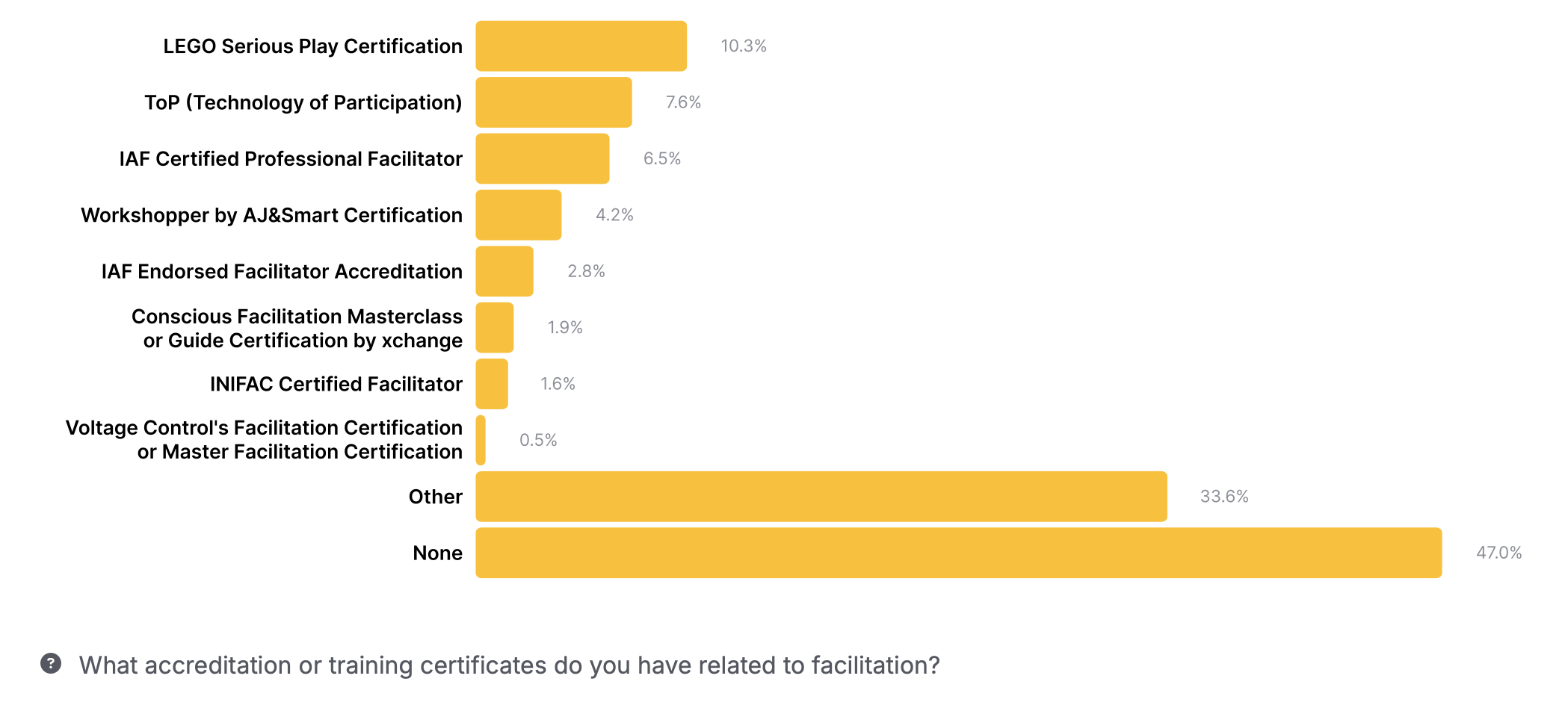
From this year’s report, note that only half of the respondents have a formal accreditation or training certificate related to facilitation. And of those that do, there’s a pretty wide spread:
I don’t see this as a bad thing at all. Of our three ways (informal, formal, and practice), only the second is produced by training. More practice needs to be available, in addition to more training, because learning happens in the doing and teaching:
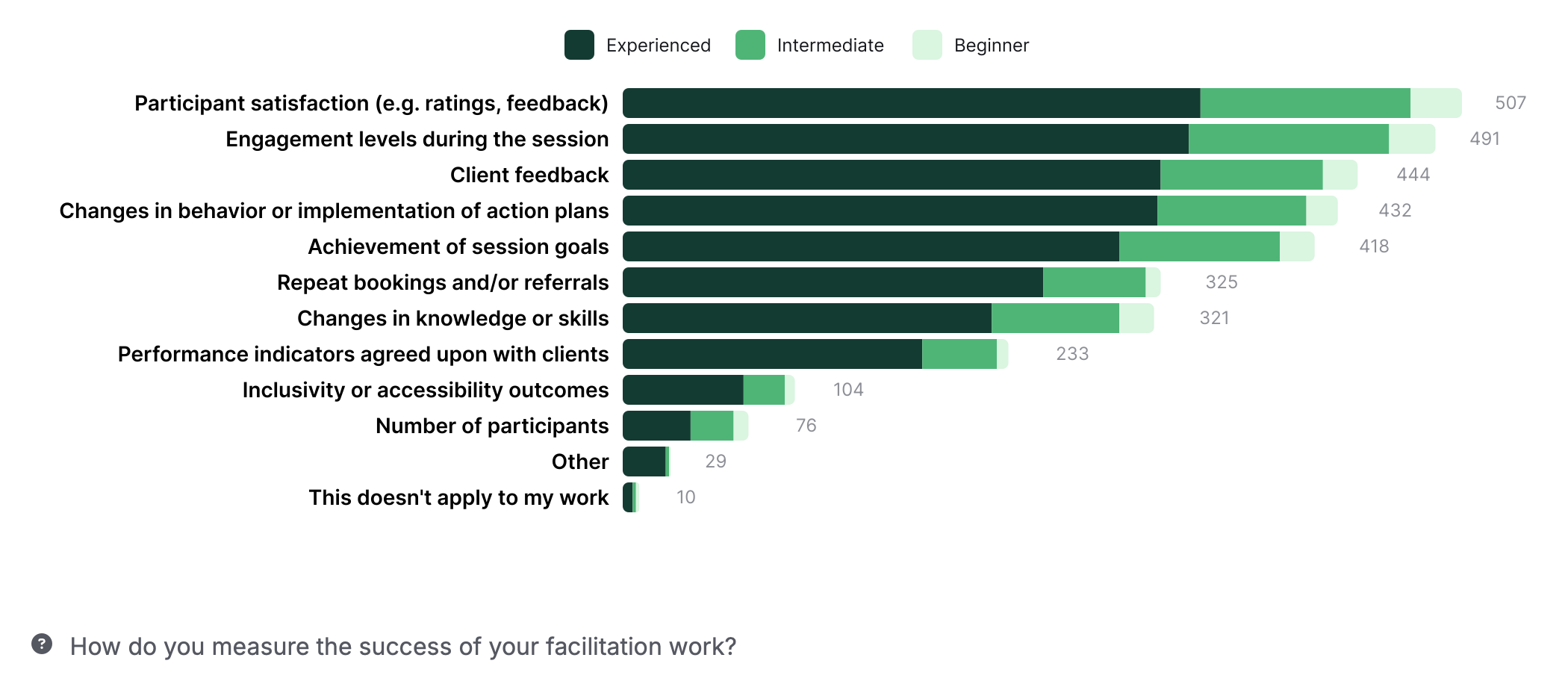
Another big opportunity people use to learn facilitation is feedback and evaluation. For the first time, this year’s “State of Facilitation” survey asked questions about evaluation. Here’s how facilitators say they’re measuring success:
Notice the weighting toward activity measures, which you could think of as ways to prove that the work got done. These are also the kinds of measures that provide quick feedback items for the facilitator to build into their future sessions. So they help with everybody getting paid, feeling good, and making improvements next time. These are all good things.
You have to get down to the 7th or 8th most common responses to get to anything related to measuring results or lasting impact for the organization.
General advice for performance measurement: you want a mix of both activity and results measures. I bet most of the evaluation shown in the chart above happens too quickly after a session to speak to impacts. And that is related to the “drive-by consulting” nature of much paid facilitation work.
Personally, I’ve only been able to tease out the impact of my facilitation work by going back to clients years or even a decade after the fact (hi Susan!) to learn what really took hold after my consulting team moved on. In some cases it was a specific habit for closing a meeting that they kept doing. In others, a way of documenting/arguing about a problem that stuck. Or in one case, a method for deciding how to schedule projects that our client’s boss liked and ended up using across her whole division. Facilitation is happening everywhere.
Three ways you can learn facilitation, starting today
(1) Informal ways
Seek out meetings, workshops, events, community gatherings, and the like. Pay attention to the facilitation as well as the content. Spend half your time looking at whoever is running the event, and half your time looking at everybody else. When are people bored? When does someone perk up? Who’s disengaged, and why? Who gets shut down early and doesn’t participate again?
(2) Formal ways
I whole-heartedly recommend the Institute of Cultural Affairs’ Technology of Participation (ToP) Facilitation Methods course as a starting point. You can take it in person around the world, or online. It is the only facilitation training I’ve taken that has not been a waste of time. And I use elements from it weekly.
(3) Ways to practice
And for practice, well, ya gotta practice. That’s not to say I can’t help you, though.
So my invitation is this. Find one activity in one of these three ways of learning and give it a shot. I’d be delighted to hear what you picked and how it went.




 Brian Kerr

 Brian Kerr

 Brian Kerr

 Brian Kerr