Customers who viewed this item also viewed
Download the free Kindle app and start reading Kindle books instantly on your smartphone, tablet, or computer - no Kindle device required.
Read instantly on your browser with Kindle for Web.
Using your mobile phone camera - scan the code below and download the Kindle app.
Follow the author
OK
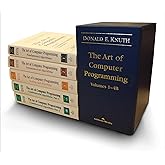
The Art of Computer Programming, Volumes 1-4A Boxed Set
The bible of all fundamental algorithms and the work that taught many of today’s software developers most of what they know about computer programming.
—Byte, September 1995
Countless readers have spoken about the profound personal influence of Knuth’s work. Scientists have marveled at the beauty and elegance of his analysis, while ordinary programmers have successfully applied his “cookbook” solutions to their day-to-day problems. All have admired Knuth for the breadth, clarity, accuracy, and good humor found in his books.
I can’t begin to tell you how many pleasurable hours of study and recreation they have afforded me! I have pored over them in cars, restaurants, at work, at home… and even at a Little League game when my son wasn’t in the line-up.
—Charles Long
Primarily written as a reference, some people have nevertheless found it possible and interesting to read each volume from beginning to end. A programmer in China even compared the experience to reading a poem.
If you think you’re a really good programmer… read [Knuth’s] Art of Computer Programming… You should definitely send me a résumé if you can read the whole thing.
—Bill Gates
Whatever your background, if you need to do any serious computer programming, you will find your own good reason to make each volume in this series a readily accessible part of your scholarly or professional library.
It’s always a pleasure when a problem is hard enough that you have to get the Knuths off the shelf. I find that merely opening one has a very useful terrorizing effect on computers.
—Jonathan Laventhol
In describing the new fourth volume, one reviewer listed the qualities that distinguish all of Knuth’s work.
[In sum:] detailed coverage of the basics, illustrated with well-chosen examples; occasional forays into more esoteric topics and problems at the frontiers of research; impeccable writing peppered with occasional bits of humor; extensive collections of exercises, all with solutions or helpful hints; a careful attention to history; implementations of many of the algorithms in his classic step-by-step form.
— Frank Ruskey
These four books comprise what easily could be the most important set of information on any serious programmer’s bookshelf.
- ISBN-100321751043
- ISBN-13978-0321751041
- Edition1st
- PublisherAddison-Wesley Professional
- Publication dateMarch 3, 2011
- LanguageEnglish
- Dimensions9 x 8.9 x 9 inches
- Print length3168 pages
There is a newer edition of this item:
Customers who viewed this item also viewed
- Art of Computer Programming, The, Volumes 1-4B, Boxed SetHardcoverFREE Shipping by AmazonGet it as soon as Thursday, Nov 5
- Designing Data-Intensive Applications: The Big Ideas Behind Reliable, Scalable, and Maintainable SystemsPaperbackFREE Shipping by AmazonGet it as soon as Thursday, Nov 5
- Structure and Interpretation of Computer Programs - 2nd Edition (MIT Electrical Engineering and Computer Science)PaperbackFREE Shipping by AmazonGet it as soon as Thursday, Nov 5Only 5 left in stock (more on the way).
- Concrete Mathematics: A Foundation for Computer Science (2nd Edition)HardcoverFREE Shipping by AmazonGet it as soon as Thursday, Nov 5
Customers also bought or read
- A Philosophy of Software Design, 2nd Edition#1 Best SellerComputer Systems Analysis & Design
Paperback$21.37$21.37Delivery Thu, Nov 5 - Structure and Interpretation of Computer Programs - 2nd Edition (MIT Electrical Engineering and Computer Science)
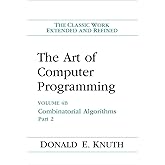
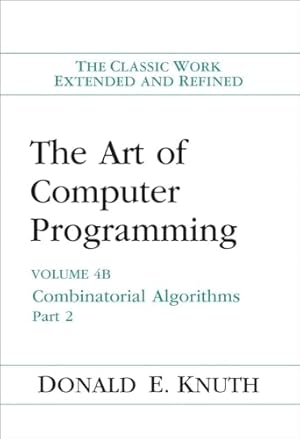
Paperback$57.20$57.20FREE delivery Thu, Nov 5 - Art of Computer Programming, The: Combinatorial Algorithms, Volume 4B
Hardcover$68.42$68.42$3.99 delivery Fri, Nov 13 - Deep Learning (Adaptive Computation and Machine Learning series)
Hardcover$51.51$51.51FREE delivery Nov 5 - 9 - Design Patterns: Elements of Reusable Object-Oriented Software
Hardcover$27.44$27.44Delivery Nov 12 - 16 - The Pragmatic Programmer: Your Journey To Mastery, 20th Anniversary Edition (2nd Edition)
Hardcover$44.58$44.58FREE delivery Thu, Nov 5
From the Publisher
Updated Box Set Now Available!
This new box set now includes Volume 4B - Combinatorial Algorithms, Part 2
"I've had loads of fun writing other parts of these volumes, but without doubt Section 7.2.2.1 [of Combinatorial Algorithms, Part 2] has been the funnest. And I know that my delight in good puzzles is shared by a significant number of leading computer scientists and mathematicians, who have told me that they chose their careers after having been inspired by such intellectual challenges."
— Donald Knuth
The Art of Computer Programming Volumes 1-4B
ISBN-10: 0137935102
Editorial Reviews
From the Back Cover
This boxed set consists of the following four volumes:
0201896834 / 9780201896831 Art of Computer Programming, Volume 1: Fundamental Algorithms
0201896842 / 9780201896848 Art of Computer Programming, Volume 2: Seminumerical Algorithms
0201896850 / 9780201896855 Art of Computer Programming, Volume 3: Sorting and Searching
0201038048 / 9780201038040 Art of Computer Programming, Volume 4A: Combinatorial Algorithms
About the Author
Donald E. Knuth is known throughout the world for his pioneering work on algorithms and programming techniques, for his invention of the TEX and METAFONT systems for computer typesetting, and for his prolific and influential writing. Professor Emeritus of The Art of Computer Programming at Stanford University, he currently devotes full time to the completion of these fascicles and the seven volumes to which they belong.
Product details
- Publisher : Addison-Wesley Professional
- Publication date : March 3, 2011
- Edition : 1st
- Language : English
- Print length : 3168 pages
- ISBN-10 : 0321751043
- ISBN-13 : 978-0321751041
- Item Weight : 12 pounds
- Dimensions : 9 x 8.9 x 9 inches
- Best Sellers Rank: #1,230,018 in Books (See Top 100 in Books)
- #257 in Computer Algorithms
- #538 in Programming Algorithms
- #2,038 in Computer Programming Languages
- Customer Reviews:
About the author

Donald E. Knuth was born on January 10, 1938 in Milwaukee, Wisconsin. He studied mathematics as an undergraduate at Case Institute of Technology, where he also wrote software at the Computing Center. The Case faculty took the unprecedented step of awarding him a Master's degree together with the B.S. he received in 1960. After graduate studies at California Institute of Technology, he received a Ph.D. in Mathematics in 1963 and then remained on the mathematics faculty. Throughout this period he continued to be involved with software development, serving as consultant to Burroughs Corporation from 1960-1968 and as editor of Programming Languages for ACM publications from 1964-1967.
He joined Stanford University as Professor of Computer Science in 1968, and was appointed to Stanford's first endowed chair in computer science nine years later. As a university professor he introduced a variety of new courses into the curriculum, notably Data Structures and Concrete Mathematics. In 1993 he became Professor Emeritus of The Art of Computer Programming. He has supervised the dissertations of 28 students.
Knuth began in 1962 to prepare textbooks about programming techniques, and this work evolved into a projected seven-volume series entitled The Art of Computer Programming. Volumes 1-3 first appeared in 1968, 1969, and 1973. Having revised these three in 1997, he is now working full time on the remaining volumes. Volume 4A appeared at the beginning of 2011. More than one million copies have already been printed, including translations into ten languages.
He took ten years off from that project to work on digital typography, developing the TeX system for document preparation and the METAFONT system for alphabet design. Noteworthy by-products of those activities were the WEB and CWEB languages for structured documentation, and the accompanying methodology of Literate Programming. TeX is now used to produce most of the world's scientific literature in physics and mathematics.
His research papers have been instrumental in establishing several subareas of computer science and software engineering: LR(k) parsing; attribute grammars; the Knuth-Bendix algorithm for axiomatic reasoning; empirical studies of user programs and profiles; analysis of algorithms. In general, his works have been directed towards the search for a proper balance between theory and practice.
Professor Knuth received the ACM Turing Award in 1974 and became a Fellow of the British Computer Society in 1980, an Honorary Member of the IEEE in 1982. He is a member of the American Academy of Arts and Sciences, the National Academy of Sciences, and the National Academy of Engineering; he is also a foreign associate of l'Academie des Sciences (Paris), Det Norske Videnskaps-Akademi (Oslo), Bayerische Akademie der Wissenschaften (Munich), the Royal Society (London), and Rossiiskaya Akademia Nauk (Moscow). He holds five patents and has published approximately 160 papers in addition to his 28 books. He received the Medal of Science from President Carter in 1979, the American Mathematical Society's Steele Prize for expository writing in 1986, the New York Academy of Sciences Award in 1987, the J.D. Warnier Prize for software methodology in 1989, the Adelskøld Medal from the Swedish Academy of Sciences in 1994, the Harvey Prize from the Technion in 1995, and the Kyoto Prize for advanced technology in 1996. He was a charter recipient of the IEEE Computer Pioneer Award in 1982, after having received the IEEE Computer Society's W. Wallace McDowell Award in 1980; he received the IEEE's John von Neumann Medal in 1995. He holds honorary doctorates from Oxford University, the University of Paris, St. Petersburg University, and more than a dozen colleges and universities in America.
Professor Knuth lives on the Stanford campus with his wife, Jill. They have two children, John and Jennifer. Music is his main avocation.
Customer reviews
Customer Reviews, including Product Star Ratings help customers to learn more about the product and decide whether it is the right product for them.
To calculate the overall star rating and percentage breakdown by star, we don’t use a simple average. Instead, our system considers things like how recent a review is and if the reviewer bought the item on Amazon. It also analyzed reviews to verify trustworthiness.
Learn more how customer reviews work on AmazonCustomers say
Generated from the text of customer reviews