Showing posts with label Fiji. Show all posts

Thursday, 5 September 2013

Peak #AGW [updated]

Yes folks, we’re not just at peak coverage of global warming/climate change/extreme-weather-event coverage, we’re already over the peak and down the other side.

2000-2013_climate_coverage

Not just down the main trend line, but if you look closely the last two spikes in coverage were not talking up the global warming “narrative,” but puncturing its phoney balloon.

Of course, that won’t stop the Pacific political leaders and leaderenes currently gathering in the Marshall Islands issuing a “communiqué” abhorring what modern industrial civilisation is doing to the climate (which, last time I checked, was delivering sixteen years of stable temperatures only marginally higher than the 1930s (two decades before modern industrial civilisation really began in earnest), and what the climate is allegedly doing to the Marshall Islands, Kiribati and Tuvalu (which is part of what nature and a growing population has always done to the “floating islands” that are low-lying coral atolls).

But smiling and waving is what these gatherings is really about, right. And at least they also expressed long overdue support for Fiji replacing, with something better, the race-based constitution that has long hamstrung the place.

Image

UPDATE:  Not just less coverage, but increasingly skeptical coverage

A partial list includes: The New York Times, the BBC, NPR, The Economist, ClimateCentral and ....

  • Daily Mail, October 2012
    "We agree with Mr. Rose that there has only been a very small amount of warming in the 21st Century." - UK MetOffice
  • NASA Global Temperature Update, January 2013
    "The 5-year mean global temperature has been flat for a decade, which we interpret as a combination of natural variability and a slowdown in the growth rate of the net climate forcing." - James Hansen, NASA
  • The Australian, February 2013
    "The UN's [IPCC] climate change chief has acknowledged a 17-year pause in global temperature rises, confirmed recently by Britain's Met Office..." -IPCC Head Rajendra Pachauri
  • Minnesota Daily, April 2013
    "Global warming forecasts have the difficulty that one can’t find much actual global warming in present day weather observations." - Physicist Robert Laughlin, Stanford University
  • Der Spiegel Online, June 2013
    "In fact, the increase over the last 15 years was just 0.06 degrees Celsius (0.11 degrees Fahrenheit) -- a value very close to zero. This is a serious scientific problem..." - Meteorologist Hans von Storch
  • The Independent , July 2013
    image“Some people call it a slow-down, some call it a hiatus, some people call it a pause. The global average surface temperature has not increased substantially over the last 10 to 15 years,” - Scientist Rowan Sutton, Reading University

The latest sighting of MSM skepticism is in, of all places, The Guardian, whose editorial writer this week conceded against type:

There is a serious debate about why observed temperatures have not kept pace with computer-modelled predictions.

Ya think?

[Hat tip c3 Headlines]

Wednesday, 15 April 2009

Fiji. What a mess. [updated]

Since writing what I thought was a fairly considered piece last year on what's going on in Fiji, things have definitely gone backwards.  Military seizure of the Reserve Bank and compulsory exchange controls; locking up a law Society president who was previously reluctantly supportive of the regime's aims;  sharpening censor's knives; expelling journalists and sacking judges.

I still maintain that it's urgently necessary to sort out the race-based constitution and electoral system and the near-feudal system of race-based land tenure, and that interim Prime Minister Frank Bainimarama understands this and has these as his goal.

He has three hurdles to overcome however in carrying that out, number one being that sorting out these fundamental constitutional problems while overturning the chiefly power bases is excruciatingly difficult, and number two being that what is difficult has been made even more so by the trade and travel sanctions and pious pontifications of other Pacific politicians, our own not excluded.

Rather than help resolve a problem set up by paternalistic colonial rulers a century-and-a-half ago, the likes of Key and Clark and Rudd have instead placed every barrier in the way they could find, and talked in unthinking knee-jerk fashion as if "new elections" under the old race-based system would be some kind of cure-all balm for a problem created by that very race-based system.

The third problem is of his own making.  He hasn't really done much to help himself.  Any constitution is only as good as the public support for it, and the 'Draft People's Charter' travelling the country was a valiant effort to garner that public support and understanding.  But by sacking judges, shutting down free speech and failing to clearly explain himself to the world (this speech to the UN is practically his only communique to the world) he's done nothing to help himself, and everything to give those pious politicians enough rope to want to have him hanged -- and enough ammunition to put at risk the fragile domestic support for positive change he's built up.

Fiji.  What a mess.

UPDATENational Business Review editor Nevil Gibson has a measured response well worth reading.

Cuba. It's still a mess.

Doug Bandow is right.  The embargo on Cuba has been disastrous, and its review is long overdue. US sanctions on trade with Cuba have done exactly nothing to harm Old Busywhiskers himself -- if anything, they've granted him and his cronies an excuse for the penury into which they've driven the populace.  Like all sanctions programmes it's harmed only the citizens themselves, about whom Castro's thugs could care less.  Far from supporting Cuban freedom, it's likely diminished it.

With sanctions, the Castro Regime has been reinforced.  Without sanctions, the Regime would likely have withered into irrelevance and nascent capitalism emerged again, much as it has in Vietnam.

"Trade and investment normally draw peoples together," says Bandow, and he's right.  It's time, as he says, for America's policy-makers "to ask the simple question: If 50 years of embargo have not worked, why do they expect another decade or two or three of sanctions to work?"

    A new political climate invites a new policy response. No more half measures. Congress and the president should drop the embargo. Americans should be free to visit and trade with Cuba. There should be no government subsidies, whether in the form of trade subsidies or foreign aid. But individuals and companies should be free to cut their own deals. Would this strategy transform the island nation? There are no guarantees, though foreign contact has helped spur liberalization elsewhere. But lifting the embargo would have a greater likelihood of success than continuing a policy which has consistently failed. Some day the Cuban people will be free. Relaxing U.S. policy would likely make that day come sooner.

A bonus point for any reader who can see the parallels with Fiji.

Thursday, 18 September 2008

Just scratching a living in paradise

It was the hand plough that got to me most.  There on the main road between two of Fiji's main cities, just minutes from a major town in an area locals proudly call 'Fiji's Salad Bowl,' a man was scratching a living -- or trying to -- on a small handkerchief of land, putting his body through exertions for which it was never intended simply to keep himself and his family somewhat fed, partially clothed and trying to pay the rent on this field and the tiny shack that occupied one corner.

It was like something out of the Middle Ages, which is a pretty fair description of the near-feudal system of land tenure that governs nearly ninety percent of Fiji's land, and which keeps most of the population in poverty -- from the 'squatters' themselves who struggle to survive, to the indigineous squattocracy who can take only pennies from their tenants, to the ten-percent of the population who've been driven from their short-term leases (the only form of ownership allowed to Indo-Fijians) and who now live in shameful conditions in Fiji's cities, excluded as they are from the "mainstream" of Fijian economic life by racist laws, and a racist constitution.

Ironically, the "system" so described was put in place by the paternalistic first colonial governor, Arthur Gordon, who wished to ensure that Fiji didn't turn into New Zealand.  An inspection of the relative standards of living demonstrates just how well he succeeded.

What he wanted was to protect native Fijians from the winds of the modern world. What he did however was to remove any possibility of Fiji itself  ever growing up and being part of that world.  What he introduced was a racially-based constitution dominated by an hereditary based Great Council of Chiefs, and a system of land tenure for most of the country that ensures no one has any genuine rights, and no possibility of economic improvement.  In 1913, US Justice Joseph McKenna declared,

The conception of property is exclusive possession, enjoyment and disposition [by which is meant to include the right to sell].  Take away these rights and you take all that there is of property.  Take away any of them and you take property to that extent. 

Three decades earlier, Gordon set in place a system of property in Fiji that ensured real property was taken away from everyone. One lot was given just the shadow of ownership, and the other was given just the shadow of possession.  Of real property rights, no-one got either.  If public ownership means no public accountability, then how about no real ownership.
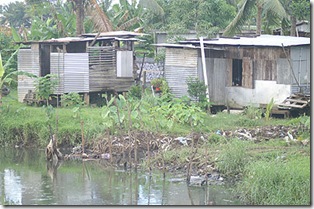
squatter03 Imagine if secure title to land existed only in 8.2% of this country, New Zealand.  Imagine if most of the balance was Maori land, with the same system of collective 'ownership' that Maori landholdings have; with all the restrictions on individual ownership that make it impossible to sell, borrow against or develop -- with all the false pride that the ruling chiefs like to demand for themselves -- and with the added hindrance that all this land is 'administered' by bureaucrats from a Native Trust Lands Board, who lease small plots out short-term to smallholders like my friend above who make barely enough to keep their own bellies fed, let alone having enough left over to sustain a landlord, and who distribute these meagre 'earnings' to tribal chiefs to distribute it as alms.

It makes the sort of impoverished shanties you see on Northland Maori land look positively luxurious -- and if the same mad land law had been effected over nearly ninety percent of the country here, as it was in Fiji, then those same shanties would be here too over most of the land.

But then add something else as well to the Fijian picture: these small short-lease-holders are primarily the descendants of "girmit" indentured workers brought over from India at the behest of colonial governors from Gordon on, with few rights either electorally or in property, and the holders of their leases are primarily natives, resentful of the low rents the Native Trust Lands Board distributes, and of the immigrant population who occupies 'their' land with so little to show for it.

One side is barred from decent access to their own land, while the other is refused secure rights, and barred from any means of securing the capital or landholdings that might allow properly industrialised agriculture to develop. (You can read here something of the history and details of Fiji's feudal land tenure sustem.)

No wonder everyone is resentful.  No wonder there's a 'coup culture.'  No wonder there's so little prosperity, and we witness -- if our eyes are open to it -- the tragic existence of Fiji's squatters, mostly dispossessed Indo-Fijians who racist law has barred from owning land, and who previous governments have left at the mercy of shifting racial, economic and political tides, and of the indigenous Fijians who aren't politically connected, for whom a lifetime of poverty is the only expectation.

No wonder one of the main Fijian exports is people -- whether sportsmen or soldiers or as emigrants just getting  the hell out -- and one of the main imports is tourists -- who avert their eyes from the poverty on the way to resorts on (mostly) freehold land all along the beautiful coastline, away from the poverty elsewhere.

Despite the condemnations of Pacific leaders like Helen Clark, who has her own racist laws and shifting racial, economic and political tides to navigate, all the evidence I've seen suggests Fiji's interim Prime Minister Frank Bainimarama might be on the right track, and much of the country seems to understand that.  Writing last year in January's Time magazine, Elizabeth Keenan argued::

    When military commander Frank Bainimarama seized power in Suva on Dec. 5, he was instantly denounced by Australia, New Zealand, the U.S., the E.U., the U.N. and the Commonwealth. Exiled Prime Minister Laisenia Qarase continues to vent outrage by phone from his island village, but his countrymen don't seem to be rallying. Soldiers at checkpoints receive abuse, but also smiles, handshakes, food and flowers. Some staunch democrats who condemned George Speight's botched coup in 2000 find themselves endorsing the aims of this takeover, if not the assault rifles that made it possible. The Methodist Church and the Great Council of Chiefs, bastions of indigenous society, have urged Fijians—including Qarase—to support the multiracial interim government "for the betterment of the nation." Writing in the Fiji Times, Catholic Archbishop Peter Mataca called Australia and New Zealand's shunning of the Bainimarama administration "regrettable and shallow." Some Fijians, he wrote, believe democracy and the rule of law "were abused and circumvented long before the military ousted the Qarase government."
   
In Fiji, it seems, not all coups are equally offensive...
    Qarase's elected government was seen as caring most about the happiness of indigenous Fijians. Bainimarama's force-backed government aims to make Fijians of all races happy. If—and it's a huge if—he can implement his idealistic program, he might just have pulled off the coup to end all Fiji coups.

From what I've seen, that's his explicit intention.  Sure, progress hasn't been as fast as anyone would have hoped -- allowing Clark and Australia's Kevin Rudd to posture as 'democrats' by berating Bainimarama for not yet holding free elections -- but progress has been made, even as measured by 'Fiji Time,' and a 'Draft People's Charter' that's not all bad news is now touring the country gathering support.

The Charter is backed by some hard-headed analysis, underpinned by recognition, for example, that "The economic growth rate in Fiji has been in long term decline since Independence – and the rate of decline is getting faster." 

    There are [many] factors that weakened the pace of economic growth... The key among these other factors include a major property rights problem relating to the availability of leasehold land, the lack of investment in infrastructure, incompatible and inconsistent policies in some areas, and a weak legal environment for business.
    Many of these latter issues raise questions about the role of the Government in the economy. In the view of many people, the Government is over-dominant in the economy; i.e. it should reconsider its role if it wishes to achieve stronger growth, greater equity, and sustainability.

I am one of those people.  Government administers most of the land, most of the business and gets to allow or disallow most of the enterprise.  No wonder there isn't much.  Bureaucratic management works as badly in Fiji as everywhere else, and enterprise is further stifled by the lack of secure property rights removing one of the primary means by which feudalism is transformed into capitalism. 

Property rights are more important than democracy.  No question.  What's crucial in Fiji is not democracy per se, but real secure property rights that will allow real capital to transform the lives of both squatters and squattocracy.  Fijian-Indian activist Thakur Ranjit Singh argues that "democracies that are devoid of or lacking in granting freedom, rights and equality to all its citizens and those without social justice are not worth defending. Qarase's regime that Bainimarama removed was an epitome of such a democracy..."  Singh argues that military commander Commodore Voreqe Bainimarama had saved Fiji from becoming "another Zimbabwe" with serious abuses of human rights and social justice.  Yes, there's been beatings and violations of free speech, but it's worth making the point that if he's to be believed, and the more I've seen of him the more I do believe him, then Bainimarama is genuinely trying to right a real wrong: the wrong of corruption in Government, and of a racist Fijian Government system that has in the past favoured indigenous, well-connected Fijians over other citizens -- and it's worth noting that at least some of the resistance to him is along racist lines. This post and comment for example at The Rotten State of Fiji blog gives some idea:

    Frank has gone completely mad! ...
    A lot of stupid Indians here continue to support Frank and his cronies. This isn't helped by the vengeful mob of Indians settled overseas in Australia and NZ. In the media, they continue to support Frank. In fact, I reckon, Australia and NZ should send those lot back to Fiji and ban them from returning. (Comment: I am with you...this coup was pro Indians and these stupid lot should be sent back to their motherland ... just like Butadroka said, quote Indians will always be Indians...unquote.)
Tim Wikiriwhi supported argued in The Free Radical last year that Bainimarama's coup wasn't just another power grab.
    Bainimarama’s coup is the complete opposite of the previous three coups, each of which attempted to establish absolutely the UN’s apartheid agenda for "indigenous rights." Whereas Rabuka and Speight were acting to cement the racist laws that raised indigenous Fijians over other Fijians, Bainimarama is a defender of the principle of equality.
Bainimarama said he was compelled to act against the government because corruption had flourished under Qarase, whom he himself appointed after the 2000 coup, and because of proposed laws that would grant pardons to plotters in a 2000 coup and hand lucrative land rights to indigenous Fijians at the expense of the large ethnic Indian minority

Wikiriwhi points to words such as these from the Commodore: “We want to rid the constitution of provisions that facilitate and exacerbate the politics of race,” arguing that

    In seeking to put a permanent end to the racist Fijian electoral system and to permanently abolish laws that grant favouritism to indigenous racists, he is in my estimation worthy of praise and support...
In seeking to permanently abolish laws that grant favouritism to indigenous racists, you're unlikely however to attract the support of the racists themselves.

And what point is democracy anyway without individual rights?  As author Tom Bethell points out, property rights and the rule of law must come first.  What you need first is the rule of law as it was developed in England -- and then denied to England's new subjects in places like Fiji by governors like Gordon.

    If you can get that without democracy, as the Hong Kong Chinese did, maybe you are in business. Democracy, especially at the early stages of development, will only mess things up.  You don't need full liberty of speech either--they certainly didn't have it in Adam Smith's England ...
    To get the political architecture right, you must do things in the right order. It is not hard to understand that to build a house, you have to bring in and assemble the parts in the right sequence. Something like that applies politically as well. I once heard Peruvian economist Hernando de Soto point out that when the correct laws are not in place (as is true all over the Third World), and the people cannot get clear title to land, the construction of informal housing will take place in reverse order. Squatters bring furniture with them; then they put up a makeshift roof, then walls, finally if they're lucky they may get a utility hookup. Foundations are probably never built. In the same way, instant democracy disorders the political economy. Democracy is something that should come later rather than earlier.
    What is needed first is a system of law that treats everyone equally, penalizes wrongdoers, and gives security to property and its exchange by contract. This will foster a sense of justice and encourage people to be productive.
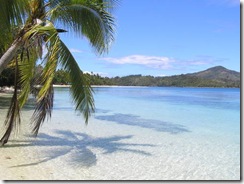
fijiWhile imperfect, it looks to me like Fiji's 'Draft People's Charter' is a step down that necessary track.  Sure, prosperity has its own problems, but as we flew back to New Zealand on Tuesday and looked down on the prosperous New Zealand landscape, it should have been clear even to the most jaundiced green eye that a land with industrialised agriculture and houses derided as "McMansions" offers a lot more comfortable existence than one -- no matter how good the coast looks in the travel brochures -- whose interior is filled with shanties and squats, and is scratched over by hand ploughs.

Thursday, 28 February 2008

Free elections, free speech, free expression ...

efb "It is inconceivable that you can hold open fair and free elections if you have media intimidation and great restraints on the freedom of expression."  That was Helen Clark, speaking yesterday about Fiji.

Hasn't the Herald and a few other people been saying something similar about the situation in New Zealand?

Just asking. 

[Hat tip Sandi]

UPDATE: Speaking of intimidation, restraints on the freedom of expression and unfair and unfree elections -- all brought to you by Helen Clark's Electoral Finance Act -- the Electoral Commission is seeking advice whether political opinions expressed on personal websites is legal.  I kid you not.

Thursday, 28 June 2007

There are people who laugh at Fiji...

* A ban on election year advertising by anyone other than politicians, something we might call speech rationing, is expected to be put before parliament shortly.

* A ban on using material from "official" parliamentary telecasts to "satirise, ridicule or denigrate" the denizens of parliament is expected to be voted in this afternoon.

* Meanwhile, the police want the power to fingerprint people without the need to arrest or lay charges against them [hat tip KG].

And there are people who laugh at what's happening in Fiji!

NB: You don't need to look to Fiji to get outraged at heavy-handed authoritarianism; but Stephen Franks suggests you might look for better law to a recent decision by the US Supreme Court, which "has just held unconstitutional aspects of campaign finance laws restricting third party-funded television ads close to elections." Do you think we could learn something from both?

UPDATE: Whale Oil quotes barrister and media law lecturer Steven Price saying it was difficult to see how the proposed restrictions on election advertising "can be demonstrably justified in a free and democratic society [a reference from the Bill of Rights Act] ... I'm also astonished to see that it doesn't permit the use of material for election campaigning." Says Oil,
So, for example, if the Prime Minister could be shown to have lied in the House, and there is sure to be plenty of that footage available, the Opposition couldn't use footage of that in its election campaign.

Yep, this is supression of freedom of expression for sure. Bloggers must unite and show the pollies what a bunch of cocks they are.

Tuesday, 26 June 2007

FREE RADICAL #75 - The Right of Revolution: In Praise of Commodore Frank Bainimarama.

With Free Radical #76 in the works and Fiji still in the news -- and real questions now beginning to be asked about just what's going on -- it seems appropriate to post the article from Free Radical #75 over which Tim Wikiriwhi left the Libertarianz. It becomes more prescient by the day -- and as you can see, when he's not waving his Bible about Tim become much more sane. (And you can check out all this blog's coverage of Fiji here.)

The Right of Revolution: In Praise of Commodore Frank Bainimarama.
by Tim Wikiriwhi


The latest coup in Fiji by Commodore Frank Bainimarama has highlighted for me the corruption of so-called “indigenous rights,” a recipe for division which is pedalled around the globe by the corrupt socialists of the UN. Four coups in twenty years is hardly a good look, but the instability is itself a product of racist laws that makes instability inevitable.


Bainimarama’s coup is the complete opposite of the previous three coups, each of which attempted to establish absolutely the UN’s apartheid agenda for indigenous rights. Whereas Rabuka and Speight were acting to cement the racist laws that raised indigenous Fijians over other Fijians, Bainimarama is a defender of the principle of equality.


Bainimarama said he was compelled to act against the government because corruption had flourished under Qarase, whom he himself appointed after the 2000 coup, and because of proposed laws that would grant pardons to plotters in a 2000 coup and hand lucrative land rights to indigenous Fijians at the expense of the large ethnic Indian minority.

"Qarase betrayed our trust when he went back to team up with the very people who caused the political instability of 2000," Bainimarama said. The new electoral system he pledged to implement would ensure that all votes cast were equal, and the present race-based election system abolished. This requires indigenous Fijians to vote for Fijian candidates, ethnic Indians for Indian candidates, and others for a third group of candidates. “We want to rid the constitution of provisions that facilitate and exacerbate the politics of race”, Bainimarama confirmed at the outset.


In seeking to put a permanent end to the racist Fijian electoral system and to permanently abolish laws that grant favouritism to indigenous racists, he is in my estimation worthy of praise and support reserved for the greatest benefactors of mankind.


Apathy and submission to injustice via political delusions

A basic principle of justice is that all law should be colour-blind; that everyone, regardless of race, should be equal before the law. We here in New Zealand have however grown soft on inequality. That this is true can not only be shown by the complete lack of protest against the blatant apartheid of the Waitangi Tribunal, of the many, many race-based policies still on the books in New Zealand.


This is an indictment against ourselves and our country, and a measure of our complacency and foolishness. So many people in so many places around the globe have been deceived into thinking that “the rule of democracy” is synonymous with “the rule of law”; that democracy is a safeguard of freedom. It is nothing of the sort.


Democracy is simply a counting of heads regardless of content. True liberty exists only when the inalienable rights of all individuals, regardless of race or colour, are put beyond the vote. Belief in the ‘democracy fallacy’ is so prevalent however that when a democracy is overthrown, even a racist democracy such as Fiji’s undeniably was, many immediately say that the perpetrators are dangerous criminals!


The reality is that democracy can be as unjust as an absolute monarchy, and it is just as immoral for a parliament to grant legal favouritism upon the grounds of race as it is for a king to do so, no matter how many people might vote for it!


The rule of law means the rule of principles of justice especially of the principle of equality before the law – equality for all, regardless of race! The democratic “mandate of the majority” is a valid way of choosing who should be in government, but not a valid way of justifying how they govern, or what laws they pass, nor an automatic justification of any law proposed by a democratic Parliament! Democracy is not synonymous with freedom.


Totalitarian democrats dread the spread of Bainimarama’s ideals

What the Clark regime are scared of is this: the simple realisation that a racist democracy not unlike the one they themselves are running has been overthrown, and overthrown in the name of overturning that entrenched and legalised racism. They can do nothing else but condemn Bainimarama!


The right of revolution

Let me state the fact that the principle of equality is no light or transient cause. What motivates me to support Bainimarama is exactly the same principle as motivated the American Declaration of Independence.


We must all be aware of the maxim of Edmund Burke: “All it takes for evil to prosper is for good men to do nothing.” If you are in a position of power to stop a great injustice, but do not exercise that power, does your inaction not amount to complicity? Any man of virtue in Bainimarama’s position would be obliged to make the same choice: That is either do nothing and allow the evil of apartheid injustice to go unchecked, or to act and put an end to it!


According to Lockeian principles, it is not unjust to overthrow a tyrant. Any good man has the right to stop the enemies of mankind by the law of nature, just as they have the right to kill any savage beast. We have the natural right to defend our lives and property. It is not a crime but a righteous necessity to overthrow a corrupt government.


The limits of political power and the supremacy of justice

While many people understand that the principle of equality before the law means you cannot have one law for blacks or browns and another for whites, few people appreciate the fullness of its limiting power over government whatsoever its form. This same principle guarantees absolute equal freedom for all: It means a president, a king, or an indigenous native has no more rights than the lowliest citizen or the most recent immigrant.


Equality before the law means you cannot have a state religion. It means you cannot have an official culture. It means you cannot have one law for the rich and another for the poor. It means you cannot grant any favouritism whatsoever!


The tyranny of the mob under demagogues

How many people really want true equality? Not many! Most would rather have some say over their neighbour’s rights and liberties than enjoy their own – they would rather have an absolute, unlimited democracy – one in which nothing has been put beyond the vote – if it allows them to somehow bully their neighbour, or to gain preference for their own. There are plenty of demagogues willing to crush minorities and to ride the waves of bigotry into power, and plenty of people around the world ready to applaud the bigots.


The proper constitutional context of the conventions of democracy

The power of voting is more critical when the government has tyrannical powers.

When government is kept in check by a just libertarian constitution – when the government has been limited to protecting the rights of the individual, and the elected government is barred from totalitarianism or unlimited majority rule – then the power to vote away the rights and liberties of minorities is of much less consequence (and remember that the smallest minority is the individual, whose rights a just government is sworn to uphold).


In such a system, what the US Founding Fathers described as a constitutional republic, no matter what religion or culture is in the majority or who is voted into office, the government cannot pass discriminatory laws nor usurp greater powers at the expense of the rights and liberties of the population.


The fact that nations like Fiji and New Zealand don’t have such constitutional restraints means that the right to vote is itself looked upon as the primary safeguard against corruption, and the notion of taking away an elected government by force sends dread trough the Mobocracy -- yet that liberation will be met with jubilation by the liberated minorities who have borne the brunt of democratic injustice.


The limits of representative government and the power of consent

It must be remembered that the right to vote is not a license to create a tyranny of the mob. The right to vote in a representative government is subordinate to the principles of justice. The mandate of the majority can never legitimately override the principle of equality before the Law. The principle of the consent of the governed is itself subordinate to the principle of equality before the law.


The principle of equality is the only condition of justice whereby everyone can be justly expected to grant consent, so this principle becomes an absolute justification for any form of government that is constitutionally founded upon it. Those who refuse to consent to equality and instead desire an unjust form of rule, whether they represent either a majority or minority, can rightfully be ignored and even suppressed (meaning: they halted from unjust revolution):

  • It is just to impose equality upon an unwilling/barbarous population by force to keep their prejudice in check.
  • It is just to crush socialist uprisings.
  • It is just to overthrow racist democracies.
  • It is just to hunt down religious terror groups who seek religious tyranny.
  • It is just to go to war to liberate a slave pen, and to occupy foreign lands wherein the threat of ideological evil dwells.

The justice of all these things hinges on the principle of equality. Equality before the law is the standard by which to judge the validity of all law and government.


This ultimate truth is founded upon our God-given equal rights, rights that exist as inalienable absolutes irrespective of laws and governments. Fiji is technically in a state of civil war, and has been since it instituted racist government long ago, at which point it went to war against those citizens whose rights it overthrew. In overturning a racist government and in suppressing racist mob uprisings, I submit that Bainimarama is acting under this principle of justice. He must take care how he goes about this difficult task.


The current confrontation with the Great Council of Chiefs was inevitable, since it was this corrupt political body that was behind the Rabuka and Speight coups, and behind the apartheid system of favouritism for indigenous Fijians. He must divest these tribal chiefs of their corrupt powers that perverted the democracy of Fiji into an apartheid system. The best thing the chiefs can do is support a new constitution in which all Fijians, regardless of race, are recognised as being equal before the law.


The responsibility for government rests with the people

“Power corrupts and absolute power tends to corrupt absolutely.” This is the great fear of any nation, and no doubt is a reason many fear the power of Bainimarama. I wonder why these same fearful souls are not leading a revolution against Helen Clark and Her Own Absolute Democracy!


How much evil will these frightened souls suffer before they rise up against her? Even in Western civilisations, millions are dying each year as a direct result of socialism, yet no one acts against it because democracy has turned them into spineless slaves. Ultimately absolute tyrants everywhere prosper because the population is too scared to overthrow them. They prefer the safety of slavery to the risk of dying for freedom. Mugabe will continue to tyrannise Zimbabweans until the people say enough is enough. Putin will continue to suppress Russian protest until the people say enough is enough. Their tyranny will continue until those sufficiently brave and staunch enough for freedom run into the seat of power and oust these tyrants!


The limits of tyrants are set by the resistance of their citizens. All would-be tyrants must fear the wrath of freedom-loving people! Dictatorships can only stand where the people choose submission over revolution.
The price of liberty is indeed eternal vigilance.


Who ought to engage in such revolution? Every enlightened individual who refuses to submit to tyranny. New Zealanders need to sort out their own apartheid systems of state before they tell Commodore Bainimarama to surrender to the racists of Fiji!


Tim Wikiriwhi is a Hamilton engineer, and a self-described Independent Libertarian.

IF YOU LIKED THIS, THEN CHECK OUT THESE RELATED ARTICLES:

Wednesday, 20 June 2007

Background to Green's Fijian expulsion

Take it for what it's worth since it appeared on Ian Wishart's website [hat tip Whale Oil], but with all the mainstream media wringing their hands in unison on Michael Greens' expulsion from Fiji, this offers some of the background to the expulsion that the MSM's pathetic coverage has completely failed to provide: a letter from one Thakur Ranjit Singh, Fiji human rights campaigner, Fiji Sun columnist and a former general manager of Fiji's Daily Post.
If NZ Government claims that the expulsion of Michael Green came as a surprise then it is a white lie. This is because the NZ government was warned about Michael Green's behaviour some four months earlier by members of Fiji community in Auckland...

[A public] meeting was told about Michael Green's behaviour towards the military regime as well as people of Fiji seeking services from NZ High Commission. It was reported that Michael Green was very close to Qarase regime and could not fathom the fact that he would no longer be in the cocktail circuit after Qarase's removal in December last year...

He failed to appreciate the reality of the situation and has now paid a heavy price for it.

The other Michael also came into prominence. The supposedly expert in Pacific affairs, Michael Field was detained at Nadi on the eve of marching orders to Michael Green and deported the following morning to New Zealand.

On 20th December, some two weeks after the removal of Qarase regime, Coalition for Democracy in Fiji held a panel discussion on Fiji affairs in Auckland. Apart from Suliana Siwatibau and NZ MP Keith Locke, I was also one of the speakers. Michael Field also attended this forum. In my presentation which was reported in Fiji as well as NZ papers, I revealed the ills of Qarase regime. The theme of my presentation was that: democracies that are devoid of or lacking in granting freedom, rights and equality to all its citizens and those without social justice are not worth defending. Qarase's regime that Bainimarama removed was an epitome of such a democracy. Michael Field did not report any part of my presentation. I am not cross that he did not report me but he displayed acute case of dereliction of media ethics in not telling Kiwis what they deserved to know...

If Michael Field was indeed the veteran journalist then he should not have abused his position and status in keeping Kiwis ignorant about what was really happening in Fiji. My experience shows that like NZ Labour Party, New Zealanders generally are still ignorant about Fiji and this had to do with a journalist like Michael Field who while occupying an influential position indulge in news selling reporting rather than informative reporting...

And it is so important for New Zealand mainstream media to have Pacific or Fijian journalists reporting on Fiji issues and informing the ignorant Kiwis on local politics, so that they get the correct picture.

But unfortunately, the mainstream media in New Zealand is in no hurry to use Fiji journalist who have migrated to New Zealand, and will depend on jaundiced views from parachute journalists from New Zealand. Unfortunately, such views appear to get copied as New Zealand's foreign policy in the Pacific.

For the full letter, see Thakur Ranjit Singh: Fiji Problem.

Singh has been critical for some time of the performance of NZ media and their "parachute journalists" in covering events in Fiji (as have some bloggers, such as this one). Speaking in December, for example, Singh told a public forum
that "NZ media was ignorant about Fiji affairs and naive about the post-coup reality."
"They shoot their mouths off through parachute journalists who relish in rubbishing things happening in NZ's neighbours without first appreciating the fact that Fiji is not a model of democracy," he said.

Singh said military commander Commodore Voreqe Bainimarama had saved Fiji from becoming "another Zimbabwe" with serious abuses of human rights and social justice.

He said New Zealand's government and media had lost sight of the basic balance of "democracy and justice".
I think he's right. Not for the first time, the failures of the Fourth Estate assist and inform the failures of the First Three. What Helen Clark has seen in Bainimarama is simply another scapegoat to draw attention away from her Government's failures, one allowing her to strut imperiously on a world stage -- and the media's pathetic coverage has allowed her to get away with it.

UPDATE: Here's the sort of analysis I would have expected from local journalists, but which (if it has appeared) I haven't seen: Elizabeth Keenan writing in January's Time magazine:

When military commander Frank Bainimarama seized power in Suva on Dec. 5, he was instantly denounced by Australia, New Zealand, the U.S., the E.U., the U.N. and the Commonwealth. Exiled Prime Minister Laisenia Qarase continues to vent outrage by phone from his island village, but his countrymen don't seem to be rallying. Soldiers at checkpoints receive abuse, but also smiles, handshakes, food and flowers. Some staunch democrats who condemned George Speight's botched coup in 2000 find themselves endorsing the aims of this takeover, if not the assault rifles that made it possible. The Methodist Church and the Great Council of Chiefs, bastions of indigenous society, have urged Fijians—including Qarase—to support the multiracial interim government "for the betterment of the nation." Writing in the Fiji Times, Catholic Archbishop Peter Mataca called Australia and New Zealand's shunning of the Bainimarama administration "regrettable and shallow." Some Fijians, he wrote, believe democracy and the rule of law "were abused and circumvented long before the military ousted the Qarase government."

In Fiji, it seems, not all coups are equally offensive...

Qarase's elected government was seen as caring most about the happiness of indigenous Fijians. Bainimarama's force-backed government aims to make Fijians of all races happy. If—and it's a huge if—he can implement his idealistic program, he might just have pulled off the coup to end all Fiji coups.
And here's an article and and photo essay from March's Time magazine (both of which have been blogged here before) drawing attention to the tragic existence of Fiji's squatters -- mostly dispossessed Indo-Fijians who racist law has barred from owning land, and who previous governments have left at the mercy of shifting racial, economic and political tides.

Monday, 14 May 2007

Arrests and beatings in racist Fiji

The hopes that some libertarians have for Bainimarama's coup in Fiji -- well, that one libertarian has (see below) -- must surely be put to the test by increasing attacks on free speech in Fiji, including most recently the arrest of bloggers for nothing more than doing what bloggers do.
Intelligentsiya reports that a Fijian businessman was arrested, detained and mistreated by the Fijian army, who suspected him of writing blog posts... Soldiers have apparently also pressured FINTEL, Fiji’s sole ISP, to block blogspot.com altogether...
"It seems," notes NZ's Pacific Empire blog [to whom the hat tip goes for the reports], "that anonymity is the only protection for the Intelligentsiya bloggers." Fiji's bloggers are annoying the regime with posts such as these:
  • ...it now a case of "once more into the breach, dear friends" for those of us who detest this governing parasite... We are fighting for our rights and as history has shown over and over again, in every age, every nation, under every tyrant(s), the truth always prevails. And the truth is Mr. Bainimarama, you have committed a wrong so vile that I hope the Lord can forgive you. You have killed, tortured, threatened, bullied the citizens of this nation in the misguided notion that you were doing the right thing. You might say that you did not do these things but as Commander, yours is the responsibility... We blog because this is now the only way we can speak out freely. We have no other avenue that we can safely use to express our mounting dissatisfaction with the way our nation is being raped... [Good Men (and Women) Doing Something]

  • Commodore why don't you tell the people how your officers like army rugby players Komaitai, Dere, Rokowailoa and now Naulia are being hitmans [sic] in your outfit because you have a weakness for rugby and in turn they become your most loyal subjects who will commit anything you bid them to do from hunting down men to actually abusing them and finally killing them. How long do you think this fact is going to remain hidden? Your army boys are talking and this is becoming a known fact. Their families are dying and their children are going to be victims of your sin and the sin of their fathers so do the honest thing and relieve them of the responsibility that you have placed on them knowing they are your murdering dogs!!! Be a man and take it like a man since you were the one who gave them that order as your shadow hit team to do the killing! [Resist Frank's Coup]
  • Deputy Solicitor General Savenaca Banuve was sacked today by the military junta for refusing to defend cases pending against the interim administration. Intelligentsiya sources confirm that Mr Banuve was given an ultimatum about handling cases brought by ousted Prime Minister Laisenia Qarase and two members of the Great Council of Chiefs. We understand that Mr Banuve replied that his lawyers would not handle those cases as they already had a heavy load and that, secondly, it was their viewpoint that the current regime was illegal... [Intelligentsiya]

  • Fiji' s Military Dicktator once said in a moment of Strongman Madness and clapped on by his purile fans dressed in green, "We can argue on the legality of the government until the cows come home."

    Well as you can see Mr DickTator, the cows ARE coming home, and this 'cow' will hold out a signpost for you to look at everyday until you get off the grass, stop chewing the nation's fat (whats left of it), and go plug yourself into an halal abattoir somewhere so we the nation's citizens can rebuild what is left of our shattered sovereignty... [Discombobulated]
All bad. But here's a challenge: it's worth making the point that if he's to be believed, Bainimarama is genuinely trying to right a real wrong: the wrong of corruption in Government, and of a racist Fijian Government system that has in the past favoured indigenous and well-connected Fijians over other citizens -- and it's worth noting that at least some of the resistance to him is along racist lines. This post and comment for example at The Rotten State of Fiji gives some idea:
Frank has gone completely mad! I wouldn't be surprised if he is sentenced to the mental ward of St. Giles once all this is over.

A lot of stupid Indians here continue to support Frank and his cronies. This isn't helped by the vengeful mob of Indians settled overseas in Australia and NZ. In the media, they continue to support Frank. Infact, I reckon, Australia and NZ should send those lot back to Fiji and ban them from returning. [Comment: I am with you...this coup was pro Indians and these stupid lot should be sent back to their motherland ... just like Butadroka said, quote Indians will always be Indians...unquote.]
Tim Wikiriwhi argues in The Free Radical that
Bainimarama’s coup is the complete opposite of the previous three coups, each of which attempted to establish absolutely the UN’s apartheid agenda for "indigenous rights." Whereas Rabuka and Speight were acting to cement the racist laws that raised indigenous Fijians over other Fijians, Bainimarama is a defender of the principle of equality.

Bainimarama said he was compelled to act against the government because corruption had flourished under Qarase, whom he himself appointed after the 2000 coup, and because of proposed laws that would grant pardons to plotters in a 2000 coup and hand lucrative land rights to indigenous Fijians at the expense of the large ethnic Indian minority.
Wikiriwhi finds comfort in words such as these from the Commodore: “We want to rid the constitution of provisions that facilitate and exacerbate the politics of race,” arguing that
In seeking to put a permanent end to the racist Fijian electoral system and to permanently abolish laws that grant favouritism to indigenous racists, he is in my estimation worthy of praise and support...
In seeking to permanently abolish laws that grant favouritism to indigenous racists you're unlikely to attract the support of the racists themselves, but it seems to me that if that's genuinely what Commodore B. is trying to do -- and for myself I'm still to be convinced -- then rather than shutting down free speech he should be daily and regularly making his case that racist government is wrong, and that he is the enemy of racist law and of racist government in Fiji.

If he's right, then truth should be his ally, not his enemy.

ImageAn example of the damage caused by Fiji's racist property law is highlighted this month in Time magazine, which has an article and photo essay on Fiji's squatters -- those dispossessed non-indigenous Fijians who haven't received the 'favour' of being allowed to own land, and who are left at the mercy of shifting economic and political tides. As that photo-caption above notes, "Most of the country's 100,000 squatters [ten percent of the country's 900,000 population] are Indo-Fijian origin; many have been driven to the cities as a result of expired farm leases" -- a fragile leasehold being the only form of ownership allowed to Indo-Fijians.
The drift of rural families into cities in search of better jobs and improved living conditions is part of a global trend, but in Fiji the country's [racist] land-ownership policies have exacerbated the problem. Laws passed in the 1970s obliged non-indigenous farmers to take 30-year leases on the land they worked.
As leases expired, government's "encouraged" indigenous Fijian "owners" to eject leaseholders (leases being all they were allowed to own), resulting in a surge to Suva by squatters in the late 1990s, who live in shameful conditions, excluded as they are from the "mainstream" of Fijian economic life by racist laws, and a racist constitution.
Farming families like the Kumars, from the Nanuku squatter settlement on the coast near Suva, were among those who lost their farms and were driven into the city in the late 1990s. "My father and I went twice to the landowners to ask them to renew the lease," says Rohit Kumar. "But both times they refused. I was crying when I left. I was looking around seeing this place I had grown up farming, seeing the place where I used to play as a little boy." Today Kumar, his wife and four children are crammed into an 8 m by 5 m shack located in the middle of a mosquito-infested mangrove swamp. Around them is a garbage tip of old tyres, tins and broken-up asbestos sheeting; human waste fills a network of stinking open drains that regularly overflow during high tide.
If this is what Commodore B. is fighting, then I'm with him. But how would we know if he is?

Friday, 9 March 2007

Bainimarama: Hero or villain?

More in sadness than joy, I have to report that Tim Wikiriwhi, the tireless Libertarianz spokesman to deregulate Maori Affairs, has resigned his post and resigned the party.

His resignation disappoints me greatly; the reason is the different estimate that he and other Libz place on The Coup of Commodore Bainamarama. Tim thinks the coup should be praised, and Bainimarama hailed as (in Tim's words) a "hero of equality and justice." His reasons for thinking so were as unclear to me then as they are now, but may be deduced from his Open Letter to Commodore Bainimarama -- Tim's first press release as an "independent libertarian".

I say "deduced" because his reasons for thinking the Commodore worthy of support are to me still unclear. A "hero of equality and justice" is to me a figure like Thomas Jefferson, or Frederick Douglass, or William Lloyd Garrison ... it would need an awful lot of evidence that would convince me that the Commodore fits into that pantheon -- and the censorship, beatings and even murders instituted in Fiji since the coup don't speak highly of his chances of being so elevated.

Tim argues that "Bainamarama is determined to make Fiji a nation where indigenous racism has no political stranglehold" and this as "one of the greatest political statements for Equality before the law by any world leader this century."
Bainamara’s intension to abolish the Fijian racist electoral system and have one electoral roll for all can only be described as the highest of political Ideas, and should he be successful, he deserves to go down in history as the greatest benefactor of Fiji!
I'm still not so sure. The censorship, beatings and murders do tend to suggest otherwise -- but since the MSM reporting from Fiji has been almost entirely lacklustre one has few facts on which to base a judgement. As I've said several times, I'm still here to be persuaded; if his heroism is so certain, then the reasons for being so certain about it and the facts to back it up should be easy to explain and simple to lay out -- but I've yet to see a full explanation, or those facts.

If anyone has such facts or can state clearly the reasons for supporting the Commodore, I'd be more than happy to see them. The best I can offer as ammunition for either side are these few relevant highlights that appeared recently:
  • NBR editor Nevil Gibson suggests, "The Bainimarama coup is widely viewed as progressive because it has a credible finance minister, Mahendra Chaudhry, and is seen as reversing Fiji’s trend toward more race-based policies. Time magazine has this largely complimentary profile." Excerpt:
    Bainimarama says entrenched corruption, race-based policies that favored the 51% of Fiji's population who are indigenous, and runaway crime drove his intervention. He rejects [Alexander] Downer's suggestion that he has acquired a taste for power as "the height of insensitivity and arrogance," saying he didn't want to be Prime Minister, and accepted the position only at the urging of his military council. "I hate this job," he says, "but it has to be done. And we are going to stay until we complete this business." How long that will take is anyone's guess... "I have told my troops that power corrupts only if you abuse the authority given to you," he says. "I am continually telling my people, 'This is the line. You can't cross this line. It doesn't do us any good.' "
  • The blog Intelligentsiya has become a key site in reporting the Bainimarama regime's activities and abuses every time it does "cross the line," and (reports Idiot/Savant) the military is hunting for them for it, "accusing them of 'portraying a negative image of the Interim Government' - which is apparently a crime in the New Fiji." The bloggers describe themselves as
    Free. Fair. Fearless. Intelligentsiya is made up of Fiji Islanders who are libertarians in their own way and who cherish the free flow of news, ideas and information and will peacefully resist any attempts by the country's military rulers to stifle free speech. intelligentsiya will also bear witness, report and discuss human rights abuses by the authorities.
Whatever the case, it looks to be a blog to keep track of. And I'd be happy to hear your own views or information.