One of my favorite science fiction novels is “The Black Cloud” by
Fred Hoyle. It describes an alien intelligence in the form of a cloud
that approaches the earth and settles by the sun. Because of its
proximity to the sun the cloud causes havoc with the climate and thwarts
the attempts of scientists to both study it and attack it. Gradually
the scientists come to realize that the cloud is an intelligence unlike
any they have encountered. They are finally successful in communicating
with the cloud and realize that its intelligence is conveyed by
electrical impulses moving inside it. The cloud and the humans finally
part on peaceful terms.
There are two particularly interesting
aspects of the cloud that warrant further attention. One is that it’s
surprised to find intelligence on a solid planet; it is used to
intelligence being gaseous. The second is that it’s surprised to find
intelligence concentrated in individual human minds; it is used to
intelligence constantly moving around. The reason these aspects of the
story are interesting is because they show that Hoyle was ahead of his
time and was already thinking about forms of intelligence and life that
we have barely scratched the surface of.
Our
intelligence is locked up in a three pound mass of wet solid matter.
And it’s a result of the development of the central nervous system. The
central nervous system was one of the great innovations in the history
of life. It allowed organisms to concentrate their energy and
information-processing power in a single mass that sent out tentacles
communicating with the rest of the body. The tentacles are important but
the preponderance of the brain’s capability resides in itself, in a
single organ that cannot be detached or disassembled and moved around.
From dolphins to tigers and from bonobos to humans, we find the same
basic plan existing for good reasons. The central nervous system is an
example of what’s called convergent evolution, which refers to the
ability of evolution to find the same solutions for complex problems.
Especially in Homo sapiens, the central nervous system and the
consequent development of the neocortex are seen as the crowning glory
of human evolution.
And yet it’s the solutions that escaped the
general plan that are the most interesting in a sense. Throughout the
animal and plant kingdom we find examples not of central but of
distributed intelligence, like Hoyle’s cloud. Octopuses are particular
fascinating examples. They can smell and touch and understand not just
through their conspicuous brains but through their tentacles; they are
even thought to “see” color through these appendages. But to find the
ultimate examples of distributed intelligence, it might be prudent not
to look at earth’s most conspicuous and popular examples of life but its
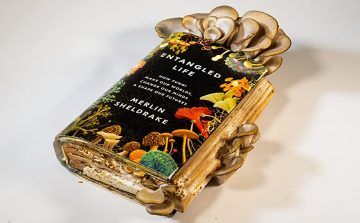
most obscure – fungi. Communicating the wonders of distributed
intelligence through the story of fungi is what Merlin Sheldrake
accomplishes in his book, “Entangled Life”.
Fungi
have always been our silent partners, partners that are much more like
us than we can imagine. Like bacteria they are involved in an immense
number of activities that both aid and harm human beings, but most
interestingly, fungi unlike bacteria are eukaryotes and are therefore,
counterintuitively, evolutionarily closer to us rather than to their
superficially similar counterparts. And they get as close to us as we
can imagine. Penicillin is famously produced by a fungus; so is the
antibiotic fluconazole that is used to kill other fungal infections.
Fungal infections can be deadly; Aspergillus forms clumps in the lungs
that can rapidly kill patients by spreading through the bloodstream.
Fungi of course charm purveyors of gastronomic delights everywhere in
the world as mushrooms, and they also charm purveyors of olfactory
delights as truffles; a small lump can easily sell for five thousand
dollars. Last but not the least, fungi have taken millions of humans
into other worlds and artistic explosions of colors and sight by
inducing hallucinations.
With this diverse list of vivid
qualities, it may seem odd that perhaps the most interesting quality of
fungi lies not in what we can see but what we can’t. Mushrooms may grace
dinner plates in restaurants and homes around the world, but they are
merely the fruiting bodies of fungi. They may be visible as clear vials
of life-saving drugs in hospitals. But as Sheldrake describes in loving
detail, the most important parts of the fungi are hidden below the
ground. These are the vast networks of the fungal mycelium – the sheer,
gossamer, thread-like structure snaking its way through forests and
hills, sometimes spreading over hundreds of square miles, occasionally
being as old as the neolithic revolution, all out of sight of most human
beings and visible only to the one entity with which it has forged an
unbreakable, intimate alliance – trees. Dig a little deep into a tree
root and put it under a microscope and your will find wisps of what seem
like even smaller roots, except that these roots penetrate into the
trees roots. The wisps are fungal mycelium. They are everywhere; around
roots, under them, over them and inside them. At first glance the the
ability of fungal networks to penetrate inside tree roots might evoke
pain and invoke images of an unholy literal physical union of two
species. It’s certainly a physical union, but it may be one of the
holiest meetings of species in biology. In fact it might well be
impossible to find a tree whose roots have no interaction with fungal
mycelium. The vast network of fibers the mycelium forms is called a
mycorrhizal network.
The mycorrhizal networks that wind their way
in and out of tree roots are likely as old as trees themselves. The
alliance almost certainly exists because of a simple matter of
biochemistry. When plants first colonized land they possessed the
miraculous ability of photosynthesis that completely changed the history
of life on this planet. But unlike carbon which they can literally
manufacture out of sunlight and thin air, they still have to find
essential nutrients for life, metals like magnesium and other
life-giving elements like phosphorus and nitrogen. Because of an
intrinsic lack of mobility, plants and trees had to find someone who
could bring them these essential elements. The answer was fungi. Fungal
networks stretching across miles ensured that they could shuttle
nutrients back and forth between trees. In return the fungi could
consume the precious carbon that the tree sank into its body – as much
as twenty tons during a large tree’s lifetime. It was the classic
example of symbiosis, a term coined by the German botanist Albert Frank,
who also coined the term mycorrhiza.
However,
the discovery that fungal networks could supply trees with essential
nutrients in a symbiotic exchange was only the beginning of the
surprises they held. Sheldrake talks in particular about the work of the
mycologists Lynne Body and Suzanne Simard who have found qualities in
the mycorrhizal networks of trees that can only be described as
deliberate intelligence. Here are a few examples: fungi seem to “buy
low, sell high”, providing trees with important elements when they have
fallen on hard times and liberally borrowing from them when they are
doing well. Mycorrhizal networks also show electrical activity and can
discharge a small burst of electrochemical potential when prodded. They
can entrap nematodes in a kind of death grip and extract their
nutrients; they can do the same with ants. Perhaps most fascinatingly,
fungal mycelia display “intelligence at a distance”; one part of a huge
fungal network seems to know what the other is doing. The most striking
experiment that demonstrates this shows oyster mushroom mycelium growing
on a piece of wood and spreading in all directions. When another piece
of wood is kept at a distance, within a few days the fungal fibers
spread and latch on to that piece. This is perhaps unsurprising. What is
surprising is that once the fungus discovers this new food source, it
almost instantly pares down growth in all other parts of its network and
concentrates it in the direction of the new piece of wood. Even more
interestingly, scientists have found that the hyphae or tips of fungi
can act not only as sensors but as primitive Boolean logic gates,
opening and closing to allow only certain branches of the network to
communicate with each other. There are even attempts to use fungi as
primitive computers.
This intelligent long-distance relay gets
mirrored in the behavior of the trees that the fungi form a mind meld
with. One of the characters in Richard Powers’s marvelous novel “The
Overstory” discovers how trees are whispering hidden signals to each
other, not just through fungal networks but through ordinary chemical
communication. The character Patty Westford finds out that when insects
attack one tree, it can send out a chemical alarm that alerts trees
located even dozens of meters away of its plight, causing them to kick
their own repellant chemical production into high gear. Meeting the
usual fate of scientists with novel ideas, Westford and her ideas are
first ignored, then mocked and ostracized and ultimately grudgingly
accepted. But the discovery of trees and their fungal networks
communicating through each other and through the agency of both
chemicals and other organisms like insects is now generally accepted
enough to become part of both serious scientific journals and
prizewinning novels.
Fungi can also show intelligent behavior by
manipulating our minds, and this is where things get speculative.
Psilocybin and LSD have been used by shamans, hippies and Silicon Valley
tech entrepreneurs over thousands of years. When you are familiar with
both chemistry and biology it’s natural to ask what might be the
perceived evolutionary utility of chemical compounds that bring about
changes in perception that are so profound and seemingly liberating as
to lead someone like Aldous Huxley to make sure that he was on a
psychedelic high during the moment of his death. One interesting clue
arises from the discovery of these compounds in the chemical defense
responses of certain fungi. Clearly the microorganisms that are engaged
in a war with fungi – and these often include other fungi – lack a
central nervous system and have no concept of a hallucination. But if
these compounds are found as part of the wreckage of fungal wars, maybe
this was their original purpose, and the fact that they happen to take
humans on a trip is only incidental.
That is the boring and likely
explanation. The interesting and unlikely explanation that Sheldrake
alludes to is to consider a human, in the medley of definitions that
humans have lent themselves to, as a vehicle for a fungus to propagate
itself. In the Selfish Fungus theory, magic mushrooms and ergot have
been able to hijack our minds so that more of us will use them,
cultivate and tend them and love them, ensuring their propagation. Even
though their effects might be incidental, they can help us in unexpected
ways. If acid and psilocybin trips can spark even the occasional
discovery of a new mathematical object or a new artistic style, both the
fungi and the humans’ purpose is served. I have another interesting
theory of psychedelic mushroom-human co-evolution in mind that refers to
Julian Jaynes’s idea of the bicameral mind. According to Jaynes, humans
may have lacked consciousness until as recently as 3000 years ago
because their mind was divided into two parts, one of which “spoke” and
the other “listened”. What we call Gods speaking to humans was a result
of the speaking side holding forth. Is it possible that at some point in
time, humans got hold of psychedelic fungi and they hijacked a more
primitive version of the speaking mind that allowed it it to turn into a
full-blown voice inside the other mind’s head, so to speak? Jaynes’s
theory has been called “either complete rubbish or a work of consummate
genius, nothing in between” by Richard Dawkins, and this might be
another way to probe whether it might be true for a reason.
It is
all too easy to anthropomorphize trees and especially fungi, which only
indicates how interestingly they behave. One can say that “trees give and trees receive”, “trees feel” and even “trees know”,
but at a biological level is this behavior little more than a series of
Darwinian business transactions, purely driven by natural selection and
survival? Maybe, but ultimately what matters is not what we call the
behavior but the connections it implies. And there is no doubt that
fungi, trees, octopuses and a few other assorted creatures are
displaying a unique type of intelligence that humans may have merely
glimpsed. Distributed intelligence clearly has a few benefits over a
central, localized one. Unlike humans who are unlikely to live when
their heads are cut off, newts can regrow their heads when they get
detached, so there’s certainly a survival advantage conferred by not
having your intelligence organ be one and done. This principle has been
exploited by the one form of distributed intelligence that is an
extension of human beings and that has taken over the planet – the
Internet. Among many ideas that are regarded as the origins of the
Internet, one was conceived by the defense department which wanted to
built a communications net that would be resilient in the face of
nuclear attack. Having a distributed network with no one node being a
central node was the key. Servers in companies like Google and Facebook
are also constructed in such a way that a would be hacker or terrorist
would have to take out several and not just a few in order to measurably
impair the fidelity of the network.
I also want to posit the
possibility that distributed systems might be more analog than central
ones and therefore confer unique advantages. Think of a distributed
network of water pipes, arteries, traffic lanes or tree roots and fungal
networks and one has the image in mind of a network that can almost
instantaneously transmit changes in parameters like pressure,
temperature and density taking place in one part of the network to
another. These are all good examples of analog computation, although in
case of arteries, the analog process is built on a substrate of digital
neuronal firing. The human body is clearly a system where a combination
of analog and digital works well, but looking at distributed
intelligence one gets a sense that we can optimize our intelligence
significantly using more analog computing.
There is no reason why
intelligence may not be predominantly analog and distributed so that it
becomes resilient, sensitive and creative like mycorrhizal networks,
being able to guard itself against existential threats, respond to new
food and resource locations and construct new structures with new form
and function. One way to make human intelligence more analog and
distributed would be to enable human-to-human connections through
high-fidelity electronics that allows a direct flow of information to
and from human brains. But a more practical solution might be to enable
downloading brain contents including memory into computers and then
allowing these computers to communicate with each other. I do not know
if this advance will take place during my lifetime, but it could
certainly bring us closer to being a truly distributed intelligence that
just like mycorrhizal networks is infinitely responsive, creative,
resilient and empathetic. And then perhaps we will know exactly what it
feels like to be a tree.


