

Marketing tips, news and more
Explore expert-backed articles on SEO, data, AI, and performance marketing. From strategic trends to hands-on tips, our blog delivers everything you need to grow smarter.
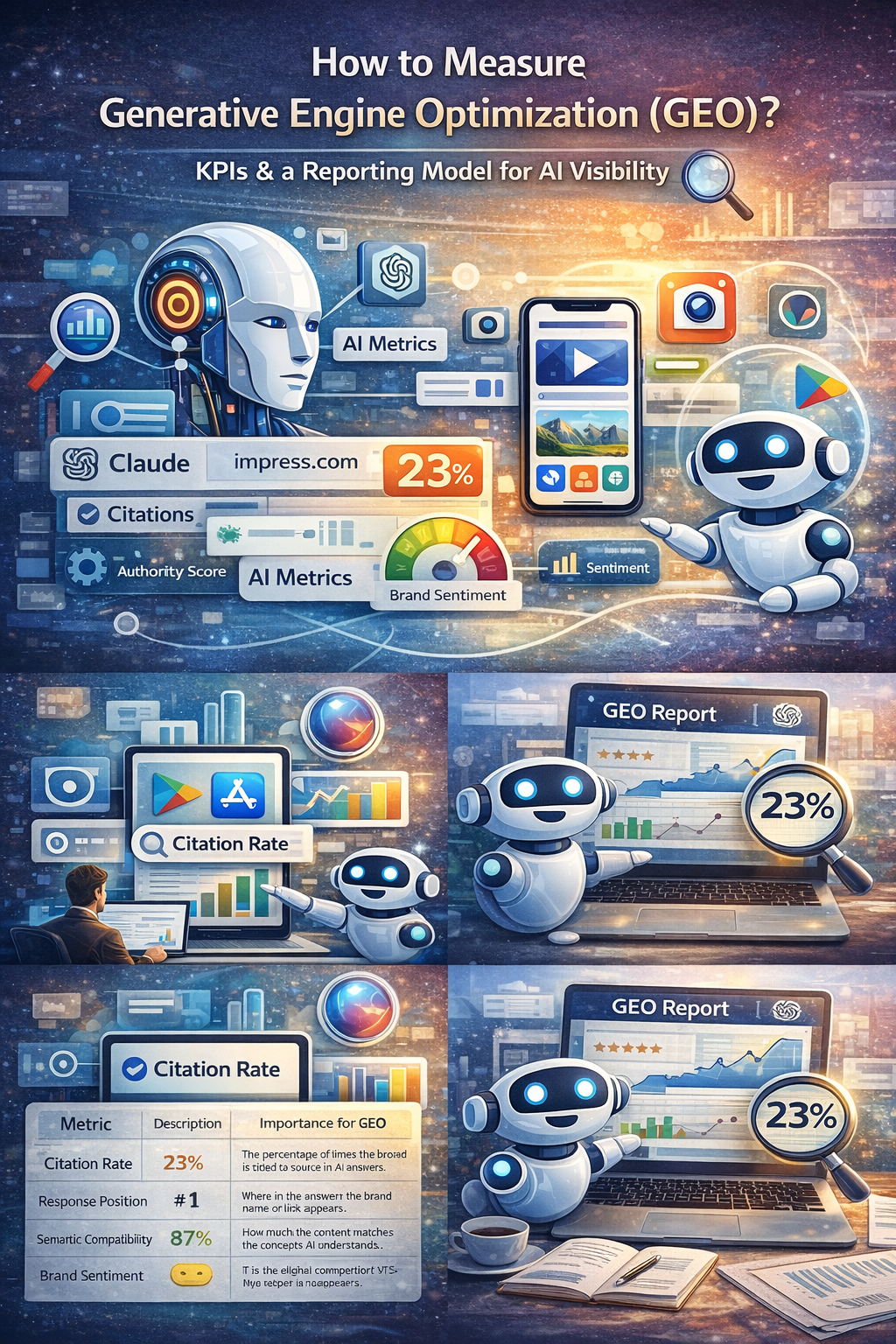
How to Measure Generative Engine Optimization (GEO)? KPIs and Reporting Model for AI Visibility
The digital marketing world is undergoing a major transformation from search engine optimization toward AI driven answer systems. In this new era, Generative Engine Optimization measurement is of vital importance for brands to sustain their digital presence. While traditional SEO metrics focus on the user clicking a link and visiting a website; GEO measures how much AI (LLM) references your brand and how you are positioned within answers. The rise of systems such as Google SGE (Search Generative Experience), Perplexity, Claude, and ChatGPT makes a new data driven analytics approach mandatory. In this content, we will examine in depth the mathematical formulas of gaining visibility in AI engines and how this process should be reported.AI engines do not present data directly; instead, they synthesize it from multiple sources to create new content. This makes classic metrics such as click through rate (CTR) insufficient on their own. The point we must now focus on is the share of the answer delivered by AI and how frequently your brand is seen as a reliable source. In Generative Engine Optimization analytics processes, not only the accuracy of the data but also how much authority the brand holds in semantically related topics should be measured. To be successful in the digital strategies of the future, you need to master not only search volumes but also AI’s conceptual association models.Unlike traditional SEO, Generative Engine Optimization measurementIn traditional SEO work, success is generally measured by ranking in the top three positions for a specific keyword. However, when it comes to Generative Engine Optimization measurement, the concept of ranking gives way to the dynamics of being cited and being part of the answer. AI engines tend to provide the user with a single final answer. Having your brand name mentioned in that answer is the strongest proof that your brand is accepted as an authority. Pageview counts in classic metrics are replaced in the GEO universe by answer interaction and attribution quality. This shift requires our measurement tools and strategic perspective to evolve as well.Ranking vs. Citation: Instead of classic SERP rankings, the number and order of citations within the AI answer should be tracked.Click vs. Answer Share: Rather than the user coming to the site, how much space the brand occupies in the information AI provides to the user is important.Keyword Based vs. Semantic Based: Not only keyword matching, but topical integrity and authority score are the cornerstone for Generative Engine Optimization analytics.Single Page vs. Knowledge Pool: Instead of the performance of a single page, the brand’s weight within the Knowledge Graph across all relevant topics is measured.When measuring, it is necessary to go beyond Google Search Console data. Special bots and semantic analysis tools are used to determine how much of the content generated by AI models uses your brand as a source.For example, in the answer given to a user’s question “Which is the best SEO agency?”, which position your brand name appears in and how positive the tone of that answer is are next generation performance indicators. Generative Engine Optimization measurement, therefore, is not only a technical data tracking process but also a reputation and trust analysis process.Critical KPIs for AI Visibility and Generative Engine Optimization AnalyticsTo track performance in AI engines, there is a need for defined, specific KPIs. Generative Engine Optimization analytics covers the process of monitoring and optimizing these metrics regularly. One of the most critical metrics, Citation Rate, indicates how frequently your content is cited by AI. Another important KPI is the Brand Sentiment in AI metric; the tone of the language AI uses when mentioning your brand (positive, neutral, or negative) is decisive for your brand image. These data are the elements that determine your brand’s share of intelligence in the digital world.Metric NameDescriptionImportance for GEOCitation RateThe percentage of times the brand is cited as a source in AI answers.Represents authority and trustworthiness.Response PositionWhere in the answer the brand name or link appears.Provides visibility and user trust.Semantic CompatibilityHow much the content matches the concepts AI understands.Increases success in reaching the right audience.Brand SentimentThe tone of the AI generated content about the brand.It is the digital counterpart of reputation management.As seen in the table above, Generative Engine Optimization analytics focuses not only on quantitative data but also on qualitative analyses. For example, the Semantic Relevance metric measures where your content is positioned in AI’s embedding space. If your content has a mathematically high correlation with the topic you are targeting, AI engines will reference you more. This proves that in Generative Engine Optimization measurement processes, content quality is as important as technical data. When defining your KPIs, you must ensure that each of them aligns with your business goals and the operating principles of AI.Citation and Generative Engine Optimization Measurement Techniques in LLM ResponsesBeing included in LLM answers is not only about producing quality content but also about presenting that content in a structure that AI can read and trust. Among the most common Generative Engine Optimization measurement techniques are Reverse Prompting and AI Benchmarking methods. Queries about your brand are directed to AI tools, and a dataset is created based on the answers received. Within this dataset, your dominance compared to competitors, which sources are referenced more frequently, and the freshness of the information are analyzed. These techniques provide concrete outputs that directly affect strategic decision making mechanisms.AI engines track certain trust signals (EEAT: Experience, Expertise, Authoritativeness, Trustworthiness) while processing data. Therefore, when performing Generative Engine Optimization measurement, it is necessary to test how these signals are perceived by AI. For example, a health article being written by a doctor or a financial analysis coming from an accredited institution increases the probability that AI will reference that source. Generative Engine Optimization analytics tools can help you create an AI Trust Score by examining your website’s schema structures, link profile, and content depth. These technical data provide the insights you need to update your content strategy in real time.Another measurement technique is the Direct Response Attribution model. In this model, the click through rates of links included in the AI’s answer and the conversion rates of those clicks are tracked. Platforms like Perplexity show sources clearly, making this kind of Generative Engine Optimization measurement easier. However, in more closed systems like ChatGPT, the focus should be on the frequency of brand mentions within the query. These analyses serve as a critical guide for deciding which channels and content types digital marketing budgets should be allocated to.Content Performance Evaluation: Reporting with Generative Engine Optimization Analytics For analyses and data to have value, they must be transformed into a systematic reporting model. A report prepared with Generative Engine Optimization analytics should cover not only numbers but also strategic areas for improvement. Establishing a Baseline in the reporting process is critical to seeing the impact of optimization efforts. For example, the percentage of queries conducted over Perplexity and Google SGE during a month in which your brand appears determines your target for the next month. This reporting cycle should be integrated with the principle of continuous improvement.Scope Definition: It is clarified which AI engines (GPT 4o, Gemini, Claude, etc.) will be analyzed.Query Set Creation: A list is prepared consisting of brand name, product category, and informational queries.Data Collection: AI answers are collected via manual or automated tools and Generative Engine Optimization measurement is performed.Competitor Analysis: Topics where competitors are referenced more and the structure of those contents are examined.Action Plan: Semantic content updates and technical fixes are planned for the areas where performance is lacking.A successful Generative Engine Optimization analytics report should be capable of proving the brand’s authority in the digital ecosystem to stakeholders. These reports should evaluate not only textbased answers but also the brand’s presence within visual and table content generated by AI.For example, if AI creates a comparison table and your brand appears in the advantageous part of that table, this is a high success indicator. Quantifying such qualitative successes is essential to understand GEO’s ROI value.Visualizing data during reporting helps complex Generative Engine Optimization measurement results be understood better. Charts such as heat maps, trend lines, and competitor comparison radars should be used. In addition, identifying misinformation AI presents about your brand and the work to correct these errors should be part of the report. A GEO report is not just a performance document, but also a report card of the brand’s accuracy and trust in the digital world.Future Strategy: Generative Engine Optimization Measurement and Artificial Intelligence IntegrationIn the future, search engines will cease to be simple indexes and will become personalized digital assistants. In this transformation, Generative Engine Optimization measurement processes will also be automated by AI itself. LLM as a judge systems have reached a level where they can pretest for brands how AI friendly a piece of content is. For companies to survive in this new ecosystem, they must place measurement processes at the center of their workflows. Static SEO strategies will give way to flexible GEO strategies that adapt to AI’s dynamic learning models.From a strategic perspective, Generative Engine Optimization analytics should aim not only to analyze past data but also to predict future trends. Identifying which topics AI is searching for more sources on provides a major advantage in shaping the content production calendar accordingly. For example, in a world where Zero Click Search rates are increasing, GEO’s ultimate success is for your brand to remain in the user’s mind as a reliable authority even if the user does not visit your site. To achieve this success, making data driven decisions and continuously measuring those decisions is the only way.As a result, Generative Engine Optimization measurement has become one of the most critical competencies of modern digital marketing. As the algorithms of AI engines change, we must also update our measurement and reporting methodologies. Brands that present transparent, honest, and highquality information will always be rewarded more by AI. On this journey, using Generative Engine Optimization analytics tools effectively will put you one step ahead of your competitors and guarantee your brand’s future in the AI era. Digital visibility is no longer just a matter of ranking, but a matter of intelligence and data integrity.
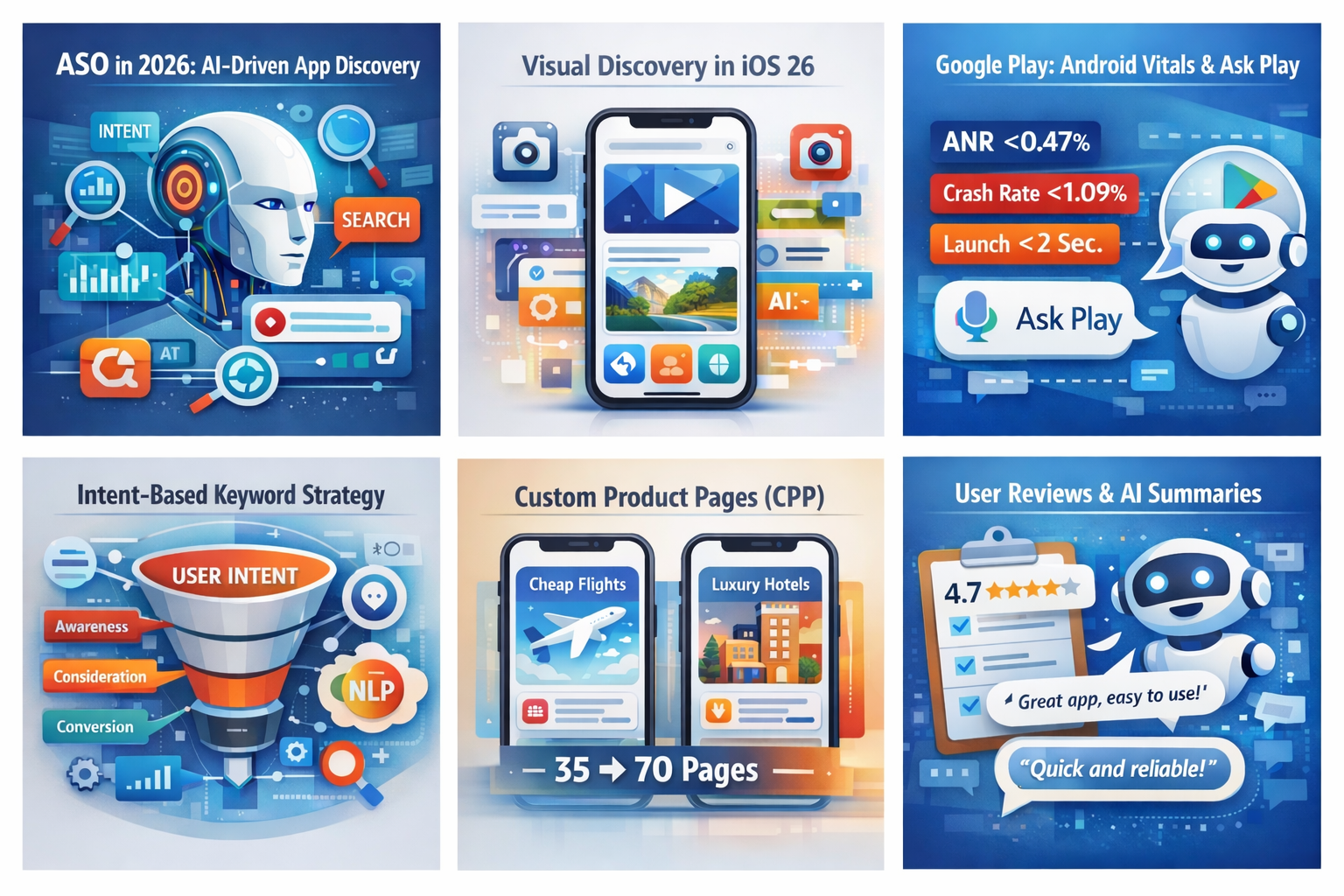
Strategic ASO and Store Discovery Dynamics Analysis in the 2026 Mobile App Ecosystem
Mobile app marketing, as of 2026, has evolved beyond traditional optimization techniques into a strategic discipline driven by artificial intelligence and centered on user intent. App Store Optimization (ASO), once seen in past years as limited to simple keyword placements and visual updates, now functions as a critical balancing element between product management, paid user acquisition, and advanced data analytics. App stores are no longer merely software catalogs; they are defined as advanced decision support systems that understand, analyze, and dynamically respond to user intent. At the core of this transformation is the evolution of app discovery processes from a linear search logic into an AIsupported interaction layer.In 2026, the most fundamental factor defining ASO strategies is the transformation of app stores into intent fulfillment platforms. In this new era, success is measured not only by ranking higher for the highest volume keywords, but by delivering the most suitable solution for the user’s immediate need in the fastest and most trustworthy way. In particular, radical changes in Apple’s search algorithm and Google Play’s AI powered Ask Play assistant are forcing ASO specialists to completely abandon traditional methodologies and build a narrative architecture aligned with machine learning systems.The Rise of Artificial Intelligence and Semantic Search: The Mechanism of Algorithmic TransformationThe year 2026 is recorded as the year when the transition from keyword focus to semantic coherence was completed in the ASO world. Keyword stuffing methods used in traditional ASO models are now perceived as spam signals by modern natural language processing (NLP) engines, causing severe damage to app rankings. Current algorithms have the ability to analyze contextual clusters formed by terms and interpret user intent, rather than focusing on the isolated existence of individual terms.This semantic revolution is materializing through the diversification of search results. With the major algorithm update Apple rolled out in mid2025, the first 10–15 results presented for a search query are now designed to reflect different user needs that could be related to that query, rather than a single intent.For example, a user searching for “photo” is presented not only with editing tools, but also with storage solutions, social sharing networks, and AIbased visual generators together. This situation has made it mandatory for ASO specialists to build intent clusters.Intent Based Keyword Strategies and Natural Language Processing2026 strategies have made a sharp transition from volumefocused approaches to intentfocused approaches. Ranking for a general term like budget tracking is no longer considered sufficient by the algorithm if the user’s specific need at that moment is “corporate expense management.” Success depends on understanding which stage of the user’s search journey they are in (awareness, consideration, conversion) and structuring the metadata accordingly.When analyzing app descriptions and titles, AI systems measure the naturalness and expertise level of the text by using scoring systems such as Google Natural Language (GNL). In this context, metadata must be optimized simultaneously for both humans and machines. Machineoriented optimization enables the algorithm to correctly label what the app does, while humanoriented optimization strengthens the clarity of the value proposition offered to the user and the emotional connection.By 2026, ASO no longer lives only inside the store; it also exists in AI layers such as Siri and Google Assistant. This is the integration of Generative Engine Optimization (GEO) principles into the store environment.Visual Discovery Revolution in iOS 26 and the Apple EcosystemApple announced the iOS 26 update in 2026, which fundamentally changes the App Store’s discovery mechanics. This update introduces a visually focused interface and an AIbased categorization layer. One of the most striking innovations is that Apple has begun treating screenshots and preview videos not merely as visual materials, but directly as indexable metadata. AIbased tagging systems analyze the visuals and text within screenshots to interpret which user problems the app solves.Custom Product Pages (CPP) and Organic Search IntegrationOne of Apple’s biggest moves in its 2026 strategy is increasing the number of Custom Product Pages (CPP) from 35 to 70 and allowing these pages to appear directly in organic search results. This development proves that the era of “one app, one store page” has officially ended. ASO professionals are now building dozens of different store interfaces for different user segments, different keyword intents, and different seasonal needs.Especially when integrated with advertising campaigns (Apple Search Ads), these pages maximize alignment between the promise of the ad the user clicked and the welcome message on the store page, delivering significant increases in conversion rates. This architectural approach allows different features of the app (for example, for a travel app, both “cheap flights” and “luxury hotels” features) to become authoritative separately.App Intents and the Siri Discovery LayerApple’s App Intents framework makes apps discoverable beyond store boundaries via Siri, Spotlight, and widgets by carrying app functions outside the store. If an app has clearly defined intents (for example, log a workout or scan an invoice), the app can be recommended even without the user entering the app store when they search for that action. This expands the scope of ASO from store page optimization to a systemwide discoverability strategy.Google Play Store: The Dominance of Android Vitals and Technical ASOOn the Google Play Store side, 2026 is a period in which technical excellence has become the primary ranking signal. Google’s algorithm no longer looks only at metadata and download counts; it also analyzes the app’s ondevice performance within seconds. This set of metrics, called Android Vitals, has become one of the most powerful factors determining an app’s fate in search results.- ANR (Application Not Responding): Apps exceeding the critical threshold of 0.47% experience visibility loss.- Crash Rate: Crash rates above 1.09% cause categorical demotion.- Launch Speed: Launch times under 2 seconds are rewarded by Google as a superior user experience.Ask Play and AIPowered InteractionThe Ask Play feature introduced with Google Play Store v49 enables users to find apps by speaking with an AI assistant inside the app store. This assistant can summarize user reviews, compare app features with competing apps, and answer the user’s specific questions. This requires ASO metadata to be conversational in structure and demands that key themes in user reviews be managed so they can be summarized positively by the algorithm.Strategic Optimization of Visual Assets and Conversion PsychologyIn 2026, visual assets are no longer merely an aesthetic preference; they are accepted as the primary language of conversion. The shortening of users’ attention span and market saturation cause apps that fail to deliver value within the first 3 seconds to be eliminated quickly. In this context, screenshots, preview videos, and app icons dominate more than 70% of user decisionmaking processes.Data shows that 50–60% of users make the decision to download an app solely by looking at the first two or three screenshots. 2026 trends indicate that the use of Panoramic Screenshots has become standardized and that these visuals are structured within a Problem–Action–Outcome framework. The first visual is expected to present the biggest value proposition directly, while the second visual is expected to show how this promise will be delivered.User Reviews and AI Generated SummariesIn 2026, app ratings and user reviews are no longer just trust signals; they are directly ranking and visibility factors. Apple and Google algorithms analyze both average ratings and the textual content of reviews in depth. It has become almost impossible for apps with ratings below 4.0 to enter Featured lists.Both stores now analyze thousands of user reviews to deliver singlesentence AI summaries. These summaries function as a “public conscience” that a user sees before downloading the app. If these summaries include statements such as “there is a crash issue” or “subscription cancellation is difficult,” conversion rates drop dramatically. This has made proactive review management an inseparable part of ASO.Measurement in a PrivacyFocused World: MMM and Incrementality TestsIn 2026, privacy regulations continue to restrict app marketers’ access to data. These restrictions have led to the complete collapse of the lastclick attribution model. It is no longer possible to track why a user downloaded an app through a single channel.To fill this data gap, in 2026 ASO teams have adopted Marketing Mix Modeling (MMM) tests as standard tools. MMM statistically decomposes the impact of ad spend, seasonality, and ASO updates on total revenue by using historical data.Conclusion: The Core Pillars of the 2026 ASO StrategyAs of 2026, ASO is no longer an app store hacking method; it is a holistic growth and brand strategy. The evolution of algorithms with AI, the rise of technical health as a primary ranking factor, and the growth of privacyfocused measurement models have fundamentally changed the skill set of ASO specialists.A successful 2026 ASO strategy must be built on these three core foundations:- Intent Focus: Rather than keyword volume, the focus should be on the user’s specific need at that moment (intent), and this intent should be matched with Custom Product Pages (CPP).- Product Quality and Technical Excellence: App store success can no longer be considered separate from product quality. Technical metrics such as Android Vitals are the primary determinants of search visibility.- Collaboration with Artificial Intelligence: Store content must be structured in a way that is persuasive for humans and also “understandable and summarizable” for AI assistants.As a result, the winners of 2026 will not be those who fill store pages with the most keywords, but those who prove the value they offer to the user in the fastest, clearest, and most trustworthy way. App stores are no longer just a download gateway; they are intelligent guides that help users reach solutions that make their lives easier. You can also contact us to receive services from a professional ASO agency.
Rethinking Digital Advertising Through Neuromarketing
Neuromarketing is reshaping the future of digital advertising by revealing how the human brain makes decisions, which moments in an ad trigger emotional responses, and which messages are more likely to be remembered. This approach enables brands not only to be seen, but to create lasting imprints in the consumer’s mind.What Is Neuromarketing and How Is It Applied to Digital Advertising?Neuromarketing combines marketing and neuroscience to uncover the subconscious decision-making processes behind consumer behavior. Tools such as EEG (brainwave measurement), fMRI (functional MRI), eye-tracking, facial coding, and GSR (galvanic skin response) record real reactions people give to advertising. This means that an ad’s impact is not evaluated through subjective statements like “I liked it,” but through direct neurological activity.In digital advertising, neuromarketing data can guide every stage from creative development to media planning. For example, EEG helps identify which seconds in a video hold the highest attention; eye-tracking shows where users look on a webpage. These insights reveal which visuals, colors, or message tones capture attention. As a result, budgets are directed not only toward visibility—but toward actual impact.The Role of Brain Data in Understanding Consumer BehaviorTraditional marketing research relies on surveys and focus groups, yet people often struggle to verbalize their true feelings. Neuromarketing fills this gap by examining decision-making at a neurophysiological level. The brain’s emotional center—the limbic system—affects nearly 80% of purchase decisions. Even rational-looking ads ultimately succeed based on the emotional response they generate.Studies show that emotionally resonant ads increase brand recall by an average of 23%. Brain data clearly identifies the exact moment when that emotional response occurs. For example, a reassuring facial expression or a calm soundtrack can trigger positive neural activation. With this insight, brands can design campaigns that don’t just “inform,” but truly make people feel something.Neuromarketing for Better Targeting and PersonalizationCampaign success today depends not only on reaching the right user but triggering the right emotional connection. Neuromarketing elevates targeting by enabling personalized emotional experiences. EEG and eye-tracking analyses can uncover which content types draw deeper focus, which color palettes attract attention, and which message tones establish trust.Even remarketing content—often repetitive—can be re-optimized using neuro-insights. If a user added a product to their cart but didn’t purchase, the system can deliver messages tailored to that user’s past emotional responses rather than generic reminders. This ushers in the era of neuro-targeting—moving beyond simple personalization toward emotional personalization.Testing User Experience (UX) Through Neuro DataUser experience has become as critical as advertising itself. However, traditional analytics cannot fully reveal where users get bored or stressed on a website. Neuromarketing fills this gap. Through eye-tracking and GSR sensors, users’ attention levels and emotional responses are recorded in real time as they navigate.These insights help identify which sections fail to attract attention, which visuals evoke trust, and which colors drive purchase intent. For instance, a clean white background may keep users on a page longer according to eye-tracking patterns. UX decisions thus shift from guesswork to neurological evidence—reducing bounce rate, increasing dwell time, and ultimately improving conversions.Brain-Based Optimization to Enhance Ad PerformanceDigital ad effectiveness is no longer measured solely by reach, but by the cognitive impact created in the viewer’s mind. EEG and fMRI analyses reveal which seconds activate the brain’s attention center (the prefrontal cortex), and which moments intensify emotions. These findings guide creative teams in identifying the most powerful scenes.For example, if attention drops during a music change or logo appearance, those moments can be redesigned. This approach can increase campaign ROI by 20–25% on average. Budgets are therefore optimized not by impressions alone, but by neurological impact.Planning Awareness Investments That Support Performance ChannelsNeuromarketing shows that performance-driven campaigns should contribute not only to short-term conversions but long-term brand awareness. High-attention and high-emotion awareness campaigns increase organic search volume and brand traffic in later periods.For instance, if a video ad instills a sense of trust, that emotional imprint influences future search behavior. Weeks later, when a user searches for a product, the brand they “felt connected to” subconsciously becomes the preferred choice. Awareness is therefore not merely visibility—it is a strategy for creating emotional memory traces.A Data-Driven and Ethical Neuromarketing ApproachDespite its power, neuromarketing carries ethical responsibilities. Data privacy, informed consent, and transparency are essential principles. Working with brain data can give brands a competitive edge, but maintaining user trust is far more valuable in the long term.Ethical neuromarketing ensures not only effectiveness, but fairness. Brands that protect user data and communicate transparently build not just sales—but trust. This strengthens the long-term role of neuromarketing in sustainable brand strategy.Neuromarketing: The New Era of Digital AdvertisingNeuromarketing allows brands to measure not only the visual impact of advertising but the emotional and cognitive layers as well. Strategies based on neuroscientific insights produce stronger outcomes in both performance and awareness. Today, brands no longer merely reach audiences; they embed themselves in their minds.In the future, neuromarketing will merge with personalization, AI, and big data to create even more precise targeting models—ushering in a new era where brands connect with consumers not through logic, but through emotion.Frequently Asked Questions1. Is neuromarketing only suitable for big brands?No. Brands of all sizes can benefit from neuro insights for creative optimization, UX testing, and measuring advertising effectiveness.2. Is neuromarketing ethical?Yes. As long as user consent, data transparency, and privacy are respected, neuromarketing is an ethical research method. The goal is not mind control, but understanding consumer reactions more accurately.3. Does neuromarketing really improve ad performance?Research shows that campaigns optimized with neuro data can achieve up to 20–25% ROI increase, higher recall, and stronger attention scores.

How Does an Analytics Agency Impact ROI?
Success in the world of digital marketing does not depend solely on advertising budgets or campaign diversity. The real difference lies in how effectively data is collected, how it is interpreted, and what decisions are made based on this data. A large proportion of businesses are still unable to see the returns they expect on their advertising investments because they are unable to effectively utilize their data potential.At this point, the analytics agency steps in, restructuring the brands' data architecture from scratch and enabling them to systematically and sustainably increase their ROI through real time analysis.The following comprehensive case study demonstrates step by step how an analytics agency made tangible contributions to a brand's growth journey.1. Data Inconsistencies, High Costs, and Low Conversion RatesA medium sized brand operating in the ecommerce sector was unable to see the same increase in sales and conversion rates despite regularly increasing its monthly advertising expenditure.The brand's main problems were as follows: Google Analytics data was inconsistent with advertising platform data. There was no advanced structure for analyzing user behavior. It was impossible to determine at which stage of the funnel the loss occurred. Mobile device conversions were significantly lower than desktop conversions. The actual performance of advertising campaigns was not visible. This situation was causing the brand's costs to increase while its returns remained stagnant.2. Strategic Transformation Plan Implemented by the Analytics AgencyThe brand began working with a professional analytics agency to remove barriers to growth. The transformation process implemented by the agency consisted of four key steps.Step 1 - Complete Reconstruction of the Measurement InfrastructureA successful analytical process is impossible without accurate measurement. Therefore, the first step was to renew the technical infrastructure. GA4 settings were checked and adjustments were made. The enhanced ecommerce event architecture was redesigned (view_item, add_to_cart, begin_checkout, purchase, etc.). Server side tracking integration was provided. Meta Conversion API and Google Ads Enhanced Conversions systems were configured. Data losses were reduced and event triggers were standardized. As a result of all these efforts, the brand's data infrastructure became much more stable, consistent, and reliable, while also establishing a solid foundation for accurately measuring marketing performance.Step 2 - User Behavior AnalysisAfter the technical infrastructure was established, the agency began to examine the user journey in detail.Critical findings obtained: More than half of users who added products to their carts left the page without proceeding to checkout. The mobile page loading speed was twice as slow as the desktop version. The conversion rate for some product categories was abnormally low compared to others. The scroll depth percentage on product detail pages was low, meaning users weren't exploring the page sufficiently. These data clearly revealed the shortcomings in the process.Step 3 - Funnel OptimizationBased on the findings from the funnel analysis, the following actions were taken: Speed and performance optimizations were made on the mobile site. Revisions were made based on UX recommendations to reduce losses in the payment step. CTA adjustments, visual size optimization, and description adjustments were made on product pages. Designs with the highest conversion rates were determined through A/B testing. This stage had the most significant impact on the increase in conversion rates.Step 4 - Data-Driven Re-Engineering of the Advertising StrategySince the data is now being transmitted correctly, the advertising budget can be optimized efficiently. Special campaigns were created for high-potential segments. Different ROAS targets were set according to product categories. Retargeting campaigns were redesigned based on user behavior. Campaigns with low performance were systematically eliminated. As a result, the return on advertising spend reached a much higher level.3. Measurable and Striking DevelopmentComprehensive analyses, the renewal of the measurement infrastructure, and optimizations carried out throughout the user journey enabled the brand to gain significant momentum in just a few months. Conversion rates have increased significantly, the effectiveness of advertising campaigns has improved noticeably, and most of the losses experienced on the mobile side have been eliminated. The consistency of data flow enabled much healthier decision-making, and the performance of marketing activities became clearly visible.All these developments strongly demonstrated how a well-designed analytical framework and expert input can have a direct impact on investment returns.4. Why Should You Work with an Analytics Agency?The contributions analytics agencies provide to brands are not limited to technical setup. The following benefits are the cornerstones of long term growth. Lower marketing costs. More accurate target audience segmentation. Reduced data loss. Efficient use of advertising spend. Early detection of bottlenecks in the conversion funnel. Developing profit-focused strategies based on products and categories. Understanding user behavior and improving the experience. Higher customer lifetime value. In short, a robust analytical infrastructure enables companies to make data-driven decisions rather than intuitive ones.5. Data Driven Transformation is Essential for ROI GrowthIn this era of intense competition in the digital ecosystem, success is only possible with properly measured data, not just campaign management. Analytics agencies strengthen brands' data infrastructure, ensuring not only their current but also their future growth processes.Frequently Asked Questions (FAQ)What is an analytics agency?Analytics agencies are consulting structures consisting of expert teams that establish and optimize brands' digital data infrastructure and interpret this data to transform it into business decisions. They provide professional support in areas such as measurement, user behavior analysis, data visualization, performance optimization, and advertising efficiency.How does an analytics agency increase ROI?An analytics agency reduces data loss with proper measurement setups, deeply analyzes user behavior, and eliminates waste in marketing investments. By identifying where campaigns are performing effectively, it enables you to allocate your advertising budget more intelligently. This ensures that ROI increases sustainably, both in the short and long term.Why is the GA4 setup important?GA4 offers an advanced measurement infrastructure that enables more comprehensive and flexible tracking of user behavior. However, for this structure to function correctly, the setup must be error free. Incorrect or incomplete installations can lead to unhealthy conversion tracking, inaccurate campaign performance interpretation, and the inability to see the true impact of digital investments. Therefore, analytics agencies prevent measurement errors and ensure reliable data flow by configuring all GA4 features to suit the brand's needs.Why does funnel optimization have such a significant impact on ROI?Understanding where users struggle throughout their conversion journey, minimizing losses, and making each step more seamless has a direct impact on ROI. Even small improvements at critical stages such as the cart, checkout, and product detail pages can significantly increase conversion rates.When is server side tracking necessary?In today's world, where browser related data loss is on the rise, server-side tracking is a critical method for enhancing data accuracy. Losses caused by ad blockers, browser limitations, and security restrictions are significantly minimized with this method. This enables healthier campaign optimization.Which industries are suitable for working with an analytics agency?Ecommerce, SaaS, B2B service providers, marketplaces, finance, healthcare, education, and tourism sectors benefit greatly from analytics consulting. The key criterion is that digital data must be at a level where it can create value for the business.Does the analytics agency provide strategic support in addition to technical setup?Yes. Professional analytics agencies don't just handle technical setup; they connect the data obtained to business objectives, provide strategic guidance, support the advertising optimization process, and guide the brand throughout its entire growth journey.How long does it take for an analytics project to yield results?Typically, the first developments begin to appear within a few weeks after infrastructure work is completed. However, achieving a sustainable increase in ROI and optimizing the entire funnel in a healthy manner requires a process lasting several months. This period may vary depending on the brand's level of data maturity.
2026 SEO Expectations and Trends: AI, GEO, and E-Commerce Strategies
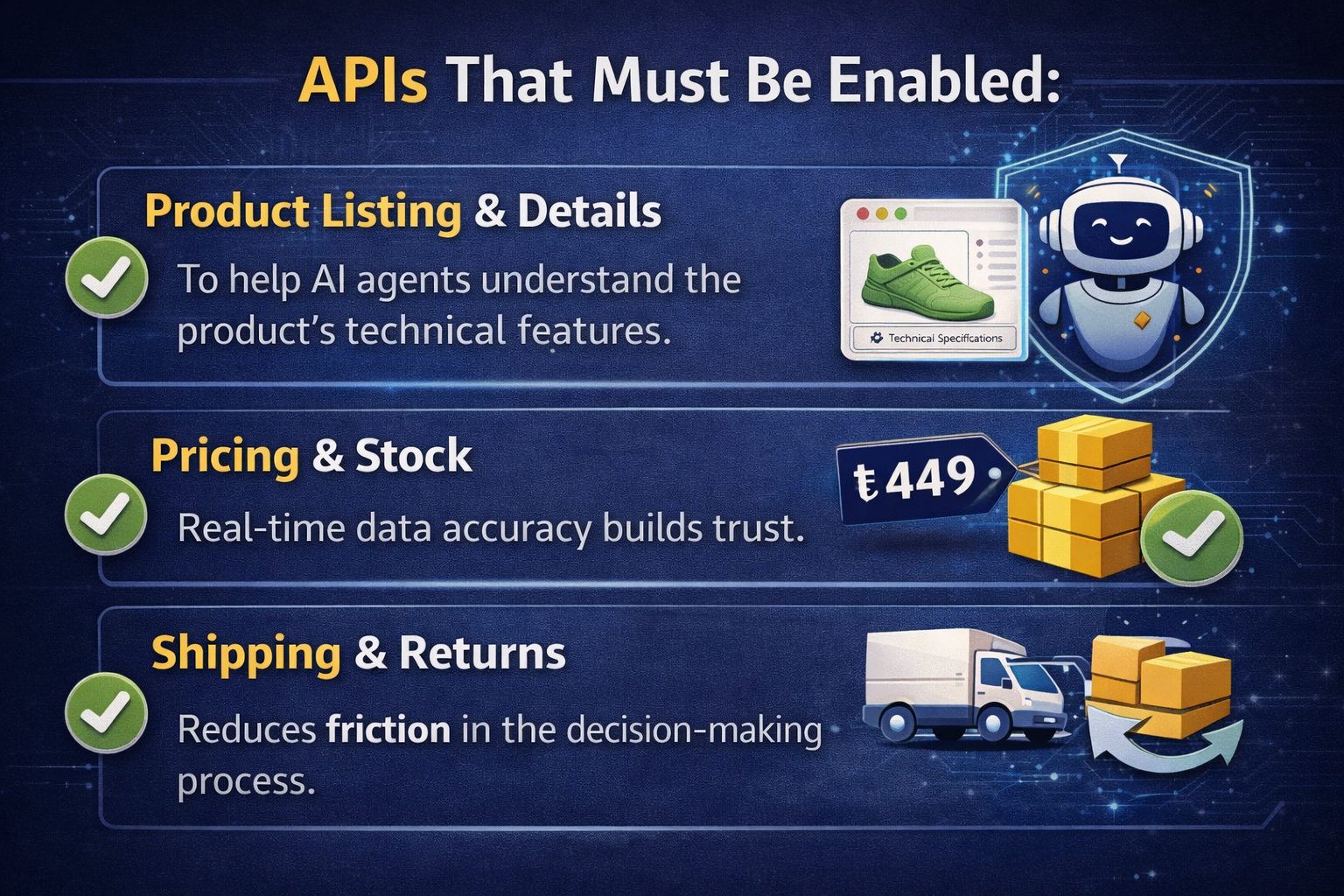
As we leave 2025 behind, the digital marketing world is undergoing a shift like never before. As we approach 2026, we are on the verge of significant changes in the SEO world. Traditional methods of SEO are slowly being replaced by newer, more sophisticated approaches. Ranking in search results is no longer just a part of SEO; it has become an essential component of brand strategies. The art of convincing systems and artificial intelligence agents (AI Agents), known as GEO (Generative Engine Optimization), has taken the place of traditional SEO strategies. For technical experts, 2026 will not only be about fighting to rank at the top of Google; it will also be the year of making your brand the "core knowledge source" in the AI ecosystem.In this article, we will explore expert insights, current data, and the most important strategies for 2026 SEO expectations and trends.Artificial Intelligence & The SEO EraBy 2025, generative engines (AI) have seen a significant rise. According to Similarweb's Generative AI 2025 report, the number of visits driven by AI platforms increased by 357% year-on-year in June 2025.Artificial intelligence’s ability to create content that better responds to user search intent will become one of the primary focuses of SEO strategies.End of 2024 (Estimated)End of 2025 (Actual)Change RateDesktop Traffic from LLM2.8%7.4%AI Engine Usage (Perplexity/ChatGPT, etc.)100 Million / Month450 Million / MonthSGE (AI Overviews) CTR4.2%1.9%Sources: index.dev, Semrush 2025 Trend Reports, Search Engine LandAccording to a survey conducted by Responsive among B2B buyers, 80% of technology buyers trust generative AI as much as traditional search engines when researching suppliers.Today’s SEO tools focus not only on technical compliance but also on brand identity and user experience. SEO is now more about understanding the target audience in-depth and implementing strategies that increase brand visibility, not just optimizing content for search engines.What Are the New Directions for SEO in 2026?In the rapid adaptation to generative search engine optimization (GEO), SEO has moved away from classic growth factors. For many websites, traffic has decreased, measuring rankings has become impossible, and AI outputs (such as SGE or AI Overviews) have sometimes become inconsistent.These changes highlight a painful truth: short-term tactics are no longer sufficient. By 2026, SEO will no longer be a "ranking game." It will evolve into the practice of shaping the information environment to ensure that machines (and people) understand you the way you want.One of the most critical factors influencing brand SEO performance will be understanding how AI systems work and how they perceive your brand. SEO experts will develop new strategies to monitor and optimize AI interactions with content.SEO and E-Commerce in 2026: AI-Driven Shopping ExperienceFor e-commerce sites, SEO will no longer just be about keyword density. One of the most important parts of SEO in 2026 will be shopping experiences optimized with new protocols such as "Agentic Commerce Protocol" (ACP). This means AI-powered shopping assistants will guide users to the right products, speeding up the purchase process.Your website must not only be crawlable by humans but also have endpoints (APIs) that AI assistants can directly use to place orders.APIs That Must Be Enabled:- Product Listing & Details: To help AI agents understand the product’s technical features. - Pricing & Stock: Real-time data accuracy builds trust - Shipping & Returns: Reduces friction in the decision-making process. LLM Perception Drift: The New Success MetricAccording to SEO advice from experts at Search Engine Journal, the main metric for 2026 will be "Perception Drift." The future of SEO will not only be shaped by algorithm changes but also by how brands build their digital identities.This means that if there is fluctuation in AI citation data, you have not adequately trained the model on your brand’s presence in your category. If you have a stable and high-quality citation rate, the model will have categorized your brand as an "authority" in that category.Thus, the focus of LLM traffic should not be on its quantity, but on the quality of LLM traffic.How Can AI Agents Recognize My E-Commerce Brand?For AI systems to recognize your brand, you need to enrich your JSON-LD schemas with precise identifiers and "Offer" details. However, technical data alone is not enough. You must embed your brand into the digital ecosystem by conducting digital PR, podcasts, and expert interviews to establish it as an "Entity."2026 SEO Trends: Content & Trust BuildingYour reputation now extends beyond your own platforms. When enriching product content, it is crucial to focus on user questions in forums like Reddit, Quora, and niche forums.Product content will be further enriched to be SEO-friendly. Brands will need to identify the most frequently asked questions about their products and create content that answers these questions in a clear and understandable manner. This way, AI systems will better recognize the brand and increase product visibility.Enriched Product ContentYour content should focus not just on explaining a problem, but also on how your product solves a specific use case.- What Problem Are We Solving?: Identify common questions in your customer’s purchase journey and answer them in a natural, clear manner. - What Purchase Support/Advantages Are We Offering?: Enrich Product schema markup with shipping types. - What Support Do We Offer After Purchase?: Incorporate the return policy into the Product schema using the returnPolicy type. - Do You Produce Content in Different Formats?: Not just text; create tools like calculators, templates, checklists, and guides to keep users (and AI agents) engaged on your site.Special Tip: SEO & GEO Optimized Introductory SectionsStudies show that AI models tend to quote content more often from the introductory sections. Structure the first 4 sentences as follows: - Definition: (E.g., What is a fitness shoe?) - Importance: (Why is choosing the right shoe important?) - Data & Statistics: (70% of users choose the wrong shoe – Source: X Institute) - Social Proof: (User reviews and summary)Why Will "Trust" Be the Most Important Factor in SEO in 2026?AI engines synthesize information from hundreds of sources. If your brand’s name does not appear positively on authoritative publishers, review sites, and community forums (such as Reddit), AI will mark you as an "unreliable" or "secondary" source.SEO will no longer be affected solely by traditional search engines, but also by new platforms (voice search, chatbots, AI assistants). In 2026, SEO will be a significant part of multi-channel marketing. Brands will expand their SEO strategies by building a consistent and strong digital presence across different platforms.2026 User Behavior and Content Strategy SEO TrendsWhile focusing on the questions AI tools associate with your brand, you can use the psychological tendencies of people (and the AI agents imitating them).- You can create comparative content for queries like "Is this brand/product the best for this use case?" - By providing clear data about where your brand is located, its headquarters, and physical accessibility, you create a "familiarity" feeling. - Transparent answers to questions like "Does it offer free trials?", "What is the return policy?", and "Is it trustworthy?" can build trust. How Will Indexing of Low-Quality Pages Change in 2026?Search engines are now filled with low-quality content that "AI-generated but does not add value." Pages that do not offer a clear value proposition will be prioritized less for crawling and indexing. To improve index quality, tracking and removing low-performing pages will become mandatory.2026 SEO Success Metrics Traditional keyword tracking will be replaced by deeper metrics. In 2026, SEO success will be tracked through micro-conversions. Analyzing small but significant user interactions on the website will form the basis of SEO strategies. - The number of links gained through LLM & AI Overview results can be tracked. - Conversion rates from AI traffic can report authority within the AI ecosystem. - It should be analyzed which concepts AI systems associate your brand with (e.g., "fast delivery," "premium quality"). Being listed with the right target keywords can be a success metric. - AI Overview snippets in SERP Features can provide reporting. - Performance increase in Direct Traffic & Branded-Traffic channels can be interpreted as brand awareness coming from AI visibility. - Google ITNQ (Information Threshold & Quality): If users don’t return to Google after landing on your page with the same query, it is the biggest evidence that your content fully addresses their needs. Metrics like average session duration, engaged session, bounce rate, and exit rate can be tracked to measure LLM traffic success. In organic traffic performance tracking, organic impressions can be tracked in line with expected CTR drops. Formula for Survival in the SEO Ecosystem in 2026SEO is no longer just a technical task; it is about managing perception and ecosystems. If you do not shape how AI systems perceive your brand, others (perhaps your competitors) will take advantage of their narrative.Success in 2026 comes from deeply understanding your target audience, preparing the technical infrastructure for autonomous systems, and delivering measurable business results.To increase your brand’s visibility in the AI ecosystem, generate meaningful insights from complex AI traffic, and establish your authority in the future search world, you need a professional roadmap.To build your strategy today and transform your technical infrastructure, you can start the SEO & GEO consultancy process with the Analytica House team.FAQsWhat are the key elements of 2026 SEO trends?In 2026, SEO will be based on properly training AI systems and understanding user behavior. Multi-channel SEO strategies and micro-conversions will also play a significant role.How will AI affect SEO strategies?AI will transform SEO from just ranking into something much more. AI will strengthen brands’ digital identities and improve SEO success by ensuring correct user interactions.How can e-commerce sites improve SEO?E-commerce sites will enrich product content and create AI-supported shopping experiences. Additionally, by targeting frequently asked questions about the product, they will develop a more efficient and NLP-compliant SEO strategy.

5 Ways to Accurately Measure Sales Impact with Google MMM
Google MMM (Marketing Mix Modeling) is one of the most powerful statistical methods for understanding the true value of your marketing budget in a cookieless world. This approach measures the total impact of all factors that influence sales — from TV ads to digital spend, from discounts to seasonality — and determines the incremental contribution of each channel. Tools like Google’s open-source solution Meridian make MMM more accessible than ever. With a properly built MMM model, you can clearly see which portion of your spend generates true incremental sales and optimize your budget for maximum ROI.1. Comprehensive and Holistic Data Collection: The Foundation of the ModelThe first and most critical step in accurately measuring sales uplift is collecting complete, clean, and well-structured data to feed the Google MMM model. MMM analyzes what has happened in the past to predict future “what if” scenarios. The accuracy of these predictions depends entirely on the quality and completeness of the data you provide.If you exclude an important data source (for example, competitor pricing or TV spend), the model may incorrectly attribute its effect to another channel — a problem known as misattribution. This can cause severe mistakes in budget allocation.For a strong MMM setup, you typically need at least 2–3 years of weekly (or ideally daily) historical data across: Dependent Variables: Weekly sales revenue, units sold, or new customer count. Marketing Variables: Spend, impressions, and clicks for Google Ads, Meta, YouTube, TV, radio, etc. External Control Variables: Discounts, promotional periods (e.g., Black Friday), competitor keyword spend, inflation, and other macro-economic indicators. Even though Google Meridian supports native integration for Ads, GA4, and YouTube, a truly holistic MMM model requires combining all online and offline data sources.2. Modeling External Factors and Seasonality: Removing NoiseOne of MMM’s greatest strengths is its ability to separate marketing impact from external influences. Sales never occur in isolation — they are shaped by seasonality, holidays, economic shifts, and competitor actions.If you don’t include these factors, the model may falsely assume your campaigns caused certain sales behaviors. For example, if you are a summer-season product brand and don’t model seasonality, the model may think your summer ad spend is solely responsible for the natural sales lift.Key external variables include: Seasonality: Predictable demand cycles (summer/winter, back-to-school, etc.) Special Days & Holidays: Black Friday, Valentine’s Day, Ramadan, etc. Economic Factors: Inflation, currency fluctuations, unemployment rates Competitor Actions: Major promotions, aggressive price drops Weather Data: Important for categories like umbrellas, HVAC, sports gear Google’s Bayesian MMM methods offer more flexibility than traditional regression models, allowing the model to separate the effects of multiple overlapping variables (e.g., a TV campaign and sunny weather boosting sales in the same week).3. Adstock and Saturation Analysis: Understanding Real Advertising ImpactMMM embraces two fundamental realities of advertising:1. Adstock (Lagged Advertising Effect): The effect of an ad doesn’t disappear instantly. A TV ad seen on Tuesday may still influence a purchase on Friday. MMM distributes this effect over time — without Adstock, the ROI of channels like TV is greatly underestimated.2. Saturation (Diminishing Returns): Spending more on a channel does not always mean increasing sales at the same rate. MMM identifies the “S-curve” for each channel to show when marginal returns start decreasing.This allows MMM to tell you:“Stop increasing spend on Channel A — it has reached saturation. Move your budget to Channel B where you can still generate incremental lift.”4. Validating the Model with Incrementality TestingMMM is a statistical model, and its predictions must be validated against real-world tests. The best way to do this is through incrementality tests — such as A/B tests or geo-tests — where you intentionally increase, decrease, or stop spending in a test region and compare results with a control region.If the MMM prediction and the real-world test results are aligned, it confirms the reliability (calibration) of your model.For example:“Reducing YouTube spend by 50% led to an 8% sales decline.”If MMM predicted a 7–9% drop, the model is well-calibrated and trustworthy for future planning.5. Budget Optimization & Scenario Planning: The Ultimate Value of MMMThe true power of MMM lies in its ability to turn analysis into strategy. Once MMM understands channel efficiency, lag effects, and diminishing returns, it becomes a budget optimizer. You can ask the model: Scenario 1 – Maximum ROI: “How do I allocate my current budget to maximize revenue?” Scenario 2 – Budget Increase: “If my budget increases 20%, where should I invest the additional amount?” Scenario 3 – Budget Cuts: “If I must reduce spend by 30%, where will cuts hurt the least?” Google Meridian enables running these simulations easily, turning MMM into a future-focused strategic tool rather than just a historical report.FAQWhy does the removal of cookies make MMM more important?MMM doesn’t rely on individual tracking or third-party cookies. While Multi-Touch Attribution becomes less reliable in a privacy-first world, MMM remains fully functional — making it one of the most dependable ROI measurement methods today.How is Google MMM (Meridian) different from traditional MMM? Speed & Accessibility: Open-source structure reduces cost and complexity. Improved Data Integration: Seamlessly connects Ads, GA4, and YouTube data. Bayesian Modeling: Provides probability ranges instead of single fixed numbers, reducing uncertainty. Is MMM suitable for small businesses?MMM works best for companies investing in multiple channels with 2–3 years of historical data. For smaller businesses, incrementality tests or GA4-based modeling may be more practical starting points.How often should MMM be updated?MMM is not a one-and-done exercise. It should be refreshed every quarter or at least every 6 months — especially after major campaigns like Black Friday or significant market changes.Can MMM measure brand awareness?MMM is optimized for hard metrics like sales. For softer metrics like brand awareness, Brand Lift studies are more suitable. However, MMM can indirectly model awareness by using branded search volume as the dependent variable.
