Woman on the Verge: 50 years of Chantal Akerman's modern, ever-shifting masterwork, Jeanne Dielman

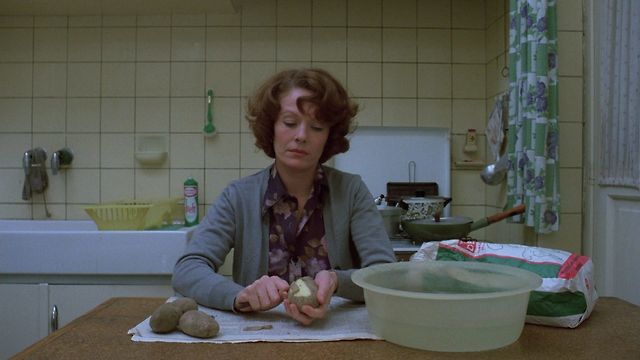
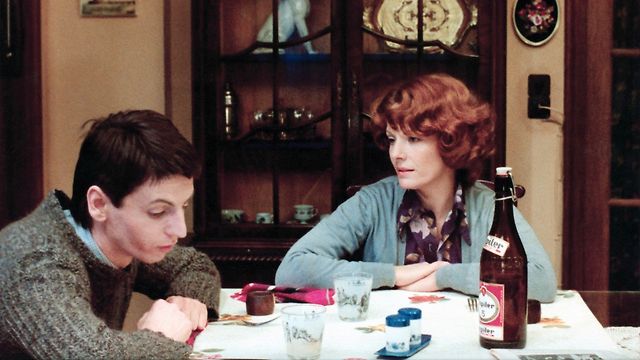
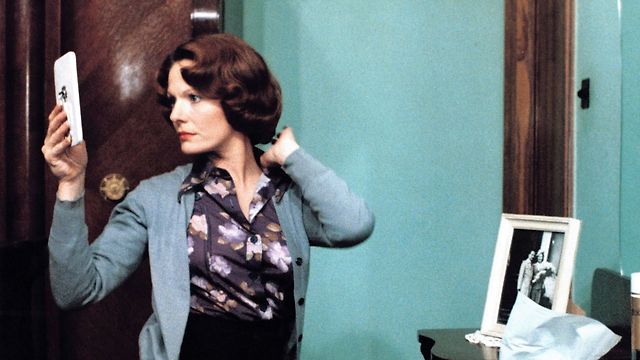
Delphine Seyrig as the eponymous Jeanne Dielman (1975). 
Delphine Seyrig as the eponymous Jeanne Dielman (1975)

To mark 50 years of Jeanne Dielman, 23 quai du commerce, 1080 Bruxelles, Ella Kemp explores what makes the film such a modern, dynamic and watchable reflection of all our greatest fears. 

The way that Chantal Akerman’s 1975 magnum opus Jeanne Dielman, 23, quai du Commerce, 1080 Bruxelles is talked about is a thing of great extremes and pressurized expectations and impact. You might have finally ticked it off after the 2022 Sight and Sound poll crowned the film the greatest of all time, dethroning Vertigo, and Citizen Kane before that. A picture directed by a woman, about a woman ostensibly doing very little, released 50 years ago, that runs for three hours and twenty-two minutes. So many factors that seemingly appeal to so few (Quentin Tarantino hasn’t seen it, and won’t comment on its top spot).

Yet, in 2025, I join countless writers, academics, cinephiles and viewers attempting to decipher what does keep us coming back. Three years ago, a poll; this year, an anniversary. There will always be something, because there is nothing else like it.

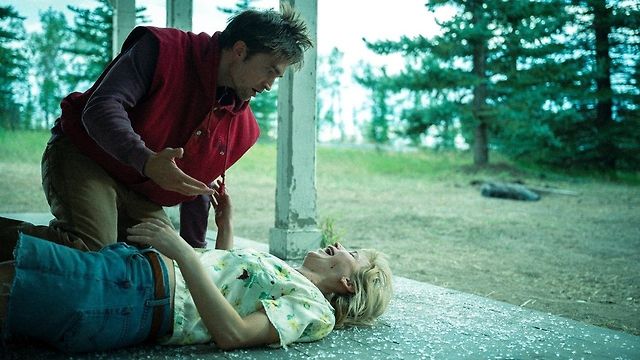
In Lynne Ramsay’s Die My Love, which played Cannes this year and adapts Ariana Harwicz’s 2017 novel of the same name, Jennifer Lawrence plays Grace, a new mother experiencing postpartum psychosis and inhabited by isolation, fury and despair. In one scene, she comes home incandescent and locks herself in the bathroom. Her gaze lights up the room; her appetite to destroy is insatiable. In so many other films, you’d cut to the next scene: Grace opening her eyes, shaking her head at such perverse fantasies. This is the real world. Thank God, she didn’t blow it all up. But Ramsay lets her do it: smeared cosmetics, shattered glass, jagged tiles; she ravages everything. It feels like, as Sydney writes on Letterboxd, “destroying myself just to prove I exist.”

Thinking about Jeanne Dielman for the past few months, how it came to life and its impact on everything that came after it, I couldn’t help but believe that Delphine Seyrig would have been so good at smashing everything up, as the eponymous housewife in that boxy Belgium apartment in Akerman’s story.

Instead, we remain—to the film’s credit and, sadly, truer to the lives we often suffer—“fracturing and splintering on a knife’s edge away from some kind of annihilation,” as Xuanlin puts it. There is some kind of release, which we’ll get to, but it only comes after three hours of “self-denial”, per Sally, which leads to what “could be seen as a defeat of [Jeanne’s] self-control, and that unleashes all of her pent up… well, self. She lashes out and retakes that control.”

Die My Love: the emotional release and the supportive husband Jeanne never got. 

Akerman started making films at the age of eighteen, when she sold shares of her 1968 black-and-white short Blow Up My Town (which she’s called the opposite of Jeanne Dielman: “Jeanne, that was resignation. Here, it is rage and death.”) on the Antwerp diamond market. She only wanted to write, until she saw Jean-Luc Godard’s Pierrot le Fou, aged fifteen, and learned what cinema could be.

It’s not that the film turned her into a cinephile (she didn’t know or care about who Godard was); more that the picture, which would inspire the violent climax of her masterpiece ten years later, showed her that movies weren’t limited to what she’d been told. “When I went to the cinema, it was to have fun, to go out with friends, have some ice cream—certainly not to be shaken up emotionally or to see a work of art,” Akerman told Criterion in 2009. “I walked into Pierrot le Fou because I liked the title. I watched that film and it was so different; I felt like it was talking to me.”

A movie about running away is what let Akerman be bold enough to film everything that was standing still. Well, standing-ish: Jeanne Dielman was, to a large extent, plucked from Akerman’s childhood memories, “seeing women from behind who were bent over, carrying bags,” she recalled on the 15 February 1976 episode of French talk show Les rendez-vous du dimanche.

Her father had three sisters, her mother three aunts. And so Jeanne sits, over three days, taking care of the house, cooking for her son, receiving three male clients to pleasure them sexually in the afternoon. Until something snaps. We may laugh, twisting ourselves into knots to analyze a film that its master has little interest in doing so. “I don’t know what’s going on in the head of the woman I show: it’s more phenomenological,” she explained in 1976. “What is your relationship to an explanation? You just don’t care!”

She wrote the script in two weeks after seeing the whole film in her head one night. “It came to me very easily, because I’d seen it all around me,” Akerman told Criterion. “Of course, not prostitution and murder. But I knew all the rest firsthand. It was in my blood.” Today, what we’d call slow or durational cinema isn’t revolutionary—but it was unheard of before Jeanne Dielman. And it took a minute to all get on the same page.

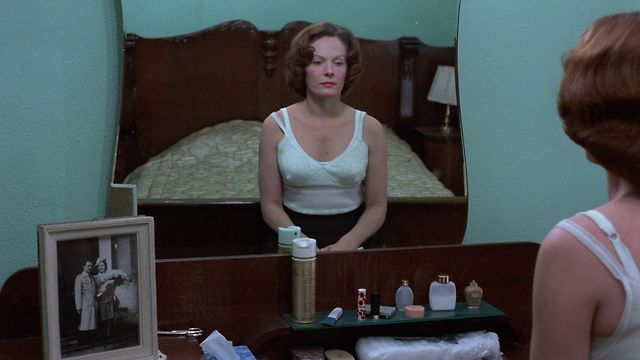
Another long day closes for Jeanne. 

The film received its world premiere in the 1975 Directors Fortnight sidebar in Cannes. Akerman, in the screening with Seyrig, could “hear the seats banging”: Everyone was leaving early. “That’s when I realized that people couldn’t stand it.” Marguerite Duras, the French writer and experimental filmmaker, was one of the people who disliked the film the most, the earliest. “She said, ‘That woman’s crazy,’ so she could relate the character to her own world,” Akerman recalled. “I was furious. That woman was like all the women I’d known as a child. Were they crazy, or was it a way to fight against craziness, anxiety?

It’s a valid question, one that Akerman disciples keep trying to convince others of. “On the night that the Sight & Sound poll was launched, I was interviewed by the BBC and they set it up as this incredibly long Belgian film about a woman peeling potatoes,” Letterboxd member and film journalist Lillian Crawford tells me over email. “I found it absurd to have to try to bottle up the feminist significance of Akerman and her work into a short answer.”

She takes comfort in her own rewatches, having first discovered the feature at university. Crawford quickly became obsessed with Akerman, to the point of embarking on a master’s to keep studying the director’s oeuvre. “I would put the film on while doing chores, ironing or dusting or cooking, largely because I find those long takes so peaceful,” she says. Dielman also holds an unusual quality, beyond its unchangeable text. “I see something new every time: the first time I watched it with other people, they laughed at moments which I had never thought to be funny. It’s perhaps the only film I have seen which completely changes every time I go back to it.”

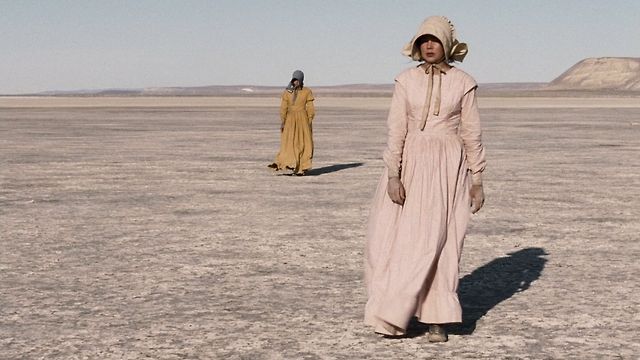
The slow beauty of a Kelly Reichardt picture, Meek’s Cutoff (2010).

Countless filmmakers continue to pay a debt to Akerman. Some—many—with direct references to Jeanne Dielman in their work, others by acknowledging its impact on the very fabric of filmmaking. Kelly Reichardt rewatches it before making every new feature, and in his review of Meek’s Cutoff, Will distills what might have made such an impact on the director as “the focus on laborious process rather than normative dramatic action”, jokingly calling the 2010 film “Jeanne Dielman: The Western, no fixed address.” Baby_Swiss adds, “Both films invite your active participation. If you’re not willing to engage, you’ll likely end up confused, disappointed and above all bored. This is a film about how people on the margins subtly exert influence, or, perhaps, it’s a film about decentering and, ultimately, recentering the traditional Western [but could be any], narrative.”

For Kitty Green, director of exclusively taut, tense films centering female isolation and oppression in The Assistant and The Royal Hotel, Dielman is the blueprint. “The Assistant is clearly referencing Jeanne Dielman,” Green told us when sharing her four favorite films. “There’s a clear link between the two of them in that they’re about routine, gesture, that sort of thing.” Revisiting my conversation with Green about the film in 2020, I’d forgotten about telling her I had my fists clenched—whether Garner’s character Jane (!) would be eating cereal or washing up mugs—waiting for something bad to happen. Sound familiar? Countless reviews of Green’s debut feature range from Jeanne Dielman goes to Hollywood” to Jeanne Dielman for girls with an email job” to Jeanne Dielman for the #MeToo era”, with one more just saying what we’re all thinking: “My God, does the patriarchy suck.”

The patriarchy does suck, for everyone, but mothers may suffer an acute kind of injustice that the rest of us may try to understand without ever experiencing it in the same way. Akerman’s mother escaped Auschwitz as a teenager, the only person in her family to do so. The director has spoken about the regret of showing Jeanne Dielman to the woman who raised her, because “she saw herself in it. It was undoubtedly thrown in the face of women of that generation. A kind of mirror that wasn’t necessarily something they appreciated seeing.” The relationship was fraught between the two women (that complexity made more literal in News from Home, released just one year later), but Dielman has gone on to represent a way out, even just through a reflection, for many more since.

Author Rachel Yoder released her debut novel Nightbitch, a magical realist take on early stay-at-home motherhood, in 2021. She shared her four favorites at the world premiere of the film adaptation starring Amy Adams last year, promising us that Jeanne Dielman was “in my [Four Favorites] before the poll; I am an original lover of [it].” It explains a lot, similarly to Die My Love, regarding the impact that film had on our shifting judgment and everlasting underestimation of women who are also mothers. Letterboxd members can also see the pipeline, for better or for worse (Nightbitch holds a 2.8 rating at the time of writing), either backhandedly complimenting Dielman’s aesthetics, or welcoming the film’s enduring lifeblood with a new hairdo.

That banality went on to fascinate Greta Gerwig, who frequently shouts out Dielman as a major touchstone in her life and work. “So much of that movie is static shots of her doing housework,” Gerwig told Natalie Portman at a 2018 post-screening Q&A for Lady Bird (and also in the film’s commentary, if you can seek it out!).

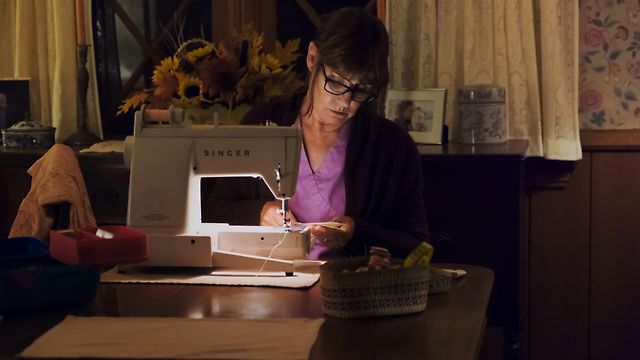
“Akerman said that it’s the lowest on the totem pole of cinema language,” Gerwig continues. “We value the image of a woman doing anything else besides housework. There was something about that intimacy of making dinner or making a bed that was really interesting to me. It felt like there was this whole world left to be explored that had been largely undocumented.” She paid direct homage to this intimate tedium, allowing an unbroken shot of Laurie Metcalf’s Marion McPherson, mother to Christine “Lady Bird” McPherson (Saoirse Ronan), fixing her daughter’s prom dress at her sewing machine, long after the rest of the household has fallen asleep.

Marion McPherson, tending to her Lady Bird (2017).

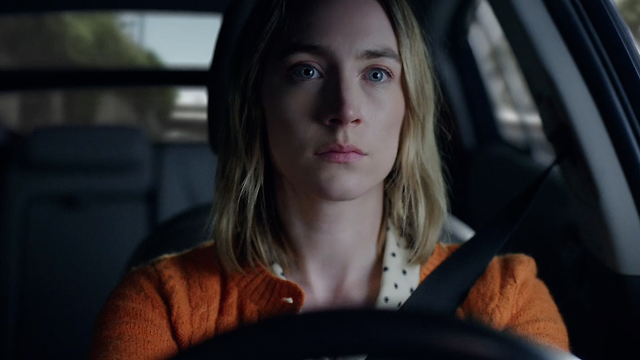
The second most popular review of Jeanne Dielman on Letterboxd comes from Demi, discovering the film in 2022 and realizing how so many “pieces of media I consider canonical to my own taste” point back to it. Expanding on his review, he tells me that “watching Jeanne Dielman wrestle with her son’s antipathy reminded me a lot of Laurie Metcalf’s relationship with Lady Bird.” (It’s not for nothing that Ronan recently starred in a very Jeanne Dielman-inspired music video for Talking Heads’ ‘Psycho Killer’—let Mike Mills explain.)

So many of the most infuriating moments of Dielman come from Jeanne’s adult son Sylvain’s throwaway remarks and ingratitudes he tosses back to his mom. “If I was a woman, I wouldn’t be capable of sleeping with a man I didn’t love,” he mumbles as she tucks him into bed. She calmly, with a similar stoic but all-knowing demeanor to Metcalf in Lady Bird, replies, “You don’t know; you’re not a woman.”

Sylvain’s failing to engage with his mother’s work, pleasuring men in the bed that she shared with his father before he died, speaks to yet another way women remain devalued for the emotional and physical burden that they shoulder for their families—but also the demonization of sex work.

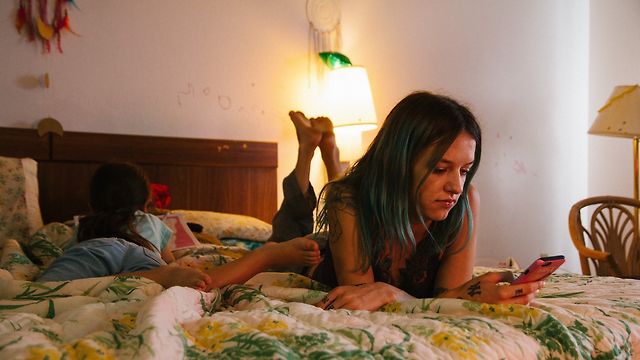
Thinking of unlikely films that draw a line to Dielman and bring the fight into the modern day, Demi suggests a Sean Baker picture. “A movie like The Florida Project, which also tackles the invisible labor and sex work of a mother raising her child alone, takes quiet cues from Jeanne Dielman (even in making the sex work feel like a reveal.)”

Single mother Halley and her daughter Moonee in The Florida Project (2017).

The quietly radical way of framing Jeanne’s methods of supporting her son speaks to Akerman’s conflicted feelings as a feminist. The past 50 years have seen us progressively, then categorically, champion her as one of the guiding lights of feminist cinema, but she was always careful to convey her position. (On Letterboxd, you can find Dielman in a lot of popular lists including films made by women, but also alternate feminist cinema, if you want to get granular).

“I’m not an active feminist. I’m not militant, if that’s the only way one defines feminism,” Akerman said. (Resolutely not taking cues from something like avant-garde dadaist punk filmmaker Věra Chytilová—who didn’t want to be called a feminist either—and her giddily violent joyride that is 1966’s Daisies. Great movie.) “I simply make films that are not colonized, that have not been filtered through the language of men. I don’t speak the language of men to express myself. That’s my way of being in the fight.”

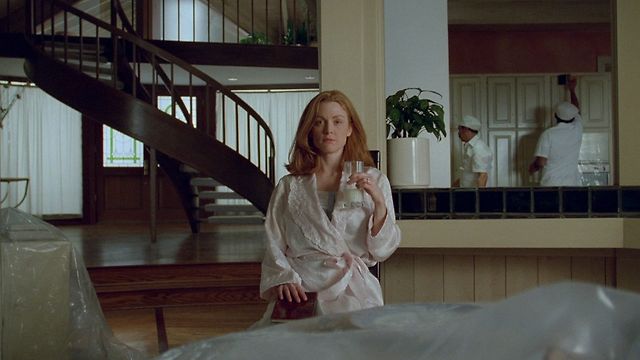
Safe’s (1995) Carol White, one and all. 

It remains heartening to see male filmmakers who live by the language that Akerman invented to tell their stories on-screen. Introducing: “Jeanne Dielman’s gay son.” Released twenty years after Jeanne Dielman, Todd Haynes’ Safe casts Julianne Moore as Carol White, his film’s housewife, breaking free from her monotony in a stark, all-consuming physical way. “I had considered Safe like Jeanne Dielman, but taking place in an airport,” Haynes told Filmmaker Magazine in 1995, reckoning with how our environment can ruin us (for more hyperrealistic, distorted time and space, revisit Gus Van Sant’s Elephant under a new light).

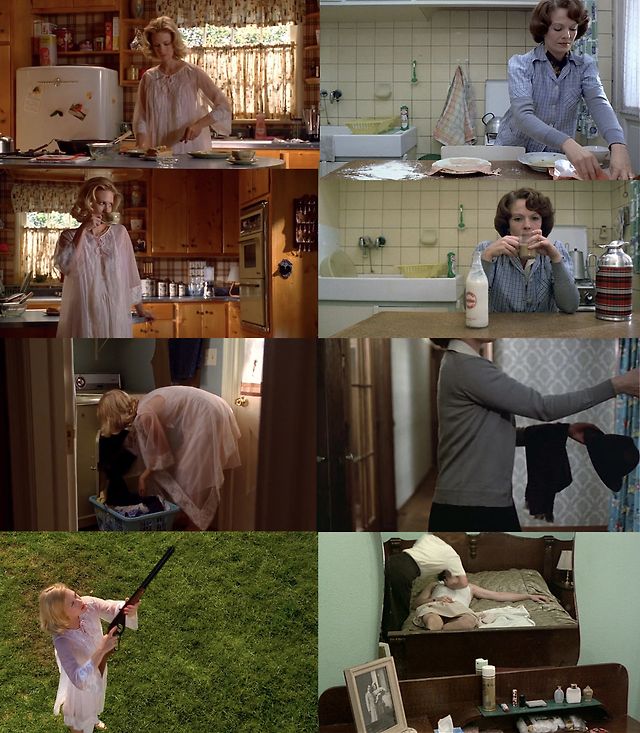
“Certain homes in Los Angeles have the quality of airports,” Haynes continues. “All traces of human life, or natural life, have been excluded and taken over. Air is controlled and space is controlled. There’s no trace of humankind, of the mess of human beings.” Haynes has put stifled, misunderstood women center frame throughout his career, but Safe is one that understands the home as its own form of cage, even if one of ostensibly your own making. John nails the connection, pinpointing Carol as “suffering the intangible oppression of patriarchal society, which acts as a disease without a diagnosis”, while S makes a solid case: “I’m assembling a team with Carol, Jeanne Dielman and Betty Draper.”

Poor Betty Draper.  — Credit… TIFF
Poor Betty Draper.  Credit… TIFF

Many reviews of Jeanne Dielman agree on the frightening, unexpectedly visceral feelings in rewatching the film, despite it being (maybe?) less intentionally terrifying than something like Safe. Today, we know its place on lists of horror under a new name, or as lo’s exhaustive list calls it, Gender roles are the real horror. On Akerman specifically, Kalien77 suggests, “Scariest horror movie of all time, because it shows things as they are and not how we picture them to be.”

The way Jeanne Dielman’s impact keeps changing is thrilling, because that same act that horrifies so many is the one that also enchants. Filmmaker and Letterboxd member Isabel Sandoval, who has Dielman in her Four Favorites, has shared its impact on her 2019 film Lingua Franca, from the daily repetition to the slow-build tension and explosive climax. “It’s my first brush with durational cinema,” Sandoval told us in Locarno in 2023. “It’s the first film I saw that trained the camera on a woman—a middle-aged woman—going about her daily rituals, her seemingly mundane chores, and calling that cinema. It made me realize I can define what is art, and what is cinema, as I produce my own work.”

Belgian filmmaker Lukas Dhont has always seen Akerman as the homegrown lighthouse in the storm. “Jeanne Dielman was the counterpoint to everything,” Dhont told me in 2023 when discussing the intersectional feminism of his filmmaking. “When I was growing up, I would sit on the kitchen floor, watching my grandmother cook for us. I’d sit next to my mother doing laundry. But I’d never come to think of it as something you could put on a cinema screen.”

Then, someone did. “I would never look at the women in my life in the same way anymore,” Dhont continues. “It was the first time that I thought, ‘I don’t have to go to jungles, deserts or space. I can place the camera next to me, and maybe I’ll have something to say about what I see, about the expectations put on me—just because of the body I was born in.’”

The impact of Jeanne Dielman crosses borders and genres. American Psycho director Mary Harron, in conversation with my colleague Mia, remembers seeing BTS footage of Akerman directing Seyrig. “They’re arguing, and Seyrig, more famous at that point, goes, ‘You have to give me motivation,’ as the director is just giving her physical directions. Akerman tells her it’ll be fine, and she breaks through: Delphine realizes that’s the way to play this character. The motivation is already there.” (See also: the entire cinema of Sofia Coppola.)

On her seemingly restrictive way of working, which she called “only dealing with externals,” Akerman told her star that she actually didn’t want it to look real. “I want people to feel the time that it takes—which is not the time it really takes.” In 2025, I am struck by my incapacity to sit still while revisiting the film at home. I feel eerily exposed, reorganizing my desk, eating my lunch, putting my plate in the dishwasher, doing my hair, fixing my makeup while Jeanne does her daily tasks, too. My attention span has never been smaller, but it goes beyond that for the Letterboxd community. Translation: Katrina’s list of Epic Movies: In which I celebrate finally getting diagnosed and treated for adhd. I have only seen one film on that list.

Countless reviews of Dielman mention both ADHD and OCD—different conditions, proving that a film made to simply reflect a way of being in fact has the power to reveal so much more. File under reviews that could only be written in the next century after production; Jakob: “Imagine TikTok tweens doing a ‘Jeanne Dielman Challenge’ where they see how long they can last watching this before their ADHD kicks in.” Noah: “If you have OCD, this movie feels like Mad Max: Fury Road.”

Jeanne and her less-than-interested son, Sylvain. 

Another part Akerman hadn’t realized that she’d put to screen until years later, she told Nicole Brenez in 2011, is something of a love letter to “lost Jewish rituals”. Having lived with her grandfather until the age of eight, Akerman was immersed in the “Eastern European way of living,” where, as a Jewish family, everything is ritualized. The way you eat, the way you move, the way you live.

After her grandfather died, Akerman wanted to keep the Sabbath and understand the customs. “The idea of the ritual has to do with the passage from animal to human,” she said, later pondering the mechanics of Jewish ritual when it comes to sex—the catalyst for the most dramatic act in Jeanne Dielman. “In Judaism, the man is required to please his wife. On Friday night, he has to get to know her—for five minutes, he has to forget about himself. You don’t have to be a believer to subscribe to that.”

The rest of this article contains spoilers for ‘Jeanne Dielman’.

But in the film, when Jeanne orgasms with her second client, everything crumbles. “Jeanne’s defenses snapped and I wanted to demonstrate that with the strongest sign of her oppression: prostitution,” Akerman told the BFI. “Jeanne Dielman kills to regain her order.” The murder comes as a shock after so much routine, but you could also argue that what comes afterwards holds greater impact. “That concluding scene is one of the greatest acts of violence ever shown in cinema, but it wouldn’t mean anything without the three hours which precede it,” Crawford posits.

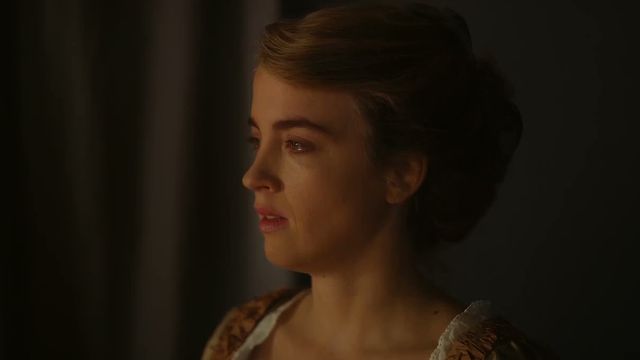
One final moment to take it all in, in Portrait of a Lady on Fire (2019).

Another filmmaker inspired by Akerman is Céline Sciamma, particularly in our beloved Portrait of a Lady on Fire. For its pacing, its politics, the power in its unbroken final shot (the two films sit side by side in Criticalme’s list of many of the best ones), letting Adèle Haenel’s Héloïse revisit the entire life she feels she’s just lived in one encounter, the camera refusing to leave her face—just like Jeanne, nearly 45 years prior. Akerman called the last shot of the film, lasting seven minutes, a “synthesis” of all that comes before, “much more dramatic” than the killing. And it’s true—in life, do you spend more time doing, or sitting: overthinking that one thing until the day you die?

To have spent so long overthinking Jeanne Dielman and to see it as just the start feels right. When we look back in another 50 years, it will mean even more. “Where would [we] be without this film?” Audrey asks. “The films we treasure can be found within Jeanne Dielman and [its] quiet contemplation on the mundanity of life and the harshness of the female experience.” Mo summarizes it beautifully: “I feel about this similarly to how Susan Sontag felt about Satantango: I’d be lucky to watch it once a year for the rest of my life.” But the community must still grow: for the skeptics, the confused? Akerman has the answer. “People are not used to looking at the frame. In my films, you either look, or you leave!”


The BFI releases the Chantal Akerman Collection: Volume 2 - 1982-2015 Blu-ray boxset on June 23. ‛Jeanne Dielman, 23 Quai du Commerce, 1080 Bruxelles’ is available to watch on BFI Player now.

Further Reading

Tags

Share This Article

Image