
CASK gene related disorders
Research into CASK-related disorders
In ultra-rare diseases such as CASK gene mutations, it is often difficult to justify developing a new medication for just a handful of children and especially difficult if the disease is poorly understood. To give CASK gene disorders the best possible chance of having licensed treatments, CASK Research UK is focused on making the community ‘clinical trials ready’.
Research for CASK families to be involved in
Family Priorities Survey
CASK Research Foundation has teamed up with the Patient Led Research Hub (PLRH) at the University of Cambridge. Together, we aim to explore how the CASK global registry (RARE-X) can support new research which is most important to you.
To help shape this research project, please complete this quick (3 min), anonymous survey and let us know which areas of living with a CASK-related disorder you would like to learn more about.
This survey aims to gather research priorities from people with lived experience of CASK-related disorders. The responses will be used to inform future research, and also may be included in reports and publications composed by CASK Research. By completing this survey, you agree that your anonymised responses may be used in this manner.
RARE-X Natural History study
In order for drug developers and researchers to identify patients eligible for either new drugs or repurposed drugs specific to CASK, it will be imperative to create a database containing the medical records and other health information of CASK patients all over the world.
RARE-X is an ongoing study that all patients can (and should) participate in. You can read more here. We have over 150 patients registered already. Please play your part in helping to find treatments for CASK.

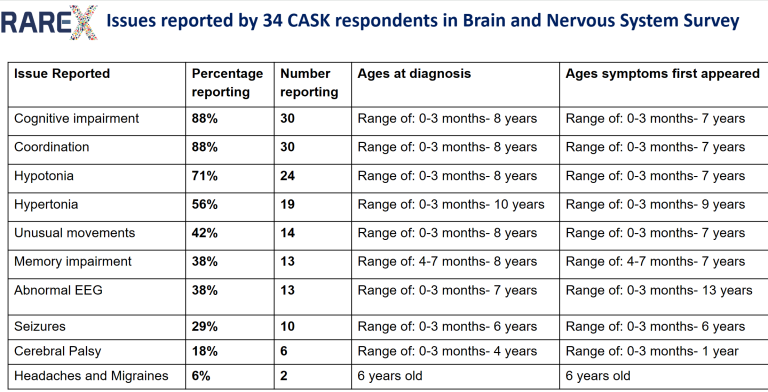
We are gathering important data relating to symptoms and prognosis. This data is, in some aspects, mirroring already published data, whilst also adding to the known symptoms and highlighting key areas for future study.
Epilepsy & Gene therapy survey
Researchers would like to learn what matters most to you and your family when taking part in epilepsy research.
GLOBAL SURVEY
Researchers often look at things like seizure numbers or side effects, but we know there’s much more to life with epilepsy. A survey has been designed to look into what matters most to you.
You can take part if you are:
• An adult living with epilepsy, or
• A parent, carer, or family member of a child or adult with epilepsy
The survey takes about 10 – 15 minutes. Your answers are anonymous.
UK CASK database

Researchers at Bristol University need two minutes of your time!
Please can all UK families complete this survey. It’s anonymous, super easy and speedy. Before you start, please find your genetics letter because you’ll need to input the gene variant of your child. Can’t find it? Bristol still wants your answers, so just skip that question.
Why is this important?
The team at Bristol are already studying CASK and are keen to ensure they continue to study the symptoms and aspects of CASK that our community need the most.
The team, led by Dr Sam Amin, renowned paediatric neurologist, have created and manage a CASK UK patient database. This will enable them to have a detailed understanding of CASK-related disorders.
Their long-term goal is to find a drug to help our children as well as ensure the NHS and NICE has enough information on our UK population to enable a drug to be licenced.
FaceMatch aims to help people with a possible genetic condition find a diagnosis by matching their facial features with people who already have a diagnosis.
All people are beautifully unique in their appearance, and some people with genetic conditions share similar facial features. These features can sometimes provide a clue to diagnosis.


Lab based research
Developing a translational research platform to understand the function of CASK and develop new drugs
This study is led by Professor James Hodge at Bristol University, UK. Professor Hodge has created CASK fly models and is using them to study the cellular mechanisms of CASK, elucidate the actions of the different domains of the CASK gene and identify possible treatment avenues. This study was funded by CASK Research Foundation.
CURE CASK - CASK Reactivation
One avenue of research is a technique called X-reactivation. In brief, this involves activating silenced healthy CASK genes that are present in the brains of females with the disorder. Read more about this revolutionary potential therapy.
At the beginning of 2024 the CASK Coalition successfully reached the funding target for this revolutionary technology. The team at UC Davis completed their study in March 2026. We are delighted to share that they were successful in activating the healthy CASK gene in brain cells, bringing us closer to a curative therapy for girls with MICPCH.
A drug to prevent cerebellar degeneration
This study, by Professor Mukherjee at Virginia Polytechnic Institute and State University, is funded by ACNRF Australia, a member of the CASK Coalition. You can read updates on the progress here.
Development of CASK patient derived pluripotent stem cells and drug screening for potential treatments for CASK disorders
Clinical Research
The Neurodevelopmental spectrum of CASK-related disorder
CASK Research collaborated with the University of Cambridge to provide important insights into the spectrum of challenges faced by individuals with CASK-related disorders. By comparing 31 children and young people from the UK-based BINGO project at the University of Cambridge with 151 previously reported cases, the researchers identified patterns in developmental outcomes, explored potential predictors of severity, and highlighted areas that need further research.
THIS STUDY IS NOW COMPLETE AND AWAITING PUBLICATION
Are you a researcher?
You can read our research strategy, eligibility criteria and more here.
CASK animal and cell models
We are currently creating a database of all available CASK models in order to accelerate research into our rare disease. If you are a researcher who works on CASK models please ensure you have completed this ten question survey.
