Inspiration and resources for a new year of music-making!

As we head into the new term and community music groups all around the state return to rehearsals, facilitators are on the hunt for new repertoire. We’ve put together a list of places you can find new songs, inspiration, and resources so you can kick off the year with a bang.

  1. Jessie Lloyd’s Aboriginal and Torres Strait Islander Songbook

This book is an essential resource for beginning the journey to decolonise your community music practice. It’s packed full of gems, starting with some generously shared wisdom on respecting First Nations cultural protocols. Plus there’s eight wonderful songs with all the resources you need to make teaching easy – lyrics, scores, chords, audio tracks, and storytelling guides.

  1. Victoria Sings

The CMVic store is full of wonderful resources and repertoire to make your job easier – in particular, Victoria Sings has been helping choir leaders all around the state (and beyond) since its release in 2004. There are 34 songs and chants that are easy to teach and learn, most of which were written by Victorian singing leaders. The songs are recorded and documented in a way that makes it easy for even the most un-assuming of singing leaders to introduce these songs to their groups. It’s less than a dollar a song and it’s about to go out of print, so this is your last chance to get your hands on a physical copy!

  1. Melbourne Tune Collection

This wonderful book is the result of 3 years on the road collecting contemporary folk music from across Victoria. It consists of 86 original songs and tunes from 58 local composers, who in true folk tradition, are a mix of professional and amateur musicians. Katherine Oleinikov travelled around the country collecting Australian folk tunes in an effort to make Australian folk music as accessible as possible and promote the incredible music that’s being written today.

  1. Making Music That Matters

Melissa Forbes is a musician, community music facilitator and researcher into community music and its benefits. Her book ‘Making Music That Matters’ provides practical strategies for community musicians to harness their strengths, foster belonging within diverse groups, and articulate their work’s value as a public health resource. Readers will discover how to create transformative musical experiences that build personal fulfilment and strengthen community connections.

  1. Queensland Kodaly Choir Legacy Project

In 2019, the Queensland Kodaly Choir sang their last notes together as a group as the institution was disbanded in 2020. However, the choir was keen to continue to share their passion for singing and music-making with others in the community and so the QKC Legacy Project was created.

The project aims to build a legacy of Australian choral music and reflect the unique philosophy, diversity, and musical backgrounds of QKC. Eminent Australian composers – Astrid Jorgensen OAM, Sandra Milliken, and Fay White – were commissioned to create songs and recordings for use by the wider community. All resources are free & available for anyone to use.

  1. The Unmuted Podcast (UK based)

Hosted by choir leaders and mental health experts Emma and Jenn Rowland-Elsen, the Unmuted podcast is about shaking up how we think about mental health, music, and what choir can really be. Each episode dives into what it really means to lead inclusive, mental-health informed choirs, and why singing together is so powerful for both our nervous systems and emotional wellbeing, not just our voices.

And if you love inspiring and informative podcasts check out Dr Belinda Densley’s Creating Song Magic, and Dr Melissa Forbes’ Leading Notes with insightful interviews of local music leaders doing wonderful things!

7.The Bird Sings (US based)

Still looking for inspiration? Why not try Lisa Littlebird’s The Bird Sings, and while you’re there have a read of the important work Decolonising Community Singing.

Happy music making in 2026!

The CMVic Team

Growing Community Music Together 

The Case For Local Action Gatherings

Image
St Albans Street Jam. Image credit Ursula Dutkiewicz

We all know that fantastic things happen when community music groups work together to co-create local events and programs connected to place and in response to local identity. But it seems that running even the simplest of community events in 2025 is easier said than done.

Economic pressures, the decline in volunteerism and collective burnout has dampened our collective capacity to plan, collaborate and allow ourselves to dream. 

Community Music Victoria’s Growing Community Music (GCM) project has, from the outset, been locally led. Through GCM we have developed a process that  offers a structured and  supported invitation for locals to work together and take ownership of projects that are connected to them, to place and with the resources to deliver them. While this process is slower and requires more flexibility and communication than shipping in a pre-designed event or program, the outcomes are deeper, focused on capacity building and seeding connections. 

Image
Brimbank Local Action Gathering. Image credit Jane York

Our latest iteration of this process, which starts with a “Local Action Gathering”, recently delivered the St Albans Street Jam, a participatory afternoon of pop-up musical performances followed by an all in jam in celebration of a united community and the joy of making music together.

It was planned and delivered by a “Local Action Team” and featured Brimbank Multicultural Choir, Sunshine Street Band, Suavis Community Choir and Pearl Afrikulture Rythms with performers across a broad range of age, ability and cultural background coming together around the shared language of music and seeking to have a positive impact the experience of the streets of St Albans. 

The St Albans Street Jam was more than meets the eye: a culmination of months of collaboration, relationship building and deep engagement between CMVic, Creative Brimbank and a group of passionate locals. The process began with a Local Action Gathering, a vibrant working session that CMVic facilitated in February with key community music stakeholders and Council.

We documented resources, identified who were our local music makers, discussed the challenges to delivering projects locally and any local project priorities. We then workshopped and co-created project ideas, including the Street Jam, to be led and delivered by the group with support from CMVic and Brimbank Council. 

CMVic’s ongoing role as host, facilitator and advocate created the environment for these outcomes by strengthening local connections, prioritising local knowledge and valuing and understanding the complexity of the work and the wisdom of community music facilitators. We were able to generate excitement, possibility and improve visibility of community music groups to each other and to the broader community and spread joy while doing it.

Image
St Albans Street Jam. Image credit: Jane York

This process has been so successful that we are hoping to deliver it in other LGAs in the coming months. If you want to chat more about how it all works and if it would be right for your community please contact us at CMVic.

Alex’s Star Shines Bright at the Celebrating Capabilities Showcase

Image
Alex performs with Music Therapist Catherine Threlfall at the Celebrating Capabilities Showcase of Talents

On December 3rd, 2023, International Day for People with Disability (IDPWD), the ‘Celebrating Capabilities Showcase of Talent’ at the Powerhouse Mildura was buzzing with energy. Among the inspiring performers, 9-year-old Alex, the youngest of the group, stole the show with a performance supported by his Music Therapist Catherine. This incredible event, made possible by funding from the Helen MacPherson Smith Trust for Community Music Victoria’s Growing Community Music (GCM) project, showcased the power of inclusive music-making.

Alex’s performance was so captivating it even caught the attention of Channel 7. His immediate reaction after leaving the stage spoke volumes: “When can I do that again?!” This infectious enthusiasm led to Alex performing at the Mildura Eisteddfod in June 2024, and he’s now planning a seven-song concert for family and friends, complete with singing, dancing, and instrument playing.

Alex shared his joy with Kylie Livingston, Local Catalyst for the GCM Project, expressing his love for singing, dancing and playing the piano and how it was lots of fun having people watch. He was excited when people joined in and even performed his own original song, “Alex’s Rock and Roll.”

Image

Alex’s Dad described the profound impact of music: “Alex connects with music; it makes him come alive. He has spent a lot of time in hospital. When he has been in hospital, he can still listen to music and participate in that activity. As you can see, Alex is not strong vocally but he can convey all that emotion by playing music, dancing and singing and as you saw at the Powerhouse in particular, it just lifts the roof and makes everyone feel great.”

He continued, “Participating in music, and the work you are doing in community music, is allowing people to shine that wouldn’t necessarily have the opportunity to shine otherwise.” He praised the showcase for fostering social connection: “Seeing them all together at the end mixing socially which, realistically is an opportunity that people with disabilities often don’t get. Often you don’t get that in a therapy setting either. Making music in a community setting allows for social cohesion and social mixing. Music is an equalizer.”

Reflecting on the event, Alex’s Dad enthused, “I thought it was absolutely fantastic! I could not fault it. It was so much more than I was expecting, particularly with the crowd involvement.” He highlighted the inclusive atmosphere, noting it wasn’t just the disability sector present, but also “general members of the public there and everyone was so positive and everyone was cheering each other on to do their best. It was phenomenal.” The central, accessible location of the Powerhouse made it truly welcoming: “It’s an inclusive, non-intimidating environment. It makes us as parents really proud and it brings a tear to our eye.”

Alex’s journey is a testament to how community music initiatives can transform lives, providing platforms for talent to flourish and fostering genuine inclusion. You can help CMVic spread the transformative power of music by making a tax deductible donation here: https://cmvic.org.au/donations

Hobsons Bay Choir Jam: gathering voices in Melbourne’s West

Image

A Community gathers around a love of singing

The landscape for community choirs shifted significantly after 2020. Many groups faced challenges including declining attendance, financial strain, and volunteer fatigue. Victoria’s Inner West was particularly affected, with at least five long-standing music groups ceasing operations in 2021-22. It was clear that these communities needed a fresh infusion of optimism, connection, and enjoyment.

In response, and with support from Community Music Victoria (CMVic), and funding from Hobsons Bay City Council and the Helen Macpherson Smith Trust, Choir Jam Hobsons Bay launched in 2023. This free, participatory singing event brought together 200 singers over two years. It fostered connection, built confidence, and strengthened community capacity, contributing to the revitalisation of local singing groups.


Beyond the Song: Forging Connections

Choir Jam highlighted a crucial point: choirs are vital sources of connection. They enhance well-being, reduce isolation, and invite more people to experience the enjoyment of group singing. CMVic’s commitment to empowering music leaders and strengthening community networks was evident throughout the event.

The gathering also developed leadership skills by linking choirs, encouraging joint efforts, and sharing effective teaching approaches and repertoire. Crucially, Choir Jam lowered common entry barriers for new participants. It’s free, relaxed, and offers a “try before you join” experience, encouraging new voices to find their place. For existing members, it showcased the local network’s breadth and variety, highlighting each group’s unique identity and offerings.

The future of Choir Jam Hobsons Bay is promising, with host choirs now independently organising the 2025 event.


Impact at a Glance:

  • 200 attendees over 2 years
  • Numerous new connections established
  • Increased interest in joining local choirs
  • Enhanced collaboration between groups and leaders
  • Peer-to-peer leadership skills shared
  • Stronger community support for choirs
  • Annual program now runs sustainably with minimal CMVic support

Your Favourite Part of Choir Jam?

Jane York, CMVic’s Local Catalyst in Inner Western Victoria, evaluated the Choir Jam model, and was inundated with positive feedback. Attendees consistently highlighted the positive atmosphere and shared experience: “Hearing so many people singing at once,” “Experiencing new skills and having fun,” “The great feeling of community around a love of singing,” and “Networking with other choirs & directors” were just a few of the enthusiastic responses. The event clearly resonated, fostering a strong sense of unity and shared passion for music.

Music at MELC: Building Community and Confidence Through Song

Image

The Mildura English Language Centre (MELC) is a vital hub for newly arrived young people, many of whom have experienced significant disruption in their lives. For these students, navigating a new country, a new language, and a new school system can be incredibly challenging. Thanks to support from the Helen Macpherson Smith Trust (HMST), Community Music Victoria (CMVic) has been bringing the power of music to MELC through the “Music at MELC” project, fostering connection, confidence, and a sense of belonging.

A Space for Expression and Connection

The Music at MELC project provides a dedicated space where students can engage with music in a fun, informal, and accessible way. Weekly music sessions, led by experienced music therapists and community arts facilitators, introduce students to a diverse range of instruments, from guitars and keyboards to drums and percussion. Crucially, these sessions are designed to be inclusive, welcoming all students regardless of their prior musical experience or English language proficiency.

“Many of our students arrive from refugee camps in Africa, Asia, and the Middle East. These students arrive with complex trauma and often very little or very different educational backgrounds. Music is such an important part of culture. Music can be an outlet for trauma and sadness, for fear and anxiety. Music is also something you can participate in with no need for language.”  Claire Kelly, MELC Assistant Principal.

“Music is such an important part of culture. Music can be an outlet for trauma and sadness, for fear and anxiety. Music is also something you can participate in with no need for language.” 

Claire Kelly, MELC Assistant Principal.
Image
Exploring backstage at Mildura Arts Centre prior to The BEAT


Beyond the Notes: Building Confidence and Wellbeing

The benefits of Music at MELC extend far beyond musical skill development. For young people who may feel isolated or overwhelmed, these sessions offer a much-needed outlet for self-expression and stress relief. Participating in group music-making builds teamwork, communication skills, and a sense of shared accomplishment. The project also plays a significant role in promoting positive mental health and wellbeing. “Music plays an important role in children’s development beyond what is considered to be ‘basic music skills’. It can also assist in turn-taking, socialisation, self-expression, emotional regulation, and language development.”Regan Schmidt, Music Therapist Sunraysia Arts and Learning.

“Music plays an important role in children’s development beyond what is considered to be ‘basic music skills’.”

Regan Schmidt, Music Therapist Sunraysia Arts and Learning.
Image
MELC Performing in the 2023 Mildura Eisteddfod


Krista* was one of many students who shared their thoughts about Music at MELC through an evaluation of the program in 2024.

“The only thing bad about music is when there is silence”

Krista, MELC student, aged 11

Her emphatic endorsement of music making was in part expression of the importance of music to her life and community, and partly to show gratitude for the opportunity to once again make music, through the Music at MELC program. Music was a part of her everyday life in Africa, where she played keyboard and sang with her family, at church and on significant occasions such as religious days, weddings and funerals. Music provided joy and was implicitly connected to family, community and life.

Most students interviewed for the evaluation had stories similar to Krista’s, sharing the significant role that music had played in their lives before coming to Australia. Many described how they had played an instrument in their country of origin, but couldn’t bring it with them.

Image
Regan Schmidt and students at MELC Graduation Celebration 2023


Investing in social cohesion into the future

HMST’s commitment to funding the Growing Community Music project has been instrumental in its success. Following the pilot in Term 4 2022, the program grew with continued support from HMST and collaborators VicHealth and Bendigo Health’s Loddon Mallee Public Health Unit. Performances at various Mildura cultural events and the long-running Mildura Eisteddfod have helped connect MELC into the local community. CMVic recently secured a grant for musical instruments from Variety Victoria, to support Music at MELC and enable an after school music programs at the Sunraysia Multicultural and Ethnic Communities Council (SMECC).

Donations to CMVic will allow us to continue creating opportunities for people to experience the many benefits of making music. Donate here.

* Names have been changed to protect privacy. Photos have been provided with permission to publish.

Making the Case for Funding Participatory Music

CMVic submitted a version of the article below to the Victorian State Government’s Investigating Funding and Support Available to Victoria’s Cultural and Creative Industries referring to the latest research on the economic and public health benefits of community music. Read on to learn more about the powerful multiplier effect of investing in community music leaders. With thanks and acknowledgment to the academics who continue to analyse, test and explore the important work that our members undertake every day. 

Image: Lauren Camilleri, Teaching Artist at Dream Big Youth Music Festival
Image

Economic and Public Health Benefits from Investing in Community Music

Community Music Victoria submits that, according to the latest research and economic modelling, a targeted increase in support for independent artists who create participatory music experiences would not only improve individual mental health and public health outcomes for participants, but also return at least $2 for each $1 invested to the Victorian Economy. 

A number of recent national and international studies have demonstrated the extent to which addressing social isolation is good for the economy, as summarised in the July 2022 White Paper Strengthening Social Connection to Accelerate Social Recovery:

  • A 2021 report from Bankwest Curtin Economics Centre 27 estimated the cost of loneliness at $2.7 billion each year, an equivalent annual cost of $1,565 for each person who becomes lonely;
  • The 2019 National Mental Health Commission showed that for every $1 invested in programs that address loneliness, the return on investment is between $2.14 to $2.87;
  • The New Economics Foundation Report (UK) estimated the cost-impact for non-private and private employers at £2.53 billion and £2.10 billion per year, respectively.

International research has repeatedly demonstrated that community music is one of the most powerful social connectors and is ideal for addressing the social determinants of health. Recent accessible surveys of this research can be found here (Creative Change Project) and here (5 ways singing helps humanity).

Historically, the community music sector has carried out this vital social service at a very low cost to the taxpayer: 

  • Community Music Victoria currently receives $67,000 p/a from Creative Victoria to train and develop the network of leaders and create accessible opportunities for participants to receive the health and wellbeing benefits of participatory music (see CMVic Annual Reports for a snapshot of the reach and impact we are achieving with this funding), 
  • Our members, who are small-scale independent artists, apply for grants for $1-$3K from local councils and/or seek philanthropic funding to carry out their work within communities. 
  • The sector has heavily relied on volunteers to deliver this vital social service, which has, in turn, tended to limit the sector’s reach and impact to those demographics that can support volunteerism.

Importantly, the ageing population, COVID-19 pandemic and rising cost of living are creating pressure on those sectors that rely on volunteering (see Volunteering Australia’s recent update) and are undermining the Community Music sector’s ability to deliver this economically important service to society. This result is increasing inequality, both intergenerationally and geographically:

  • The pipeline for new leaders entering the sector is throttled by cost of living pressures. It is increasingly expensive to acquire the skills to become a community music leader, but in the formative years, there is insufficient financial security to build a practice.
  • Relying on volunteer and underpaid artists to take on these important community roles means that only those with economic independence can sustain a practice. Hence, while community arts continue to thrive in the rich inner suburbs, those regions and demographics that would most benefit from this community service are least able to access appropriately trained and supported practitioners. 

Recommendation:

CMVic recommends to the inquiry that investing in subsidised access to participatory music making for the target populations outlined in the VicHealth 10 year strategy 2023–2033 would achieve significant net economic gain for Victoria, while also delivering public health benefits by addressing the social determinants of health for regions and demographics where this is most needed.

“We Just Like to Sing!”: small singing groups having a big impact!

By Jane York

When I started working with CMVic as the interim Local Catalyst for Inner West Victoria I didn’t expect to spend my Saturday line dancing to the 1990s pop country hit Achy Breaky Heart, but that’s exactly how last month’s Cairnlea Community Sing-Along event kicked off (quite literally)!

While not formally on the event run-sheet, one of the group leaders Antoinette Camilleri casually mentioned that it’s a popular ice-breaker with her Cairnlea Sing-Along Group and everyone immediately agreed we had to see it in action. It may not be the sort of activity you first think of when you think about choirs, but this fun and super silly warm-up, full of hip bumps, giggles and missed steps, was a perfect example of the types of things community music leaders do to keep their groups engaged and bring them into the space. For the types of groups this Community Sing-Along event was targeting, togetherness was the priority over formal introductions and extensive vocal warm-ups.

Image

The concept of the Cairnlea Community Sing-Along sprang out of engagement and research throughout Melbourne’s Western suburbs and beyond in the second half of 2023 as part of CMVic’s Growing Community Music project. It became clear that there was a significant portion of participatory singing happening that didn’t fit neatly into traditional understandings of community choirs. And while those of us working in the space understand ‘community choir’ is a broad term that involves many operational models, sizes and abilities, this cohort of groups had some things in common…

  • They strongly prioritise participation and connection over musical output
  • They may not identify as a choir, instead a singing or sing-along group
  • They may not meet once a week in the evening, some meet fortnightly and during the day
  • They rarely use sheet music and mostly sing in unison or rounds
  • They are often operating out of a neighbourhood, community house or health centre 
  • Entry is either free or affordable with sliding scales
  • They are sometimes led by volunteers who may not identify as career singing leaders
  • They may not have the size, reliable attendance or musical capacity to perform on their own outside their regular meeting time

These types of groups gather all across Victoria and serve their local communities, many of which could be described as disadvantaged or marginalised and at risk of social isolation. These group sessions are designed for maximum ease of participation, for people to be able to rock up, join in and experience joy and connection in a low pressure way. Some of them, like the Cairnlea Sing-Along group, sing to backing tracks with their leader taking requests and finishing on What A Wonderful World to “combat the blues”! During our sing-along event Elly McKinnon from With One Voice Sunbury leads us in a round but first asks if anyone doesn’t know what that means; one person doesn’t and she warmly explains. No prior musical knowledge is assumed and no one is shamed or made to feel unworthy of joining in.

The aim of the Cairnlea Community Sing-Along event was to bring together some of these similar types of groups in a relaxed format that addresses the barriers to them engaging in other performance, workshop or development opportunities. Over 30 singers joined us on the day from 7 different groups, with leaders from our 3 host groups teaching and leading a few of their groups favourite songs for the whole room to sing together.

Preparing for performances, working on tricky repertoire and having the size and confidence to sing parts is beyond the reach of many of these groups. The main goal of their regular sessions is providing access to everyone to enjoy singing and nothing beyond that. When planning our event leaders didn’t know until the day how many singers were going to make it, they couldn’t get much in the way of firm commitments and while group members did happily show up from each group, it highlighted how challenging it is to even begin thinking about a performance or workshop event outside of rehearsal time for these groups.

Although a lot has changed in the past few decades in the perception of what a community choir is and does, thanks in no small part to the work of Community Music Victoria and Creativity Australia and With One Voice, assumptions and expectations still exist around performance and musical output. The idea that all music groups are performance groups is just not the case for some of the groups and programs serving our most vulnerable community members. 

In Brydie-Leigh Bartleet and Emma Heard’s recent research paper “Can Community Music Contribute To More Equitable Societies?” It’s clear that the positive outcomes of making music together are multiple and most of the studies included reported “positive outcomes for individual participants experiencing disadvantage including wellbeing and social connection, identity formation, self-acceptance and reimagined futures, and confidence and empowerment”. 

The importance of casual, local and welcoming music making opportunities are a key piece to growing participation in community music. Understanding, supporting and sustaining these types of groups into the future should be a priority for community organisations, Councils and Neighbourhood Houses and requires funding, leadership development, tailored programming, education, partnerships and advocacy. We need to ensure we aren’t trying to squeeze a round peg into a square hole so that they can continue to offer accessible music making to the community in their own way, as one group member commented at our event “we just like to sing”!  

5 ways singing helps humanity

Image

We all know that singing is fun – just think back to the last time you belted out a rock tune on a family road trip, or sang along with friends, and strangers, at the pub or a music festival.

There’s also the spiritual experience of singing hymns at church, or an Indigenous sacred ceremony, or in perfect harmony in a mass choir.

Image
Singing is fun, and brings people together. Photo: Getty Images

But it goes deeper than that.

Our researchers at the University of Melbourne’s Faculty of Fine Arts and Music working through the Creativity and Wellbeing Hallmark Initiative, the Creative Arts Therapies Research Unit and the Wilin Centre for Indigenous Arts and Cultural Development are seeking to understand the value of singing from cultural, emotional, social, and health perspectives, as well as developing programs to implement its benefits.

Here’s just some of what research has found over the past decade.

Singing increases oxytocin levels (aiding bonding) and decreases cortisol (lowering stress). It can also rapidly result in feelings of connection and flow – improving our mood, strengthening sense of identity and helping out long and short-term memory.

For many of us, singing plays a key role from birth. In fact caregivers and infants use melody, harmony, pitch, timbre and tempo to bond and provide comfort in a mutually beneficial interaction.

Singing with a slow-paced, medium pitch inflection using a soft timbre – lullabies typically use this type of vocalisation – can gently connect with and pacify infants, while the cooing responses of the infant can equally engage and soothe the caregiver.

The mutual benefits of this bonding through song can persist throughout life.

Image

Lullabies can pacify infants, while the cooing responses of the infant have a similar effect on the caregiver. Photo: Getty Images

2. SINGING CONNECTS US TO OUR CULTURE

Singing contributes to the development of our thinking and language and, in turn, to our cultural identity, as well as general quality of life and opportunity.

Children as young as five have been shown to already know dozens of songs, connecting them to cultural knowledge about ritual significance, social etiquette, facts about life and lifestyle, skills like counting, techniques for making and doing things, and so on.

The core elements of songs include repetitive melody and rhythmic structures which work with the words to produce powerfully mnemonic effects that can re-enforce knowledge, support memory and capture history.

Songs connect us to our culture, and the stories within songs can help shape our identity and build meaning within society. Important First Nations work at the University has found that singing and songs not only foster community knowledge, but can revitalise it, acting to strengthen political agency, pride and resilience.

This shows how vital it is to repatriate songs lost to communities.

Image

Core elements of songs include repetitive melody and rhythmic structures. Photo: Supplied

3. SINGING MAKES US HAPPY, EVEN IN LOCK-DOWN

During the first waves of COVID-19 across 2020, singing was both popular and successful in passing time and connecting with others. Online ‘choirs’ brought joy to millions, even though these activities were principally asynchronous and required extra effort to record and multitrack to generate the choral effect.

And you don’t even have to sing to get some benefit from singing. We found that songs feature strongly in emotional regulation, even when passively engaging through listening.

4. SINGING CAN IMPROVE OUR PHYSICAL HEALTH

Our music therapy researchers have shown that singing has multiple benefits in managing degenerative conditions like Parkinson’s Disease, where volume of voice and mood improved after an intensive, researcher-designed singing program.

For people with dementia, and their carers, singing can improve lucidity, focus and enjoyment.

Image

Singing can improve lucidity, focus and enjoyment for dementia sufferers and their carers. Photo: Getty Images

A recent landmark clinical trial by our researchers, published in the Lancet, found that recreational choir singing decreased depression and dementia symptoms, particularly among those people with more severe dementia.

The behavioural aspects like group social dynamics, an emphasis on fun and less of a focus on the individual are likely to feed into the positive outcomes for those with dementia.

5. SINGING UNITES PEOPLE

In one project, our researchers collaborated with adults in a multicultural workplace to explore how a workplace choir could strengthen culture, identity, and positive emotions. The team did this by focusing on lullabies – reconnecting participants to some of those earliest musical bonds.

The study generated strong social bonding, providing a platform for cohesion and understanding while mantaining the expression of distinctive identities that are understood and valued across cultural, linguistic and religious differences.

Singing has also helped people manage trauma, grief and loss including illness and disaster, providing emotional sharing, catharsis and resilience.

Image

Without a doubt, singing can helps us to maximise our social and emotional potential. Photo: Supplied

Our researchers continue to collaborate with communities to develop knowledge and programs to use singing for people of all ages and backgrounds, in community and specialised medical settings to support their diverse needs throughout their lives.

All of this tells us that without a doubt, singing can help us to maximise our social and emotional potential.

So, whether it’s in the shower, the car or on stage, on your own or with a group, try bursting into song and see how you feel afterwards. The evidence suggests it’ll be good.

This article was first published on Pursuit. Read the original article.

Banner: Getty Images

Image

Growing Grey Gratefully

Not only does music add colour to life, new research has shown that playing and actively engaging with music can also significantly increase the amount of grey matter in our brains, the area of our noggins where our valuable neurons are stored.

Establishing a practice of regular music making has the potential to alter the process of normal, age-related brain shrinkage in healthy older adults, arresting the gradual cognitive decline associated with atrophy Establishing a practice of regular music making has the potential to alter the process of normal, age-related brain shrinkage in healthy older adults, arresting the gradual cognitive decline associated with atrophy, the cause of diminished working memory and other core executive functions as we grow older.

These findings are the result of a randomised controlled trial by a Swiss-based research team who spent six months tracking 132 retired adults between the ages of 62 and 78 years (Marie, Damien, et al., 2023.).

Participants were selected for inclusion in the study on the basis they had taken music lessons for no longer than six months at any previous point in their lives. This precluded any existing brain plasticity linked to earlier musical learning from affecting the outcomes of the study. They were then randomised into two groups: a treatment group and a control group.

Participants in the treatment group were enrolled into a one year course of weekly, hour-long piano lessons and were also required to do half an hour of homework each day. Participants in the control group were set hour-long music awareness tasks intended to help them identify instruments being played in the context of many different musical styles and were also required to do half an hour of homework each day.

The good news is that both groups returned data showing an increase in cognitive functioning and a robust amount of new grey matter leading to improved tonal working memory after just six months; amazing, eh? Click here to read a review of the findings or, for a more in-depth analysis, the original research paper can be accessed here.

Feeling motivated to start building your own grey matter? A full list of the Victorian singing and instrumental groups listed on the CMVic website is available here: https://cmvic.org.au. And maybe begin knitting bigger beanies for yourself and your music making pals to accomodate those growing brains with this how to guide. Enjoy!

Review by Deb Carveth, Copy Editor for Community Music Victoria. Feature photo by David Matos on Unsplash

Reference

Marie, Damien, et al. “Music interventions in 132 healthy older adults enhance cerebellar grey matter and auditory working memory, despite general brain atrophy.” Neuroimage: Reports 3.2 (2023): 100166.

Rocks ‘n’ Stroll along the Elwood Singing Walking Trail

Along a well-known part of Melbourne’s Bayside, a new Singing Walking Trail is fine tuning walkers into their environment through a series of songs telling stories that incite fresh knowledge and new perspectives of its familiar landscape.

Back during the murky depths of the 2020  lockdown, plans for the Elwood Singing Walking Trail were conceived and hatched by local choir leader and project facilitator, Jeannie Marsh. Originally intended to lift the spirits of Jeannie’s Elwood Community Choir at a time when singers were isolated from each other, a key focus of the project is connection, a cornerstone of all Jeanie’s work, and this spirit has flowed outwards from the choir, to the broader community of Elwood. 

“It was planned to be something that was accessible to anyone, irrespective of their situation whether they were living alone, home-schooling or whatever, to help combat feelings of loneliness and isolation, an activity to connect people more closely to their environment by sharing knowledge and stories of the local area using music and songs to keep everyone together and healthy in all ways.” 

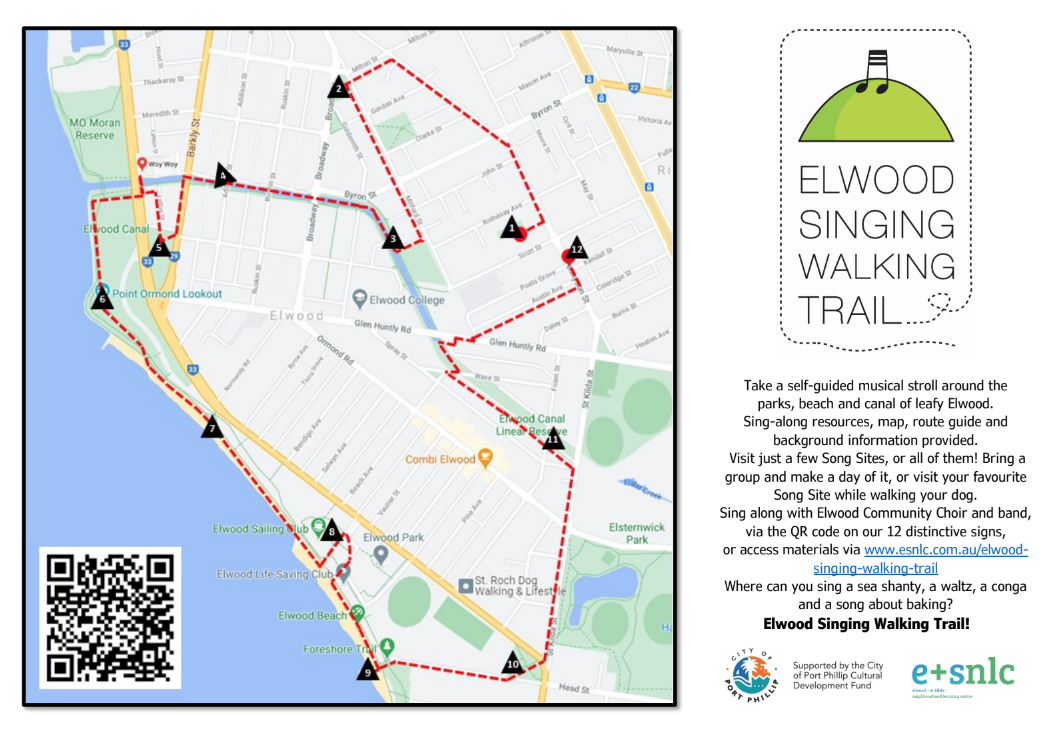
With an initial grant from the City of Port Phillip, Jeannie and the choir embarked on a research and development plan in late 2020/early 2021. “We came up with these 12 songs and a little route with 12 stops around Elwood starting at the Neighbourhood Learning Centre where we rehearse, then going along the canal to the beach and ending back at the King of Tonga Bar which is across the road from where we rehearse, for a drink.” The resulting ‘self-guided musical stroll’ was officially launched and gifted to the fortunate community of Elwood through the hard work and dedication of the choir and Jeannie, in October 2022.

The stroll takes in 12 sites along a 6.8km stretch around Elwood, telling an oral history through songs celebrating a wonderfully broad range of local topics from weavers to water rats; music halls to middens; sourdough to ‘spotties’; migration and many more to delight and enlighten listeners of all ages. 

The trail also shines a light on the historical relevance of the place now called Elwood, back when it was an area of plentiful sustenance for First Nations people, long, long before it became the Bay as we know it today.  Before the waters came pounding through the Heads to transform the woodlands and wetland swamp into Port Phillip Bay, or ‘Nerm’ – the name given to the bay by First Nations people, as told to European settlers – Elwood was a site where kangaroos played, and eels and shellfish could be plentifully sourced. Jeannie has woven this history into a song called Nerm which can be listened to at song site 8 to encourage us to think beyond the immediacy of what we see when we look out towards the bay, and to reflect upon its legacy and the need to treat it with respect and care.

A soft launch for the ESWT was held in May 2021 and a second grant, combined with $6k raised by the choir at an auction, was then used for phase two of the project: compiling sing-along resources, marketing and promotional material to spread the word and promote the route. Jeannie recalls being struck by such a clear demonstration of passion and support for the project: “We have a number of visual artists within the group as well as a sculptor who all donated work; Rebecca Barnard came and sang for us; Tracy Harvey was the auctioneer and the choir members and their families were all very generous, it was really lovely.” 

Audio engineer James Hodson who had worked with Jeannie on a number of other projects came on board as the choir’s ‘fantastic’ audio guy, “you couldn’t do a project like this without somebody like James.” James is a multi-instrumentalist and when it came to songs such as Carry On, the 1931 song by Jack O’Hagan located at song site 3, James got in there and did an arrangement like a 1930s dance band playing all of the instruments himself. Carry On was written to raise people’s spirits during the Depression and, 90 years later, it has come back into its own to tell the story of Elwood’s music hall history.

Each of the 12 song sites is marked out by an illustration by local illustrator Consuelo Fernandez-Ortiz, and is accompanied by a QR code for access to information on the area, as well as links to a YouTube clip of the song and resources for singers such as sheet music and words to each song. “People can do the trail at any time because it’s self-guided. You can do the whole thing in one day and stop off somewhere for lunch, or find a site that you like, sit there as often as you like and listen to it seventeen times!” 

In reflecting on the journey of the Elwood Singing Walking Trail to date, Jeannie has clearly enjoyed its collaborative nature and bringing it into being. “It’s been a really enjoyable project and while it’s been multi-layered, it has been so harmonious and that’s just a joy to have a team of people who’ve shared artistic vision, community goals and everyone has given 110%.” 

To continue building momentum and awareness of the existence of the fabulous Elwood Singing Walking Trail, Jeannie is currently running Sunday Strolls around a part of it, once a month. “We do four song sites at a time and it runs for an hour and a half from 10:30 am until 12 noon on a Sunday morning. Elwood has some great shops and local businesses, we have loads of indigenous history and art deco history all along the beach, there are a lot of layers which will become clear or you can just ignore all that, have some fun listening to some songs, singing some songs and doing some dancing! ” 

The next Sunday Stroll will be held on Sunday 16th April, leaving from the Elwood Pier. The Sunday Stroll is free, just turn up with your mobile phone to access the music, all set to sing and wearing comfortable shoes; dancing optional!

For a sneak preview of songs and Song sites: https://www.esnlc.com.au/elwood-singing-walking-trail-song-sites-map-and-songs

Image

Written by Deb Carveth, Community Music Victoria Copy Editor, with Jeannie Marsh; thanks Jeannie!
Main photo: ESWT Sunday Stroll 150123 singing at sign. Credit JEANNIE MARSH

We can all make music! Inspirational stories to celebrate and champion the practice of community music making.

Design a site like this with WordPress.com
Get started