Writing Classes
We offer a sliding scale for each course.
We also offer a reduced rate for those who can’t make a course but would like to have
access to its materials and video recordings.
For more info, please email info@consequenceforum.org
Upcoming Classes
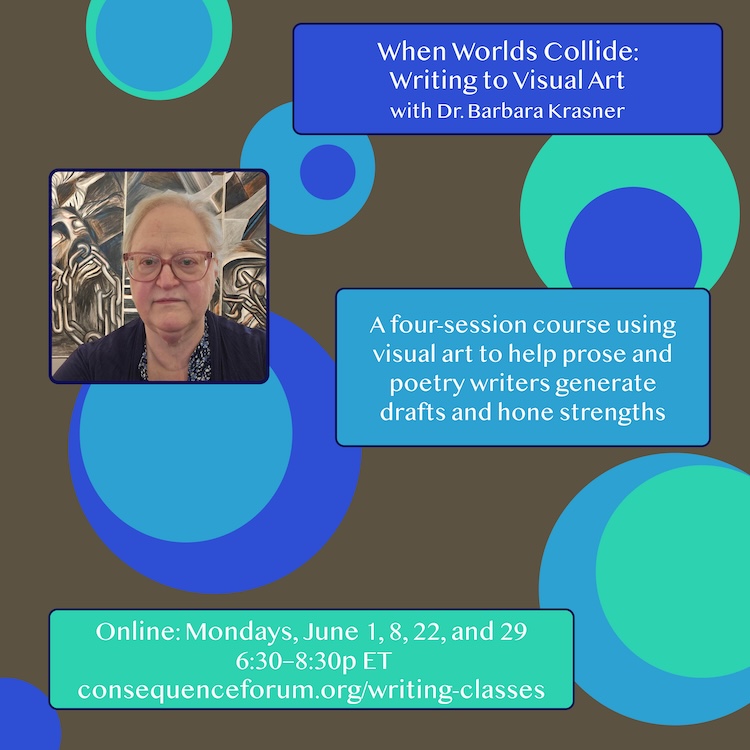
When Worlds Collide: Writing to Visual Art
What: For millennia, writers have expressed their thoughts in response to visual art through ekphrasis, the Greek word for “description.” Visual art provides sensory entry into writing about the complexities of conflict and collision. It lends itself to strong imagery, rhythm, and history.
No previous knowledge of art or art history is necessary for this course. You will receive ten images in seixty-second intervals to spark ideas. Then you’ll choose two of them for more in-depth generative writing in fifteen-minute intervals. Using the Amherst Writers & Artists method, we’ll read our work aloud (optional) and give strengths-based feedback on what’s strong and memorable. There is no critique.
Upon completion of the workshop, students will:
1. Have a minimum of eight drafts of ekphrastic writing
2. Discover where the strengths in their writing shine
3. Gain an appreciation of visual art to prompt creative writing
All experience levels and multiple genres welcome.
Who: Barbara Krasner is an award-winning multi-genre author. She holds an MFA from the Vermont College of Fine Arts and a PhD in Holocaust & Genocide Studies from Gratz College. Her work has appeared in more than seventy literary journals and she is the author of ten poetry collections, including the ekphrastic Poems of the Winter Palace (Bottlecap Press, 2025), The Night Watch (Kelsay Books, 2025), Insomnia: Poems after Lee Krasner (dancing girl press, 2026), and the forthcoming The Wanderers (Shanti Arts, 2026). She lives and teaches in New Jersey.
Where & When: Online: Mondays, June 1, 8, 22, and 29 from 6:30p – 8:30p ET
Class Limit: 12
Cost: $100
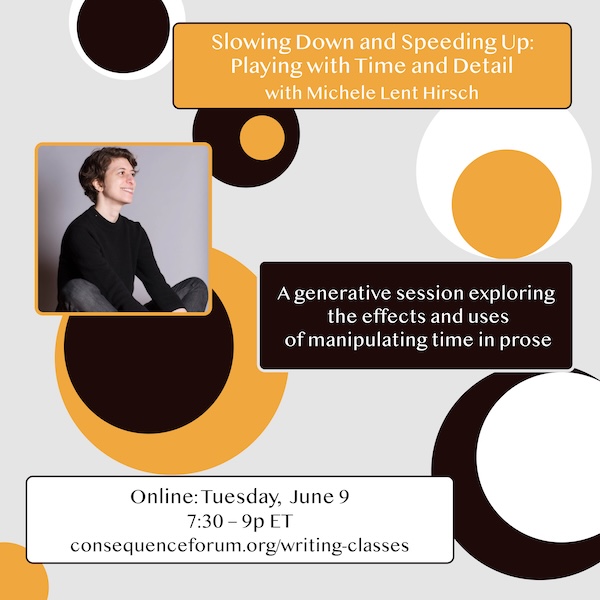
Slowing Down and Speeding Up: Playing With Time and Detail in Prose
What: Even when we write about less difficult subjects, choosing what speed we use to recount them can change our own, and our readers’, understanding. If we’re reflecting on how conflict affects our world or the people we come from, experimenting with time and detail can make a big difference.
When might zooming out or zooming in, speeding up or slowing down, help us convey the profound effect something has had on us, our family, our community? What happens when we play with the pace of events in unexpected ways?
We’ll read a few short examples together, talk about how they expand or compress time—and use them as prompts to try some new writing of our own. By the end of class, participants will have new ways of thinking about pacing and detail—the big picture and the small—as well as examples and drafts to keep experimenting with.
Who: Michele Lent Hirsch is a genderqueer writer, editor, and educator. Her poetry and prose have appeared in Third Coast, Bellevue Literary Review, and The Guardian, among other outlets. Her first book—a blend of memoir and journalism on disability and gender—came out from Beacon Press, and has been translated into Korean. It’s been featured in Literary Hub, The New York Times, and Longreads. An editor at a range of publications, Michele works with writers to deepen their craft, and has taught workshops at the 92nd Street Y and elsewhere.
When & Where: Online: Tuesday, June 9 from 7:30p – 9p ET
Class Limit: 15
Cost: $25
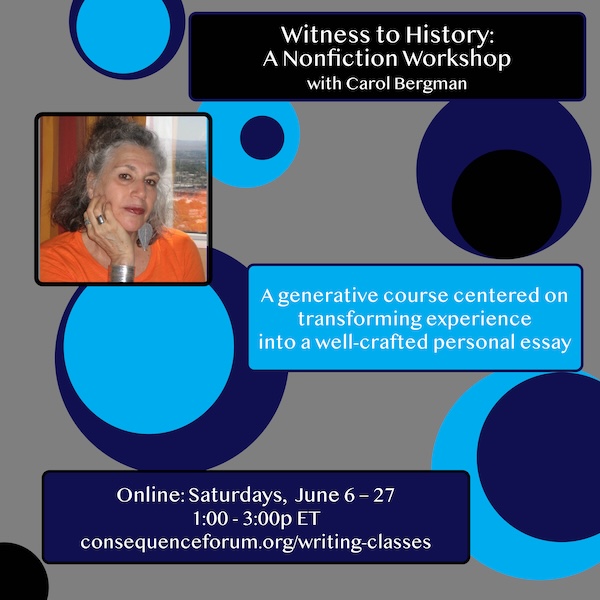
Witness to History: A Nonfiction Workshop
What: Writing a personal essay about an experience related to war or geopolitical violence can be powerful. You’ve taken a complex reality and presented it in an artful and clear way so that someone else can be moved by it. However, the process can also be fraught as you have to navigate questions of veracity and representation in addition to the usual challenges of craft.
In this workshop, writers will develop a personal essay based on an event related to war or geopolitical violence they have witnessed or participated in first-hand. This event can be anything from being in combat to participating in a conflict-related protest to growing up in a household with a relative who is a refugee.
We’ll begin with oral story-telling of personal recollections and then seek out primary material, such as interviews and archival material, before drafting the essay. Then, in a gentle and trusting workshop setting, each draft will be commented on and discussed, so that the writer will have a better understanding of what needs to be revised in future drafts. The goal by the end of the course is for each writer to leave with a solid initial draft and a strong sense of what to do next.
All writers are welcome as the only required tools are memory and a willingness to share observations and experiences.
Who: Carol Bergman was an Adjunct Associate Professor of writing at NYU, College of Applied Liberal Arts until Covid, and a founding faculty at Gotham Writers Workshop. She is a prize winning, much published author, and the co-owner of Mediacs, a small press.“Objects of Desire,” appearing in Lilith and Whetstone Literary Review was nominated for a Pushcart Prize in nonfiction. “Another Day in Paradise; International Humanitarian Workers Tell Their Stories,” with a foreword by John Le Carré, was nominated for the J. Anthony Lukas Book Prize. Her articles, essays, reviews, and interviews have appeared in numerous publications in the UK, the US, Canada, and Australia. www.carolbergman.net
When & Where: Online: Saturdays, June 6 – 27 from 1p – 3p ET
Class Limit: 10
Cost: $105
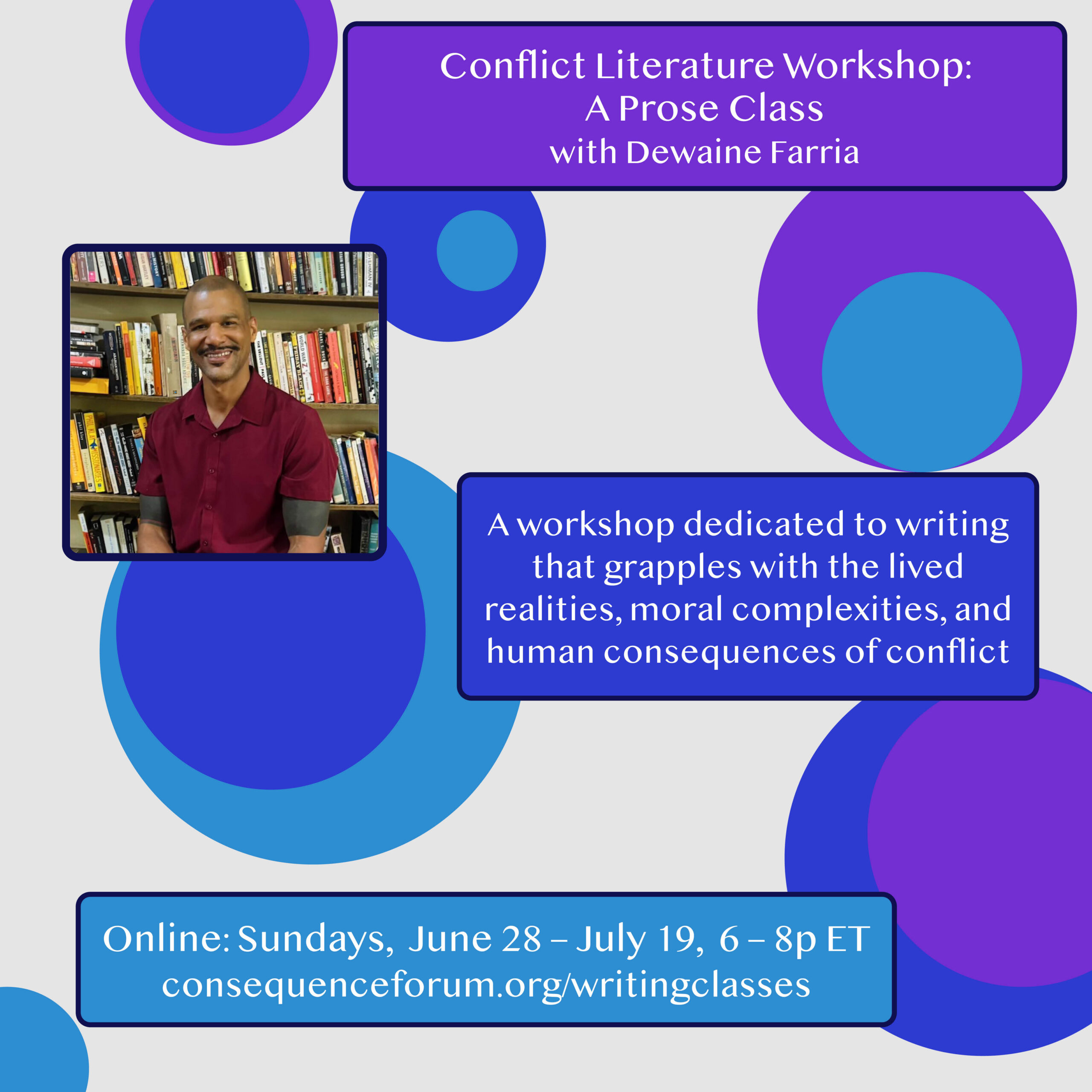
Conflict Literature Workshop: A Prose Class
What: This workshop centers on the development and critique of original writing that engages with conflict in its broadest sense. Participants will submit a piece of up to two thousand words—fiction or creative nonfiction—that explores conflict from any perspective: civilian, military, journalistic, displaced, humanitarian, or otherwise imagined.
The course is designed to support writers working within what we define as conflict literature—writing that grapples with the lived realities, moral complexities, and human consequences of conflict. Through guided discussion and peer critique, participants will deepen both their craft and their understanding of how conflict can be represented with nuance, responsibility, and emotional resonance.
Participants should be prepared to encounter material that may include depictions of trauma, violence, displacement, and loss. While no one is expected to share beyond their comfort level, the workshop encourages thoughtful engagement with difficult subject matter.
In three of the four sessions, participants will engage in a thirty-minute facilitator-led discussion of selected works of conflict literature, distributed in advance (including a short story, two essays, and an excerpt from a longer work):
◆ “The Things They Carried” – Tim O’Brien
◆ “Shooting an Elephant” – George Orwell / “The Third Winter” – Martha Gellhorn
◆ Nothing Ever Dies – Vietnam and the Memory of War (excerpt) – Viet Thanh Nguyen
Each session will include in-depth discussion of participant work. Writers will be workshopped for approximately thirty minutes each.
At the start of their session, the writer will read a brief excerpt (two to three minutes) from their piece. This is followed by a structured “listening phase,” during which the group discusses the work while the writer remains present but does not respond. This approach allows the writer to hear how the piece is received without interruption or the need to clarify intent.
Following the discussion, the writer is invited to rejoin the conversation to ask questions, respond to feedback, or seek clarification. Emphasis is placed on constructive, respectful critique that supports revision and strengthens craft. Formal feedback guidance will be disseminated prior to the course.
Sessions that include assigned readings will begin with a facilitated discussion connecting the text to key themes in conflict literature, such as voice, ethics of representation, narrative authority, and the portrayal of violence and memory.
By the end of the workshop, participants will:
◆ Receive detailed verbal and written feedback on an original piece of writing
◆ Develop a stronger understanding of craft techniques relevant to writing about conflict
◆ Engage critically with contemporary conflict literature across perspectives and forms
◆ Strengthen their ability to give and receive constructive critique
◆ Leave with concrete revision strategies for their submitted work
With a maximum of eight participants, the workshop ensures that each writer’s work is discussed in depth in a focused, supportive environment.
Who: Dewaine Farria is a former US Marine, and has spent much of his professional life with the United Nations, with assignments in the North Caucasus, Kenya, Somalia, and Occupied Palestine. In recognition of his actions during an attack on a UN compound in Mogadishu in June 2013, he received the United Nations Bravery Award.
He has received fellowships from the National Security Education Program (2004), MacDowell (2021, 2022), and the National Endowment for the Arts (2022). He holds a BS from the University of the State of New York-Albany, an MA in International and Area Studies from the University of Oklahoma, and an MFA in Creative Writing from the Vermont College of Fine Arts.
Tobias Wolff selected his debut novel, Revolutions of All Colors (Syracuse University Press, 2020) as winner of the inaugural Veteran’s Writing Award. Farria’s short stories and essays have appeared in Literary Hub, The New York Times, The Rumpus, The Daily Beast, Southern Humanities Review, CRAFT, War on the Rocks, Consequence, and the anthology Our Best War Stories (Middle West Press, 2020).
When & Where: Online: Sundays, June 28 – July 19 from 6p – 8p ET
Class Limit: 8
Cost: $350
Previous Workshops
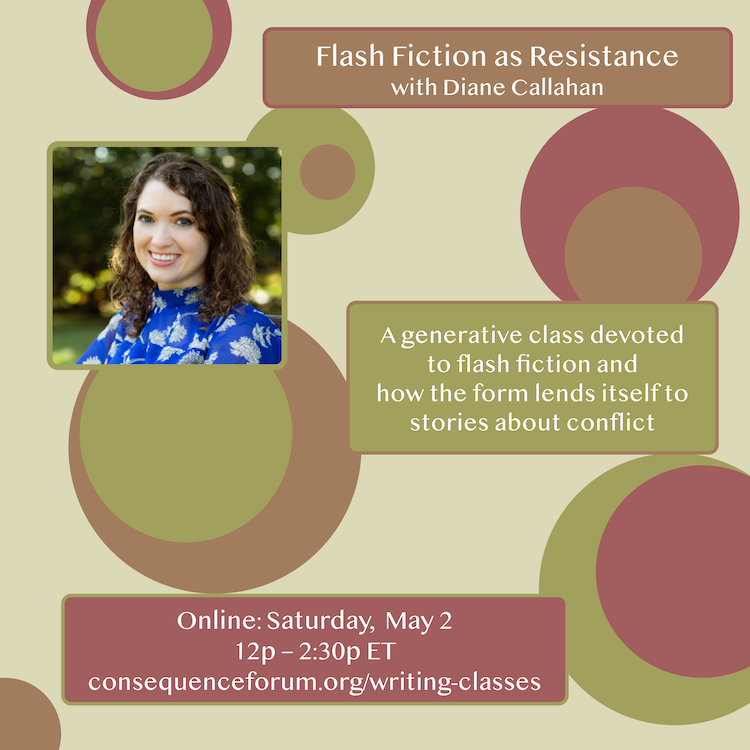
Flash Fiction as Resistance
What: Flash fiction can feel intimidating as a form. How can a writer convey a full story or emotion in under a thousand words? And how can we do justice to war and geopolitical violence in such a short space?
In this two-hour intensive, we’ll explore the power of flash through examples of published work from Consequence and writing prompts tailored to help you create a new piece around themes of conflict. We’ll discuss how flash can be a tool for resistance through hyperfocus on a particular image or the use of inventive structures. Through the compression of language, writers can communicate nuanced ideas and experiences that lend themselves to rereading.
By the end of this intensive, students will have 1) A draft or outline of a new flash fiction piece themed around the human consequences of war or geopolitical violence, 2) developed an understanding of at least three tools for approaching flash fiction as a genre, and 3) a deeper understanding of the purpose and possibilities of flash.
All levels of writers are welcome
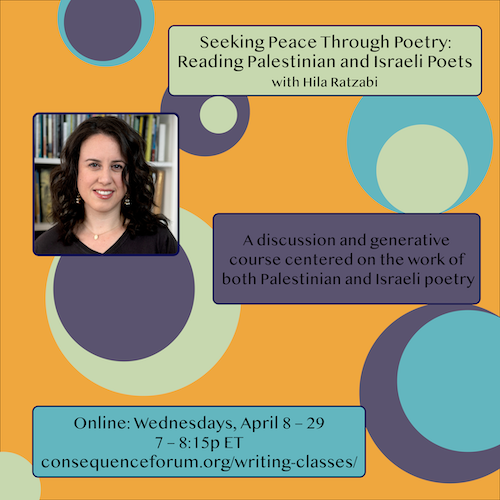
Seeking Peace through Poetry: Reading Palestinian and Israeli Poets
What: After more than two years of devastation in Israel and Palestine, and decades of loss and dispossession, those who care about the fate of all people on the land are heartbroken and weary. Poetry may not be able to repair broken agreements or bring the dead back to life, but it can help us pick up the broken pieces of our world, bear witness, and imagine a different way forward.
We will read Palestinian and Israeli poets in translation who express the human cost of war, the pain of loss, and the longing for home. Among the poets we will read and discuss are those who paid the ultimate price in this latest war: Hiba abu Nada, a Gazan poet killed by an Israeli airstrike, and Amiram Cooper, an Israeli poet who was taken hostage and died in captivity. Other poets we will read are Mosab Abu Toha, Adi Keissar, Hosam Maarouf, Tuvia Ruebner, among many others.
In each session, we will create a safe and supported space to read and discuss the poems. We will then engage in writing exercises inspired by the poems in which we will be invited to contemplate our own relationships to this fraught material. We will consider: How do we make sense of events we read about in the news that feel incomprehensible? How do we look inward during a time of war? What does home mean to you? What could peace look like?
You will leave the class with several poem drafts and an expanded sense of humanity that comes from bearing witness through poetry to the costs of war. All are welcome regardless of background, knowledge, poetry experience, or relationship to the topic.
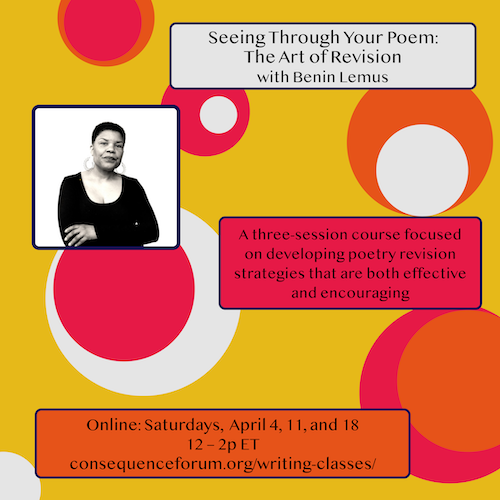
Seeing Through Your Poem: The Art of Revision
What: Revising can be difficult. Cutting parts you like, figuring out what might work better, determining if a section is working at all—these realities can make writing a less than enjoyable process.
In this class, we’ll focus on strategies to make this process less onerous and more fruitful. We’ll discuss, among other ideas, how to approach revision by making small and intentional choices, and why current practices may or may not be working. We will also explore and dispel many of the myths about the revision and editing process (i.e., it’s hard, it takes too long, etc.), the difference between the two (subtle, but important), and how to infuse joy and curiosity into these processes. We’ll also engage in several writing exercises and provide actionable strategies that will allow you a chance to practice these new techiques.
By the end of the course, writers will understand what revision is and how it serves the poet and their poems, have developed various strategies for revising their work, and have a curated reading list for future reference.
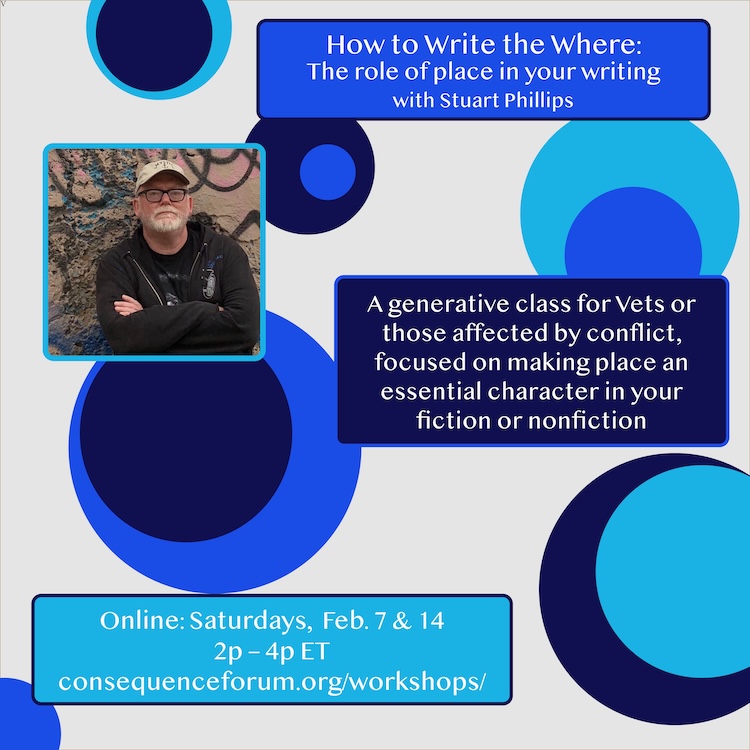
How to Write the Where: The Role of Place in Your Writing
What: Place. Whether you are writing memoir or fiction, it is easy to forget that place can, and should, be an essential character in your story. The taste of the dust, the drip of the rain, the smell of the diesel—by weaving multi-sensory descriptions of where your story takes place you make the story more visceral, accessible, and impactful.
This two-session class (four hours total) will combine short readings (PDFs provided in advance), lecture, generative exercises, and discussion to give each student an understanding of the many ways in which they can bring place alive, as well as hands-on practice in integrating this into their writing practice.
At the end, each student will have a better understanding of the role place can play in their writing, and concrete ideas on how to apply these concepts.
All levels of writers are welcome, especially Vets and those affected by conflict.
