Welcome to the Subtraction Worksheets page at Math-Drills.com where you will get less of an experience than our other pages! This page includes Subtraction worksheets on topics such as five minute frenzies, one-, two-, three- and multi-digit subtraction and subtracting across zeros.
Subtraction has been around for several years now... well maybe more than a few, so it's probably a good thing for students to learn. People experience subtraction every minute of their lives from banks and the government taking away your money to the cookies in the jar mysteriously disappearing. With a good knowledge of subtraction, you can understand why your bank account reaches zero and do something to prevent it from happening.
Some students do have difficulty with subtraction, so take it easy on them. Help them to learn their addition facts first. Once they know those, they will need a few more strategies to successfully subtract. Teaching with manipulatives like base ten blocks or cereal or insects in the park can help students gain a deeper understanding of subtraction. The subtracting worksheets on this page are meant to support good teaching practices, so only use them for independent learning if students are practising skills they already know.
We use the words, minuend, subtrahend and difference on this page. Please refer to the following, so you know which word means which part of a subtraction question.
Minuend - Subtrahend = Difference
Most Popular Subtraction Worksheets this Week
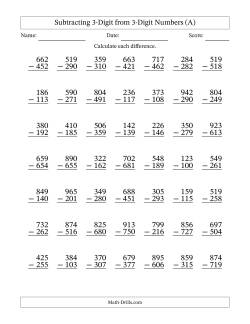
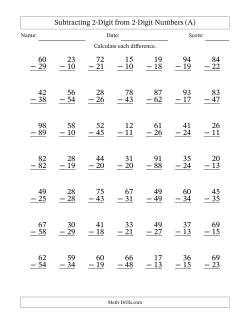
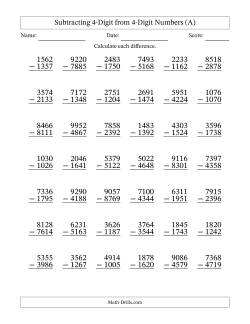
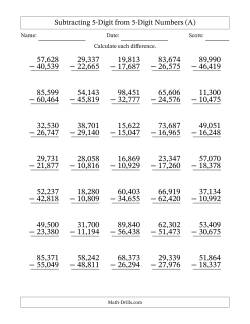
1 Subtraction Facts Tables

Five minute subtraction frenzies are timed practice charts that help students develop subtraction fact recall speed. These charts are similar to the addition and multiplication frenzy charts, but due to the nature of how subtraction works, we could not focus solely on the single digit fact families. For example, you might get questions like 18 - 4 = 14. You also have to be aware that you must subtract the row number from the column number to get a positive number (or zero). Other than that, they should be a nice way to practice some mental subtraction. As with most of these pages, please only use them as a timed activity with students who will experience success. If a student does not have the necessary skills to complete a frenzy in under five minutes, you may need to take a different approach to how you deliver this page. For all others, students should be able to complete this page in under five minutes with a 98% or greater accuracy and improve their time as they get more practice.
(1.1) Five Minute Subtraction Frenzies
Most of the subtraction tables in this section are meant to be used as a reference for students learning their subtraction facts. After a while, most students will remember the facts and recall them easily when completing math problems.
(1.2) Individual Subtraction Facts Tables for Subtrahends 0 to 11
(1.3) Individual Subtraction Facts Tables for Subtrahends 1 to 12
(1.4) Individual Subtraction Facts Tables for Subtrahends 1 to 20
- Individual Subtraction Facts Tables for Subtrahends 1 to 20 (Black and White)
- Individual Subtraction Facts Tables for Subtrahends 1 to 20 (Gray Scale)
- Individual Subtraction Facts Tables for Subtrahends 1 to 20 (Color)
- Individual Subtraction Facts Tables for Subtrahends 1 to 20 (Montessori Color)
- Individual Subtraction Facts Tables for Subtrahends 1 to 20 with Fillable Answers (Black and White) ✎
- Individual Subtraction Facts Tables for Subtrahends 1 to 20 with Fillable Answers (Gray Scale) ✎
- Individual Subtraction Facts Tables for Subtrahends 1 to 20 with Fillable Answers (Color) ✎
- Individual Subtraction Facts Tables for Subtrahends 1 to 20 with Fillable Answers (Montessori Color) ✎
(1.5) Compact Subtraction Facts Tables
2 Subtraction Facts

Subtraction facts are generally learned after or while students are learning addition facts. The subtraction worksheets in this section are meant to be used for practice, testing or with teacher guidance. They will not teach students how to subtract or what the connection is between addition and subtraction; for that, students require a teacher or parent.
Some students might find it easier to start with subtraction facts with minuends (the first number) limited to 9 or lower. This way, they don't need to count across 10 eliminating that extra pesky digit... for now.
(2.1) Subtracting Single-Digit from Single-Digit Numbers
The following worksheets cover the subtraction facts with subtrahends (the amount being subtracted) and differences (the answer) from 0 to 9 which corresponds to addition facts from 0 to 9. There are also worksheets with no zeros; in other words, with subtrahends and differences from 1 to 9. The minuends are the amounts to be subtracted from, so a minuend of 18 means that both the subtrahend and the difference will be 9. The worksheets marked with an asterisk (*) include all possible questions in a random order on each version of the worksheet.
(2.2) Subtraction Facts with Subtrahends and Differences from 0 to 9
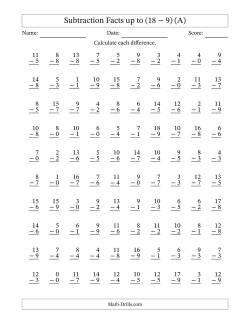
- Subtraction Facts from (0 − 0) to (18 − 9) (100* Questions) ✎
- Subtraction Facts from (0 − 0) to (18 − 9) (81 Questions) ✎
- Subtraction Facts from (0 − 0) to (18 − 9) (64 Questions) ✎
- Subtraction Facts from (0 − 0) to (18 − 9) (50 Questions) ✎
- Subtraction Facts from (0 − 0) to (18 − 9) (25 Large Print Questions) ✎
- Subtraction Facts from (0 − 0) to (18 − 9) (12 Very Large Print Questions) ✎
- Subtraction Facts from (2 − 1) to (18 − 9) (100 Questions) ✎
- Subtraction Facts from (2 − 1) to (18 − 9) (*81 Questions) ✎
- Subtraction Facts from (2 − 1) to (18 − 9) (64 Questions) ✎
- Subtraction Facts from (2 − 1) to (18 − 9) (50 Questions) ✎
- Subtraction Facts from (2 − 1) to (18 − 9) (25 Large Print Questions) ✎
- Subtraction Facts from (2 − 1) to (18 − 9) (12 Very Large Print Questions) ✎
- Subtraction Questions with Minuends from 10 to 18 and All Regrouping (100 Questions)
- Subtraction Questions with Minuends from 10 to 18 and All Regrouping (64 Questions)
- Subtraction Questions with Minuends from 10 to 18 and All Regrouping (25 Large Print Questions)
Sometimes students just need to reinforce a single number at a time which is where these worksheets come in. There are three sets of worksheets in this section, each with a different number of questions. The last set is the most interesting as there are no questions repeated. Eleven and Twelve have been included as they are essentially subtracting by 10 and 1 or 2 more.
(2.3) Subtracting Individual Focus or Target Facts (50 Questions per Page)
- Subtracting 0 (50 Questions) ✎
- Subtracting 1 (50 Questions) ✎
- Subtracting 2 (50 Questions) ✎
- Subtracting 3 (50 Questions) ✎
- Subtracting 4 (50 Questions) ✎
- Subtracting 5 (50 Questions) ✎
- Subtracting 6 (50 Questions) ✎
- Subtracting 7 (50 Questions) ✎
- Subtracting 8 (50 Questions) ✎
- Subtracting 9 (50 Questions) ✎
- Subtracting 10 (50 Questions) ✎
- Subtracting 11 (50 Questions) ✎
- Subtracting 12 (50 Questions) ✎
(2.4) Subtracting Individual Focus or Target Facts (25 Questions per Page)
- Subtracting Zero (0) (25 Large Print Questions) ✎
- Subtracting One (1) (25 Large Print Questions) ✎
- Subtracting Two (2) (25 Large Print Questions) ✎
- Subtracting Three (3) (25 Large Print Questions) ✎
- Subtracting Four (4) (25 Large Print Questions) ✎
- Subtracting Five (5) (25 Large Print Questions) ✎
- Subtracting Six (6) (25 Large Print Questions) ✎
- Subtracting Seven (7) (25 Large Print Questions) ✎
- Subtracting Eight (8) (25 Large Print Questions) ✎
- Subtracting Nine (9) (25 Large Print Questions) ✎
(2.5) Subtracting Individual Focus or Target Facts with Differences of 0 to 99 (100 Unique Questions per Page)
- Subtracting One (1) with Differences 0 to 99 (100 Unique Questions) ✎
- Subtracting Two (2) with Differences 0 to 99 (100 Unique Questions) ✎
- Subtracting Three (3) with Differences 0 to 99 (100 Unique Questions) ✎
- Subtracting Four (4) with Differences 0 to 99 (100 Unique Questions) ✎
- Subtracting Five (5) with Differences 0 to 99 (100 Unique Questions) ✎
- Subtracting Six (6) with Differences 0 to 99 (100 Unique Questions) ✎
- Subtracting Seven (7) with Differences 0 to 99 (100 Unique Questions) ✎
- Subtracting Eight (8) with Differences 0 to 99 (100 Unique Questions) ✎
- Subtracting Nine (9) with Differences 0 to 99 (100 Unique Questions) ✎
- Subtracting Ten (10) with Differences 0 to 99 (100 Unique Questions) ✎
- Subtracting Eleven (11) with Differences 0 to 99 (100 Unique Questions) ✎
- Subtracting Twelve (12) with Differences 0 to 99 (100 Unique Questions) ✎
(2.6) Horizontally Arranged Subtraction Facts
- Horizontal Subtraction Facts with Minuends to 18 (100 Questions) ✎
- Horizontal Subtraction Facts with Minuends to 18 (50 Questions) ✎
- Horizontal Subtraction Facts with Minuends to 18 (25 Questions; Large Print) ✎
- Horizontal Subtraction Facts with Subtrahends and Differences from 1 to 20 (100 Questions per page) ✎
- Horizontal Subtraction Facts with Subtrahends and Differences from 1 to 20 (50 Questions per page) ✎
- Horizontal Subtraction Facts with Subtrahends and Differences from 1 to 20 (25 Large Print Questions per page) ✎
(2.7) Horizontally Arranged Subtraction Facts 1 to 10 Minus 1 to 5
(2.8) Horizontally Arranged Subtracting 1s and 2s from Single-Digit Minuends
(2.9) Horizontally Arranged Subtracting Focus Facts
- Horizontal Subtracting 0s (100 per page) ✎
- Horizontal Subtracting 1s (100 per page) ✎
- Horizontal Subtracting 2s (100 per page) ✎
- Horizontal Subtracting 3s (100 per page) ✎
- Horizontal Subtracting 4s (100 per page) ✎
- Horizontal Subtracting 5s (100 per page) ✎
- Horizontal Subtracting 6s (100 per page) ✎
- Horizontal Subtracting 7s (100 per page) ✎
- Horizontal Subtracting 8s (100 per page) ✎
- Horizontal Subtracting 9s (100 per page) ✎
- Horizontal Subtracting 0s and 1s (100 per page) ✎
- Horizontal Subtracting 2s and 3s (100 per page) ✎
- Horizontal Subtracting 4s and 5s (100 per page) ✎
- Horizontal Subtracting 6s and 7s (100 per page) ✎
- Horizontal Subtracting 8s and 9s (100 per page) ✎
(2.10) Subtracting a Number from Itself
The make ten subtraction strategy involves "spliting" the subtrahend (amount being subtracted) into two parts. The first part should be the exact amount that will reduce the minuend (the first number) to ten (or multiple of ten as the case may be) and the second part is the leftover amount. The strategy helps students internalize a mental strategy for subtracting across tens. For example, with the question 15 - 9, students first recognize that they need to subtract 5 to get 10, so they split the 9 into 5 and 4. Subtracting 5 from 15 results in 10 and subtracting 4 more results in 6, so 15 - 9 = 6. This strategy can be used any time students need to subtract "over" a multiple of ten and there are many worksheets in this section to practice it. For example, subtracting 84 - 8, students recognize that they must subtract 4 from 84 to get 80 which leaves 4 more to subtract from 80 to get 76.
(2.11) Make Ten Strategy Worksheets with 10 and Multiples of 10
- Make 10 Subtraction Strategy
- Make 20 Subtraction Strategy
- Make 30 Subtraction Strategy
- Make 40 Subtraction Strategy
- Make 50 Subtraction Strategy
- Make 60 Subtraction Strategy
- Make 70 Subtraction Strategy
- Make 80 Subtraction Strategy
- Make 90 Subtraction Strategy
- Make Multiples of 10 Subtraction Strategy
3 Long Subtraction Worksheets

Try teaching a mental math strategy for subtraction called counting up. Here is how it is done:
Start with the second number (the subtrahend) and count up by tens until you find the closest value to the first number (the minuend). Keep track of how many tens you counted. Add or subtract a single digit number to get the minuend exactly then adjust the tens by that amount. For the question, 84 - 35, start at 35, and count, 45, 55, 65, 75, 85 (five tens) and one down to get 84. Five tens minus one is 49. For the question 65 - 22, start at 22 and count, 32, 42, 52, 62 (four tens) and three up to get 65. Four tens and three is 43. The previous examples used two-digit numbers, but the strategy can swiftly be modified for larger numbers. How far can your students go with it? Here is an example with three-digit numbers:
Let's use the question 927 - 648. First, count up by hundreds to 948 (that's 300). Then count down by tens to 928 (that's -20). Finally count down by ones to 927 (that's one). 300 - 20 - 1 = 279. That's almost easier than adding!
The multi-digit or long subtraction worksheets in the first part of this section are classic long subtraction worksheets with randomly generated numbers. Regrouping should be necessary about half of the time. Versions with ALL regrouping and NO regrouping follow. If you would like to see numbers with thousands separators, look a little further down and choose the appropriate version for your location.
(3.1) Subtracting up to 3-Digit Numbers with Some Regrouping
(3.2) Subtracting up to 3-Digit Numbers with Some Regrouping (Large Print)
- Subtracting 1-Digit from 2-Digit Numbers with Some Regrouping (Large Print) ✎
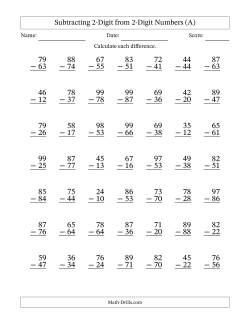
- Subtracting 2-Digit from 2-Digit Numbers with Some Regrouping (Large Print) ✎
- Subtracting 1-Digit from 3-Digit Numbers with Some Regrouping (Large Print) ✎
- Subtracting 2-Digit from 3-Digit Numbers with Some Regrouping (Large Print) ✎
- Subtracting 3-Digit from 3-Digit Numbers with Some Regrouping (Large Print) ✎
- Subtracting 1- to 3-Digit from 1- to 3-Digit Numbers with Some Regrouping (Large Print) ✎
- Subtracting 3-Digit from 4-Digit Numbers with Some Regrouping (Large Print) ✎
(3.3) Subtracting 4- to 9-Digit Numbers with Some Regrouping
- Subtracting 4-Digit from 4-Digit Numbers with Some Regrouping ✎
- Subtracting 4-Digit from 5-Digit Numbers with Some Regrouping ✎
- Subtracting 5-Digit from 5-Digit Numbers with Some Regrouping ✎
- Subtracting 5-Digit from 6-Digit Numbers with Some Regrouping ✎
- Subtracting 6-Digit from 6-Digit Numbers with Some Regrouping ✎
- Subtracting 6-Digit from 7-Digit Numbers with Some Regrouping ✎
- Subtracting 7-Digit from 7-Digit Numbers with Some Regrouping ✎
- Subtracting 7-Digit from 8-Digit Numbers with Some Regrouping ✎
- Subtracting 8-Digit from 8-Digit Numbers with Some Regrouping ✎
- Subtracting 8-Digit from 9-Digit Numbers with Some Regrouping ✎
- Subtracting 9-Digit from 9-Digit Numbers with Some Regrouping ✎
(3.4) Subtracting 4- to 6-Digit Numbers with Some Regrouping (Large Print)
- Subtracting 4-Digit from 4-Digit Numbers with Some Regrouping (Large Print) ✎
- Subtracting 4-Digit from 5-Digit Numbers with Some Regrouping (Large Print) ✎
- Subtracting 5-Digit from 5-Digit Numbers with Some Regrouping (Large Print) ✎
- Subtracting 5-Digit from 6-Digit Numbers with Some Regrouping (Large Print) ✎
- Subtracting 6-Digit from 6-Digit Numbers with Some Regrouping (Large Print) ✎
For students who need a little extra help with lining things up, these long subtraction worksheets have the digits spaced farther apart on a grid. The answer keys also show the carrying values to help diagnose where things went wrong (but hopefully they won't).
(3.5) Long Subtraction Worksheets with Grid Support
- 2-Digit Minus 2-Digit Subtraction With Grid Support
- 3-Digit Minus 2-Digit Subtraction With Grid Support
- 3-Digit Minus 3-Digit Subtraction With Grid Support
- 4-Digit Minus 3-Digit Subtraction With Grid Support
- 4-Digit Minus 4-Digit Subtraction With Grid Support
- 5-Digit Minus 4-Digit Subtraction With Grid Support
- 5-Digit Minus 5-Digit Subtraction With Grid Support
- 6-Digit Minus 5-Digit Subtraction With Grid Support
- 6-Digit Minus 6-Digit Subtraction With Grid Support
- 2- to 4-Digit Minus 2- to 4-Digit Subtraction With Grid Support
- 3- to 6-Digit Minus 3- to 6-Digit Subtraction With Grid Support
The next long subtraction worksheets include questions that require regrouping at every step. They can be frustrating and difficult for students who are not familiar with the concept of subtraction. Try showing them with base ten blocks how regrouping works.
(3.6) Subtracting up to 3-Digit Numbers with All Regrouping
(3.7) Subtracting up to 3-Digit Numbers with All Regrouping (Large Print)
(3.8) Subtracting 4- to 8-Digit Numbers with All Regrouping
(3.9) Subtracting 4- to 6-Digit Numbers with All Regrouping (Large Print)
Some students require a little extra help when learning to subtract large numbers. These subtraction worksheets include questions where the regrouping step has been eliminated. This might help students learn a subtraction algorithm before learning about regrouping.
(3.10) Subtracting up to 3-Digit Numbers with No Regrouping
- Subtracting 2-Digit from 2-Digit Numbers with NO Regrouping ✎
- Subtracting 2-Digit from 3-Digit Numbers with NO Regrouping ✎
- Subtracting 3-Digit from 3-Digit Numbers with NO Regrouping ✎
- Subtracting 2-Digit from 4-Digit Numbers with NO Regrouping ✎
- Subtracting 3-Digit from 4-Digit Numbers with NO Regrouping ✎
(3.11) Subtracting up to 3-Digit Numbers with No Regrouping (Large Print)
- Subtracting 2-Digit from 2-Digit Numbers with NO Regrouping (Large Print) ✎
- Subtracting 2-Digit from 3-Digit Numbers with NO Regrouping (Large Print) ✎
- Subtracting 3-Digit from 3-Digit Numbers with NO Regrouping (Large Print) ✎
- Subtracting 2-Digit from 4-Digit Numbers with NO Regrouping (Large Print) ✎
- Subtracting 3-Digit from 4-Digit Numbers with NO Regrouping (Large Print) ✎
(3.12) Subtracting 4- to 9-Digit Numbers with No Regrouping
- Subtracting 4-Digit from 4-Digit Numbers with NO Regrouping ✎
- Subtracting 5-Digit from 5-Digit Numbers with NO Regrouping ✎
- Subtracting 6-Digit from 6-Digit Numbers with NO Regrouping ✎
- Subtracting 7-Digit from 7-Digit Numbers with NO Regrouping ✎
- Subtracting 8-Digit from 8-Digit Numbers with NO Regrouping ✎
- Subtracting 9-Digit from 9-Digit Numbers with NO Regrouping ✎
(3.13) Subtracting 4- to 6-Digit Numbers with No Regrouping (Large Print)
Why horizontal subtraction worksheets? Students can show their understanding of place value and number sense if they do not already have the numbers lined up. Vertical subtraction is often learned based on a student's understanding of single-digit subtraction, but looking at the whole number is lost in the algorithm.
(3.14) Horizontally Arranged 2-Digit Minus 1-Digit Questions
(3.15) Horizontally Arranged 2-Digit Minus 2-Digit Questions
(3.16) Horizontally Arranged 3-Digit Minus 1-Digit Questions
(3.17) Horizontally Arranged 3-Digit Minus 2-Digit Questions
(3.18) Horizontally Arranged 3-Digit Minus 3-Digit Questions
(3.19) Horizontally Arranged Various-Digit Minus Various-Digit Questions
Many students in English-speaking countries are used to seeing numbers with comma-separated thousands.
(3.20) Long Subtraction Worksheets with Comma Separated Thousands
- Subtracting 2-Digit from 4-Digit Numbers (Comma Separated) ✎
- Subtracting 3-Digit from 4-Digit Numbers (Comma Separated) ✎
- Subtracting 4-Digit from 4-Digit Numbers (Comma Separated) ✎
- Subtracting 2-Digit from 5-Digit Numbers (Comma Separated) ✎
- Subtracting 3-Digit from 5-Digit Numbers (Comma Separated) ✎
- Subtracting 4-Digit from 5-Digit Numbers (Comma Separated) ✎
- Subtracting 5-Digit from 5-Digit Numbers (Comma Separated) ✎
- Mixture of Multi-Digit Subtraction from 2 to 4 digits (Comma Separated) ✎
- Mixture of Multi-Digit Subtraction from 2 to 5 digits (Comma Separated) ✎
(3.21) Long Subtraction Worksheets with Comma Separated Thousands and All Regrouping
- Subtracting 4-Digit Numbers with ALL Regrouping (Comma Separated) ✎
- Subtracting 5-Digit Numbers with ALL Regrouping (Comma Separated) ✎
- Subtracting 6-Digit Numbers with ALL Regrouping (Comma Separated) ✎
- Subtracting 7-Digit Numbers with ALL Regrouping (Comma Separated) ✎
- Subtracting 8-Digit Numbers with ALL Regrouping (Comma Separated) ✎
(3.22) Long Subtraction Worksheets with Comma Separated Thousands and No Regrouping
- Subtracting 5-Digit from 5-Digit Numbers with NO Regrouping (Comma Separated) ✎
- Subtracting 6-Digit from 6-Digit Numbers with NO Regrouping (Comma Separated) ✎
- Subtracting 7-Digit from 7-Digit Numbers with NO Regrouping (Comma Separated) ✎
- Subtracting 8-Digit from 8-Digit Numbers with NO Regrouping (Comma Separated) ✎
- Subtracting 9-Digit from 9-Digit Numbers with NO Regrouping (Comma Separated) ✎
Space-separated thousands are becoming more widely used, including in the United States. Canadian students have used both comma separated and space separated thousands for many years.
(3.23) Long Subtraction Worksheets with Space Separated Thousands
- Subtracting 2-Digit from 4-Digit Numbers (Space Separated) ✎
- Subtracting 3-Digit from 4-Digit Numbers (Space Separated) ✎
- Subtracting 4-Digit from 4-Digit Numbers (Space Separated) ✎
- Subtracting 2-Digit from 5-Digit Numbers (Space Separated) ✎
- Subtracting 3-Digit from 5-Digit Numbers (Space Separated) ✎
- Subtracting 4-Digit from 5-Digit Numbers (Space Separated) ✎
- Subtracting 5-Digit from 5-Digit Numbers (Space Separated) ✎
- Mixture of Multi-Digit Subtraction from 2 to 4 digits (Space Separated) ✎
- Mixture of Multi-Digit Subtraction from 2 to 5 digits (Space Separated) ✎
(3.24) Long Subtraction Worksheets with Space Separated Thousands and All Regrouping
- Subtracting 4-Digit Numbers with ALL Regrouping (Space Separated) ✎
- Subtracting 5-Digit Numbers with ALL Regrouping (Space Separated) ✎
- Subtracting 6-Digit Numbers with ALL Regrouping (Space Separated) ✎
- Subtracting 7-Digit Numbers with ALL Regrouping (Space Separated) ✎
- Subtracting 8-Digit Numbers with ALL Regrouping (Space Separated) ✎
(3.25) Long Subtraction Worksheets with Space Separated Thousands and No Regrouping
- Subtracting 5-Digit from 5-Digit Numbers with NO Regrouping (Space Separated) ✎
- Subtracting 6-Digit from 6-Digit Numbers with NO Regrouping (Space Separated) ✎
- Subtracting 7-Digit from 7-Digit Numbers with NO Regrouping (Space Separated) ✎
- Subtracting 8-Digit from 8-Digit Numbers with NO Regrouping (Space Separated) ✎
- Subtracting 9-Digit from 9-Digit Numbers with NO Regrouping (Space Separated) ✎
Even though period separated thousands are not common in the English-speaking world, we provide these for our friends in other countries who may find them useful.
(3.26) Long Subtraction Worksheets with Period Separated Thousands
- Subtracting 2-Digit from 4-Digit Numbers (Period Separated) ✎
- Subtracting 3-Digit from 4-Digit Numbers (Period Separated) ✎
- Subtracting 4-Digit from 4-Digit Numbers (Period Separated) ✎
- Subtracting 2-Digit from 5-Digit Numbers (Period Separated) ✎
- Subtracting 3-Digit from 5-Digit Numbers (Period Separated) ✎
- Subtracting 4-Digit from 5-Digit Numbers (Period Separated) ✎
- Subtracting 5-Digit from 5-Digit Numbers (Period Separated) ✎
- Mixture of Multi-Digit Subtraction from 2 to 4 digits (Period Separated) ✎
- Mixture of Multi-Digit Subtraction from 2 to 5 digits (Period Separated) ✎
(3.27) Long Subtraction Worksheets with Period Separated Thousands and All Regrouping
- Subtracting 4-Digit Numbers with ALL Regrouping (Period Separated) ✎
- Subtracting 5-Digit Numbers with ALL Regrouping (Period Separated) ✎
- Subtracting 6-Digit Numbers with ALL Regrouping (Period Separated) ✎
- Subtracting 7-Digit Numbers with ALL Regrouping (Period Separated) ✎
- Subtracting 8-Digit Numbers with ALL Regrouping (Period Separated) ✎
(3.28) Long Subtraction Worksheets with Period Separated Thousands and No Regrouping
- Subtracting 5-Digit from 5-Digit Numbers with NO Regrouping (Period Separated) ✎
- Subtracting 6-Digit from 6-Digit Numbers with NO Regrouping (Period Separated) ✎
- Subtracting 7-Digit from 7-Digit Numbers with NO Regrouping (Period Separated) ✎
- Subtracting 8-Digit from 8-Digit Numbers with NO Regrouping (Period Separated) ✎
- Subtracting 9-Digit from 9-Digit Numbers with NO Regrouping (Period Separated) ✎
4 Various Other Long Subtraction Worksheets

Generally, a student would not regroup to determine the complements of 10, 100, 1000, etc. One strategy that could be used is as follows: working from left to right, a student would take each digit in the subtrahend and figure out its nines complement. If the digit was 3, for example, the nines complement of 3 is 6. For the last digit (ones), the student would use the tens complement. For example, a typical question is 1000 - 456. The nines complement of 4 is 5, the nines complement of 5 is 4 and the tens complement of 6 is 4. Putting it all together, the student would get 5 4 4 or 544 = 1000 - 456.
(4.1) Calculating Complements of Powers of Ten (Subtracting Across Zeros)
A similar strategy is employed with the next worksheets except students must adapt to calculating the largest place value number.
(4.2) Calculating Complements of Multiples of Powers of Ten (Subtracting Across Zeros)
- Subtracting from multiples of 10
- Subtracting from multiples of 100
- Subtracting from multiples of 1000
- Subtracting from multiples of 10000
- Subtracting from a mixture of multiples of 100 and 1000
- Subtracting from a mixture of multiples of 1000 and 10000
- Subtracting from a mixture of multiples of 100, 1000 and 10000
These worksheets are meant to give students practice dealing with 0's in the middles of subtraction questions. Whether using pencil and paper or mental arithmetic, it is always a good idea to make sure students know what to do when they encounter zeros.
(4.3) Subtracting Across Zeros in the Middle (Ones Always Need Regrouping)
(4.4) Subtracting Across Zeros in the Middle (Ones Sometimes Need Regrouping)
Subtracting numbers in number systems other than decimal numbers including binary, quaternary, octal, duodecimal and hexadecimal numbers.
(4.5) Subtracting in Other Base Number Systems
- Subtracting Binary Numbers (Base 2)
- Subtracting Ternary Numbers (Base 3)
- Subtracting Quaternary Numbers (Base 4)
- Subtracting Quinary Numbers (Base 5)
- Subtracting Senary Numbers (Base 6)
- Subtracting Octal Numbers (Base 8)
- Subtracting Duodecimal Numbers (Base 12)
- Subtracting Hexadecimal Numbers (Base 16)
- Subtracting Vigesimal Numbers (Base 20)
- Subtracting Hexatrigesimal Numbers (Base 36)
- Subtracting Various Numbers (Various Bases)

