Multi Database Support
Running Multiple Databases in MIDAS
Organisations with more than one site often reach a point where a single booking system doesn't map neatly to their structure. A community organisation running halls in three separate towns, a university with facilities spread across multiple campuses, a company with offices in different cities - each location has its own rooms, its own clients, and its own booking patterns.MIDAS handles this through its multi-database feature. A single MIDAS installation can run multiple independent databases under one login URL, each acting as a self-contained booking system.
What each database contains independently
Each database within your MIDAS system has its own venues, resources, users, clients, invoices, and settings. Changes in one database don't affect the others. If you need the catering team at one site to only see that site's bookings, that's simply a matter of assigning them to the correct database.Access for users
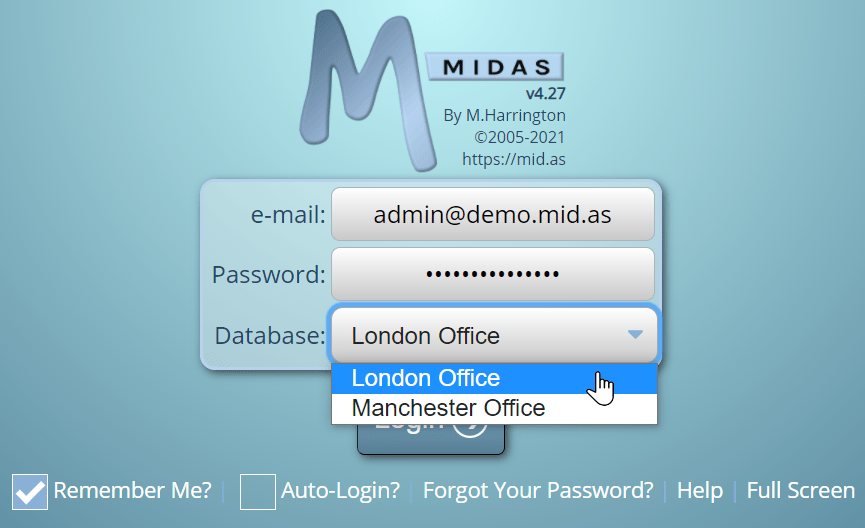
Users log in at the same URL regardless of which site they work at. After logging in they can select which database to access - or, if they only have access to one, they go straight in. A user can have access to multiple databases if their role requires it.Cost compared to separate systems
Adding an additional database to an existing MIDAS installation costs significantly less than purchasing a second standalone system. The hosting, the domain, the maintenance overhead - all of that stays the same. You're simply extending one system rather than running two.→ Start a free trial to explore how the multi-database setup works.
Further reading:
