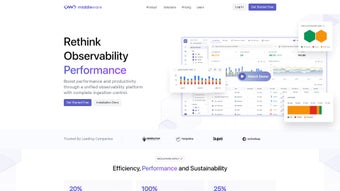

Download Middleware – Umfassende Monitoring‑Observability‑Plattform
Intro – Warum Middleware die moderne Observability‑Lösung ist
In den heutigen hyper‑skalierenden Cloud‑Umgebungen ist ein einziges Dashboard, das jede Ecke Ihres Anwendungs‑Stacks beleuchten kann, kein Luxus mehr – es ist eine Notwendigkeit. Teams, die auf fragmentierte Werkzeuge setzen, verbringen oft unzählige Stunden damit, Logs, Metriken und Traces zusammenzufügen, nur um kritische Vorfälle zu verpassen, die durch die Lücken schlüpfen. Die Middleware Observability Platform beseitigt diese Reibung, indem sie eine cloud‑native Monitoring‑Lösung liefert, die tiefe Telemetrie, Echtzeit‑Analytics und automatisierte Diagnosen in einem kohärenten Tool vereint. Von Grund auf für Micro‑Service‑Architekturen konzipiert, bietet Middleware End‑to‑End‑Sichtbarkeit auf Antwortzeiten, Fehlerraten, Ressourcenverbrauch und die komplexen Interaktionen zwischen Services, Datenbanken, Queues und Dritt‑API‑Schnittstellen. Durch das Sammeln von Metriken, Traces und Logs in einem einheitlichen Schema können Ingenieure vom „Feuer‑löschen“ zu proaktivem Performance‑Management übergehen und die mittlere Wiederherstellungszeit (MTTR) drastisch reduzieren.
Was Middleware wirklich auszeichnet, ist die Fähigkeit, mühelos mit Ihren Workloads zu skalieren. Egal, ob Sie ein paar Container auf einer einzigen VM betreiben oder Tausende von Pods über mehrere Regionen orchestrieren, die verteilte Architektur der Plattform garantiert latenzarme Datenerfassung und nahezu Echtzeit‑Alarmierung. Die intuitiven Dashboards und anpassbaren Widgets ermöglichen es Ihnen, exakt die Ansicht zu erstellen, die Sie benötigen – sei es als DevOps‑Leiter, der SLA‑Einhaltung verfolgt, als SRE, der Latenzspitzen überwacht, oder als Produktmanager, der fehlerbehaftete Nutzererfahrungen verstehen möchte. Sicherheit und Compliance sind im Kern verankert: Daten werden während der Übertragung und im Ruhezustand verschlüsselt, und rollenbasierte Zugriffskontrollen (RBAC) erlauben präzise Berechtigungen für Teams, Auftragnehmer oder Auditoren. Die Integration mit gängigen CI/CD‑Pipelines und IaC‑Tools stellt sicher, dass Observability von Tag 1 Teil Ihres Deployment‑Workflows ist und blinde Flecken nach jedem Release reduziert werden. Kurz gesagt, Middleware stattet Organisationen jeder Größe mit den Erkenntnissen aus, die nötig sind, um hohe Performance, Verfügbarkeit und Kosteneffizienz in ihren Cloud‑Ökosystemen zu gewährleisten.
Key Features – Powering Comprehensive Monitoring
- Unified Metrics, Traces, and Logs: Collect and correlate data from every layer of your stack without juggling multiple tools.
- Real‑Time Alerting & Anomaly Detection: AI‑driven thresholds identify outliers before they become incidents.
- Distributed Tracing Across Services: Follow a request end‑to‑end, pinpoint latency sources, and visualize call graphs.
- Dynamic Dashboards & Custom Widgets: Drag‑and‑drop interface lets you build role‑specific views in minutes.
- Auto‑Discovery of Services: Seamlessly detects new micro‑services, containers, or serverless functions as they are deployed.
- Scalable Cloud‑Native Architecture: Horizontal scaling ensures ingestion of millions of data points per second.
- Granular RBAC & Audit Trails: Secure access controls meet SOC 2, ISO 27001, and GDPR requirements.
- Integrations & API‑First Design: Native connectors for Kubernetes, Docker, AWS, Azure, GCP, Prometheus, Grafana, Slack, PagerDuty, and more.
- Cost‑Optimization Insights: Spot over‑provisioned resources, idle instances, and recommend right‑sizing.
- Self‑Service Reporting: Export data to CSV, PDF, or embed charts into internal portals.
Each feature has been engineered to reduce the operational overhead that typically accompanies observability solutions. For instance, the auto‑discovery engine taps into cloud provider APIs and container orchestrators to map service dependencies automatically, eliminating manual configuration. Meanwhile, the AI‑driven anomaly detection continuously learns normal traffic patterns, allowing it to flag subtle deviations that traditional static thresholds would miss. The platform’s extensible API also means you can push custom metrics from proprietary applications or pull data into your existing ITSM tools, ensuring a seamless workflow across the organization. Whether you are looking to improve MTTR, enforce SLOs, or simply gain confidence that your infrastructure can handle peak loads, Middleware’s feature set provides the foundation for a robust, future‑proof observability strategy that scales with your business.
Installation, Usage, and Compatibility Guide
Step‑by‑Step Installation
Getting Middleware up and running is intentionally straightforward. The platform is offered as a SaaS solution with optional on‑premises deployment for highly regulated environments.
1. Create an Account – Visit the official website, click “Sign Up,” and provide your corporate email. A verification link is sent to complete the registration.
2. Choose a Deployment Model – For most users, the cloud‑hosted version is ideal. If you need an on‑premises instance, download the Docker‑compose bundle or the Helm chart for Kubernetes.
3. Deploy the Collector Agents – Install the lightweight agent on each host or container. Agents are available for Windows, macOS, Linux, as well as for serverless runtimes (AWS Lambda, Azure Functions, Google Cloud Functions). The agent automatically discovers running processes, instruments them, and begins streaming telemetry to the central platform.
4. Configure Data Sources – Use the web UI to add integrations such as Prometheus, Elasticsearch, or custom HTTP endpoints. Middleware’s auto‑discovery will suggest services based on the agents it detects.
5. Set Up Alerts & Dashboards – Leverage pre‑built templates for common use‑cases (e.g., API latency, database connection errors). Customize thresholds, notification channels, and escalation policies.
The entire process from sign‑up to first dashboard typically takes under 30 minutes, even for complex multi‑cloud environments.
Daily Usage Workflow
Once installed, daily interaction with Middleware revolves around three core activities: monitoring, troubleshooting, and optimization.
Monitoring: The home dashboard presents key performance indicators (KPIs) such as request latency percentiles, error‑rate trends, and CPU/memory utilization across all services. You can drill down into any metric, apply time‑range filters, and compare against historical baselines.
Troubleshooting: When an alert fires, click the incident in the “Alerts” panel to open the correlated trace view. Middleware highlights the exact hop where latency spiked or an exception occurred, and provides stack‑trace details, environment variables, and recent log entries.
Optimization: The “Cost Insights” tab aggregates resource usage data, suggesting right‑sizing actions. Export reports to share with finance or operations teams, and track the impact of any changes directly in the platform.
The intuitive UI is fully responsive, meaning you can investigate incidents from a laptop, tablet, or even a mobile phone using the dedicated iOS/Android apps.
Compatibility Across Environments
Middleware is built to be truly cross‑platform. The collector agents support:
- Windows Server 2016 + (64‑bit)
- macOS 10.15 + (Apple Silicon and Intel)
- Linux distributions: Ubuntu 18.04 + , Debian 10 + , CentOS 7/8, Red Hat Enterprise Linux 8
- Kubernetes 1.18 + (any conformant distribution)
- Docker Engine 19.03 +
- Serverless runtimes: AWS Lambda (Node.js, Python, Java), Azure Functions, Google Cloud Functions
Because the backend is cloud‑native, you can ingest data from on‑premise data centers, public clouds, or hybrid environments without additional gateways. The platform also respects proxy settings, TLS certificates, and SSO integrations (SAML, OAuth2, OpenID Connect), ensuring seamless adoption across diverse IT landscapes.
Pros, Cons, FAQ, and Conclusion – Your Path to Unified Observability
Pros and Cons
Middleware delivers a powerful blend of features that address the most pressing challenges in modern cloud monitoring. Its unified data model, AI‑driven alerting, and extensive integration ecosystem make it a compelling choice for enterprises seeking to streamline operations and improve reliability. The platform’s scalability ensures it can handle growth from a few services to thousands without performance degradation, while robust security measures keep sensitive telemetry safe. On the downside, some advanced AI capabilities are reserved for higher‑tier subscription plans, which may increase costs for smaller teams. Additionally, organizations that prefer a purely on‑premises solution must manage the additional complexity of self‑hosting the platform.
Pros:
- Unified observability across metrics, logs, and traces.
- AI‑driven anomaly detection reduces noise and improves early detection.
- Auto‑discovery accelerates onboarding of new services.
- Scalable architecture handles high‑volume data streams.
- End‑to‑end encryption and granular RBAC meet stringent compliance standards.
Cons:
- Advanced AI features require premium licensing.
- On‑premises deployment adds operational overhead compared to the managed SaaS option.
- Self‑service reporting formats are limited to CSV and PDF, with no native Excel export.
Frequently Asked Questions
What types of data does Middleware collect?
Middleware captures metrics, distributed traces, and log events from every component of your stack, providing a single source of truth for performance analysis.
Can I use Middleware in a hybrid cloud environment?
Yes. The platform’s agents run on-premise, in public clouds, and in serverless runtimes, allowing you to monitor hybrid workloads without additional gateways.
Is there a free trial available?
A 14‑day free trial is offered for the SaaS version, giving you full access to all core features before you decide on a subscription plan.
Conclusion – Take Control of Your Cloud Performance Today
If you’re ready to replace fragmented monitoring tools with a single, secure, and scalable observability platform, Middleware is the answer. Its AI‑enhanced alerting, comprehensive integrations, and cost‑optimization insights empower your teams to detect problems faster, resolve them with confidence, and keep operational expenses in check. Don’t let hidden performance issues erode user trust or inflate your cloud bill—take the first step toward unified visibility by signing up for a free trial today. Click the “Start Free Trial” button below, and experience the difference that a truly modern observability solution can make for your organization.



.png)