new

Get trending papers in your email inbox!

Subscribe

Trending Papers

byImageAK and the research community

Trending Papers

A decoder-only foundation model for time-series forecasting

A large language model adapted for time-series forecasting achieves near-optimal zero-shot performance on diverse datasets across different time scales and granularities.

  • 4 authors
· Oct 14, 2023
Submitted by
Image
taesiri

GLM-5: from Vibe Coding to Agentic Engineering

GLM-5 advances foundation models with DSA for cost reduction, asynchronous reinforcement learning for improved alignment, and enhanced coding capabilities for real-world software engineering.

  • Image
  • Image
  • Image
  • Image
  • Image
  • 186 authors
· Feb 17, 2026

TradingAgents: Multi-Agents LLM Financial Trading Framework

A multi-agent framework using large language models for stock trading simulates real-world trading firms, improving performance metrics like cumulative returns and Sharpe ratio.

  • 4 authors
· Dec 28, 2024
Submitted by
Image
taesiri

SkillOpt: Executive Strategy for Self-Evolving Agent Skills

SkillOpt introduces a systematic text-space optimizer for agent skills that trains skills as external agent state with stable updates and zero deployment inference overhead, achieving superior performance across multiple benchmarks and execution environments.

MicrosoftResearch Microsoft Research · May 22, 2026

EverMemOS: A Self-Organizing Memory Operating System for Structured Long-Horizon Reasoning

EverMemOS presents a self-organizing memory system for large language models that processes dialogue streams into structured memory cells and scenes to enhance long-term interaction capabilities.

  • 11 authors

· Jan 5, 2026
Submitted by
Image
ChengCui

PaddleOCR-VL-1.6: Expanding the Frontier of Document Parsing with Under-Optimized Region Refinement and Progressive Post-Training

PaddleOCR-VL-1.6 enhances document parsing performance through targeted data optimization and progressive post-training techniques, achieving state-of-the-art results on OmniDocBench v1.6.

PaddlePaddle PaddlePaddle · Jun 2, 2026
Submitted by
Image
akhaliq

OpenDevin: An Open Platform for AI Software Developers as Generalist Agents

OpenDevin is a platform for developing AI agents that interact with the world by writing code, using command lines, and browsing the web, with support for multiple agents and evaluation benchmarks.

  • Image
  • Image
  • Image
  • Image
  • Image
  • 24 authors

· Jul 23, 2024
Submitted by
Image
taesiri

MinerU2.5: A Decoupled Vision-Language Model for Efficient High-Resolution Document Parsing

MinerU2.5, a 1.2B-parameter document parsing vision-language model, achieves state-of-the-art recognition accuracy with computational efficiency through a coarse-to-fine parsing strategy.

  • Image
  • Image
  • Image
  • Image
  • Image
  • 61 authors
· Sep 26, 2025

Kronos: A Foundation Model for the Language of Financial Markets

Kronos, a specialized pre-training framework for financial K-line data, outperforms existing models in forecasting and synthetic data generation through a unique tokenizer and autoregressive pre-training on a large dataset.

  • 7 authors
· Aug 2, 2025
Submitted by
Image
akhaliq

Efficient Memory Management for Large Language Model Serving with PagedAttention

PagedAttention algorithm and vLLM system enhance the throughput of large language models by efficiently managing memory and reducing waste in the key-value cache.

  • Image
  • Image
  • Image
  • Image
  • Image
  • 9 authors
· Sep 12, 2023
Submitted by
Image
qiushao

FastContext: Training Efficient Repository Explorer for Coding Agents

FastContext separates repository exploration from code solving in LLM agents using specialized exploration models that reduce token consumption and improve resolution rates.

microsoft Microsoft · Jun 12, 2026

LMCache: An Efficient KV Cache Layer for Enterprise-Scale LLM Inference

LMCACHE enables efficient KV cache management for large language models by storing caches outside GPU memory, supporting cache reuse across queries and inference engines while achieving significant throughput improvements.

  • Image
  • Image
  • 11 authors

· Oct 8, 2025
Submitted by
Image
akhaliq

Mem0: Building Production-Ready AI Agents with Scalable Long-Term Memory

Mem0, a memory-centric architecture with graph-based memory, enhances long-term conversational coherence in LLMs by efficiently extracting, consolidating, and retrieving information, outperforming existing memory systems in terms of accuracy and computational efficiency.

  • Image
  • Image
  • 5 authors
· Apr 28, 2025
Submitted by
Image
SenXu1123

VibeThinker-3B: Exploring the Frontier of Verifiable Reasoning in Small Language Models

VibeThinker-3B demonstrates that compact models can achieve state-of-the-art performance on verifiable reasoning tasks through specialized training techniques, challenging conventional scaling assumptions.

WeiboAI WeiboAI · Jun 15, 2026
Submitted by
Image
taesiri

LTX-2: Efficient Joint Audio-Visual Foundation Model

LTX-2 is an open-source audiovisual diffusion model that generates synchronized video and audio content using a dual-stream transformer architecture with cross-modal attention and classifier-free guidance.

  • Image
  • Image
  • Image
  • Image
  • Image
  • 29 authors
· Jan 6, 2026
Submitted by
Image
iieycx

JoyAI-VL-Interaction: Real-Time Vision-Language Interaction Intelligence

A vision-language model operates continuously in real-time, making autonomous decisions about when to respond or delegate, enabling interactive systems that perceive and act upon environmental changes without user prompting.

jdopensource JD.com Open Source · Jun 10, 2026

OmniFlatten: An End-to-end GPT Model for Seamless Voice Conversation

A novel GPT-based model, OmniFlatten, enables real-time natural full-duplex spoken dialogue through a multi-stage post-training technique that integrates speech and text without altering the original model's architecture.

  • Image
  • 9 authors
· Oct 23, 2024
Submitted by
Image
RuofengYang

ARIS: Autonomous Research via Adversarial Multi-Agent Collaboration

ARIS is an open-source research harness that uses cross-model adversarial collaboration to ensure reliable long-term research outcomes through coordinated execution, orchestration, and assurance layers.

Submitted by
Image
namespace-ERI

Toward Generalist Autonomous Research via Hypothesis-Tree Refinement

An AI framework called Arbor enables autonomous scientific research by combining strategic coordination, isolated hypothesis testing, and a persistent knowledge tree to iteratively improve research outcomes across multiple domains.

RUC-NLPIR NLPIR Lab @ RUC · Jun 10, 2026
Submitted by
Image
zbhpku

DataFlow: An LLM-Driven Framework for Unified Data Preparation and Workflow Automation in the Era of Data-Centric AI

DataFlow is an LLM-driven data preparation framework that enhances data quality and reproducibility for various tasks, improving LLM performance with automatically generated pipelines.

PekingUniversity Peking University · Dec 18, 2025
Submitted by
Image
andito

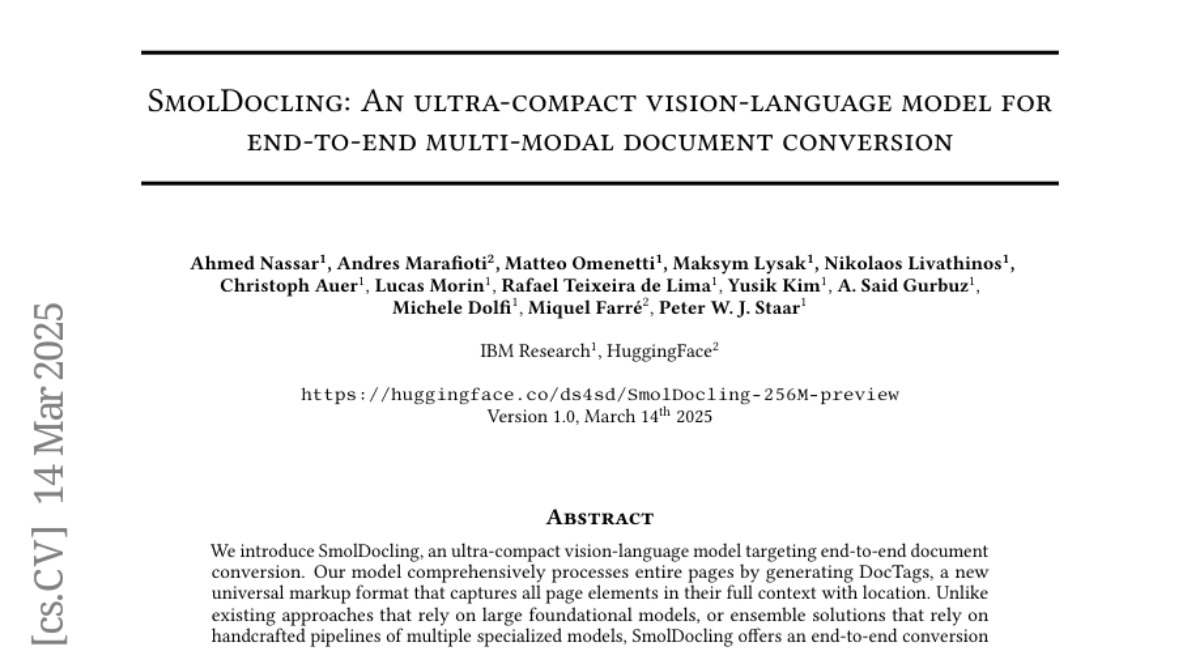
SmolDocling: An ultra-compact vision-language model for end-to-end multi-modal document conversion

SmolDocling is a compact vision-language model that performs end-to-end document conversion with robust performance across various document types using 256M parameters and a new markup format.

ibm-granite IBM Granite · Mar 14, 2025
Submitted by
Image
AdinaY

DreamX-World 1.0: A General-Purpose Interactive World Model

DreamX-World 1.0 is a interactive text/image-to-video model that generates long-horizon content with camera control and scene persistence using specialized encoding, training techniques, and optimization methods.

GD-ML AMAP-ML · Jun 15, 2026
Submitted by
Image
rajkumarrawal

Recursive Language Models

We study allowing large language models (LLMs) to process arbitrarily long prompts through the lens of inference-time scaling. We propose Recursive Language Models (RLMs), a general inference strategy that treats long prompts as part of an external environment and allows the LLM to programmatically examine, decompose, and recursively call itself over snippets of the prompt. We find that RLMs successfully handle inputs up to two orders of magnitude beyond model context windows and, even for shorter prompts, dramatically outperform the quality of base LLMs and common long-context scaffolds across four diverse long-context tasks, while having comparable (or cheaper) cost per query.

Multi-module GRPO: Composing Policy Gradients and Prompt Optimization for Language Model Programs

mmGRPO, a multi-module extension of GRPO, enhances accuracy in modular AI systems by optimizing LM calls and prompts across various tasks.

  • Image
  • 13 authors
· Aug 6, 2025
Submitted by
Image
taesiri

Cosmos 3: Omnimodal World Models for Physical AI

Cosmos 3 is an omnimodal world model that processes and generates multiple data types through a unified mixture-of-transformers architecture, achieving state-of-the-art performance in various understanding and generation tasks.

nvidia NVIDIA · Jun 1, 2026
Submitted by
Image
jiaruz2

Recursive Multi-Agent Systems

RecursiveMAS extends recursive scaling principles from single models to multi-agent systems, enabling collaborative reasoning through iterative latent-space computations with improved efficiency and accuracy.

StanfordUniversity Stanford University · Apr 28, 2026
Submitted by
Image
mervenoyan

RF-DETR: Neural Architecture Search for Real-Time Detection Transformers

RF-DETR, a light-weight detection transformer, uses weight-sharing NAS to optimize accuracy and latency for real-time detection across diverse datasets.

Roboflow Roboflow · Nov 12, 2025
Submitted by
Image
nielsr

Ultralytics YOLO26: Unified Real-Time End-to-End Vision Models

YOLO26 addresses real-time vision challenges through a unified model family with NMS-free inference, improved training strategies, and multi-task capabilities spanning detection, segmentation, and pose estimation.

Ultralytics Ultralytics · Jun 2, 2026
Submitted by
Image
fdugyt

MOSS-TTS Technical Report

MOSS-TTS is a speech generation model using discrete audio tokens and autoregressive modeling with capabilities for voice cloning, pronunciation control, and long-form generation across multiple languages.

OpenMOSS-Team OpenMOSS · Mar 18, 2026
Submitted by
Image
shanyou92

Kairos: A Native World Model Stack for Physical AI

Kairos is a world model framework that learns from diverse experiences, maintains persistent states through hybrid temporal attention mechanisms, and operates efficiently across different hardware platforms for physical AI applications.

  • Image
  • Image
  • Image
  • Image
  • 24 authors
· Jun 16, 2026
Submitted by
Image
MoeinAbtahi

Memanto: Typed Semantic Memory with Information-Theoretic Retrieval for Long-Horizon Agents

Memanto presents a universal memory layer for agentic AI that eliminates computational overhead of hybrid semantic graph architectures through a typed semantic memory schema and information-theoretic search engine.

moorcheh Moorcheh.ai · Apr 23, 2026

Zep: A Temporal Knowledge Graph Architecture for Agent Memory

Zep, a memory layer service, outperforms MemGPT in the DMR benchmark and LongMemEval by excelling in dynamic knowledge integration and temporal reasoning, critical for enterprise use cases.

  • Image
  • Image
  • 5 authors
· Jan 20, 2025
Submitted by
Image
Uyoung

Moebius: 0.2B Lightweight Image Inpainting Framework with 10B-Level Performance

A lightweight image inpainting framework achieves high-fidelity results with significantly reduced parameters and inference time through novel local-global interaction blocks and adaptive distillation strategies.

  • Image
  • Image
  • 6 authors
· Jun 17, 2026
Submitted by
Image
taesiri

SCAIL-2: Unifying Controlled Character Animation with End-to-end In-Context Conditioning

SCAIL-2 enables end-to-end character animation by directly transferring motion from driving videos without intermediate representations, using unified task decomposition and synthetic data generation.

zai-org Z.ai · Jun 9, 2026
Submitted by
Image
taesiri

AgentScope 1.0: A Developer-Centric Framework for Building Agentic Applications

AgentScope enhances agentic applications by providing flexible tool-based interactions, unified interfaces, and advanced infrastructure based on the ReAct paradigm, supporting efficient and safe development and deployment.

  • Image
  • Image
  • Image
  • 23 authors
· Aug 22, 2025
Submitted by
Image
jasonrqh

COLLEAGUE.SKILL: Automated AI Skill Generation via Expert Knowledge Distillation

Person-grounded AI skills are automatically distilled from heterogeneous traces into inspectable, correctable packages that capture both capabilities and behavioral patterns.

ShanghaiAiLab shanghai ailab · May 29, 2026

AI-Trader: Benchmarking Autonomous Agents in Real-Time Financial Markets

AI-Trader presents the first fully automated live benchmark for evaluating large language models in financial decision-making across multiple markets with autonomous information processing.

  • Image
  • Image
  • 6 authors
· Dec 1, 2025
Submitted by
Image
akhaliq

Very Large-Scale Multi-Agent Simulation in AgentScope

Enhancements to the AgentScope platform improve scalability, efficiency, and ease of use for large-scale multi-agent simulations through distributed mechanisms, flexible environments, and user-friendly tools.

  • Image
  • Image
  • Image
  • Image
  • 8 authors
· Jul 25, 2024

LightRAG: Simple and Fast Retrieval-Augmented Generation

LightRAG improves Retrieval-Augmented Generation by integrating graph structures for enhanced contextual awareness and efficient information retrieval, achieving better accuracy and response times.

  • 5 authors
· Oct 8, 2024

PDFMathTranslate: Scientific Document Translation Preserving Layouts

PDFMathTranslate enables layout-preserving scientific document translation using large language models and precise layout detection, offering improved precision, flexibility, and efficiency.

  • 4 authors
· Jul 2, 2025

PyTorch Distributed: Experiences on Accelerating Data Parallel Training

The PyTorch distributed data parallel module optimizes large-scale model training using techniques like gradient bucketing, computation-communication overlap, and selective synchronization to achieve near-linear scalability.

  • Image
  • Image
  • Image
  • 11 authors
· Jun 28, 2020
Submitted by
Image
akhaliq

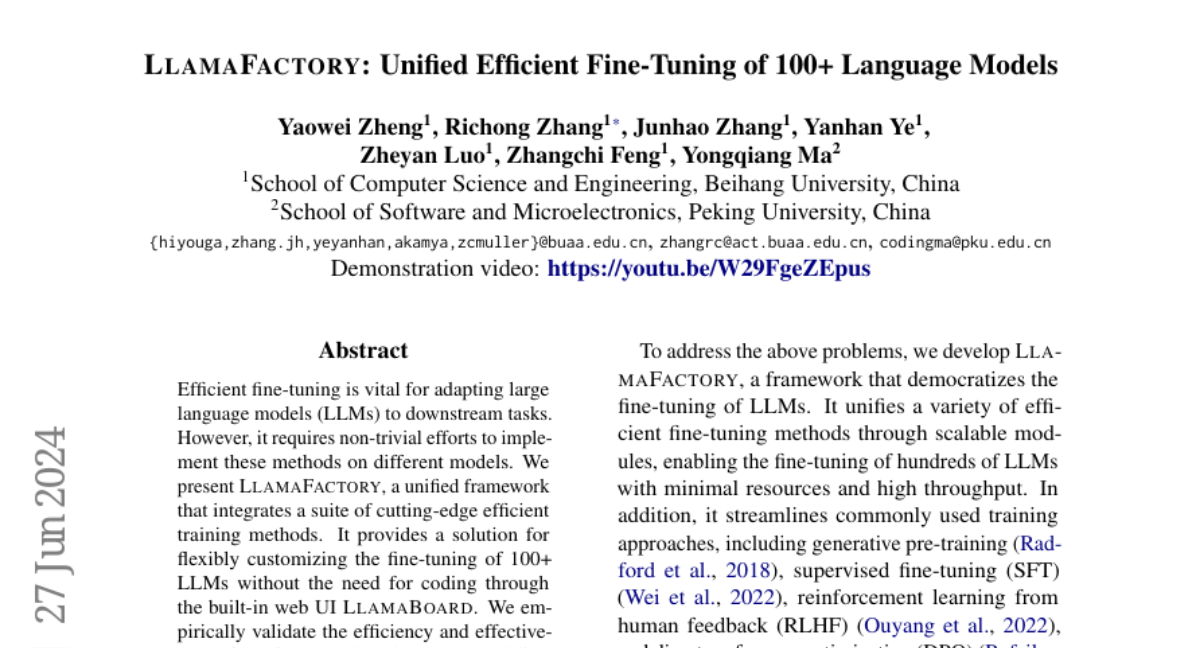
LlamaFactory: Unified Efficient Fine-Tuning of 100+ Language Models

LlamaFactory is a unified framework enabling efficient fine-tuning of large language models across various tasks using a web-based user interface.

  • Image
  • Image
  • Image
  • 5 authors
· Mar 20, 2024
Submitted by
Image
hao-li

Agent READMEs: An Empirical Study of Context Files for Agentic Coding

Agentic coding tools receive goals written in natural language as input, break them down into specific tasks, and write or execute the actual code with minimal human intervention. Central to this process are agent context files ("READMEs for agents") that provide persistent, project-level instructions. In this paper, we conduct the first large-scale empirical study of 2,303 agent context files from 1,925 repositories to characterize their structure, maintenance, and content. We find that these files are not static documentation but complex, difficult-to-read artifacts that evolve like configuration code, maintained through frequent, small additions. Our content analysis of 16 instruction types shows that developers prioritize functional context, such as build and run commands (62.3%), implementation details (69.9%), and architecture (67.7%). We also identify a significant gap: non-functional requirements like security (14.5%) and performance (14.5%) are rarely specified. These findings indicate that while developers use context files to make agents functional, they provide few guardrails to ensure that agent-written code is secure or performant, highlighting the need for improved tooling and practices.

  • Image
  • 11 authors
· Nov 17, 2025

Enhancing Financial Sentiment Analysis via Retrieval Augmented Large Language Models

A retrieval-augmented LLM framework improves financial sentiment analysis by tuning LLMs for sentiment prediction and augmenting them with external context, outperforming traditional models and other LLMs.

  • 5 authors
· Oct 6, 2023
Submitted by
Image
Ray368

GateMem: Benchmarking Memory Governance in Multi-Principal Shared-Memory Agents

Current memory agents lack reliable shared institutional deployment due to challenges in balancing utility, access control, and forgetting across multiple principals with diverse authorization contexts.

  • Image
  • 10 authors
· Jun 17, 2026
Submitted by
Image
unilm

VibeVoice Technical Report

VibeVoice synthesizes long-form multi-speaker speech using next-token diffusion and a highly efficient continuous speech tokenizer, achieving superior performance and fidelity.

MicrosoftResearch Microsoft Research · Aug 26, 2025

IndexTTS: An Industrial-Level Controllable and Efficient Zero-Shot Text-To-Speech System

IndexTTS, an enhanced text-to-speech system combining XTTS and Tortoise models, offers improved naturalness, enhanced voice cloning, and controllable usage through hybrid character-pinyin modeling and optimized vector quantization.

  • 5 authors
· Feb 8, 2025
Submitted by
Image
cmhungsteve

SpatialClaw: Rethinking Action Interface for Agentic Spatial Reasoning

SpatialClaw is a training-free framework that uses code as an action interface to enable flexible, stateful spatial reasoning in vision-language models, achieving superior performance across diverse 3D/4D spatial reasoning tasks.

nvidia NVIDIA · Jun 11, 2026
Submitted by
Image
Paranioar

SenseNova-U1: Unifying Multimodal Understanding and Generation with NEO-unify Architecture

Unified vision-language models treat understanding and generation as integrated processes rather than separate tasks, demonstrating strong performance across multiple multimodal capabilities including image synthesis and action reasoning.

sensenova SenseNova · May 12, 2026
Submitted by
Image
hsaest

QUEST: Training Frontier Deep Research Agents with Fully Synthetic Tasks

QUEST is an open-family of deep research agents trained with synthesized data and reinforcement learning to perform well across diverse long-horizon search tasks.

osunlp OSU NLP Group · May 22, 2026