
Download RSS Menu – Minimalist RSS/Atom Aggregator for Mac
Overview
RSS Menu is a lightweight, free Mac application that lives quietly in your menu bar while keeping you up‑to‑date with the latest headlines from your favorite blogs, podcasts, and news sites. Developed by Edot‑studios, the tool supports both RSS and Atom feeds, offering a no‑frills experience that emphasizes speed, stability, and seamless integration with macOS. The current release, version 1.11.6, was refreshed on 10 March 2008 and adds enhanced Keychain support, bug fixes, and performance improvements that make it a reliable companion for anyone who wants a quick glance at fresh content without opening a full‑featured reader. Because it runs as a menu‑bar item, RSS Menu consumes far less screen real‑estate than traditional feed readers, making it ideal for minimalist users, writers, and developers who spend most of their day in front of a terminal or IDE. The app is built for macOS 10.4 (Tiger) and later, and it remains fully compatible with modern macOS releases thanks to its modest system requirements and reliance on native Apple frameworks. With over 1,500 downloads since its first appearance in 2006, RSS Menu has proven its staying power as a dependable, secure, and unobtrusive news aggregator. Whether you are looking for a free way to monitor industry blogs, track project updates, or simply enjoy a quick daily news digest, RSS Menu delivers a polished experience that feels native to the Mac environment.
Key Features of RSS Menu
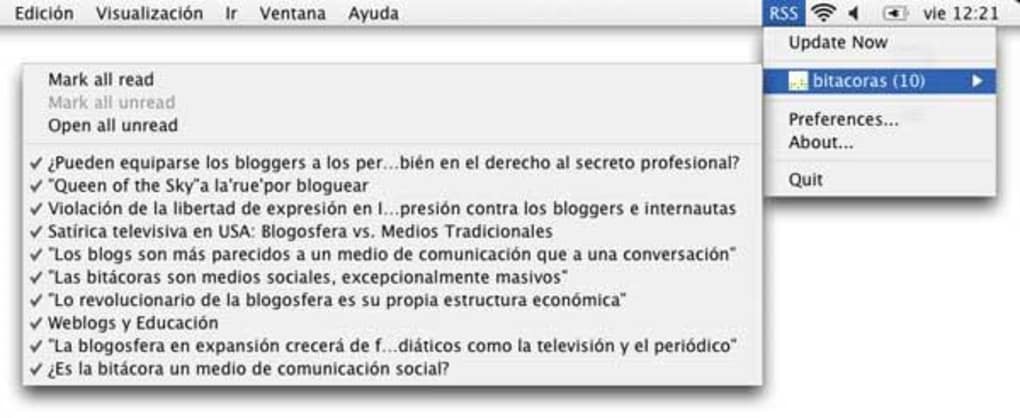
- Menu‑Bar Integration: Displays unread counts and headlines directly in the macOS menu bar for instant access.
- Support for RSS & Atom: Handles both feed formats, allowing you to add any standard feed without conversion.
- Keychain‑Protected Credentials: Stores login information securely in macOS Keychain, keeping private feeds safe.
- Drag‑and‑Drop Feed Adding: Simply drag a feed URL onto the menu icon to subscribe instantly.
- Customizable Refresh Intervals: Choose how often the app polls each source, balancing freshness with bandwidth.
- Lightweight & Low‑Memory Footprint: Uses minimal system resources, leaving CPU and RAM available for primary tasks.
- Automatic Update Checks: Notifies you when a newer version is available, ensuring you always run the most secure build.
- Simple Unread/Read Toggle: Mark items as read with a single click, or clear all at once from the dropdown.
- Native macOS Look & Feel: Follows Apple’s Human Interface Guidelines for a seamless visual experience.
- Offline Caching: Stores the latest headlines locally so you can browse when you’re not connected to the internet.
Installation, Usage & Compatibility
Getting RSS Menu up and running on your Mac takes just a few minutes. Follow these steps for a smooth installation:
- Download the DMG: Click the “Download RSS Menu” button below to retrieve the latest DMG file from the official Edot‑studios site.
- Mount the Disk Image: Double‑click the downloaded
.dmgfile; macOS will mount it as a virtual drive. - Copy to Applications: Drag the
RSS Menu.appicon into your/Applicationsfolder. This step also grants the necessary permissions for the app to access the menu bar. - Launch the App: Open
RSS Menufrom Launchpad or Finder. The icon will appear in the menu bar, usually at the far right. - Add Feeds: Click the menu icon, select “Add Feed,” and paste the URL of any RSS or Atom feed. Alternatively, drag a URL directly onto the icon for instant subscription.
- Configure Settings: Use the preferences pane (accessible via the gear icon) to adjust refresh intervals, set notification styles, and enable Keychain integration for private feeds.
RSS Menu is compatible with macOS 10.4 (Tiger) and all subsequent releases, including macOS 12 Monterey, macOS 13 Ventura, and macOS 14 Sonoma. The app runs natively on Intel and Apple Silicon processors, thanks to Apple’s universal binary support. Because it relies on standard macOS frameworks, there are no additional runtimes or libraries required.
Once configured, using RSS Menu is intuitive: clicking the menu bar icon reveals a dropdown list of your subscribed feeds, each showing the number of unread items. Selecting a headline opens the linked article in your default web browser, while a quick right‑click provides options to mark items as read, delete a feed, or open the feed’s website directly. The app also offers a “Refresh All” command for manual updates, though most users rely on the automatic interval they set during installation.
Security is a core concern. By leveraging macOS Keychain, RSS Menu ensures that any credentials you store for protected feeds are encrypted and only accessible by the app itself. This eliminates the need for plain‑text password files and aligns with Apple’s security best practices. Regular updates—delivered through the built‑in update checker—address emerging vulnerabilities and keep the application stable across macOS releases.
Pros & Cons
- Pros
- Free, no hidden costs or subscription fees.
- Extremely lightweight; negligible impact on system performance.
- Native macOS integration provides a clean, unobtrusive UI.
- Secure storage of credentials via Keychain.
- Drag‑and‑drop feed addition simplifies the onboarding process.
- Works on both Intel and Apple Silicon Macs.
- Cons
- Lacks advanced organization features such as tags or folders.
- No built‑in article preview; links open in external browsers.
- Interface is deliberately minimal, which may feel too sparse for power users.
- Last major update was in 2008; while stable, some users may prefer more actively maintained alternatives.
Frequently Asked Questions
Is RSS Menu compatible with the latest macOS versions?
Yes. RSS Menu runs on macOS 10.4 (Tiger) and later, including macOS 12, 13, and 14. The universal binary ensures smooth operation on both Intel and Apple Silicon Macs.
Can I import a large number of feeds at once?
While RSS Menu does not include a bulk‑import feature, you can add multiple feeds quickly by dragging a text file containing one URL per line onto the menu icon. Each URL will be processed and added sequentially.
Does the app support private or password‑protected feeds?
Yes. When you add a protected feed, RSS Menu stores the username and password securely in macOS Keychain, ensuring that credentials are encrypted and only accessible to the application.
How does RSS Menu handle offline reading?
The app caches the most recent headlines locally, allowing you to view titles and descriptions even when you lose internet connectivity. However, full article content is opened in your default browser, so offline reading is limited to headlines.
Is there a way to customize the appearance of the menu bar icon?
RSS Menu uses a static monochrome icon that matches the macOS menu bar style. At present, the application does not provide icon‑customization options, preserving its minimalist aesthetic.
Conclusion – Should You Download RSS Menu?
If you value a clean, unobtrusive way to stay on top of your favorite RSS and Atom feeds without sacrificing system performance, RSS Menu is a compelling choice. Its free price tag, native macOS integration, and secure handling of private feeds make it an excellent fit for writers, developers, and anyone who prefers a “set‑and‑forget” news reader perched in the menu bar. While power users might miss advanced categorization or an in‑app article preview, the app’s simplicity is precisely what sets it apart from bloated alternatives. For anyone looking to add a reliable, lightweight aggregator to their Mac toolbox, the answer is clear: download RSS Menu today, configure a few feeds, and enjoy a constant stream of fresh content without ever leaving your desktop.