High-performance imagery. Simplified.

Turn your Simera Sense imagery into analysis-ready data without the complexity of building your own processing pipeline. Calibrated following ESA EDAP+ best practice guidelines.

Vito Remote Sensing Logo

Get to insights faster.

IPT is purpose-built for the Simera Sense xScape product range. It handles multispectral and hyperspectral payloads from raw L0 data through to orthorectified, radiometrically calibrated products.

Precise georeferencing

Direct georeferencing using satellite telemetry with GPS positioning and star tracker attitudes.

Calibrated radiometry

Convert raw digital numbers to TOA (Top of Atmosphere) radiance or reflectance with per-pixel DSNU and PRNU corrections.

Seamless integration

Designed for the Simera Sense xScape product range, handling multispectral and hyperspectral payloads.

Multi-level processing

From raw L0 data through radiometrically and geometrically corrected L1B to fully orthorectified L1C products.
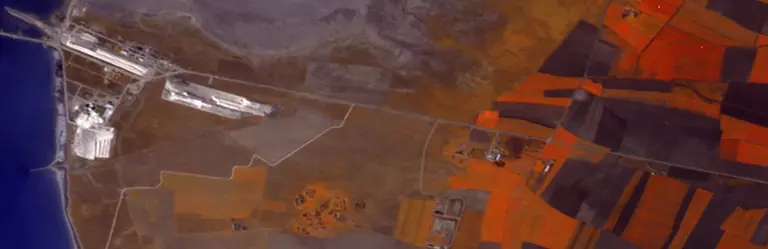
Simera Sense Image processing Tool example

Choose the tier that works for you.

IPT offers two distinct processing tiers. Whether you need a fast turnaround for quick image assessment or a fully calibrated, orthorectified product ready for downstream analysis, IPT has you covered.

Express Image Processing

Fast turnaround for quick image assessment. Ideal for mission operators who need a rapid look at newly acquired data before committing to full processing.

Fast turnaround for quick image assessment

Pre-flight calibration coefficients

Satellite telemetry-based geolocation

L1B and L1C product generation

Interbands geometric correction

Direct georeferencing with RPC generation

Advanced Image Processing

Full in-flight calibration and precision correction for mission-critical applications where accuracy is non-negotiable.

Everything in Express Image Processing, plus:

Vicarious in-flight radiometric calibration

Dark current update from night-time orbits

Absolute calibration using Libya-4, Niger-2, RadCalnet

Cross-validation with Sentinel-2A and 2B

Geometric calibration with bundle adjustment and GCPs

Calibration done to ESA EDAP+ best practice guidelines

From raw telemetry to analysis-ready data.

IPT processes satellite imagery through three well-defined stages, each building on the last. Every step is traceable, calibrated, and compatible with standard downstream tools.

Raw Data Processing

Decompression, packet assembly, and GPS synchronisation.
LEVEL0

Radiometric & Geometric Correction

Band co-registration, direct georeferencing, and optional vertical/horizontal destriping.
LEVEL1B

Orthorectification

Full terrain relief correction using DEM and resampling to a fixed grid at native GSD.
LEVEL1C

Built for the applications that matter.

IPT produces data that feeds directly into mission-critical workflows across agriculture, environmental monitoring, defence, and disaster response.

Precision agriculture

Water management

Forestry

Mining

Battlefield assessment

Disaster assessment

Ready to process your satellite imagery?

Talk to our team about integrating IPT into your mission pipeline, or download the product brochure to share with your team.

FAQ

Got more questions?
We’re here to help!
The IPT (Image Processing Tool) is a processing solution for the Simera Sense xScape optical camera range. It converts raw satellite acquisitions into structured product levels with increasing calibration, geolocation, and usability.

The specification describes three main product levels:

  • Level 0: raw satellite data with minimal processing.
  • Level 1B: radiometrically corrected or calibrated and geo-referenced data that remains in sensor geometry.
  • Level 1C: orthorectified and projected data suitable for direct geospatial analysis.

Express processing relies on pre-flight laboratory radiometric measurements and ancillary satellite or camera metadata to geolocate and correct imagery. It does not include in-flight calibration.

Advanced processing adds in-flight vicarious radiometric calibration and advanced geometric calibration to improve absolute radiometric and geolocation performance.

A Level 0 product is raw, unprocessed data directly acquired from the satellite. It is primarily organized and packaged rather than corrected. Typical content includes original sensor readings, time and location stamps, telemetry, and auxiliary metadata.

Level 0 focuses on data integrity and preparation for later stages. Key steps include data decompression, packet assembly into frames or swaths, time tagging and synchronization, and storage in a standard archival format. No radiometric or geometric correction is applied at this stage.
Level 1B provides Top-of-Atmosphere radiance or reflectance data after radiometric and geometric processing. The data remains in sensor geometry, but each pixel is linked to geographic information.
Level 1C adds orthorectification and projection, producing georeferenced, radiometrically corrected or calibrated imagery aligned to a fixed map grid. It is intended for direct geospatial analysis and operational use.
  • Interband geometric correction
  • Direct georeferencing using telemetry, position, velocity, and attitude data
  • RPC generation for geometric modelling
  • Radiometric processing from DN to TOA radiance or TOA reflectance
  • Optional vertical and horizontal de-striping
  • Band-specific grayscale quicklook generation
It corrects spectral band misregistration, where the same ground point is not perfectly aligned across bands. This improves multispectral and hyperspectral analysis quality for tasks like classification, vegetation monitoring, and change detection.
Direct georeferencing uses satellite position, velocity, attitude, and sensor line-of-sight information to estimate the geographic location of pixels on Earth, typically expressed as longitude, latitude, and height.
Rational Polynomial Coefficients (RPCs) are mathematical coefficients that approximate the relationship between image coordinates and ground coordinates. They simplify georeferencing and orthorectification without requiring full detailed sensor models in downstream software.
Radiometric processing corrects raw digital numbers and converts them into physical values. The workflow includes dark signal non-uniformity correction, gain and PRNU correction, optional conversion from TOA radiance to TOA reflectance, and optional high-frequency equalization and destriping.
The advanced option adds in-flight vicarious calibration. It refines radiometric and geometric calibration coefficients after launch, including dark current updates, radiometric checks over desert sites, RadCalNet-based assessment, Sentinel-2 comparison, and geometric calibration using bundle adjustment and ground control points.
Level 1 products serve as input for Level 2 processing. On request, VITO can provide atmospheric correction using our iCOR tool), which produces Top of Canopy (TOC) surface reflectance products.
Level 0 is delivered in raw binary format specific to onboard instruments. Level 1 products use standard Cloud Optimized GeoTIFF for image datasets, plus associated JSON metadata, KML footprint files, and in some cases RPC, TIFF quicklook, and JPEG preview files.
A Level 1B product typically includes a parent product directory, a contour KML file, a JSON metadata file, band subdirectories for spectral-band files, and band-specific datasets such as LTOA, RTOA, quality grids, angle grids, latitude and longitude grids, height grids, and RPC files.
A Level 1C product includes a contour KML file, a JSON metadata file, an RGB quicklook TIFF, an RGB preview JPEG thumbnail, and band subdirectories with LTOA, RTOA, quality, angles, and height datasets.
Level 1C image files can be delivered in either Geographic Lat/Lon (EPSG:4326) or UTM/WGS84, using the relevant EPSG:326xx or EPSG:327xx code depending on hemisphere and zone.
The RGB quicklook is a false-colour COG file built from four 8-bit bands: red, green, blue, and alpha transparency. It is optimized for visual inspection and uses JPEG compression internally.
The RGB preview thumbnail is a downsampled JPEG intended for fast browsing and quick visual inspection. It has no assigned coordinate reference system.
Metadata covers acquisition timing, satellite and sensor details, processing level, geographic coverage, quality indicators, and processing history. It is delivered in a JSON-style key-value format organised by sections.
The General section includes references for the input Level 0 product and output Level 1 product, the processing level, start and stop acquisition times, the IPT software version, and the product generation time.
The CRS section provides the coordinate reference system as a PROJ4 string, a WKT string, and an EPSG code. It also records the ground sampling distance as a formatted value in meters.

The Instrument_Configuration section stores band-level TDI settings, binning factor, and the imager acquisition mode, such as snapshot mode, line scan mode, or high accuracy hyperspectral mode.

The Calibration section includes references to the geometric and radiometric ICP files, boresight and payload-to-body-fixed angles, leap seconds, and polar motion information such as Bulletin-B reference, Delta UT1, and polar motion X and Y coordinates.
The Processing_Steps section indicates whether interband geometric correction and absolute geometric correction were applied, what radiometric output type was generated, and whether high-frequency equalization was applied in across-track and along-track directions.
The Radiometric_Quality section summarises band-by-band percentages of correct pixels, interpolated pixels, missing pixels, negative pixels, and saturated pixels, making it easier to assess scene usability without reading every quality grid manually.

Both product types use a directory naming pattern that combines a free-form prefix with the processing level and the scene start acquisition timestamp. The patterns are
<PREFIX>_LEVEL1B_<START_ACQUISITION_TIME> and
<PREFIX>_LEVEL1C_<START_ACQUISITION_TIME>.

A Level 1B band folder can include TOA radiance or reflectance files, radiometric quality grids, grayscale quicklooks, viewing and solar angle files, longitude and latitude grids at different heights, altitude grids, and RPC files.
A Level 1C band folder can include TOA radiance or reflectance files, radiometric quality grids, viewing and solar angle files, and altitude grids. Unlike Level 1B, Level 1C focuses on projected image products rather than sensor-geometry longitude and latitude layers and RPC packaging.
The specification states that Level 1 image files are Cloud Optimized GeoTIFFs with full-resolution pixels plus lower-resolution overviews for efficient access and display. They use DEFLATE compression and a 512 by 512 block size for the core image datasets.
Each COG image file includes at least three core metadata tags: NoData, Description, and Unit Type. These help users interpret dataset values consistently across tools.
The RPC file stores bias and random error values, line and sample offsets and scales, latitude, longitude, and height offsets and scales, and the numerator and denominator coefficient sets for line and sample transformations.
No. The specification says Level 1B does not include RGB quicklooks. Instead, it provides grayscale quicklooks per spectral band in sensor geometry.
The Level 1C contour KML contains the product footprint and an embedded RGB quicklook, allowing convenient inspection in tools such as Google Earth.
Each Level 1B and Level 1C spectral band includes a radiometric quality grid that stores per-pixel status. Product metadata also reports percentages of correct, missing, interpolated, negative, and saturated pixels per band.

0 = good pixel
1 = missing pixel
2 = input DN saturated
3 = became saturated during DN-to-TOA conversion
4 = became negative during DN-to-TOA conversion
5 = interpolated from neighbouring pixels

Choose Level 1C when you need spatially corrected imagery ready for GIS workflows, mapping, monitoring, or direct geospatial analysis. Choose Level 1B when you need full-resolution sensor geometry with detailed geometric modelling and product-side georeferencing information.
Express processing uses direct georeferencing from satellite GPS and star tracker data. Advanced processing adds geometric calibration with bundle adjustment and accurate Ground Control Points (GCPs) to derive refined interior and exterior orientation parameters, achieving superior absolute geolocation accuracy.

IPT is designed for the Simera Sense xScape optical camera product range (xScape50, xScape100, xScape200) supporting both multispectral and hyperspectral payloads with instrument-dependent spectral band configurations.

IPT is a collaboration between Simera Sense and VITO (Flemish Institute for Technological Research). VITO provides the processing software and vicarious calibration services, while Simera Sense offers the camera hardware and integration.

New generation of optical payloads

Imager Electronics for Optical Front Ends