Announcing Asimov Press, an editorially-independent venture that will publish books and essays that make sense of biology, AI, and our collective future.
Learn more: asimov.com/news/asimov-pr…
We're building software for genetic design. It's called Kernel.
Kernel comes pre-loaded with 600,000+ searchable sequences. These sequences can be dragged and dropped to design plasmids.
You can also filter sequences based on "type," such as promoters, terminators, and so on.
Today we're thrilled to announce $200M in funding from @cppinvestments@Fidelity@HorizonsHK and @a16z !
These funds will fuel the expansion of our mammalian synthetic biology tools and services business to tackle challenges in therapeutics manufacturing
Our ability to design biological systems is improving rapidly.
In 40 years, the field went from modeling three genes in phage to building synthetic gene circuits with 76,000 bases of DNA.
A brief history of genetic design, told in 7 experiments.
Read: letter.asimov.com/p/design-histo…
Today, we announced that the MIT-Broad Foundry team has joined Asimov and set up shop in our main office.
We are retiring the name "Foundry" and switching to Asimov Labs.
Our moonshot, as a team, is to solve genetic design.
Here's what that means...
asimov.com/news/asimov-la…
We're building software for genetic design. It's called Kernel.
After designing a genetic construct in Kernel, you can simulate its performance within a living cell (e.g. E. coli or CHO).
We're working on many tools that will make it easier to design biology. Check it out.🔻
Biology is the world's most advanced technology. But it's so difficult to reliably engineer.
We're launching a technical blog to explain what we're building — and why it's hard — in public. It's modeled on the engineering blogs at Stripe & OpenAI.
Read: asimov.com/news/lift-off
Chinese Hamster Ovary (CHO) cells are used to make roughly 70 percent of all F.D.A. approved biologics—molecules made by living cells—sold on the market.
Many of the most widely used biologics are antibodies; including Humira, with sales exceeding $21 billion in 2022, and
An F1 car is built from 14,500 individual parts. Every screw, and every system, is modeled and simulated before the car is pieced together. We should do the same for biology.
In this blog post, we describe our metabolic simulator for CHO cells. This simulator can reveal
We want to make better, more precise gene therapies.
So we used a transformer model to design synthetic DNA sequences that only switch "on" in specific tissues. One promoter was up to 120x more active in heart vs. liver.
Our latest blog explains how.🔻
asimov.com/news/ai-promot…
Some peptides are good at killing microbes, but also damage mammalian cells.
This study took one such peptide, made thousands of variants, and measured their toxicities.
A ML model, trained on the results, found a peptide with high activity + no toxicity when tested in mice.
GitHub changed the way developers work.
It gave them tools to store code, track changes, and build upon millions of open-source projects.
The same tools should exist for biology. And we're building them...for DNA, rather than lines of code.
letter.asimov.com/p/github
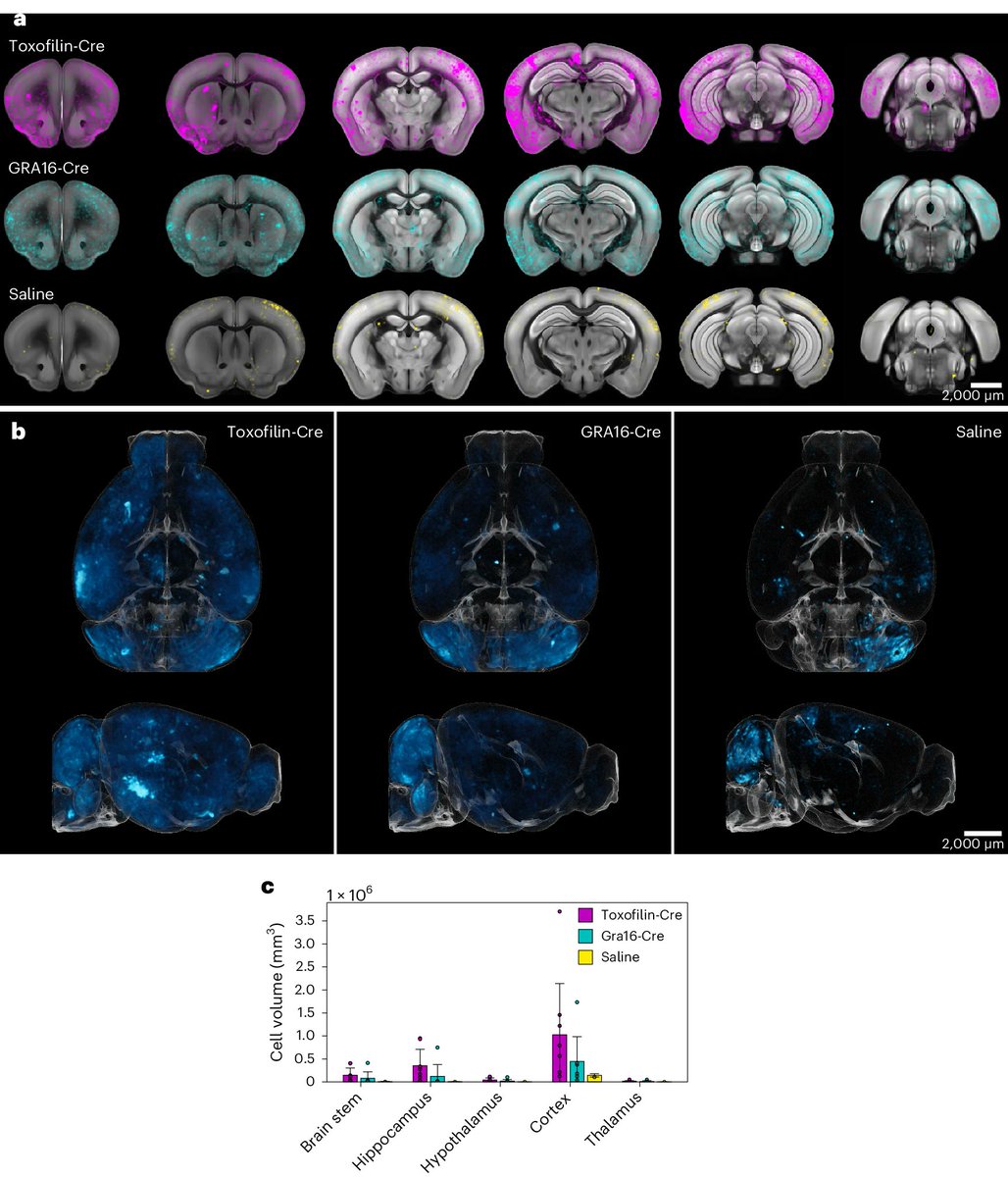
A parasite called Toxoplasma gondii can pass through the blood-brain barrier and enter the central nervous system. Can it be hijacked to deliver molecules into neurons?
Apparently, yes (in mice). A new study in Nature Microbiology reports an engineered T. gondii secretion system