Log inSign up
Hubble Space Telescope
5,059 posts
user avatar
Hubble Space Telescope
@HubbleTelescope
A former account for the Hubble Space Telescope. For more about Hubble, follow @NASAHubble. For more on Hubble's science operations, follow @SpaceTelescope.
Joined June 2008
164
Following
402.9K
Followers
  • Pinned
    user avatar
    Hubble Space Telescope
    @HubbleTelescope
    Oct 16, 2024
    We’ve moved! For the latest updates on Hubble, please go to @NASAHubble. For more on Hubble's science operations, please visit @SpaceTelescope.
    Image
    27K
  • user avatar
    Hubble Space Telescope
    @HubbleTelescope
    Dec 10, 2020
    The location vs The shot
    Image
    Image
  • user avatar
    Hubble Space Telescope
    @HubbleTelescope
    Oct 12, 2020
    How it started (1997): How it’s going (2018):
    Image
    Image
  • user avatar
    Hubble Space Telescope
    @HubbleTelescope
    Apr 6, 2023
    Hubble observed a curious linear feature that was first dismissed as an imaging artifact from the telescope’s cameras. But follow-up observations reveal it is a 200,000-light-year-long chain of young blue stars created in the wake of a runaway black hole: bit.ly/3JTk7Ma
    This illustration shows a black field speckled with white, yellow and red galaxies. A black hole near the bottom left corner of the image plows through space, leaving a diagonal trail of newborn stars stretching back to the black hole’s parent galaxy in the upper right corner. The black hole is represented by a black half-sphere. It is encircled by an elongated disk of material compressed on the lower left side and trailing off on the upper right side. The material closest to the black hole appears pink, white and streaky. Beyond this, the leading edge of the disk, near the bottom, left corner, is milky violet. The disk trails off behind the black hole, becoming black. Beyond the disk, a diagonal “contrail” of blue and pink stars extends toward the blue-and-pink parent galaxy. The bridge of stars trails off, becoming narrower as it approaches the galaxy.
    3M
  • user avatar
    Hubble Space Telescope
    @HubbleTelescope
    Mar 13, 2022
    Happy 241st anniversary to Uranus, discovered by William Herschel on this day in 1781! This Hubble image shows the planet with faint rings and … what are those six white spots surrounding the planet? fal.cn/3mTGM
    Image
  • user avatar
    Hubble Space Telescope
    @HubbleTelescope
    Jan 19, 2023
    Who’s throwing shade? Three of Jupiter’s largest moons—Io, Ganymede, and Callisto—as they cross the planet’s face. Hubble caught the rare triple eclipse in 2004. With labels: bit.ly/3TkPEcx Credit: NASA, ESA, E. Karkoschka (University of Arizona) and L. Barranger.
    Image
    00:00
    566K
  • user avatar
    Hubble Space Telescope
    @HubbleTelescope
    Mar 30, 2022
    #Hubble has spotted the farthest star ever seen! A lucky alignment and natural magnification made it possible for the telescope to see the star’s light, which took 12.9 billion years to reach Earth: fal.cn/3nnSu
    Image
  • user avatar
    Hubble Space Telescope
    @HubbleTelescope
    Mar 30, 2022
    Hubble has established an extraordinary new benchmark: detecting the light of a star⭐️ that existed within the first billion years after the universe's birth in the big bang—the farthest individual star ever seen to date! (1/7) 🧵
    Image
  • user avatar
    Hubble Space Telescope
    @HubbleTelescope
    Jan 27, 2023
    This time-lapse of Hubble images, spanning 22 years, traces the ongoing aftermath of Supernova 1987A. Hubble shows a shockwave from the stellar explosion hitting a ring of material previously cast off by the dying star. Explore the scene: bit.ly/3Hblaal
    Image
    00:00
    529K
  • user avatar
    Hubble Space Telescope
    @HubbleTelescope
    Dec 23, 2022
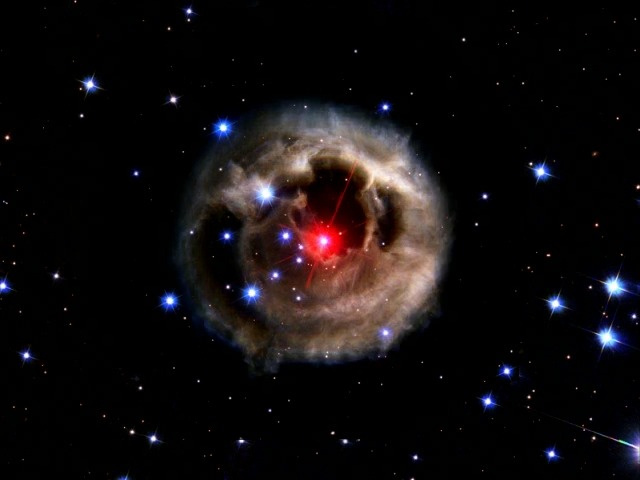
    This dramatic video shows a time-lapse of Hubble photos of V838 Mon, which brightened suddenly in 2002. The brilliant flash reflected off surrounding dusty clouds, creating what’s known as a light echo: bit.ly/3htKM7I
    Image
    00:00
    332K
  • user avatar
    Hubble Space Telescope
    @HubbleTelescope
    Dec 31, 2021
    Hubble had quite a year, but perhaps one its best moments was the release of the 31st anniversary image in April of a giant star on the edge of destruction. Watch as this visualization takes us right up to AG Carinae. Credit: NASA/ESA/STScI
    Image
    00:00
  • user avatar
    Hubble Space Telescope
    @HubbleTelescope
    Apr 4, 2022
    Researchers using the Hubble have caught a planet in the act of what could be likened to a "flash fry"—a violent and intense process called disk instability. (1/7)
    Image
  • user avatar
    Hubble Space Telescope
    @HubbleTelescope
    Oct 8, 2021
    Do you recognize this mystical looking cloud? It’s a spire of cold gas and dust from the famous Eagle Nebula. This soaring tower is 9.5 light-years (57 trillion miles or nearly 92 trillion kilometers) tall 😨: fal.cn/3iTdK
    a close up of a nebula
  • user avatar
    Hubble Space Telescope
    @HubbleTelescope
    Mar 1, 2022
    How can this star-studded field yield clues to the Milky Way galaxy’s early construction stages? It takes a painstaking eye from Hubble researchers: fal.cn/3mzWC
    Image

New to X?

Sign up now to get your own personalized timeline!

Create account

By signing up, you agree to the Terms of Service and Privacy Policy, including Cookie Use.

Terms·Privacy·Cookies·Accessibility·Ads Info·© 2026 X Corp.
Don't miss what's happening
People on X are the first to know.
Log inSign up
Advertisement
Advertisement