Log inSign up
LeoLabs
1,523 posts
Image
user avatar
LeoLabs
@LeoLabs_Space
Persistent Orbital Intelligence 📡 🛰️
Menlo Park, CA
leolabs.space
Joined September 2016
317
Following
27K
Followers
  • Pinned
    user avatar
    LeoLabs
    @LeoLabs_Space
    Jun 10
    A new class of radar is here. Scout-S™ delivers persistent custody, dynamic tracking, and deployable sensing for LEO and VLEO — extending coverage where mission demand is greatest. It's more than a radar. It’s a new approach to space sensing. Deploy Where the Mission Demands.
    Image
    00:00
    7.3K
  • user avatar
    LeoLabs
    @LeoLabs_Space
    Oct 16, 2020
    No indication of collision. 👍 CZ-4C R/B passed over LeoLabs Kiwi Space Radar 10 minutes after TCA. Our data shows only a single object as we'd hoped, with no signs of debris. We will follow up in the coming days on Medium with a full in-depth risk assessment of this event!
  • user avatar
    LeoLabs
    @LeoLabs_Space
    Oct 13, 2020
    We are monitoring a very high risk conjunction between two large defunct objects in LEO. Multiple data points show miss distance <25m and Pc between 1% and 20%. Combined mass of both objects is ~2,800kg. Object 1: 19826 Object 2: 36123 TCA: Oct 16 00:56UTC Event altitude: 991km
    Image
  • user avatar
    LeoLabs
    @LeoLabs_Space
    Feb 28, 2024
    Too close for comfort. 😳 At ~06:30 UTC today we observed a conjunction at 608 km between two non-maneuverable spacecraft: a derelict Russian satellite and an operational NASA satellite. Miss distance = <20 meters Probability of collision = 3 to 8% at TCA
    Image
    519K
  • user avatar
    LeoLabs
    @LeoLabs_Space
    Nov 24, 2023
    ⚠️ We've detected a secondary object in close proximity to Object C, a payload released by Russian satellite COSMOS 2570 around October 30. Our radar measurements indicate that this newest object was released by Object C, possibly on November 23 at 14:00 UTC.
    Image
    402K
  • user avatar
    LeoLabs
    @LeoLabs_Space
    Sep 18, 2023
    ⚠️ On Sept 13, a derelict Soviet-era payload had a conjunction with a Chinese rocket body. The miss distance was 36 m (± 13 m) and the probability of collision was 1E-3 (i.e., 0.1% or 1/1,000). While we've seen more nail biting events, this one is notable — here's why.
    Image
    GIF
    328K
  • user avatar
    LeoLabs
    @LeoLabs_Space
    May 16, 2023
    Another close call in LEO. ⚠️🛰️ Around 7:00 ET today (May 16), we observed a close conjunction at ~545 km between a satellite recently launched out of China and a defunct Soviet-era satellite from 1984. This incident illustrates the collision risk posed by #SpaceDebris.
    Image
    GIF
    478K
  • user avatar
    LeoLabs
    @LeoLabs_Space
    Oct 15, 2020
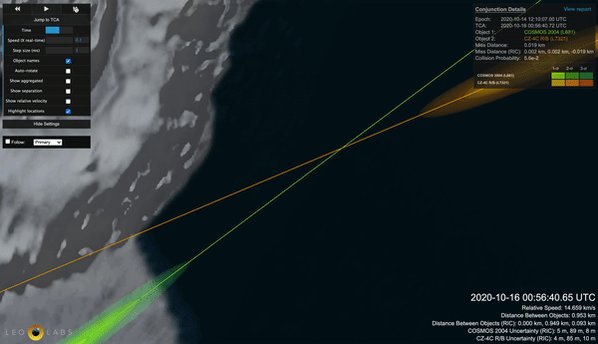
    Data from the most recent event updates show miss distance of 25 meters (+/- 18 meters at 1-sigma uncertainty). We will gather observation data tonight from the first radar pass after TCA to hopefully confirm no new debris is detected.
  • user avatar
    LeoLabs
    @LeoLabs_Space
    Nov 16, 2021
    Some new debris objects from today's breakup (orange orbit) visualized relative to ISS (blue orbit). Objects in white denote largest pieces of Cosmos 1408 tracked by LeoLabs. (Dots not to scale.) Debris ranges in altitude from 440 to 520km.
    Image
    GIF
  • user avatar
    LeoLabs
    @LeoLabs_Space
    Oct 14, 2020
    1/ This event continues to be very high risk and will likely stay this way through the time of closest approach. Our system generates new conjunction reports 6-8x per day on this event with new observation data each time.
    Image
    GIF
  • user avatar
    LeoLabs
    @LeoLabs_Space
    Jan 27, 2020
    1/ We are monitoring a close approach event involving IRAS (13777), the decommissioned space telescope launched in 1983, and GGSE-4 (2828), an experimental US payload launched in 1967. (IRAS image credit: NASA)
    Image
  • user avatar
    LeoLabs
    @LeoLabs_Space
    Oct 16, 2020
    Our latest data confirms Cosmos 2004 is still intact. Our final risk assessment showed a computed miss distance of 11 meters (+16 / -11 meters at 1-sigma uncertainty). More to come next week as we will share a more detailed risk analysis of this event.
    Image
    Image
  • user avatar
    LeoLabs
    @LeoLabs_Space
    Jan 27, 2020
    Replying to @LeoLabs_Space
    2/ On Jan 29 at 23:39:35 UTC, these two objects will pass close by one another at a relative velocity of 14.7 km/s (900km directly above Pittsburgh, PA). Our latest metrics on the event show a predicted miss distance of between 15-30 meters.
    Image
  • user avatar
    LeoLabs
    @LeoLabs_Space
    Apr 21, 2023
    On April 13, we detected a large maneuver by Object 53357, the PRC’s experimental spaceplane. This maneuver resulted in a decrease in altitude from 613 - 355 km. Shown below: the previous orbit is in orange and the new one is in blue.
    Image
    167K

New to X?

Sign up now to get your own personalized timeline!

Create account

By signing up, you agree to the Terms of Service and Privacy Policy, including Cookie Use.

Terms·Privacy·Cookies·Accessibility·Ads Info·© 2026 X Corp.
Don't miss what's happening
People on X are the first to know.
Log inSign up
Advertisement
Advertisement