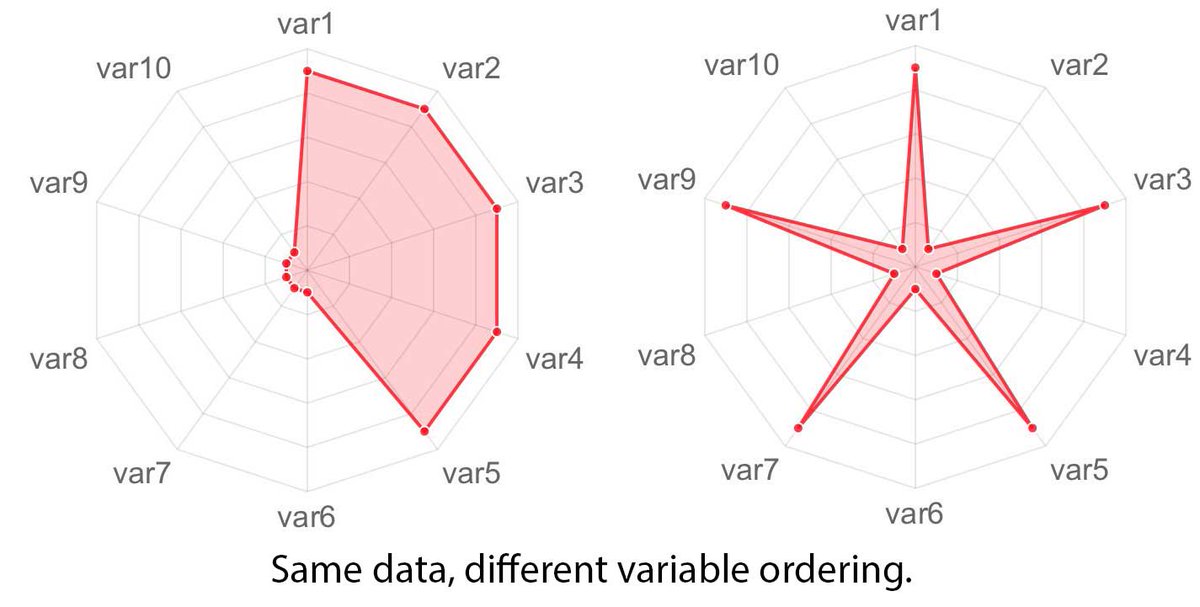
A reminder, blatantly plagiarized from @stat_sam, of why radar plots are misleading. Eye focuses on area, not length.
Luke Bornn
46 posts
Co-Founder and Chief Scientist, @ZelusAnalytics. Formerly @ToulouseFC, @SacramentoKings, @SFU, @ASRomaEN, @Harvard
- Here's a handful of free online resource/textbooks to get you started: * web4.cs.ucl.ac.uk/staff/D.Barber… * camdavidsonpilon.github.io/Probabilistic-… * web.stanford.edu/~hastie/ElemSt… * mlyearning.org * users.stat.umn.edu/~gary/book/fcd… * web.stanford.edu/class/psych209… * r4ds.had.co.nz * adv-r.had.co.nzWith @LukeBornn's call for sports analysts to broaden their technical skills in mind, which are the best online courses (or textbooks etc.) for learning quantitative skills which are useful across a wide range of domains?
- Sports scientists -- Here's evidence that the scientific literature may be grossly over-estimating the value of acute:chronic workload ratios in predicting injuries: Talk: youtube.com/watch?v=TIRINm… Paper: lukebornn.com/papers/bornn_s… Code: github.com/lukebornn/acut…
- My lab has had 11 Sloan papers over the last 5 years: '14: EPV '15: Counterpoints, Move or Die '16: Pressing Game, Court Realty '17: Possession Sketches, Scorekeeper Bias '18: Open Spaces, NFL Injury, NBA Replay, Deep Learning Trajectories here's a summary thread of them all:
- Simpson's Paradox in Basketball: Shooting improves as defenders guard closer (!!). Must condition on shot location. h/t Nate + @afranks53
- Decided in the fall that this will be my last year authoring papers at Sloan. As such, this thread is a great (and complete) resource for the 18 papers we’ve authored there since 2014. SSAC has been really good to me and my students — v thankful for doors opened and friends made!My lab has had 11 Sloan papers over the last 5 years: '14: EPV '15: Counterpoints, Move or Die '16: Pressing Game, Court Realty '17: Possession Sketches, Scorekeeper Bias '18: Open Spaces, NFL Injury, NBA Replay, Deep Learning Trajectories here's a summary thread of them all:
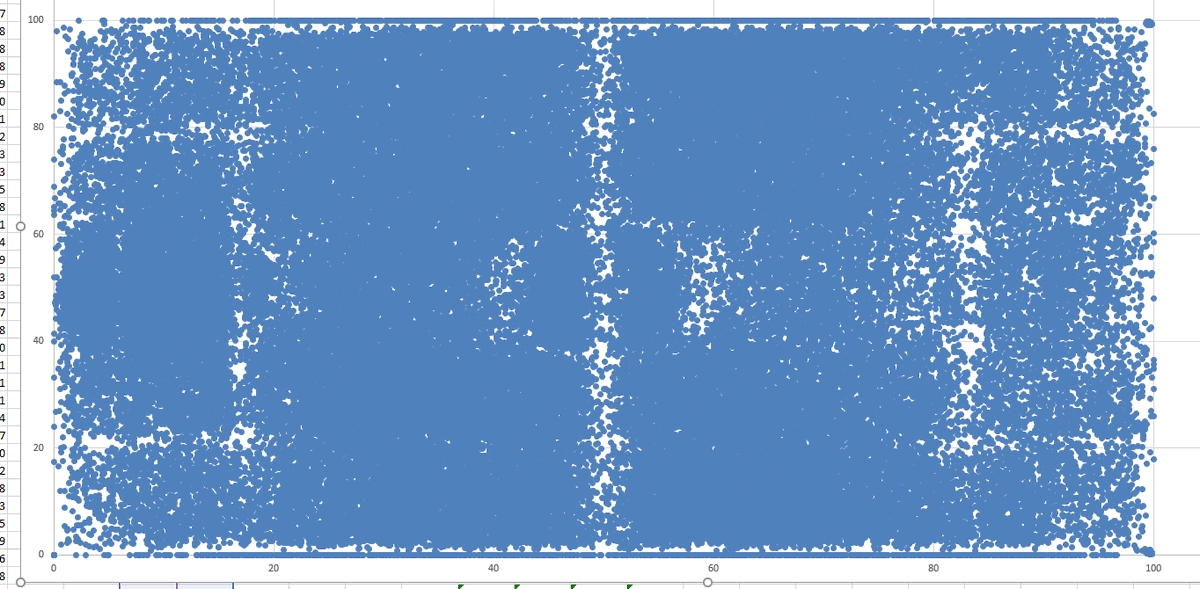
- People usually point to collection bias (events never "exactly on the line") and rounding, but there's more. Tagging locations on a 105x68 pitch is really hard: 2-4m errors are normal. But lines provide a reference point, so tagged locations become much more accurate around them.I was looking at the Premier League event data and noticed that lines are almost visible to naked eye. I think I have seen someone mentioning this before, but it should be a data entry issue, right? No reason for players to avoid lines. Can't find the reference for it.
- I rarely speak publicly on technical topics these days, so I really enjoyed recording an episode on Alex Andorra's Bayes podcast recently. For those with a more technical bent in the stats/analytics community, hopefully there are some useful nuggets here.
- While watching this 0-0 draw, thought I'd try visualizing some personal golf data. The intersection of golfers and sports analysts couldn't fill a foursome, but perhaps a couple of you are interested. First up, a round at Bandon Dunes from earlier in the summer. 1/5
- Replying to @LukeBornn2019a: Soccer EPV (w/ @JaviOnData, @dcervone0). We can measure at every instance the expected value of the current possession by embedding deep learning (to capture 22-player spatio-temporal dynamics) within Markov models (for explainability). lukebornn.com/papers/fernand…
- Replying to @LukeBornn2018a: Open Spaces (w/ @JaviOnData). Using tracking data, we can measure how soccer players create space both for themselves and for their teammates. #SSAC18 lukebornn.com/papers/fernand…
- Replying to @LukeBornnAnd lastly, credit for these projects belongs with the students who lead them: @dcervone0, @alexdamour, @afranks53, @_amiller_, @IavorBojinov, @MattvanBommel, @JaviOnData, @OSPpatrick, Nate, Yatao, Nazanin. Also, to @Harvard, @SFU, @SacramentoKings for supporting the research.