Log inSign up
Prof. Michael Lin
1,576 posts
user avatar
Prof. Michael Lin
@MichaelLinLab
Stanford Neurobiology and Bioengineering Precision molecular design / synbiochem. Also @michaelzlin
Greenberg → Tsien →
linlab.stanford.edu
Joined July 2022
211
Following
2,536
Followers
  • user avatar
    Prof. Michael Lin
    @MichaelLinLab
    Sep 5, 2024
    Congrats to my friend and colleague Guosong Hong for his stunning and original discovery, published today in Science, on clearing tissues *in living animals* with a common food dye! The dye is tartrazine, used in Doritos! science.org/doi/10.1126/sc…
    Image
    436K
  • user avatar
    Prof. Michael Lin
    @MichaelLinLab
    Sep 20, 2024
    Super-excited to reveal our latest fluorescent voltage indicator, ASAP5, now online @NeuroCellPress! ASAP5 features higher responsivity and kinetics, allowing detection of single synaptic transmission events. The link gives free access until 2024.11.09: authors.elsevier.com/a/1joYd3BtfH9B…
    Image
    35K
  • user avatar
    Prof. Michael Lin
    @MichaelLinLab
    Oct 27, 2024
    This may be obvious to some but I'm now convinced: fierce competition for grants and papers is leading to low societal ROI (return on investment). Why, when competition should mean only the best-formulated and executed work is accepted for funding and high-profile publication?
    85K
  • user avatar
    Prof. Michael Lin
    @MichaelLinLab
    Jul 6, 2023
    Today in @naturemethods: our new positively tuned voltage indicator, ASAP4e, for extended electrical recordings in the brain. ASAP4e achieves greater responsivity (>200% per 100mV vs 50% for other fluorescent voltage sensors) and better photostability.
    Content cover image
    A positively tuned voltage indicator for extended electrical recordings in the brain
    From nature.com
    38K
  • user avatar
    Prof. Michael Lin
    @MichaelLinLab
    Oct 18, 2025
    This is at once true and useful, and also what is wrong with science in the 21st century. Being a good scientist is about understanding a field well, thinking of unique hypothesis, and performing experiments carefully to address them. Being a *successful* scientist OTOH ...
    user avatar
    Ali Max Erturk
    @erturklab
    Oct 16, 2025
    I am often asked what the one skill is that young scientists should work on the most. My answer: your storytelling via presentations. The better you present, the more your ideas travel, the more doors open, and the more people want to work with you. A few tips: Have one clear
    Image
    45K
  • user avatar
    Prof. Michael Lin
    @MichaelLinLab
    Oct 18, 2025
    Just submitted my 15th grant proposal of 2025. 2 hits and 5 rejections already, for a 29% hit rate. NIH funding rate this year will be under 5%; otherwise would have skipped most of the smaller ones. But applying for grants every 2-3 weeks is not preferable, to put it mildly.
    28K
  • user avatar
    Prof. Michael Lin
    @MichaelLinLab
    Sep 29, 2023
    Stanford Neurobiology is hiring an assistant professor in any neuroscience area! We are a diverse and friendly group, and committed to staying that way, so people of all backgrounds are encouraged to apply! Reviews start 2023.11.01 URL: facultypositions.stanford.edu/en-us/job/4946… @StanfordBrain
    Image
    32K
  • user avatar
    Prof. Michael Lin
    @MichaelLinLab
    Dec 1, 2023
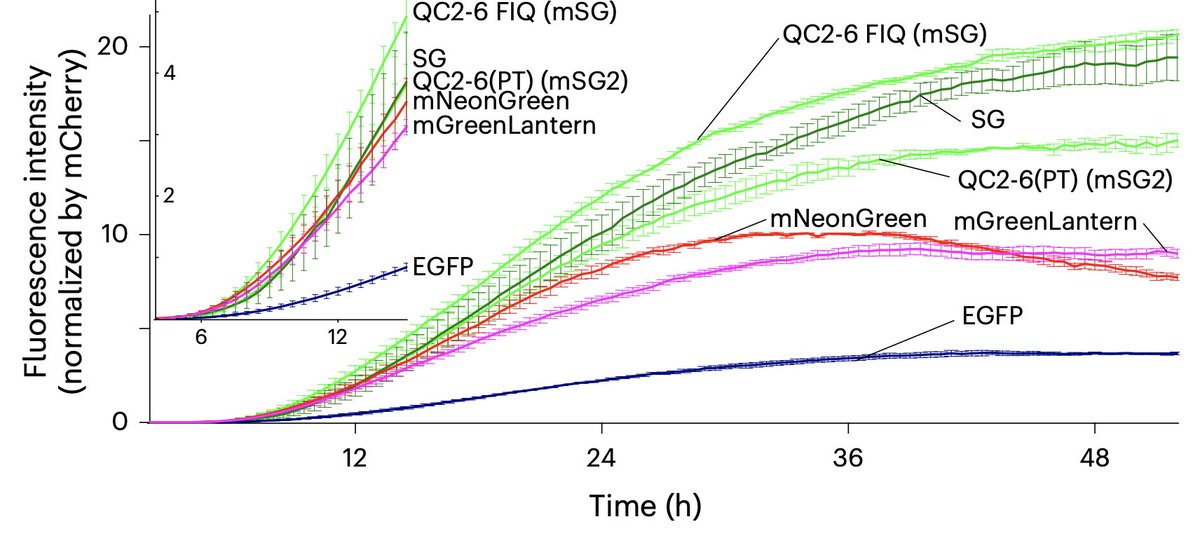
    Looks like we finally have "the next GFP". Until now we had monomeric GFPs brighter than EGFP (mClover3, mNeonGreen, mGreenLantern) but with reduced photostability. In monomeric StayGold (mSG), there's finally an mGFP that is both brighter and more photostable. Brightness:
    Image
    user avatar
    Rita Strack
    @rita_strack
    Nov 30, 2023
    So excited to share this lovely paper from the Miyawaki lab on their monomeric StayGold variants! @michaelzlin and I were chatting at Janelia and he said we're in a second golden age of FP development. I believe it!
    39K
  • user avatar
    Prof. Michael Lin
    @MichaelLinLab
    Jul 27, 2024
    Exciting times for voltage imaging! In a new study published today, our collaborators @attila_losonczy and @a_negrean find that behavior regulates electrical signals in neuronal dendrites in a structured but dynamic way.
    Content cover image
    Functional architecture of intracellular oscillations in hippocampal dendrites
    From nature.com
    12K
  • user avatar
    Prof. Michael Lin
    @MichaelLinLab
    Nov 13, 2025
    Head-mounted 2-photon miniscope voltage imaging! Weijian Yang's group at UC Davis sped up 2p scanning by multiplexing to achieve 400-Hz voltage imaging of ~20 neurons, using ASAP4e. These are the first freely moving single-cell voltage recordings as far as I know.
    Image
    8.1K
  • user avatar
    Prof. Michael Lin
    @MichaelLinLab
    Sep 25, 2024
    Which monomeric GFP is the brightest and most photostable? A winner has just been announced, and it is mStayGold from the Miyawaki lab, edging out two other monomeric StayGold candidates.
    Image
    biorxiv.org
    Quantitative Comparison of Monomeric StayGold Variants Using Protein Nanocages in Living Cells
    To standardize comparison of fluorescent proteins and independently determine which monomeric StayGold variant is best for live microscopy, we analyzed fluorescent protein tagged I3-01 peptides that...
    15K
  • user avatar
    Prof. Michael Lin
    @MichaelLinLab
    Feb 9, 2023
    Out in @nchembio today: our work on cephalofurimazine, a new NanoLuc substrate. We get >20x more light from the brain than FLuc+luciferin, and perform through-skull imaging with our CaMBI activity indicator. Great work by @su_yichi together with @promega nature.com/articles/s4158…
    10K
  • user avatar
    Prof. Michael Lin
    @MichaelLinLab
    Oct 31, 2025
    A reminder that association may not be causation. Also an example of how optogenetics allows causation to be probed, although that too is tricky as it's hard to know if an optogenetic stimulus recapitulates natural ones correctly. Maybe with better voltage imaging to guide it...
    user avatar
    neurosock🧠Brain Chips🦾
    @neurosock
    Oct 30, 2025
    Dopamine ≠ reward but turns out, also not the learning molecule we thought. If DA RPE is the emperor, this work SCREAMS it was running naked all the time. This paper got quite some attention recently. Let me explain why it is so relevant. Here is my toy model and notes:
    Image
    12K
  • user avatar
    Prof. Michael Lin
    @MichaelLinLab
    Dec 6, 2022
    Looking through 13 years of DNA samples to find a plasmid I may or may not have made in the Tsien Lab
    Image
    Image

New to X?

Sign up now to get your own personalized timeline!

Create account

By signing up, you agree to the Terms of Service and Privacy Policy, including Cookie Use.

Terms·Privacy·Cookies·Accessibility·Ads Info·© 2026 X Corp.
Don't miss what's happening
People on X are the first to know.
Log inSign up
Advertisement
Advertisement