Excited to share a new @ScaleAILabs research in collaboration with @phylo_bio on coding agents for drug-discovery research! 💊
We ran Claude Code, Codex, and Gemini on 60+ expert-curated drug-discovery tasks inside a shared Biomni-powered biomedical research environment and the
Scale Labs
122 posts
welcome to the lab.
from the researchers at @scale_AI
Joined October 2025
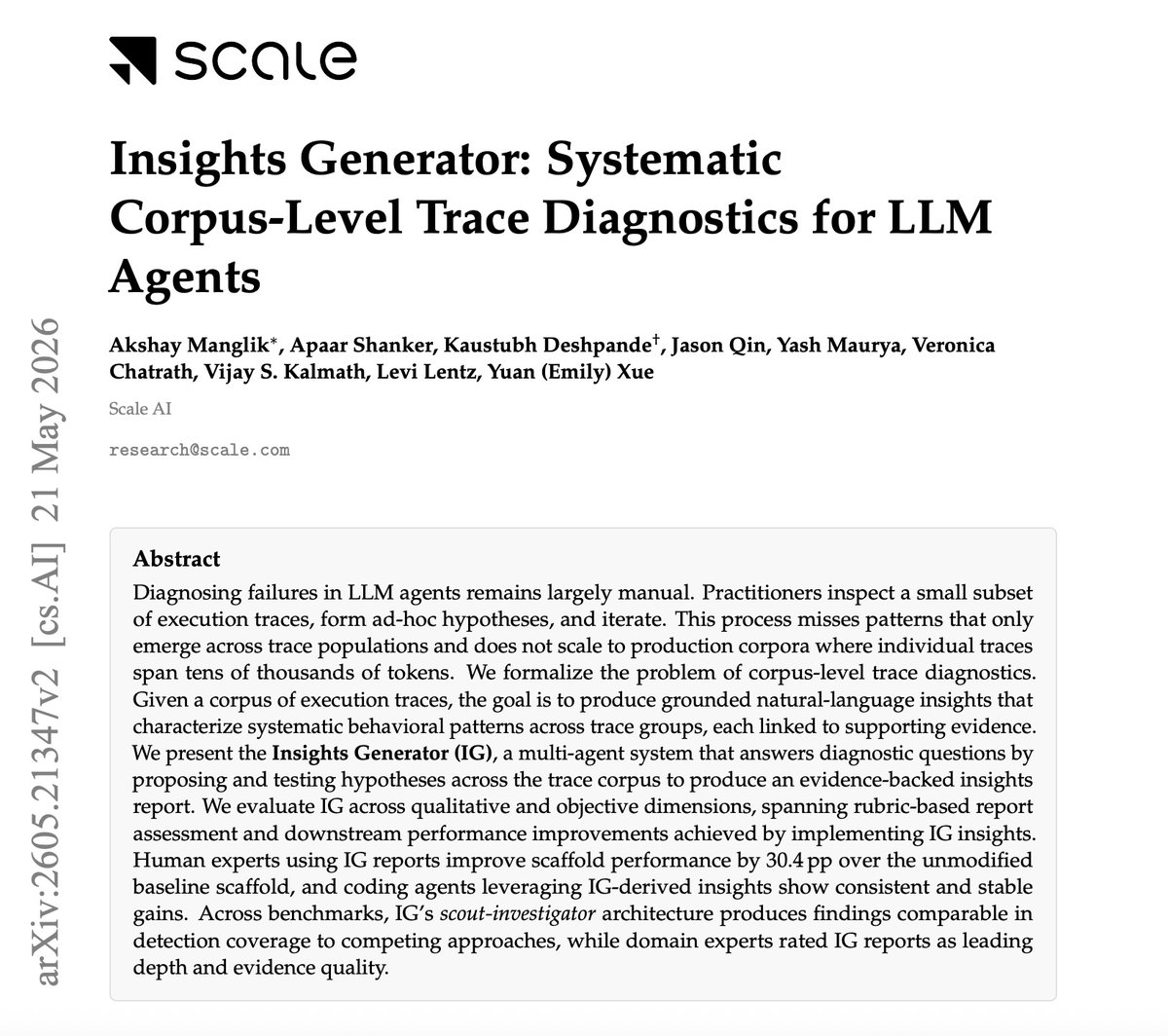
- Scale Labs repostedHow do you turn agent traces into an improvement flywheel? Excited to share Insights Generator (IG) — new @scale_AI / @ScaleAILabs research that finds behavioral patterns and bugs in agent traces. Engineers & coding agents using IG achieved 30+% gains on agent benchmarks. 🧵
- Replying to @ScaleAILabsSelective escalation remains one of the biggest challenges for reliable human-in-the-loop AI. We hope HiL-Dynamics helps users find the right setup for their workflows and gives model builders clearer signals for building agents that collaborate with humans more effectively.
- Replying to @ScaleAILabsNot all agents fail the same way. GPT-based agents tend to ask early. Claude-based agents tend to explore first.But when GPT runs inside Codex, a harness that discourages asking, that behavior nearly disappears. The harness shapes collaboration strategy as much as the model
- Replying to @ScaleAILabsWe found agents are highly sensitive to customization. Some rely heavily on system prompts and examples. Others, like Codex, needed additional ask tools to reach their full potential. Small setup changes can completely change collaboration behavior.
- Replying to @ScaleAILabsWe evaluated five production agent stacks: Codex, Claude Code, Google Antigravity, ADK, and OpenCode, with and without customization and skill tuning. Even with the best enhancements, agents still struggle to escalate to humans at the right moment. State-of-the-art agents
- Today we're releasing HiL-Dynamics, the first open-source tool that measures how production agents actually collaborate with humans under uncertainty. Not just whether they got the answer. Now you can measure exactly when your agent asks for help, when it makes assumptions, and
- Claude Opus 4.8 just landed on our MCP Atlas Leaderboard! Opus 4.8’s performance places it in the top band of SOTA models for agentic tool calling. The Claude 4 family keeps getting better at long-horizon tool use. Check out the updated rankings:
- Replying to @ScaleAILabsThe takeaway: standard security evaluations may be underestimating the attack surface of interactive AI agents. A model that appears secure on fully specified tasks may become significantly more vulnerable once it has to handle ambiguity and request additional user input.
- Replying to @ScaleAILabsWhy does this happen? We found two key shifts once agents enter clarification mode: - Models process incoming information differently - The clarification interface itself creates a new attack surface Asking follow-up questions can change how easily an agent can be manipulated.
- Replying to @ScaleAILabsAcross 10 frontier models, clarification-seeking consistently increased vulnerability to prompt injection attacks. Examples: - o3: 1.8% → 34.0% attack success - Gemini-3-Flash: 2.2% → 35.7% Models that appeared robust in standard execution settings became far easier to