Today, @niraj and I are excited to unveil Ritual (@ritualnet) to the world.
Ritual is a bidirectional response that sits at the intersection of modern cryptographic schemes and ai objects to bring forth a new wave of intelligent apps spanning both the web3 and web2 worlds.
i am once again here to say agent discovery & registry hell is one of the least impactful things to focus on that for whatever reason keeps nerd sniping cracked ppl...most "mid" solutions for it are good enough and "better" solutions barely move the needle
either you:
1)
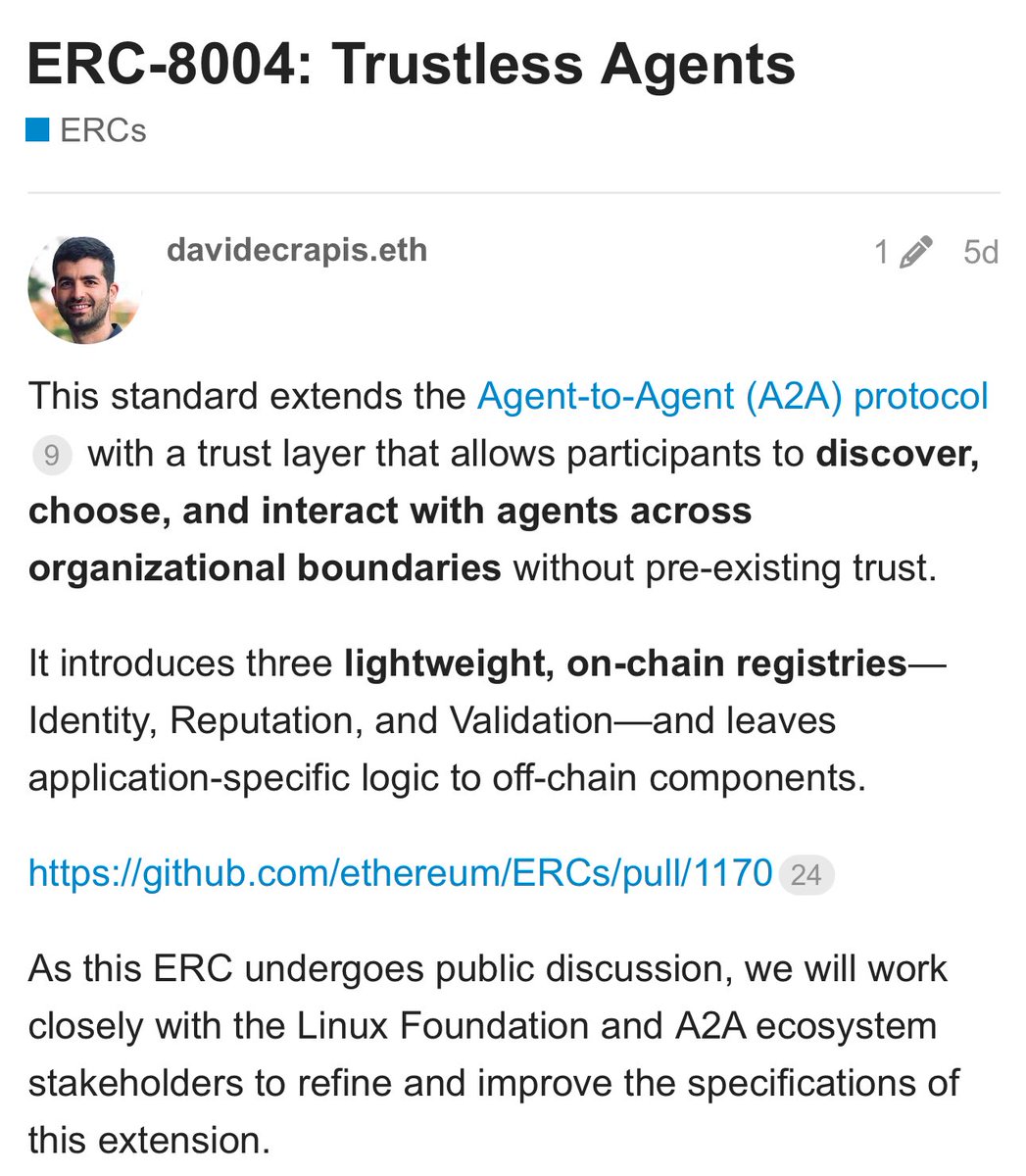
ethereum is SERIOUSLY gearing up for ai. (erc-8004) by @DavideCrapis just dropped, it’s called “trustless agents” and here’s what you need to know:
but first:
you can think of ethereum as an important substrate for ai, not necessarily because it can run all the models, but
--- stuff i made money on ---
anish
--- stuff i lost money on ---
anish
USDC
OHM (bought and didn't stake it)
IQ
empty set dollar emptying our dollars
anish's 8 months spent on gobblers
Leo (somehow)
whenever Vfat made an update on his website
Tokemak (+Tokamak)
jpeg'd
my 3
The coming weeks will mark a critical inflection point in Ritual's journey—we'll be releasing dozens of updates that we've teased since inception but haven't explicitly talked about yet in the wild.
I've always pushed Ritual to do first, and tweet second. We've now finished the
Resonance is the culmination of 1.5 years of work—the focus for us has always been to enable new behavior for users across web3, not just crypto x ai.
Resonance will bootstrap the next generation of prover networks, RaaS platforms, IP marketplaces, and MEV enthusiasts👇
A few clarifications on Ritual, and other projects mentioned:
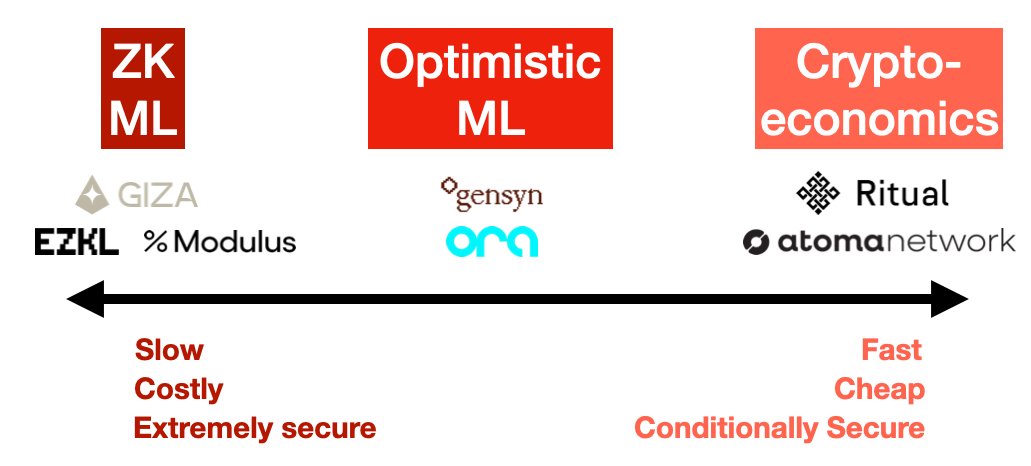
Ritual itself is not opinionated about the computational integrity mechanism for inference, whether ZK, OP, some convex combo, or otherwise. Our setup is modular enough to support various types of proof systems as I
Don’t trust, verify: An Overview of Decentralized AI Inference
Say you want to run a large language model like Llama2-70B. A model this massive requires more than 140GB of memory, which means you can’t run the raw model on your home machine. What are your options? You might jump
"our market maker fucked us"
been meaning to write about this for a while but reality is most founders in the space are retarded at expressing & pricing risk. given the strong experimentation / tinkering culture, naturally makes sense that founders think they have to "innovate"
where we’re at today:
we've enabled any on-chain or off-chain app to access models in a modular way allowing users to choose what type of experience they want along the payments, privacy, and computational integrity dimensions. we’ve kept a neutral view on the exact type of
non-consensus take, but bewildering to me the crypto x ai space spends so much time on specific types of verifiability (zkml). constant regurgitation of the same narrative by "important" people in the space. computational integrity *is* important but in a vanishingly small set of
🔧// Infernet, Reimagined //
We’re thrilled to introduce three new products powering the Infernet ecosystem:
❖ Infernet Cloud
❖ Infernet Explorer
❖ Infernet CLI
Configuring & deploying Infernet nodes is now effortless:
seeing a lot of undeserved bittensor hate on the TL today, but zooming out the discourse is the same as the rest of the space re: mega (gte), bera, pump, monad, etc. on how to retain & incentivize apps to stay on the base layer in a world of ~commoditized infra
@bittensor_, to
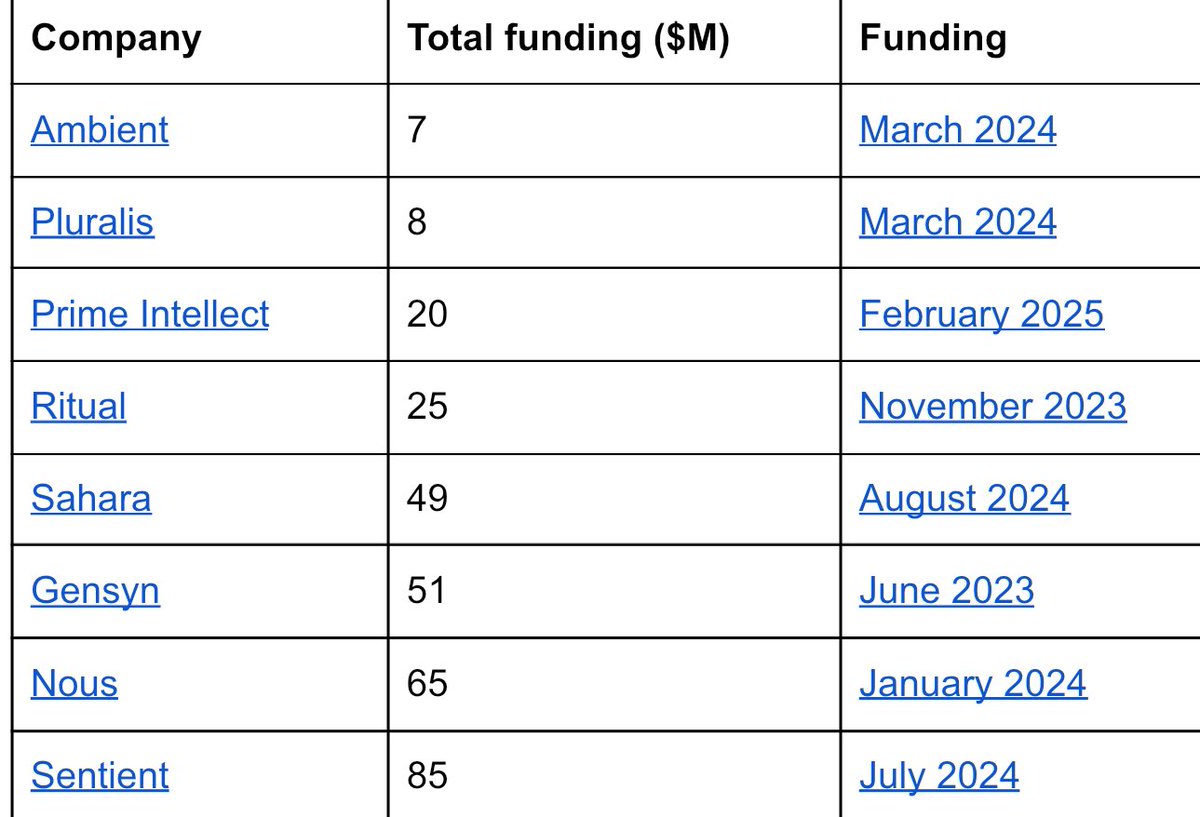
Bittensor clone … there’s a few of these.
Here’s what I think:
There are no direct competitors to Bittensor itself, but there are many VC-funded competitors to many Bittensor subnets (specifically ones like subnet 4, Manifold’s Targon network)... The common pattern we observe