The GENIUS Act creates a stablecoin framework built on four fundamental flaws — leaving consumers exposed to runs, failed issuers, unclear legal rights and protracted resolution chaos.
Read BPI’s latest blog:
A "bank" funded by uninsured deposits, reliant on assets that can be subject to rapid and substantial capital losses in times of stress. What could go wrong?
bpi.com/beware-the-kra…@krakenfx
In 2009, President Obama signed the bipartisan CARD Act into law. Many in Washington celebrated this major accomplishment.
Accusations that banks charge "illegal" fees, or are not committed to providing robust disclosures, are irresponsible and just wrong. Get the #FactsonFees.
Fintechs and aggregators have criticized banks for charging for data access, distracting from their real goal:
To preserve high-volume, often continuous data extraction (at no cost), frequently without the customer’s awareness, with the intent to store/resell the financial data.
We analyzed the reported cases of allegedly fraudulent #PPP transactions based on DoJ news releases & criminal complaint affidavits cross-referenced w/ SBA loan-level data.
In a majority of cases, the allegedly fraudulent loan was obtained from a FinTech.
The ON RRP facility, once described as a temporary tool, sits at a massive $2.2 trillion – bigger than the GDP of South Korea.
That's a big problem. But, perhaps there's a straightforward solution. We explain:
The Tsar Bell, the largest bell in the world, weighs approx. 216-tons. That's ~3x heavier than Space Shuttle Endeavor.
Yet the Tsar Bell pales in comparison to the largest bell in the history of the financial world, which will pose extraordinary challenges to the incoming FSOC.
What is a SAR?
How many of these SARs are really illegal activity versus false positives?
Why would a bank identify a suspicious transaction for law enforcement and continue to bank that client?
We answer your questions: bpi.com/the-truth-abou…#FinCENFiles
Recent discussions about "debanking" put new focus on law-abiding businesses reporting challenges accessing banking services, but alleviating this issue requires a closer look at inefficient regulatory requirements and the opaque bank examination regime:
bpi.com/the-truth-abou…
The federal government's new capital rules would make loans more expensive and less accessible, hurting everyday Americans when our economy is still recovering from a pandemic and grappling with rising interest rates.
Take action to #StopBaselEndgame: stopbaselendgame.com
BPI commented today on the Department of Justice’s request for public input on bank merger analysis.
Please see a copy of our comments and a full statement here:
bpi.com/banks-thrive-a… 1/6
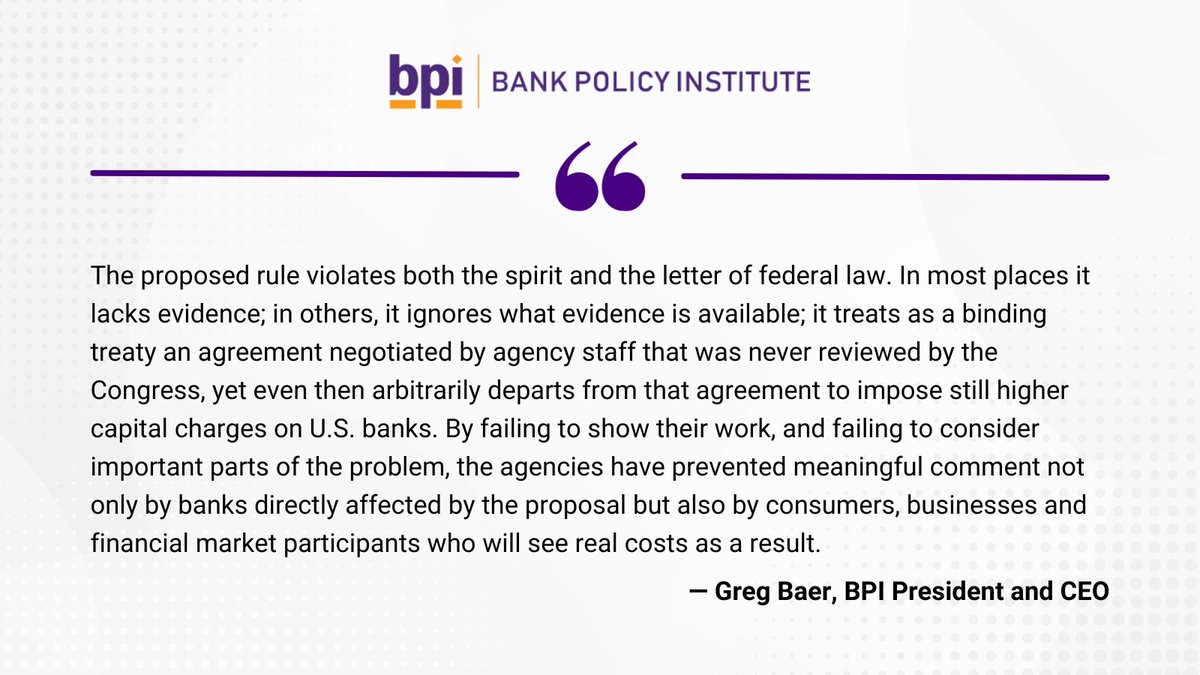
RELEASE: Basel Proposal Violates the Law
The banking agencies’ Basel proposal violates both the substantive and procedural requirements of the law that governs all federal agency rulemaking. The only solution is for the agencies to re-propose the rule. bpi.com/basel-proposal…
The third (and final) installment of our Basel Finalization series explores potential modifications to enhance the sensitivity to risk & reduce the procyclical impact of capital requirements, so as to prevent worsening of economic downturns.
Read it here—