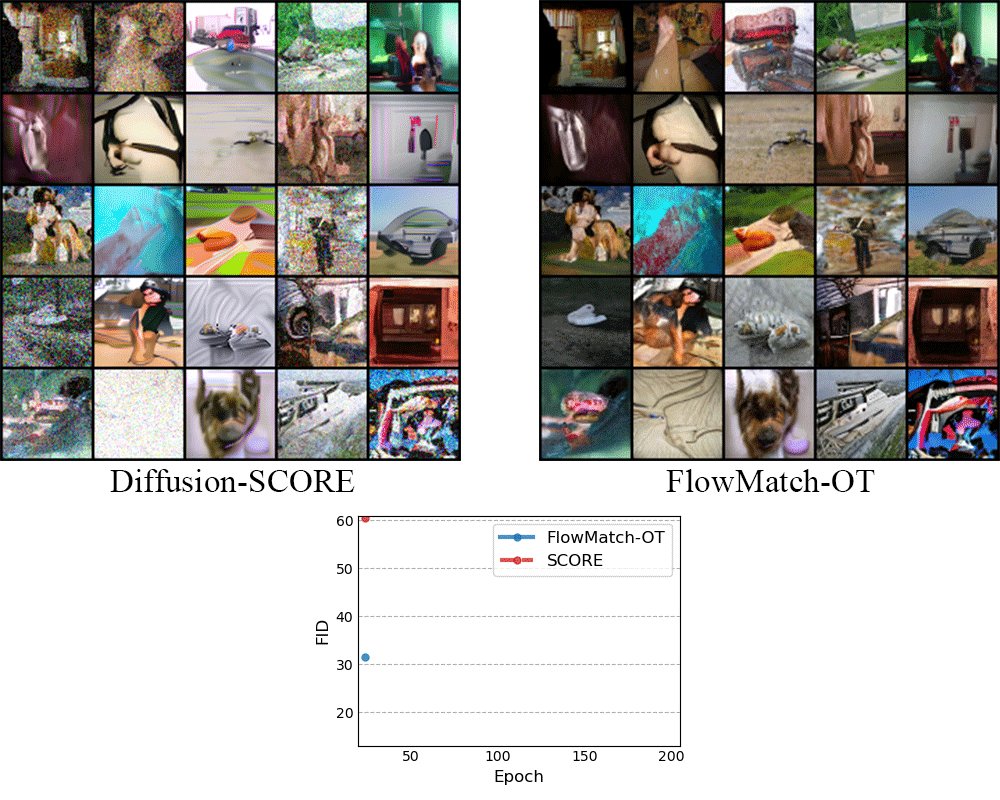
**Flow Matching** (#ICLR2023 spotlight) offers a simple simulation-free method for training flow-based generative models, generalizing and improving upon diffusion models in training speed, sampling efficiency, and generation quality. @RickyTQChen@helibenhamu@mnick@lematt1991
New paper: Introducing Moser Flows (MFs), a new class of continuous normalizing flows (CNFs) on manifolds based on divergences of neural nets. First generative modeling results on general curved surfaces!
with Noam Rozen @adityagrover_@mnickarxiv.org/abs/2108.08052
1/7
Excited to share that our paper "Moser Flow: Divergence-based Generative Modeling on Manifolds" won an Outstanding Paper Award at NeurIPS 2021!!
blog.neurips.cc/2021/11/30/ann…
Noam Rozen @adityagrover_@mnick
See thread for a short summary 👇
New paper: Introducing Moser Flows (MFs), a new class of continuous normalizing flows (CNFs) on manifolds based on divergences of neural nets. First generative modeling results on general curved surfaces!
with Noam Rozen @adityagrover_@mnickarxiv.org/abs/2108.08052
1/7
New paper: Universal Differentiable Renderer (UDR) - learning 3D shapes from 2D images under a wide range of reflectance and lighting models. arxiv.org/abs/2003.09852@YarivLior@matanatzmon
"Generator Matching" is a significant generalization of Flow Matching. It demonstrates that the "matching" principle applies to a wide range of Markov processes, opening up a vast, unexplored design space for scalable generative models.
New paper out!
We introduce “Generator Matching” (GM), a method to build GenAI models for any data type (incl. multimodal) with any Markov process. GM unifies a range of state-of-the-art models and enables new designs of generative models.
arxiv.org/abs/2410.20587
(1/5)
📣 A new #ICML2023 paper investigates the Kinetic Energy of Gaussian Probability Paths which are key in training diffusion/flow models. A surprising takeaway: In high dimensions *linear* paths (Cond-OT) are Kinetic Optimal!
Led by @shaulneta w/ @RickyTQChen@lematt1991@mnick
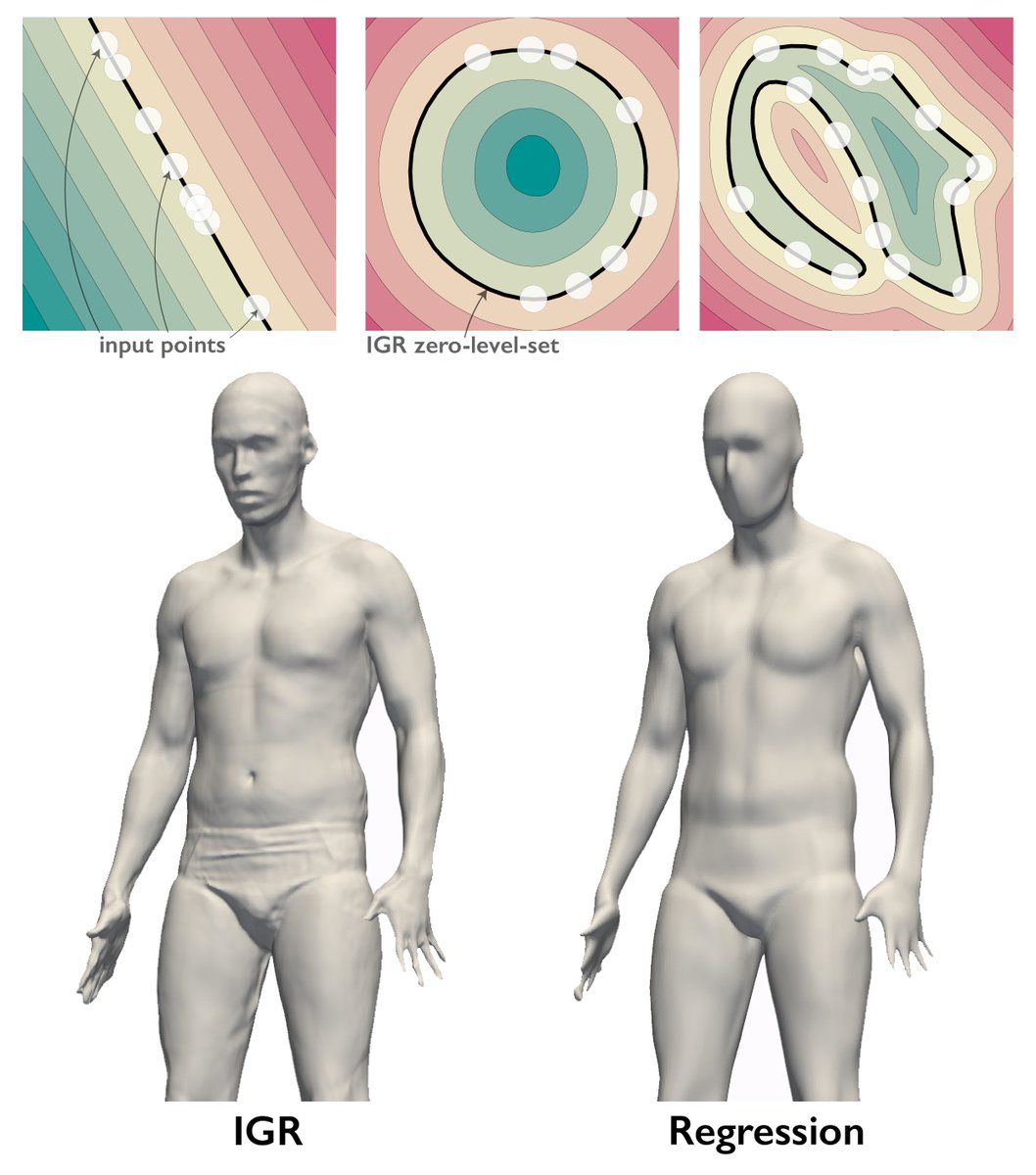
For those interested in *implicit neural representations* my talk from #cvpr20 workshop on Deep Learning Foundations
of Geometric Shape Modeling and Reconstruction is here:
youtu.be/rUd6qiSNwHs featuring work by @matanatzmon@YarivLior@AmosGropp and others.
Mosaic-SDF is a **simple 3D shape representation**, based on a set of local grids that is: (1) param efficient, (2) easy to compute for a given shape, and (3) “tensorial”. Therefore, it is suitable for scalable 3D generative models.
Thrilled to share Mosaic-SDF (M-SDF), a simple 3D representation suitable for 3D generative models!
Check out more results of text-to-3D generations here - lioryariv.github.io/msdf
Designing both expressive and efficient equivariant (or invariant) neural architectures can be done by replacing the costly group averaging with an *input dependent* subset, called a Frame.
Excited to share “Frame Averaging for Invariant and Equivariant Network Design”: a general
framework for building computationally efficient and maximally expressive equivariant neural architectures. Accepted as an *Oral presentation* to #ICLR2022!
arxiv.org/abs/2110.03336
Yaron @lipmanya and I are hiring a PhD intern for FAIR EMEA!
If you're interested in fundamental research on generative modeling and related topics, feel free to reach out: {rtqichen,ylipman}@Meta.com.
*The position is in Paris.* Dates are flexible.
metacareers.com/jobs/140947795…