Today, I’m excited to share with you all the fruit of our effort at @OpenAI to create AI models capable of truly general reasoning: OpenAI's new o1 model series! (aka 🍓) Let me explain 🧵 1/
It's deeply concerning that one of the best AI researchers I've worked with, @kaicathyc, was denied a U.S. green card today. A Canadian who's lived and contributed here for 12 years now has to leave. We’re risking America’s AI leadership when we turn away talent like this.
This is on the scale of the Apollo Program and Manhattan Project when measured as a fraction of GDP. This kind of investment only happens when the science is carefully vetted and people believe it will succeed and be completely transformative. I agree it’s the right time.
Announcing The Stargate Project
The Stargate Project is a new company which intends to invest $500 billion over the next four years building new AI infrastructure for OpenAI in the United States. We will begin deploying $100 billion immediately. This infrastructure will secure
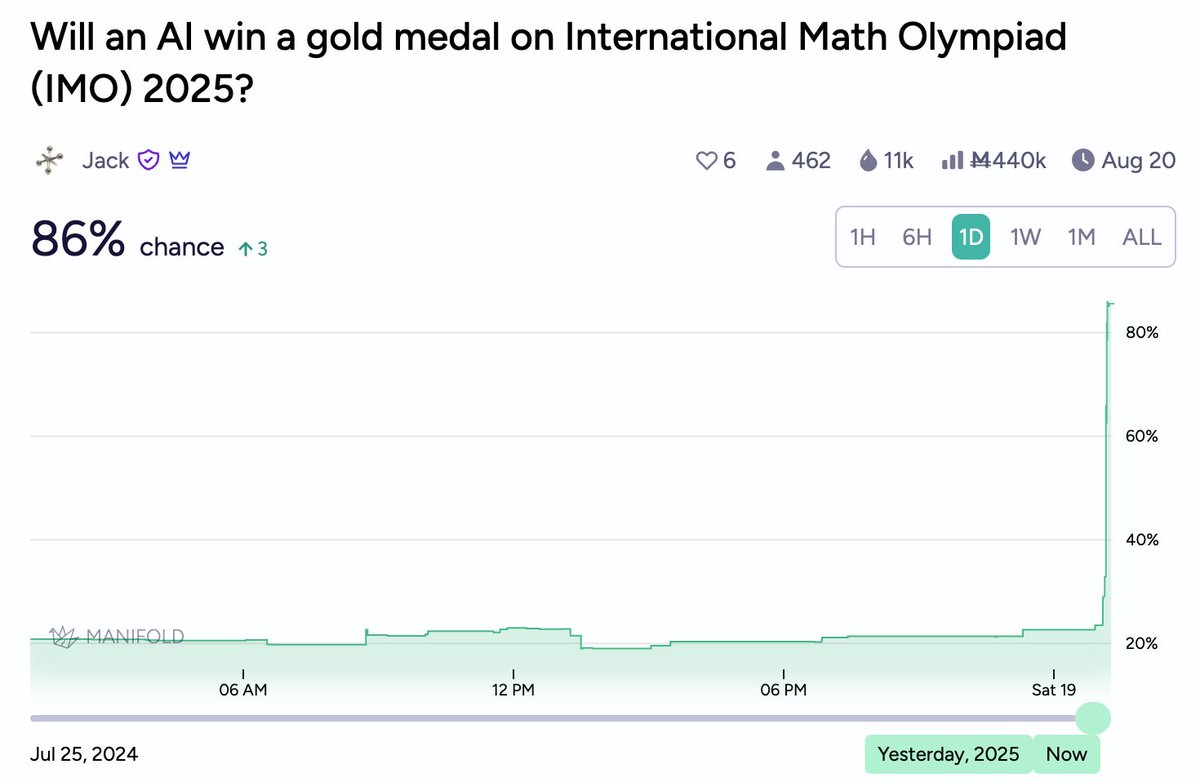
Today, we at @OpenAI achieved a milestone that many considered years away: gold medal-level performance on the 2025 IMO with a general reasoning LLM—under the same time limits as humans, without tools. As remarkable as that sounds, it’s even more significant than the headline 🧵
1/N I’m excited to share that our latest @OpenAI experimental reasoning LLM has achieved a longstanding grand challenge in AI: gold medal-level performance on the world’s most prestigious math competition—the International Math Olympiad (IMO).
3 years ago my teammates and I set out toward a goal that seemed like science fiction: to build an AI that could strategically outnegotiate humans *in natural language* in Diplomacy. Today, I’m excited to share our Science paper showing we’ve succeeded! 🧵
Meta AI presents CICERO — the first AI to achieve human-level performance in Diplomacy, a strategy game which requires building trust, negotiating and cooperating with multiple players.
Learn more about #CICERObyMetaAI: bit.ly/3GBwLzx
Those of us at @OpenAI working on o1/🍓 find it strange to hear outsiders claim that OpenAI has deprioritized research. I promise you all, it's the opposite.
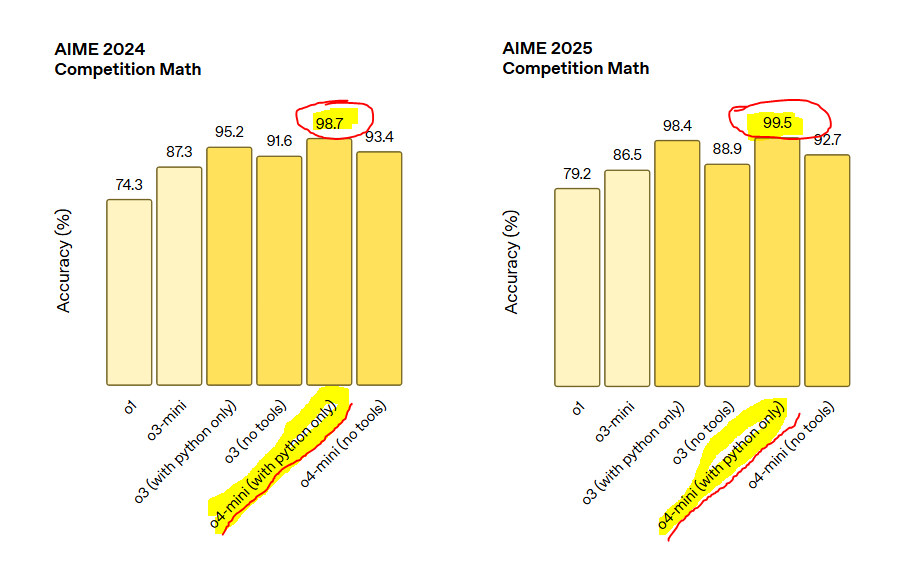
We did not “solve math”. For example, our models are still not great at writing proofs. o3 and o4-mini are nowhere close to getting International Mathematics Olympiad gold medals.
AI has *solved* math. OpenAI did it with o4
Not "is close to solving math"
Not "is competitive at math"
*SOLVED*
This is far bigger than anyone realizes. Let me explain why.
First, you need to understand some historical context. Typically, with AI/ML you know that you're
Readers added context
Open AI did not "solve" math
Source: Noam Brown, research at OpenAI leading test time compute scaling
x.com/polynoamial/st…
12 years ago I tried making my first poker AI in college and dreamed of beating the world's best pros. After seven years of a PhD, I'm excited to announce that I finally did it! It's been quite an adventure. Looking forward to the next one!
Facebook AI and @CarnegieMellon researchers have built Pluribus, the first AI bot to beat elite poker pros in 6 player Texas Hold’em. This breakthrough is the first major benchmark outside of 2 player games and we’re sharing specifics on how we built it. ai.facebook.com/blog/pluribus-…
I worked in quant trading for a year after undergrad, but didn't want my lifetime contribution to humanity to be making equity markets marginally more efficient. Taking a paycut to pursue AI research was my best life decision. Today, you don't even need to take a paycut to do it.
>be you
>work in HFT shaving nanoseconds off latency or extracting bps from models
>have existential dread
>see this tweet, wonder if your skills could be better used making AGI
>apply to attend this party, meet the openai team
>build AGI
@OpenAI's o1 thinks for seconds, but we aim for future versions to think for hours, days, even weeks. Inference costs will be higher, but what cost would you pay for a new cancer drug? For breakthrough batteries? For a proof of the Riemann Hypothesis? AI can be more than chatbots