


StormaticsStormatics

At Stormatics, we believe in elevating PostgreSQL by providing the specialized expertise required to unlock the full potential of what it can deliver for critical data workloads. PostgreSQL performs best when it is treated as a deliberate, well-engineered core of your systems. 

PostgreSQL DBA as a Service | Stormatics
24×7 · Follow-the-Sun · AI Augmented

PostgreSQL DBA as a Service

Your database runs 168 hours a week. Most teams cover far less than that. The gap is where incidents happen.

Renowned PostgreSQL experts working alongside your team, around the clock, every day of the year.
PostgreSQL DBA as a Service

Renowned Experts

Over 100 years of combined PostgreSQL experience, across cloud, on-prem, and hybrid environments.

Scalable Coverage

Adjust support as workloads evolve. Scale up for migrations, scale back when things stabilize.

24×7 Follow-the-Sun

Our global team catches and resolves issues before they affect operations. Day, night, weekends included.

No Hiring Cycle

Enterprise-grade PostgreSQL coverage without adding headcount. Coverage starts in days, not months.
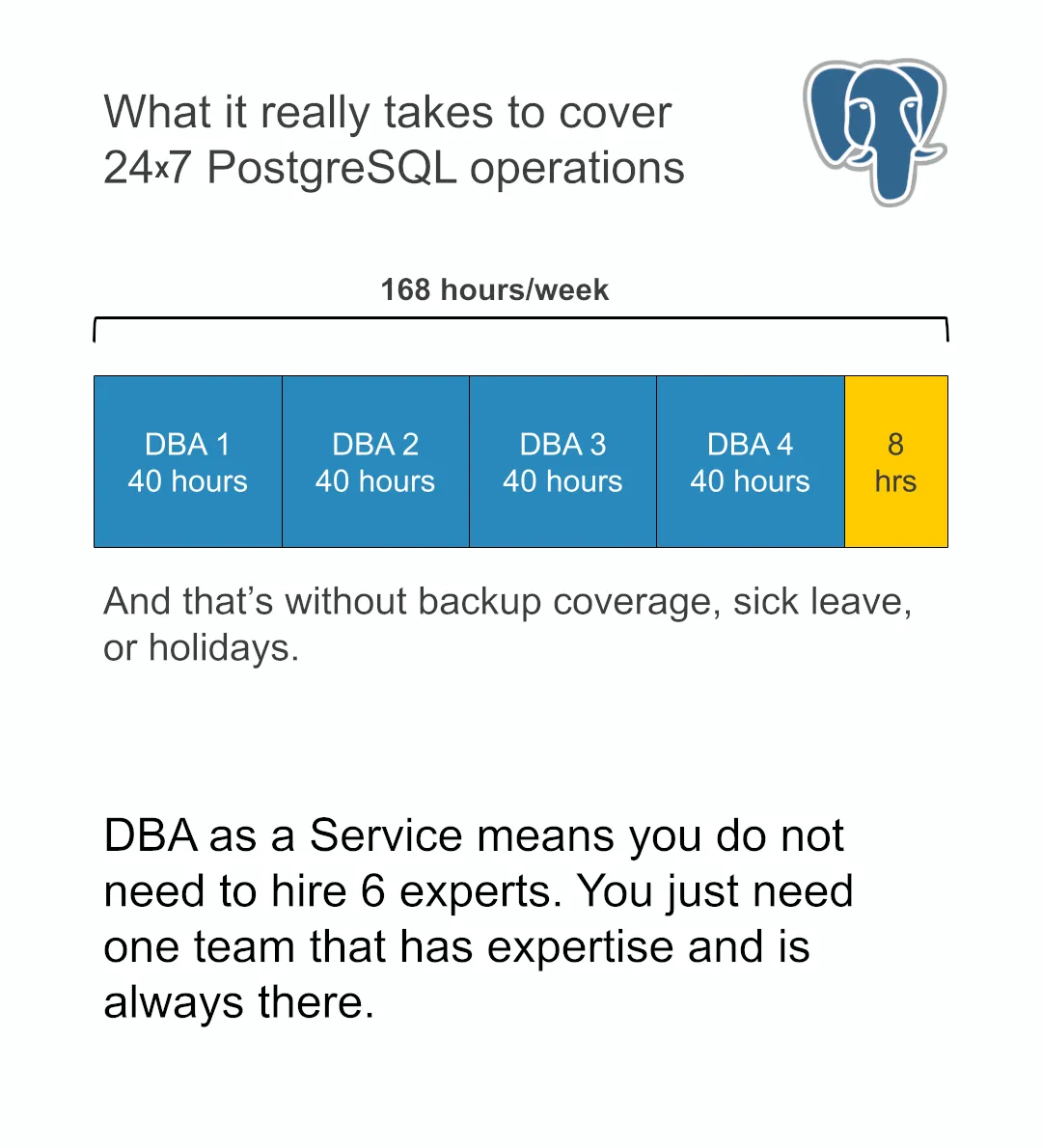
168 hours per week: 4 DBAs at 40 hours each still leaves gaps

24×7 coverage is not a hire. It is a department.

There are 168 hours in every week. At 40 hours per person, you need at least 4.2 people just to cover the clock. That leaves zero margin for holidays, sick leave, or overlap.

In practice, reliable 24×7 PostgreSQL operations requires 6 senior specialists. Each one needs deep expertise across HA, replication, performance tuning, and incident response.

You cannot find one at short notice. Building a team of six is not realistic for most organizations.

DBA as a Service means you do not need to hire 6 experts. You need one team that has the expertise and is always on. That is what Stormatics delivers.

Three ways to work with Stormatics

DBA as a Service adapts to your team structure. In each case, the outcome is the same: reliable PostgreSQL operations and more engineering time back on product.

No DBA on staff

Your full PostgreSQL operations team

We become your dedicated database function, handling monitoring, maintenance, performance tuning, HA, backups, and incident response. Your engineers stay focused on product.

One DBA on staff

Alongside your DBA

We extend your DBA's capacity and eliminate single-point-of-failure risk. Your DBA keeps ownership of the environment. We add 24×7 coverage, a second expert perspective, and backup when it matters most.

An existing DBA team

Capacity relief for your team

We take over day-to-day operational maintenance: health checks, monitoring, vacuuming, backup validation. Your in-house team redirects that time to strategic projects, migrations, and the work that moves the business forward.

Estimate your coverage gap

Plug in your numbers to see what your current setup is costing and where the gaps are.

What does your situation cost?
Adjust the sliders to see a personalised estimate.
4
$130k
20%
0
No, business hours only

Your setup across 4 instances needs 3 DBAs. You currently have 0.

Engineers are spending 20% of their time on database work. At $130k average salary, that is roughly $26k/year in engineering capacity going to database operations instead of product.

Coverage gap: 3 DBAs

Enter your details to see the full breakdown.

Service coverage

We are vendor agnostic and cover every aspect of PostgreSQL administration. Your engineers stay on product while we handle everything below.

Operations & Reliability

  • Initial database installation and setup
  • SLA-based high availability
  • Disaster recovery with defined RTO and RPO
  • Replication setup and failover management
  • Automated backup plans and recovery testing
  • PostgreSQL upgrades and hot-fixes
📈

Performance & Scaling

  • Workload-based performance optimization
  • Query analysis and tuning
  • Vacuum and index strategy
  • Capacity planning
  • Architectural health checks
  • Ongoing advisory on design and scaling patterns
🔒

Security & Governance

  • Access control and security hardening
  • Encryption configuration and validation
  • Audit logging setup
  • Compliance-aligned database configuration
  • Upgrade planning with tested rollback paths
  • Clear reporting and documentation

What happens when experts manage your PostgreSQL operations

These outcomes are from actual DBA as a Service engagements, across a single quarter.

15×
Faster report generation
Reports went from 30+ minutes to under 2 minutes through resource optimization and parameter tuning.
1.8 TB
WAL bloat resolved
A stalled Debezium replication slot nearly filled the disk. Root cause identified and WAL usage restored to normal.
~33%
Batch time reduced
Batch processing cut from ~3 hours to ~2 hours through targeted maintenance and strategic indexing.
Days → 1
Time to coverage
Most customers are onboarded within days. Health checks, monitoring, and backups configured in the first week.

Most of our longest clients started with a single engagement.

A common path starts with a consulting engagement: a performance crisis, a migration, a health check. After seeing the depth of expertise firsthand, most teams realize building this internally is not realistic. They make the shift to ongoing operations.

You do not have to commit to DBAaaS from day one. Start where the need is sharpest. We will earn the rest.

1

A specific problem brings you in

A performance bottleneck, a replication failure, a stalled migration, or a health check that reveals deeper issues.

2

You see the depth of expertise firsthand

The engagement resolves the immediate issue and surfaces systemic improvements you had not planned for.

3

The math makes the decision obvious

Hiring 6+ specialists is not feasible. Losing this expertise after the project ends is not acceptable. DBA as a Service becomes the natural next step.

Frequently Asked Questions (FAQs)

Q.How is this different from hiring a full-time DBA?

With Stormatics, you get a flexible team of PostgreSQL-certified DBAs with decades of experience, available 24×7. You avoid hiring costs, delays, and knowledge gaps while gaining enterprise-grade expertise on demand.

The service covers performance tuning, uptime monitoring, incident response, backups, failover management, and routine database maintenance, all backed by SLA-based support – 24 hours a day, 7 days a week.

Yes, our DBA as a Service model adapts to your needs, whether you are expanding or lessening your operations.

DBA as a Service is ideal for organizations facing resource or skills gaps in database management. Typical scenarios include:

  • No Dedicated DBA: There is no one formally responsible for database administration, and no budget for a full-time DBA. This is high risk, as untrained staff often struggle with disaster recovery or performance issues.
  • Single DBA: One person holds all the database knowledge or has been assigned DBA tasks without formal training. This creates risk during sick leave, vacations, or emergencies where expert recovery is needed.
  • Overloaded DBA Team: Your in-house DBA team spends most of its time on routine maintenance instead of high-impact business projects. DBAaaS can take over BAU tasks or provide additional resources to help deliver critical projects faster.

You only pay for what you need. With predictable pricing, no recruitment overhead, and reduced risk of downtime or misconfiguration, the service helps lower the total cost of ownership while boosting database reliability.

Absolutely, we work with your current PostgreSQL environment. No mandatory rearchitecture.

It is ideal for engineering teams that need production-grade Postgres stability but cannot hire an in-house DBA.

Yes. Our team specializes in HA and DR for PostgreSQL, including automated failover, replication monitoring, and quarterly DR testing. We design and maintain clusters to meet strict uptime SLAs.

We optimize query performance, storage configurations, and replication strategies to avoid unnecessary overprovisioning. This means you scale your resources based on actual workload requirements, which results in directly lowering your cloud spend.

Yes. We routinely work alongside in-house teams or replace existing vendors. Our engagement starts with a detailed health check and transition plan to ensure zero disruption to ongoing operations.

It includes proactive monitoring, incident detection, and immediate response to performance degradation, replication lag, or downtime risk. Our follow-the-sun model ensures your database is monitored at all times.

Yes. We manage upgrades, hotfixes, and complex migrations while maintaining uptime. For mission-critical environments, we use tested, zero-downtime strategies.

Most customers are onboarded within days. Initial health checks, monitoring, and backup configurations are typically set up in the first week, allowing immediate stabilization of production workloads.

Related Resources

Case Studies

Latest Blogs

April 21, 2026

Cost of PostgreSQL performance issues

PostgreSQL is widely adopted because it removes licensing constraints and gives companies like OpenAI, Lovable, and Supabase, a reliable foundation…
April 9, 2026

The 1 GB Limit That Breaks pg_prewarm at Scale

Recently, we encountered a production incident where PostgreSQL 16.8 became unstable, preventing the application from establishing database connections. The same…
March 30, 2026

Three Years of Stormatics: What Building a PostgreSQL Consultancy Looks Like

In three years, Stormatics has grown from a one-person bet on a market gap to a team of eleven serving…