Funny Papers: Park Chan-wook on how Looney Tunes influenced the cartoonish comedy of No Other Choice

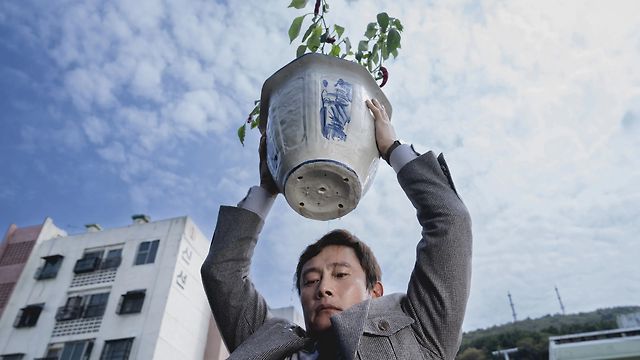
Man-su (Lee Byung-hun) has No Other Choice.

No Other Choice filmmaker Park Chan-wook talks to Mia Lee Vicino about blending comedy and tragedy into one entity, creating complex women characters and finding inspiration in Charlie Chaplin and Looney Tunes’ Road Runner. Meep meep!

Man-su has lived a foolish life… He’s a very pitiful person who is stuck in a small box where he believes that a husband or a father has to act a certain way.

—⁠Park Chan-wook

Director Park Chan-wook has always been funny. Perhaps most well-known for his intricate weaving of beauty and brutality, of eroticism and revulsion, the latest masterpiece from the director of The Handmaiden and the Vengeance Trilogy, No Other Choice, fully leans into the dark humor and physical comedy that has—until now—been tastefully peppered into his work. It also delves into a different kind of desire: to retain upper-middle-class status. It’s a modest dream that has drifted farther and farther out of reach as economies collapse and the job market becomes even more cutthroat—literally so, in the case of protagonist Man-su (Lee Byung-hun).

After working at a paper company for 25 years, Man-su is unceremoniously and abruptly laid off. Spiraling into self-pity at the prospect of no longer earning enough money for his wife, Miri (Son Ye-jin), and kids to live comfortably in a spacious house, the former breadwinner takes drastic measures by murdering the competition: his fellow unemployed white-collar papermen. Adapted from Donald E. Westlake’s novel, The Ax, Director Park shifts the story from 1997 America to 2024 South Korea. “I did not need to make any fundamental changes,” he tells me during our interview, “which only goes to show how the subject matter and the core ideas of the novel were applicable regardless of the time period in the country.”

A passion project in the making since at least 2009, No Other Choice’s anti-capitalist themes have only grown more relevant, as demonstrated by the Letterboxd community’s embrace of its timely satire. Currently, its 4.2-out-of-five-star rating places it firmly in the top 50 highest-rated films of 2025, as well as one of our top three highest-rated thrillers of the year. In our conversation below, Director Park reflects on the cartoons of his childhood, expanding and enhancing the women characters of the source material, reuniting with Lee Byung-hun 25 years after Joint Security Area and more.


Over the course of your career, you and your co-writers have brought so many interesting, complex, gloriously strange women characters to life—from Lady Vengeance to  I’m a Cyborg, But That’s OK to Thirst to Stoker—and No Other Choice is no exception. In comparison to the source novel, The Ax, your adaptation expands on the wife character’s role. I’d love to hear about this welcome change.
Park Chan-wook: Yes, compared to the original novel, I put a lot of work into the wife character, Miri. I made her more complex and actively involved in the story, and she greatly influences her husband. And I created our first victim Bummo’s wife, Ara [Yeom Hye-ran], and gave her a great role as well.

The victims are all a mirror of Man-su. They’re almost clones of him who share similarities with him. In that same sense, Ara is Man-su’s wife Miri’s clone. Compared to their husbands, these two women are more realistic in the way they think, and they’re much wiser as well.

Regarding Miri, the terrible things that Man-su does—the murders—make up the majority of the film; the core of the motivation behind why he does that has to do with Miri. He believes he’s doing this for his wife. But that’s not what Miri wants, and that gap between what each of them thinks the other wants really makes up the essence of the film. Miri doesn’t want Man-su to do bad things to find a job, but Man-su believes that he has to go all that way for his wife. Yet, Miri tells her husband, “If you do anything bad, it means we’re in it together.”

Miri isn’t actually doing these bad things with her husband, but she’s vaguely aware of the fact that he’s doing all of this for her, so she feels responsible for what he’s doing. Even if she’s not responsible for what he’s done, she believes that she is, and that’s where the beauty of the character lies. It shows her maturity.

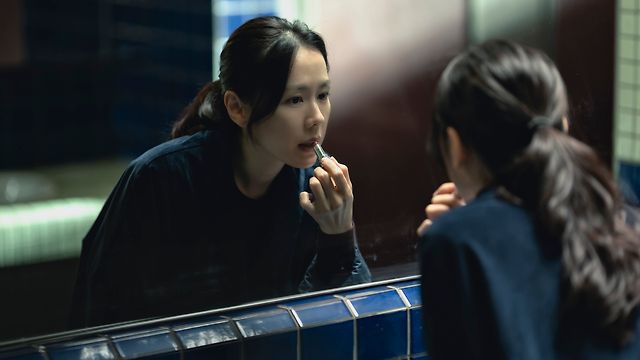
Son Ye-jin as Miri.
Son Ye-jin as Miri.

Not only are you satirizing the folly of capitalism, but you’re also satirizing other social issues, such as the nuclear family and traditional gender roles. Could you talk about the futility of Man-su’s quest to be the “perfect” husband and father, and how it ironically transforms him into a serial killer?
Man-su has lived a foolish life where he believes that making money at his job equates to his entire existence, and that to make money equates to being a father and a husband. So, to him, losing his job means he’s become worthless as a man. He’s a very pitiful person who is stuck in a small box where he believes that a husband or a father has to act a certain way.

What’s interesting is that as he goes through his murders, in that process, he regains his self-confidence. He’s fully aware that what he’s doing is wrong, but at the same time, with each success, his self-confidence grows bigger. So when his son is arrested by the police, he actively tries to resolve the situation. At this point, this was after two successful murders, so he’s actively involved: he’s telling his son what he should be saying to the police, and he even threatens his friend Wonno [Kim Hyung-mook] to resolve the situation.

But the solution that he comes up with is that he encourages his son to make a false statement to the police, which was not a very educational method. He’s using the self-confidence he’s gained from murders and resolving the situation by telling his son to make a false statement. His son and his wife, who are unaware of anything at this point, are completely enamored by the father’s cool new attitude, because he comes off as very manly. I think that goes to show how the film offers a commentary on this false sense of masculinity.

Yes! As you say, his performance is so pitiful to the point of being hilarious. Lee Byung-hun has said that he didn’t realize he was giving such a slapstick performance until reviews started coming out, but you’ve said that you were influenced by cartoons and animation, so you must have realized all along. I would love to hear more about how cartoons may have influenced this film.
I never necessarily asked my actors to watch the cartoons together, but we all grew up with them and we saw them when we were younger. Naturally, we harbor a lot of love towards that medium. So, in the long shot where people are screaming as they’re running away, or in that scene where the three people are trying to grab the gun under the cabinet and they’re crawling on the floor and the camera looks down on them, scenes like that are very reminiscent of cartoons. It reminds all of us of our younger days when we were growing up with them. That’s what elicits innocent laughter when watching scenes like that. It’s reminiscent of not only cartoons, but silent films like Charlie Chaplin’s.

Were there any specific cartoons from your childhood that you remember loving?
Road Runner.
So, clearly, if it’s influenced by Looney Tunes and Charlie Chaplin, No Other Choice is very funny, but it’s almost equally tragic. How do you balance tone, blend comedy and tragedy into one entity?
A film like Modern Times is a perfect example of tragedy and comedy working together. I’ve never considered it as mixing two different elements together—I’ve always considered tragedy and comedy to be one thing. The comedy comes from the foolishness of Man-su’s decision, in the way that he wants to resolve his problems, in the clumsiness and the execution of his decision. These are the elements that lead to comedy, and that’s inherently connected to how tragic his situation is. The comedy can never be separated from his tragedy, nor from the sympathy that the audience may feel towards Man-su.

You retained the fact that the protagonist works at a paper company from the novel, but while adapting it for the visual language of the screen, you created this juxtaposition, this friction, between Man-su’s personal world of family and gardening versus his professional world of killing people and trees (for paper). Could you expand on that contrast between nurturing and ending life?
The murders that Man-su commits are very animalistic. It can almost be compared to the acts of a predator in a jungle. In contrast, I wanted to show Man-su in his natural space. I wanted to show, through his love of plants, that he used to be a man like this, but he has changed, and that his plants are also related to the materials that paper is made up of.

Man-su’s love for plants can also be seen as being relevant to his upbringing. His father had a pig farm and he had to kill the pigs, so even throughout his career, he had to raise those pigs and kill them. You inherently raise pigs so that you can kill them and eat them, but especially after the disease had spread, he had to kill off all of them. So, Man-su, having grown up seeing something like that, wanted to be something that’s opposite to what he’s seen as a child, so he’s become a lover of plants.

It also allows us to consider how Man-su’s son is going to grow up to be. His father was a lover of plants, but he killed a man and planted an apple tree where he buried the man. If we imagine the future where his father is making apple jams out of the apples from that apple tree, wouldn’t he hate plants? Wouldn’t he grow up to be a hater of plants? All of those questions would only be in our imagination, but this was the general background behind why I made Man-su a lover of plants.

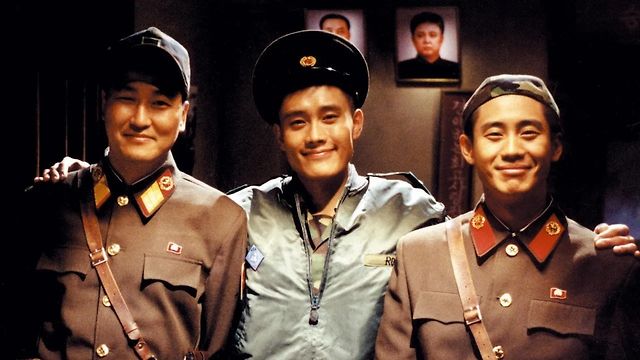
Song Kang-ho, Lee Byung-hun and Kim Tae-woo in Joint Security Area (2000).

One last question: in addition to reuniting with various crew members from your other projects, like your editor and composer, you’ve also reunited with Lee Byung-hun after working with him on Joint Security Area 25 years ago. How has it felt to nourish these long-lasting creative working relationships with your cast and crew and to grow alongside them—much like plants—over the years?
I always enjoy working with the same people, as long as our schedules align. There is a concern where, if you’re so close with them already, you might become lazy or lose tension or fall back into the same mannerisms. Fortunately, the people I work with are always keeping me on my toes and we’re always working on new stories and new films, so that is not a concern in my case. The only exception for my continued working relationships are actors—a combination of people I’ve worked with before and new people are always ideal.


No Other Choice’ is now playing in select US theaters, courtesy of NEON.

Further Reading

Tags

Share This Article

Image