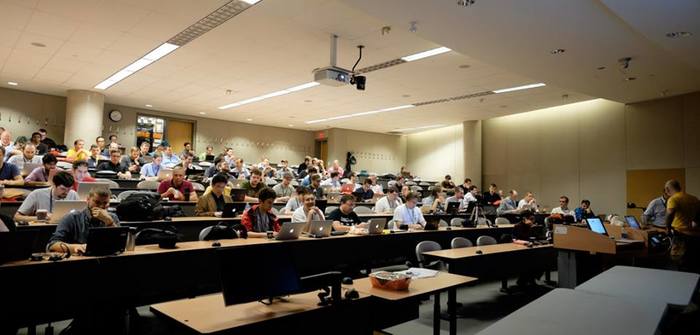

The largest #BSD technical conference in North America, established 2004. Come join us yearly in May for two days of tutorials + a two day conference. Past talk recordings are at https://youtube.com/@BsdcanOrg
(visit https://lists.bsdcan.org/mailman/listinfo/ to sign up for announcements or join the volunteers mailing list)
Joined Apr 2018
Today is the day! Please get your submissions in. The deadline is in less than 24 hours!
See https://www.
bsdcan.org/2026/papers.html and links therein for instructions.
https://www.
bsdcan.org/2026/papers.html and links therein for instructions.
There is only 1 more day to get your submissions in. Submit today! Ottawa is beautiful in June ;-)
BSDCan 2026 is now accepting submissions for the June 2026 conference, see https://www.
bsdcan.org/2026/papers.html and links therein for instructions.
Submissions deadline is January 17, 2026, the conference runs tutorials June 17-18, talks June 19-20.
2 more days!
BSDCan 2026 is now accepting submissions for the June 2026 conference, see https://www.
bsdcan.org/2026/papers.html and links therein for instructions.
Submissions deadline is January 17, 2026, the conference runs tutorials June 17-18, talks June 19-20.
#bsdcan #conference #freebsd #netbsd #openbsd #bsd #development #networking #freesoftware #libresoftware
3 more days!
BSDCan 2026 is now accepting submissions for the June 2026 conference, see https://www.bsdcan.org/2026/papers.html and links therein for instructions.
Submissions deadline is January 17, 2026, the conference runs tutorials June 17-18, talks June 19-20.
#bsdcan #conference #freebsd #netbsd #openbsd #bsd #development #networking #freesoftware #libresoftware
The #BSDCan 2026 Call for Participation closes Saturday the 17th!
All are welcome and we would love to hear about the exciting BSD projects you are working on and stories you have to share!
Thank you Apple, ARM, Netflix, and the FreeBSD Foundation for returning as #BSDCan 2026 sponsors!
We could always use more and the CFP closes soon!
BSDCan 2026 is now accepting submissions for the June 2026 conference, see https://www.bsdcan.org/2026/papers.html and links therein for instructions.
Submissions deadline is January 17, 2026, the conference runs tutorials June 17-18, talks June 19-20.
#bsdcan #conference #freebsd #netbsd #openbsd #bsd #development #networking #freesoftware #libresoftware
BSDCan 2026 is now accepting submissions for the June 2026 conference, see https://www.bsdcan.org/2026/papers.html and links therein for instructions.
Submissions deadline is January 17, 2026, the conference runs tutorials June 17-18, talks June 19-20.
#bsdcan #conference #freebsd #netbsd #openbsd #bsd #development #networking #freesoftware #libresoftware
BSDCan 2026 is now accepting submissions for the June 2026 conference, see https://www.bsdcan.org/2026/papers.html and links therein for instructions.
Submissions deadline is January 17, 2026, the conference runs tutorials June 17-18, talks June 19-20.
#bsdcan #conference #freebsd #netbsd #openbsd #bsd #development #networking #freesoftware #libresoftware
BSDCan 2026 is now accepting submissions for the June 2026 conference, see https://www.bsdcan.org/2026/papers.html and links therein for instructions.
Submissions deadline is January 17, 2026, the conference runs tutorials June 17-18, talks June 19-20.
#bsdcan #conference #freebsd #netbsd #openbsd #bsd #development #networking #freesoftware #libresoftware
The #BSDCan 2026 Call for Participation is now open!
https://www.bsdcan.org/2026/papers.html
The submissions deadline is January 17th, 2026 and the conference takes place June 17th through 20th.
We are pleased to announce at the @EuroBSDCon closing session that #BSDCan 2026 will take place June 17th - 20th in Ottawa, Canada.
See you there!
BSDCan
boosted

The last BSDCan 2025 video has been posted!
Adventures in porting a Wayland Compositor to NetBSD and OpenBSD by Jeff Frasca
I'm typing this in my Xuake Wayland Compositor on OpenBSD.
I started this journey on the NetBSD 9.99.x branch and ended up having to dig into the guts of wscons, mesa, libdrm, the kernel drm subsystem, the AMDGPU driver and more. I have a couple of very small, but hard fought patches in the NetBSD kernel. It's not over yet, either. I still have a few bugs around the compositor shutdown process and a lot of integration work to be able to hope to have other people try this out.
Topics to cover in the talk include (but are not limited to):
History of Wayland and other background info
How your graphics stack and driver is organized and actually works
The actual porting journey on both NetBSD and OpenBSD
A Demo! I should be able to show it running
Current status, future work
For more information, please visit:
https://www.bsdcan.org/2025/
- and -
https://www.bsdcan.org/2025/timetable/timetable-Adventures-in-porting.html
BSDCan
boosted
A new BSDCan video has been posted:
Automating My FreeBSD Lab: From Setup to Daily Use with Ansible & Salt by Roller Angel
Automating My FreeBSD Lab: From Setup to Daily Use with Ansible & Salt
Abstract
Managing multiple FreeBSD machines can be time-consuming, but automation makes it effortless. In this talk, I will demonstrate how I use Ansible to set up my FreeBSD lab and Salt to maintain and scale it across multiple machines—including how I configured a second FreeBSD laptop with just SSH access.
Attendees will see how automation enables:
Seamless FreeBSD system setup using Ansible.
Automated configuration management with Salt.
Effortless scaling to new machines, reducing manual setup to a few commands.
By the end of the talk, attendees will understand how to leverage Ansible and Salt to build a reproducible and maintainable FreeBSD infrastructure.
Intended Audience
FreeBSD users interested in automating system setup and maintenance.
System administrators managing multiple FreeBSD machines.
Anyone curious about Ansible and Salt for FreeBSD automation.
Attendees should have basic FreeBSD knowledge, but no prior experience with automation tools is required.
For more information, please visit:
https://www.bsdcan.org/2025/
- and -
https://www.bsdcan.org/2025/timetable/timetable-Automating-My-FreeBSD.html
BSDCan
boosted
A new BSDCan video has been posted:
ZFS Direct IO Benchmarking Pitfalls by Mateusz Piotrowski
Not too long ago, support for direct IO landed in OpenZFS after years of discussions and reviews. We truly live in the future where we can finally reject complicated caching and fully embrace the unbuffered conversations with our disks. Or can we really?
Those of you who know a bit about ZFS know that the ARC is actually pretty important (without one ZFS would historically stand for zzz 😴 instead of Zetta). How could it be then that skipping the ARC might improve performance?
During the presentation we will discuss what workloads and setups benefit from direct IO, what its limitations are, and what pitfalls to avoid during benchmarking. We will also look at the implementation to understand how all the promises of stability and compatibility were kept.
Direct IO is reported to deliver amazing performance boosts in some deployments. Understanding how not to hold it wrong is a great first step to potentially unlocking that speed-up on your systems too!
For more information, please visit:
https://www.bsdcan.org/2025/
- and -
https://www.bsdcan.org/2025/timetable/timetable-ZFS-Direct-IO.html
BSDCan
boosted
A new BSDCan video has been posted:
Effective Bug Reports, Code Change Requests, and Conference Proposals by Michael Dexter @dexter
Open Source is participatory and BSD Unix is no exception, with its own unique development workflows and events. Bug reporting, code proposing, and event participation are fundamental elements of the BSD Unix community and despite appearances, are open to anyone to participate.
This talk will take a pragmatic tour of effective engagement on these topics with real-world examples and tips for:
Bug reports that are actionable and inspire attention
Code change requests and reviews that are more likely to review and acceptance
Conference proposals that stand out, accurately set expectations, and are more likely to be accepted
The secret is that all of that all of these are fundamentally indistinguishable: You are tasked with marketing your idea to others and must show your work, justify your points, demonstrate sincerity, and ultimately convince others of your initiative, regardless of its size.
For more information, please visit:
https://www.bsdcan.org/2025/
- and -
https://www.bsdcan.org/2025/timetable/timetable-Effective-Bug-Reports,.html
BSDCan
boosted
A new BSDCan video has been posted:
The NetBSD Packet Filter(NPF)by Emmanuel Nyarko
One of NetBSD's goal with network security is to upgrade NPF with lots of useful features and then be used as the primary packet filter. In this talk, As NetBSD's current primary maintainer of NPF, I will reveal the improvements I have added to NetBSD's NPF packet filter. I will also reveal Further improvements in relation to performance and the direction of the project to reaching completion.
For more information, please visit:
https://www.bsdcan.org/2025/
- and -
https://www.bsdcan.org/2025/timetable/timetable-The-NetBSD-Packet.html
BSDCan
boosted
A new BSDCan video has been posted:
Enhancing Unix Education through Chaos Engineering and Gamification using FreeBSD by Andreas Kirchner, Benedict Reuschling
For more information, please visit:
https://www.bsdcan.org/2025/
- and -
https://www.bsdcan.org/2025/timetable/timetable-Enhancing-Unix-Education.html
BSDCan
boosted
A new BSDCan video has been posted:
Why (and how) we're migrating many of our servers from Linux to the BSDs by Stefano Marinelli @stefano
A few years ago, we decided to migrate many of our servers (and many of those of our clients) from Linux to the BSDs - FreeBSD, OpenBSD, NetBSD - depending on the specific services. In this presentation, I will discuss the reasons behind our decision, the technical and organizational challenges we faced, the tangible benefits we have experienced, and why we believe this migration is successful. I will provide specific examples and real-life case studies. In an increasingly complex world, relying on simple, stable, and secure solutions is becoming more and more important, and the BSDs can make a significant contribution in this direction.
For more information, please visit:
https://www.bsdcan.org/2025/
- and -
https://www.bsdcan.org/2025/timetable/timetable-Why-and-how.html
BSDCan
boosted
A new BSDCan video has been posted:
ELF Nightmares: GOTs, PLTs, and Relocations Oh My by John Baldwin
Mapping abstract symbol names in source code to concrete addresses at runtime requires cooperation between the compiler, static linker, and runtime loader. This talk will talk about some of the practices and data structures used for this task including ELF relocations, Global Offset Tables and Procedure Linkage Tables. Depending on time, it may also cover some more advanced topics such as initialization functions ("ifuncs").
For more information, please visit:
https://www.bsdcan.org/2025/
- and -
https://www.bsdcan.org/2025/timetable/timetable-ELF-Nightmares-GOTs,.html
The largest #BSD technical conference in North America, established 2004. Come join us yearly in May for two days of tutorials + a two day conference. Past talk recordings are at https://youtube.com/@BsdcanOrg
(visit https://lists.bsdcan.org/mailman/listinfo/ to sign up for announcements or join the volunteers mailing list)
Joined Apr 2018

