

We need to stop thinking of internet infrastructure as too hard to fix. It’s the underlying system we use for nearly everything we do. The former prime minister of Sweden, Carl Bildt, and former Canadian deputy foreign minister, Gordon Smith wrote in 2016 that the internet was becoming “the infrastructure of all infrastructure.” It’s how we organize, connect and build knowledge, even — perhaps — planetary intelligence. Right now, it’s concentrated, fragile and utterly toxic.
 18th April 2024
 Notes: 3

“The goal was to test if the country’s national internet infrastructure – known inside Russia as RuNet – could function without access to the global DNS system and the external internet.Internet traffic was re-routed internally, effectively making Russia’s RuNet the world’s largest intranet.“
If you look at where the money goes (always a good idea), it’s not clear that the “smart city” is really about digitizing cities. Smart cities are a generational civil war within an urban world that’s already digitized. It’s the process of the new big-money, post-internet crowd, Google, Apple, Facebook, Amazon, Microsoft et al., disrupting your uncle’s industrial computer companies, the old-school machinery guys who ran the city infrastructures, Honeywell, IBM, General Electric. It’s a land grab for the command and control systems that were mostly already there.
Important update from The Chairman @brucesterling

¯\_(ツ)_/¯
Further Reading: Infrastructure Territory and The Geopolitics of The Stacks (2014)
In this and later posts, I want to explain how this shift from territorial to functional sovereignty is creating a new digital political economy. Amazon’s rise is instructive. As Lina Khan explains, “the company has positioned itself at the center of e-commerce and now serves as essential infrastructure for a host of other businesses that depend upon it.” The “everything store” may seem like just another service in the economy—a virtual mall. But when a firm combines tens of millions of customers with a “marketing platform, a delivery and logistics network, a payment service, a credit lender, an auction house…a hardware manufacturer, and a leading host of cloud server space,” as Khan observes, it’s not just another shopping option.
Digital political economy helps us understand how platforms accumulate power. With online platforms, it’s not a simple narrative of “best service wins.” Network effects have been on the cyberlaw (and digital economics) agenda for over twenty years. Amazon’s dominance has exhibited how network effects can be self-reinforcing. The more merchants there are selling on (or to) Amazon, the better shoppers can be assured that they are searching all possible vendors. The more shoppers there are, the more vendors consider Amazon a “must-have” venue. As crowds build on either side of the platform, the middleman becomes ever more indispensable. Oh, sure, a new platform can enter the market—but until it gets access to the 480 million items Amazon sells (often at deep discounts), why should the median consumer defect to it? If I want garbage bags, do I really want to go over to Target.com to re-enter all my credit card details, create a new log-in, read the small print about shipping, and hope that this retailer can negotiate a better deal with Glad? Or do I, ala Sunstein, want a predictive shopping purveyor that intimately knows my past purchase habits, with satisfaction just a click away?
Read more From Territorial to Functional Sovereignty: The Case of Amazon
FrankPasquale’s work is excellent. extremely looking forward to this new series


WHOLE FOODS: CUSTOMER, NOT RETAILER
This is the key to understanding the purchase of Whole Foods: to the outside it may seem that Amazon is buying a retailer. The truth, though, is that Amazon is buying a customer — the first-and-best customer that will instantly bring its grocery efforts to scale.
Today, all of the logistics that go into a Whole Foods store are for the purpose of stocking physical shelves: the entire operation is integrated. What I expect Amazon to do over the next few years is transform the Whole Foods supply chain into a service architecture based on primitives: meat, fruit, vegetables, baked goods, non-perishables (Whole Foods’ outsized reliance on store brands is something that I’m sure was very attractive to Amazon). What will make this massive investment worth it, though, is that there will be a guaranteed customer: Whole Foods Markets.
(via Amazon’s New Customer – Stratechery by Ben Thompson)
Extremely good essay. well worth a read.
STACKS STACKS STACKS - Jay

Pokémon Go makers sued for encouraging trespassing
The class action lawsuit is the first to be filedagainst the Pokémon Go makers, and is seeking damages that, while not specified, could be in excess of $5 million (£3.7 million) for a “flagrant disregard” for theimpact of the game on real world places. Jeffrey Marder, the New Jersey man who brought the case, claimed that at least five players had knocked on his door and asked to catch Pokémon in his garden. The game superimposes creatures into the real world, which players must physically approach in order to catch.

“Defendants have shown a flagrant disregard for the forseeable consequences of populating the real world with virtual Pokémon without seeking the permission of property owners,” the lawsuit alleges.
Marder is seeking class action status against Niantic, the company behind the game that was released a month ago, as well as co-creators Nintendo and the Pokémon Company, on behalf of other owners of residential and public property.
(via Pokémon Go makers sued for encouraging trespassing)
Piece above is from 2016. But now the case is going ahead:
‘Pokémon Go’ Suit Makes Case for Virtual Trespassing
Federal judge is set to decide on case alleging game developer caused hordes to illegally enter properties
https://www.wsj.com/articles/pokemon-go-suit-makes-case-for-virtual-trespassing-1491310800
i just went back and re-read @nathanjurgenson‘s seminal:
Digital Dualism versus Augmented Reality
the systematic bias to see the digital and physical as separate; often as a zero-sum tradeoff where time and energy spent on one subtracts from the other. This is digital dualism par excellence. And it is a fallacy.
I am proposing an alternative view that states that our reality is both technological and organic, both digital and physical, all at once. We are not crossing in and out of separate digital and physical realities, ala The Matrix, but instead live in one reality, one that is augmented by atoms and bits. And our selves are not separated across these two spheres as some dualistic “first” and “second” self, but is instead an augmented self. A Haraway-like cyborg self comprised of a physical body as well as our digital Profile, acting in constant dialogue.
https://thesocietypages.org/cyborgology/2011/02/24/digital-dualism-versus-augmented-reality/
When talked about clouds at @theorizingtheweb 14:
Infrastructure Territory and The Geopolitics of The Stacks

https://medium.com/@thejaymo/colonising-the-clouds-4405d2d590b5
furthermore
The Cloud, the State, and the Stack: @mthvn in Conversation with Benjamin Bratton
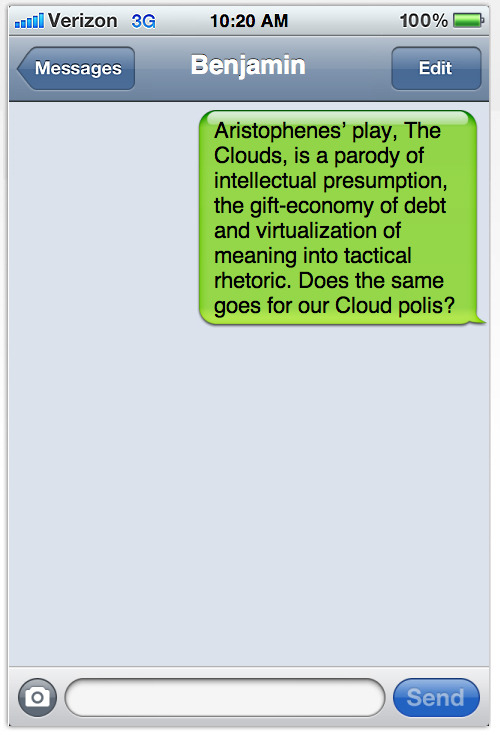
Here we have the vertical superimposition of two possibly incommensurate logics of geography and governance. One, a globally distributed, cognitive capitalist, NSA-protected polis predicated on data rationalization, and two, a geographically circumscribed central command which sees the Cloud as an extension of the body of the State.
http://mthvn.tumblr.com/post/38098461078/thecloudthestateandthestack
In other pokemon go thoughts i’m level 30 and caught a Pineco today // JAY
p.s i also been posting other things like these over on @solarpunks

As Intermediaries and Infrastructures they (Platforms) are positioned to capture and control as much data as possible.
- Nick Srnicek
Nick Srnicek is the ‘Author of Platform Capitalism’ published by Polity

Alarmed that decades of crucial climate measurements could vanish under a hostile Trump administration, scientists have begun a feverish attempt to copy reams of government data onto independent servers in hopes of safeguarding it from any political interference.
What do Google, Uber, and Facebook have in common? You might think that the answer is that they are all technology companies. But actually it is that they all pretend to be technology companies. This shared lie amongst platform companies is both bad for workers and bad for users of those platforms, Mark Graham writes.
Platform companies in the gig economy, in particular, have a lot to answer for. At the moment, there are millions of people around the globe who make a living from jobs that they source from apps and websites. The World Bank estimates that there are about five million online outsourcing workers doing tasks that range from transcription to translation to writing fake news articles. And there are many millions more doing gig work that needs to be done in particular places: ranging from driving taxis to delivering parcels and food.
(via Let’s make platform capitalism more accountable – New Internationalist)
STACKS // JAY
Geopolitics of AI Forming ? East VS West? // JAY
The online giant said on Tuesday that all of its data centers around the world will be entirely powered with renewable energy sources sometime next year.
This is not to say that Google computers will consume nothing but wind and solar power. Like almost any company, Google gets power from a power company, which operates an energy grid typically supplied by a number of sources, including hydroelectric dams, natural gas, coal and wind power.
What Google has done over the last decade, with relatively little fanfare, is participate in a number of large-scale deals with renewable producers, typically guaranteeing to buy the energy they produce with their wind turbines and solar cells. With those guarantees, wind companies can obtain bank financing to build more turbines.
The power created by the renewables is plugged into the utility grid, so that Google’s usage presents no net consumption of fossil fuels and the pool of electricity gets a relatively larger share of renewable sources.
“We are the largest corporate purchaser of renewable energy in the world,” said Joe Kava, Google’s senior vice president of technical infrastructure. “It’s good for the economy, good for business and good for our shareholders.
"Google Says It Will Run Entirely on Renewable Energy in 2017 - The New York Times
”It’s the carbon neutral stacks that want to win the long game. Also, its good for shareholders apparently…so yay??” // JAY
The suppression software has been contentious within Facebook, which is separately grappling with what should or should not be shown to its users after the American presidential election’s unexpected outcome spurred questions over fake news on the social network. Several employees who were working on the project have left Facebook after expressing misgivings about it, according to the current and former employees.
(via Facebook Said to Create Censorship Tool to Get Back Into China - The New York Times)

When it comes to dating apps, Tinder rules the English-speaking world. In fact, of the 41 countries assessed in the Statista Digital Market Outlook (DMO), the app is the most downloaded in 16, putting it level with London-based Badoo for the number of countries in which it is market leader.
(via https://www.statista.com/chart/6783/the-dating-app-worldmap/)
As the technology industry came to grips in the last week with the reality of a presidential election that did not go its way, many in Silicon Valley landed on the idea that widespread misinformation spread online was a primary factor in the race’s outcome.
On Monday, both Google and Facebook altered their advertising policies to explicitly prohibit sites that traffic in fake news from making money off lies. That’s very likely a worthwhile fix, even if it comes too late. The internet has loosened our collective grasp on the truth, and efforts to fight that dismaying trend are obviously worth pursuing.
Yet it would be a mistake to end this investigation at fake news. In fact, the dangers posed by fake news are just a symptom of a deeper truth now dawning on the world: With billions of people glued to Facebook, WhatsApp, WeChat, Instagram, Twitter, Weibo and other popular services, social media has become an increasingly powerful cultural and political force, to the point that its effects are now beginning to alter the course of global events.
"