What I’ve been reading
David Stuart, The Four Heavens: A New History of the Ancient Maya. The best book about the ancient Maya that I know of, and also a book about how we keep on discovering more about them. “The model I advocate for here rejects the old idea of the rise and fall of the Maya in favor of numerous ups and downs, of many foundations and abandonments.”
James E. Dobson and Rena J. Mosteirin, Perceptron. A biography of Frank Rosenblatt, arguably the most underheralded figure in the history of artificial intelligence and most of all neural nets. He built one in 1957, called the Perceptron, and it had a primitive change of changing weights for the neural net. He had an early notion of back-propagation. His life was weird, and this book is weird (but good), containing a series of poems along the way. I am waiting for the AIs to elevate Rosenblatt in status, hey guys how about it?
Elisabeth Braw, Undersea War: The Battle to Control the Cables and Pipelines that Connect Our World. A useful book on a still underrated topic. “Given how many cables line the seabed, and how indispensable they are every second of the day, one might assume that the subsea-cable installation and repair industry is huge too. It’s not. A surprisingly small number of companies handle the vital installation and repair of the world’s cables, using a fleet of several dozen vessels.”
There is Marc Levinson, The UPS Man: James E. Casey and the Creation of Modern Logistics.
Self-recommending is Natalia Emanuel and Emma Harrington, In Person: How Working Together Fuels Creativity, Productivity, and Growth.
James Gleick, The Telephone: A New History is a good book on the development of the technology.
*You Can See Everything* (no spoilers)
An excellent and also original movie, you all should see it. There are different interpretations, but I read it as a story between two autistic people, and the bond they have but also the great difficulties they have in understanding each other, because they are so very different. I am not saying that is what the moviemakers intended, but I feel it is what they ended up putting on the screen.
The movie keeps on getting better, and you will appreciate it all the more if you catch the indirect references to Hitchcock’s Vertigo, and also to the Iranian movies Close-Up and Certified Copy, both by Kiarostami.
Of course Holmes should not be in jail (house arrest?), and this movie cements the view I already held. I come away from this movie with a consistent sense of her, rather than with the feeling we can never know a person.
*This Beautiful Country*
The author is Edward Cutler and the subtitle is How Italy’s Nature Shaped its Culture and Civilisation. This is an excellent book on how “the Italy you know” has been shaped by its natural environment, such as its mountains, rivers, geology, and so on. Ever wondered why Sardinia is different? The book is good at sticking to specifics. Excerpt:
This extraordinary overlap has made Italy the continent’s botanical crossroads and one of its greatest arboreal sanctuaries. Within Europe, few countries host such a variety of native trees: at least 140 species, more than almost anywhere west of the Balkans. Some, like the Sicilian fir, Lobel’s maple and the Etna birch, are totally unique. The structure of Italy’s forests is equally diverse — dense, high-altitude canopies, open oak pastures, cork scrub and coastal maquis, each shaped by centuries of disturbance and renewal. This is the legacy of a land that sreved first as Europe’s refuge during the Ice Ages and later as its great corridor of return, where northern, eastern and African floras met and mingled in perpetual exchange.
Recommended to all those with an interest in Italy.
Our fascination with screens, demand curves slope downward installment #1637
What we find here is that the quality-adjusted screen time price index is down 39 per cent since 2000, but that change is overwhelmingly a function of improvements in quality, not declines in prices paid for devices, subscriptions and so on. So the steep rise in screen time over the past 20 years has led to a 52 per cent rise in real-terms spending per person on digital technology.
What seemed at first like a story of screen time outcompeting socialising and reading thanks to a widening advantage on cost, now looks more like digital technology winning out through the sheer force of unparalleled convenience and attention capture, even if that comes at a mounting financial (let alone social) cost.
Here is more from John-Burn Murdoch at the FT, wwmas?
The archaeology tranche of Emergent Ventures
- Björn Öste is building Arkhub, an AI-powered platform that analyzes remote-sensing and other archaeological data to identify potential ancient sites in the Amazon and enable further investigation by citizen scientists.
- J. Cameron Monroe is leading the Allada Regional Archaeology Project, using lidar, remote sensing, and archaeological fieldwork to reconstruct the historical landscape of the Kingdom of Allada and strengthen cultural heritage preservation in Benin.
Previously reported grantees include:
- Benjamin Arbuckle is combining archaeology and ancient DNA analysis to reconstruct entire ecosystems of ancient cities, with the goal of understanding how human societies can thrive in balance with their environments.
- Jesse Casana, an archaeology professor at Dartmouth, is developing drone-based radar imaging methods to detect and map archaeological sites buried beneath desert sands. His work combines advanced remote-sensing technologies with efforts to preserve endangered cultural landscapes.
- Leila Character is developing drone-based imaging and AI tools to detect hidden archaeological sites, making discovery faster, cheaper, and more accessible to researchers worldwide.
- Bryce Hoenigman is developing an AI tool to help date ancient cuneiform tablets by analyzing how written symbols evolved over time, with the goal of making archaeological research faster and more accurate.
With thanks to Yonatan Ben Shimon for his generosity in support of this. We do still have funds remaining in this tranche…
Saturday assorted links
1. GLM-5.3 understands Bob Lucas (and then some). It amuses me how many basic principles of economics are being rediscovered in these new contexts.
2. Most famous book tied to every U.S. state. The NJ answer is crazy, how about Roth’s American Pastoral?
3. Adam Tooze on Perry Mehrling.
4. How employment is changing at Anthropic.
5. Susannah Clarke on fantasy writing.
6. Caracas is safe now? (NYT)
Solving for the equilibrium?
Sixteen AI agents were each handed 1,000 satoshis of real bitcoin and told nothing about how to use it. A hundred rounds later, four of them had roughly doubled their money, two had been wiped out, and the three richest agents held more than half of all the bitcoin in the room. Nobody wrote a rule that said “exploit the trusting ones.” The agents found that on their own. This was not a thought experiment. It was a real study of AI agents and Bitcoin, run by an independent developer with 8 Claude agents and 8 GPT-4o agents, and its raw payment data is public. I downloaded every one of those payments and checked what they really show, including one headline claim that holds up better than I expected and one that does not hold up at all.
This matters now because the plumbing for AI agent payments arrived this year. In July 2026, Lightning Labs released Wavelength, a…
Here is more from Hayanan, via Sonia Farrell Pearson.
New Matt Faherty study of the NSF
From the Executive Summary:
- Therefore, the NSF, NIH, and the federal government should put far more resources and effort into developing metascience. With proper metascience efforts, the NSF could run experiments on science funding reform proposals, such as shifting to a people-over-projects funding model or directly funding replication efforts, and determine which reforms will most improve NSF outcomes. The NSF’s September 2026 announcement of an Office of Metascience is a welcome step toward this goal. This report’s recommendations can help guide the office’s development, its experimental agenda, and the evaluation of its results.
- On July 21, 2026, Michael Kratsios, the director of the White House Office of Science and Technology Policy, released “Science: A New Golden Age,” a report for the President that, if fully enacted, might constitute the greatest overhaul of federal science policy since World War II. Based on my interviews and research, I strongly support most of the report’s recommendations and conclusions, and I believe the wider science community should as well.
Here is the entire study, of interest throughout. Here is an earlier Matt Faherty study on improving the NIH.
Friday assorted links
1. Can Dybantsa (and others) turn around the Wizards? (NYT)
2. Claims about interpretability. I have to say I do not quite “get it”…? Here is some exposition.
3. “90% of Americans’ working hours are spent on tasks not covered well by AI benchmarks. That’s our best guess from a new project mapping frontier benchmarks onto the US economy.” Study here.
4. Ross Douthat (The Free Press) on how to survive the robot apocalypse.
5. Jonathan Beauchamp podcast on genonomics.
6. More Bob Hall on monetary economics.
7. Arundhati Roy is upset at AI.
8. Flying car, at least for a bit. And here. As Roon points out, they offer you the characters too!
India has more Restrictive Labor Law than Germany
In Premature Imitation and India’s Flailing State, Shruti Rajagopalan and I discuss how India has essentially all of the laws of a developed country but at much lower state capacity–this mismatch creates what we call premature imitation, with a host of negative consequences. What is even more amazing, however, is when a country like India regulates beyond most developed countries. Anand, Chandra, and Pradeep provide a case in point at Prosperity Insights–India regulates labor hours more than Germany.
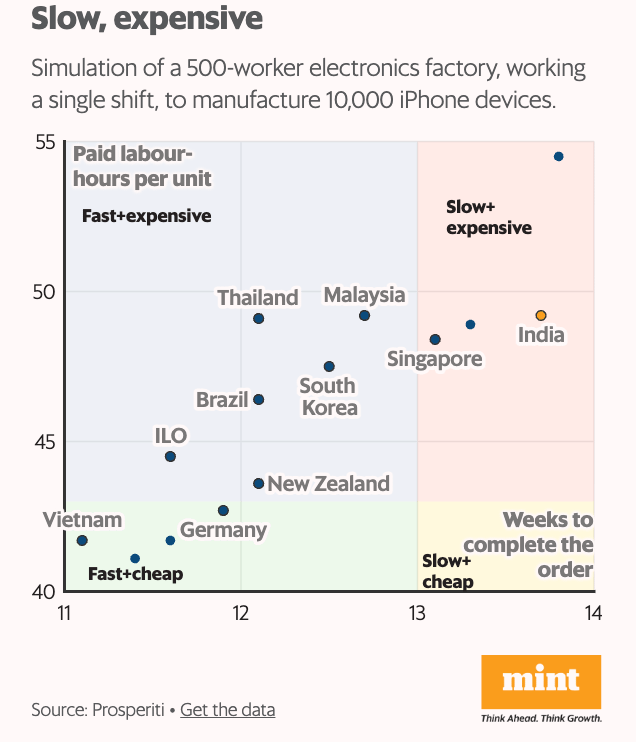 Germany and India share an 8 hour standard working day but India requires any overtime to be paid at twice the regular rate–most developed countries are at 1.5 and a few have no statutory cap at all. In fact, Germany has no statutory overtime rate–it can vary depending on bargaining. Germany is also more flexible than India on the number of overtime hours. India has a cap of 144 overtime hours a quarter. Technically, Germany doesn’t regulate overtime hours but it does cap total hours at 10 a day and 48 a week on average. The average is crucial. In Germany overtime hours can be moved between weeks within a 6 month period while India regulates each week. In other words, long weeks in Germany are legal as long as short weeks offset them before the period ends–while in India each week has a cap. The weekly cap and the double overtime pay make it very costly and difficult to meet rush or large seasonal orders.
Consider a hypothetical 500-worker electronics factory, working a single shift, in each of the 16 countries studied. Ahead of a September iPhone launch, each factory receives an order for 10,000 devices to be completed in three months.
Say the factories are identical in productivity, wages and technology; only the rules on working hours differ. How fast and at what labour cost would the Indian factory deliver compared to elsewhere?
The results are stark.
The factory in India cannot match the pace of its global peers. It takes 13.7 weeks to complete the 10,000-iPhone order, 23% longer than the fastest factory…The Indian factory falls behind because it cannot keep the same pace throughout the production cycle. Without the option to rearrange regular hours, the only way to go faster is overtime…The Indian factory cannot compete on cost either. To complete the iPhone order, it pays for 49.3 labour-hours per unit, at least 18% more than factories at the cost frontier. India’s unit cost is high because 144 of the 800 production hours per worker are paid as overtime at 2x the regular wage, pushing paid labour to 985 hours for 800 hours of output.
…The combination of slow delivery and high cost makes India an unattractive manufacturing destination.
Amazingly, on an equal-wage basis producing iPhones in Germany is actually cheaper and faster than in India! Of course, wages are not equal but neither is productivity–the key point is that the chart isolates the cost of India’s regulatory inflexibility.
Returning to premature imitation, it won’t surprise you that many firms and workers in India evade the overtime rules and come to their own understandings but this applies mostly to small Indian firms and not the Foxconns and big international firms that India wants to attract but which must obey the laws as written.
Hat tip: Paul Novosad.
On Bergman’s *Persona*
I first saw Ingmar Bergman’s Persona, his stone-cold classic of 1965, as a teenager, and God knows how many times I have seen it since. It has the greatest opening sequence in cinema: a percussive, rapid-fire montage that can never be wholly accommodated or understood. The film’s story is, however, a simple one (even if its Jungian resonances are deep and complex). A celebrated actress, Elisabeth Vogler (one of Liv Ullmann’s defining roles), is struck dumb, having dried up in the middle of a performance of Electra. Three months later, still speechless, she is granted a nurse, Alma (Bibi Andersson), who, fearing silence, cannot stop talking to and at her patient. Elisabeth becomes the audience, Alma the performer, and the two personalities intertwine against a biblical monochrome landscape of sand, rock and water. More than 60 years on, it remains inexhaustible, never to be entirely absorbed, intimate, stark and utterly compelling.
Here is more from Paul Lay.
I guest host the NYT podcast and interview Dwarkesh
Here is the audio, video, and transcript. Excerpt:
Cowen: Unreleased models — why are they important?
Patel: As in the ones that are internal to the companies?
Cowen: Well, many companies have unreleased models. Maybe it would cost too much to release them or they’re not safe yet, but the public doesn’t see them.
Patel: Yeah.
Cowen: You’re an insider. Whether or not you see them, you hear about them; you know something about them. How should we think about unreleased models, and how does that change our picture of what’s going on?
Patel: I think there’s a very frustrating element to the current situation right now, where people inside the A.I. labs claim to have evidence that makes them more worried, and they are not allowed to talk about it. This makes it a very difficult situation on the outside to evaluate how worried we should be.
For example, maybe two days ago, I was talking to somebody at Anthropic, and they were like: Look, I expect A.I.s to beat humans at A.I. research within nine months.
And I’m like: Why do you believe that?
They’re like: It’s not just vibes, but I have information on the inside.
I’m like: What is it? Is it a new model? Is it some evaluation you ran?
He’s like: I can’t talk about it.
I think it’s a terrible state of affairs. If they really believe this, if they think that we’re in a situation where we’re less than a year away from automating A.I. research and radically speeding it up, they should make this evidence public.
I especially worry about the following scenario, whereas A.I.s get better and better at making A.I. progress faster and automating it, they will be inclined not to keep releasing models that are even close to their smartest models externally, because then if they release those externally, it would help others make smart models.
And it’s just kind of a schlep to release models externally. You need all these safeguards and everything.
Cowen: So the gap between what they know and what we know would get bigger and bigger under that scenario. We’d end up more in the dark, more surprised when things happen. It would be harder for regulators, policymakers, members of Congress, everyone.
Kudos to Dwarkesh for taking the other side of the microphone. Do also see our discussion of AI psychosis, among other topics.
Thursday assorted links
Astra Held Its Ground (Truth)
TheoPhysEval: We present a suite of 50 unpublished research-level theoretical physics problems with verifiable answers. Without AI assistance, a typical problem in our collection could be solved by a world expert in about a day or less but would take considerably longer for experts in adjacent specialties. We test the ability of off-the-shelf AI agents to tackle these problems autonomously, without human hints. When given access to tools available in a realistic setting, including the ability to search the literature and write scripts for numerical and symbolic work, the best-performing agent, GPT-6-Astra harnessed in Codex, obtains the final answers with a near-perfect accuracy of 98% at an average cost under USD 3 per problem.
Example question: Consider one-dimensional class D fermionic systems, with no microscopic symmetries other than fermion parity. Restrict to the trivial phase and to free-fermion models. Using the suspension construction, construct a two-parameter Hamiltonian corresponding to a fermion parity pump. What is the central charge of the critical theory at the diabolical point? Under free-fermion perturbations, what does the diabolical point destabilize to?
But here is the most remarkable part from one of the authors, theoretical physicist Suvrat Raju:
Our initial evaluation suggested that GPT-6-Astra’s score was in the late eighties followed closely by Opus 5.5 But, as we started to investigate the mistakes that the models might have made, the models, especially Astra, insisted that they were right and that it was the expert-supplied answers that were erroneous. When we went back to the experts it turned out, in multiple instances, that the experts found some subtle errors buried deep inside their calculations. As they revised their answers, Astra’s score started to inch up and it finally ended up with 98% (49/50).
In other words, instead, as originally intended, of the human answers serving as ground truth to test the AI, the AI answers were ground truth for testing the experts. As I commented on twitter, we are at “the fuck” level.

Why I do not use LLMs more
They are so very, very good at matching me to the books I wish to read and the music I wish to listen to. In this odd sense they are not very sticky. The LLMs are amazing, but the world is awesome too! Thus the LLMs keep on sending me away. There is quality travel as well.
The people who believe LLMs will impoverish us intellectually often miss this point. And it might also provide a cap on market demand. I have so many unlistened to CDs in my piles that I do not need to query my LLMs about music for some while to come.
