Recently Listed
1,070 launchesAccessibility paired with personalization defines this free home workout generator, which addresses the persistent gap between fitness aspirations and the constraints of modern life. The product serves anyone seeking structured exercise without the barriers of gym memberships, equipment purchases, or time-consuming workout research. Its appeal spans busy professionals, parents managing multiple schedules, students with limited budgets, and frequent travelers. The core offering hinges on immediate utility. Users select a fitness goal, available duration, and fitness level, and the system generates a complete routine with warm-up, timed intervals or set-rep structures, and cool-down. The setup takes under ten seconds, eliminating the planning friction that derails consistency for many people. What distinguishes this product is its execution of simplicity without sacrificing depth. The library houses 185 pre-made routines across ten distinct goal categories, from fat loss and strength-building to mobility and high-intensity interval training. Behind these routines sits a database of 107 illustrated exercises with form guidance, addressing a common pain point for home exercisers who lack real-time coaching feedback. The visual library transforms the experience from following vague instructions to understanding proper movement patterns. The structured approach to progression stands out. Multi-week plans provide day-by-day schedules that increase in difficulty weekly, converting one-off workouts into sustainable habit-building regimens. A 30-day weight loss challenge, 30-day glute and ab challenges, and a seven-day beginner plan offer guided pathways rather than forcing users into abstract open-ended choice. The absence of friction points shapes the experience throughout. There is no account creation, no paywalls, no equipment requirements, no geographic limitations. The system accepts variable inputs—adjustable session length from 10 to 45 minutes, multiple difficulty levels, and optional equipment—without fragmenting the user experience. Audio cues during workouts eliminate the cognitive load of tracking intervals manually. From a business perspective, the model prioritizes user acquisition and retention over immediate monetization. Offering genuine utility for zero cost positions the product to achieve scale. The free-first approach makes it a credible recommendation for budget-conscious users and creates pathways for future monetization through premium features, advanced analytics, or community features if the founder chooses. The product succeeds because it removes obstacles between intention and action, solving a problem experienced by millions while maintaining enough sophistication to sustain engagement beyond novelty.

An adult content creation platform built on AI image and video generation, CornDude targets independent creators seeking to produce adult material at scale without traditional production overhead. The service consolidates character design, still image generation, and video animation into a single workflow, positioning itself as a fully integrated studio environment rather than a collection of disconnected tools. The platform's architecture centers on building reusable AI characters as a foundation for content production. Users design a fictional character's appearance once, then deploy that character across multiple scenes and content types. This workflow pattern addresses a core pain point for adult creators: maintaining visual consistency across a content library without reshooting with the same talent repeatedly. CornDude offers three main content generation paths. The AI image generator produces still photographs of characters in defined poses. The AI video generator handles short-form animation, with generation times under sixty seconds for instant clips. A third mode, called Studio, enables longer-form video production where users submit a scene description and receive multi-shot sequences with transitions and continuous narrative flow in a single generation pass. The platform distinguishes itself through preset scene templates that reduce the friction of content conception. Rather than writing prompts from scratch, creators select from fifteen-plus predefined scenarios across categories including specific sexual acts and positions, then modify prompts to customize the output. This library structure suggests the product prioritizes usability for creators without strong technical prompting skills. Content governance appears explicit and deliberate. The terms of service prominently emphasize that users must create original fictional characters and cannot upload real individuals' likenesses without consent. The platform includes age verification and compliance statements referencing 2257 record management, though the depth of these compliance measures cannot be assessed from the website alone. The product lacks publicly visible pricing information, making the business model unclear from available materials. The signup flow suggests a freemium structure with generation limits, though this remains unconfirmed. CornDude operates in a narrow but substantive market niche. For adult creators seeking to reduce production costs and accelerate content generation, the integrated character-to-scene workflow offers clear utility. The service's viability depends on sustained technological improvements in generation quality, regulatory evolution around synthetic media, and whether content creator demand justifies the product's ongoing development.


Forming a US company as a foreign entrepreneur has historically been a friction-filled process. BaseAcross eliminates that friction by handling corporate formation and ongoing compliance entirely for non-resident founders who lack a US Social Security Number or physical address. The product targets a specific and underserved market: international founders who want to establish legitimacy, open US bank accounts, and accept payments via Stripe without navigating Byzantine bureaucracy or hiring expensive lawyers. The solution encompasses the entire lifecycle—from LLC or C-Corp incorporation in Wyoming or Delaware through annual compliance filings, compliance deadline tracking, and essential documentation for banking applications. What distinguishes BaseAcross is the comprehensiveness of its integrated offering. Beyond formation, the platform handles EIN assignment without requiring an SSN, a critical advantage for non-resident founders. It generates the specific documents that US banks demand, maintains compliance calendars with cost estimates surfaced well in advance, and connects users to startup credit programs from Google Cloud, AWS, and Microsoft. The platform also extends into adjacent needs: it provisions a US business phone number, sets up professional email and business domains, provides bookkeeping with automated transaction categorization, and offers managed WordPress or Shopify hosting. The user experience is designed for transparency. The timeline is explicit: same-day filing after confirmation, EIN assignment within one to two weeks, and bank-ready documents shortly after. Users see the full order and cost before paying, with the platform handling communication with state filing agencies throughout. Pricing is straightforward: $249 annually plus state fees at cost. The example shown—$351.40 total for Wyoming incorporation—reflects actual filing costs passed through without markup. Certain features like the US phone number and domain are free for the first three months, then included in the ongoing "Operate" plan. Annual compliance obligations like state reports carry transparent pricing shown in advance. The platform integrates deeply with financial infrastructure founders actually use: Mercury, Stripe, PayPal, Shopify, and others are embedded throughout the product. This reflects BaseAcross's understanding of what founders need downstream and builds the company formation experience around those requirements. For non-resident founders, particularly those bootstrapping or early-stage, BaseAcross removes a genuine barrier to incorporating in the US and accessing US financial rails without that incorporation requiring a US presence or identity number.


Clipboard interception represents an often-overlooked attack surface in developer workflows. Most security tools catch secrets after they've leaked—in logs, repositories, or cloud environments. PasteGuard addresses a gap in that defensive chain by protecting sensitive data at the moment of paste, before an accidental action becomes a security incident. The product targets individual developers, professionals, and organizations who want to prevent credential exposure during normal copy-paste operations across Windows applications. It detects passwords, API keys, access tokens, cloud credentials, connection strings, and private keys using local detection rather than cloud services. What distinguishes PasteGuard is its commitment to local-first processing. The detection engine runs on the device itself without uploading clipboard content to external services. This privacy-by-design approach acknowledges that clipboard content is inherently sensitive and warrants protection at the source. The product ships with 101 secret detectors covering cloud platforms, databases, source control, DevOps tools, SaaS products, and AI services. The workflow is straightforward. PasteGuard monitors clipboard changes in the background without disrupting normal copy behavior. When sensitive content is detected, it applies protection based on user configuration: warning the user, sanitizing the content, or allowing the paste if the destination application is whitelisted as trusted. A local activity history lets users review what the protection layer has intercepted. The product strategy reflects pragmatism about adoption barriers. Rather than forcing trial periods on users, the free tier offers permanent access to core secret detection, safe paste workflows, and multiple protection modes. The paid Pro edition adds advanced rule control and workflow customization for professionals who need fine-grained configuration. Organizations can deploy consistent PasteGuard setup across managed devices. The product emerged from a real security incident where a credential was accidentally pasted into the wrong destination during routine developer work. Rather than solving credential leakage after exposure, the founder recognized that prevention at the clipboard level was more practical than rotation and incident response. PasteGuard fills a specific but meaningful security gap. It solves a problem that occurs frequently in developer workflows and shields against the easiest mistakes. The local-first architecture removes friction that might otherwise prevent adoption. For teams where accidental secret exposure represents a genuine risk, PasteGuard provides direct defense at a leverage point in the copy-paste chain.

Consolidating classroom planning and material preparation into one workspace addresses a core challenge for educators. Teachers typically juggle timetables, lesson planning, worksheet generation, and assessment creation across multiple tools or notebooks. Teacher Planner brings these activities together in a single browser-based application, reducing the time teachers spend starting from scratch with classroom materials. The product's most distinctive feature is its adaptable planning interface. Teachers can organize their work by day, week, or month, or step back to view units across an entire term using the Unit Timeline. An Outline view displays all lessons in structured format. This multiplicity of perspectives allows educators to balance immediate preparation with long-range planning without switching between applications. When plans change, teachers can shift lessons forward without reorganizing their entire schedule. What further differentiates the offering is the ability to import existing timetables through photos or PDFs. Rather than manually retyping class schedules from previous terms or current schools, teachers provide an image or document and the system extracts class names, times, and periods. Users review the extracted data before confirming, reducing transcription errors. The AI toolkit targets the material preparation side of the equation. Teachers generate lesson plans from learning objectives, create worksheets from topics or passages, draft multiple-choice quizzes with answer keys, rewrite existing text at different complexity levels, and produce written feedback on student work. These tools function as starting points. The interface consistently emphasizes that teachers review and edit AI-generated content to suit their specific students and teaching approach. Structurally, Teacher Planner operates on a freemium model, offering both free and paid subscription tiers. This pricing approach lowers adoption barriers for educators while establishing revenue streams for the business. The specific pricing details and feature restrictions remain undisclosed in public materials. The product occupies a practical position between general note-taking applications and comprehensive learning management systems. It targets the workflow gap where teachers currently cobble together planning and material creation using disconnected tools, offering a cohesive workspace with integrated AI assistance rather than claiming to replace broader institutional systems.


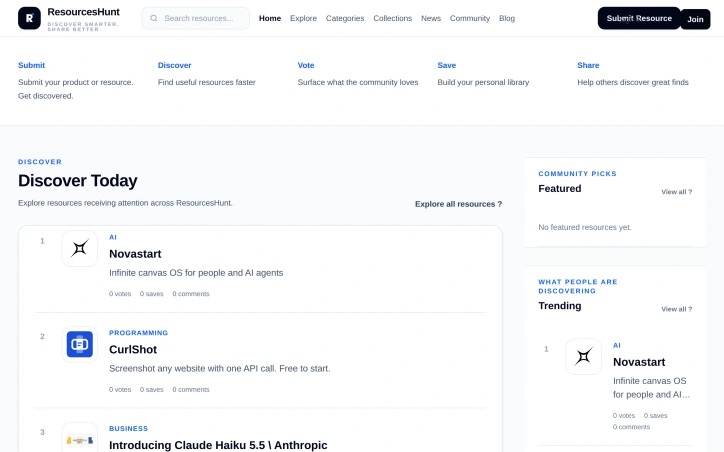
Keeping track of tools and resources across multiple domains creates information overload for professionals, developers, and entrepreneurs. ResourcesHunt addresses this friction by functioning as a community-driven directory where users discover, evaluate, and catalog resources spanning AI, programming, design, business, and education. The platform operates on a straightforward premise: curate by consensus. Users can vote on resources, save favorites to personal collections, and leave comments, creating a reputation signal that surfaces quality discoveries. Rather than relying on algorithmic feeds, the community validation mechanism means trending resources reflect genuine user interest and utility. What distinguishes ResourcesHunt from general bookmarking tools is its categorical organization and submission-first model. The platform invites users to contribute their own findings, building content through participation rather than editorial selection alone. This approach works particularly well for niche categories like AI tools and open-source alternatives, where new releases emerge constantly and recommendations from peers carry weight. The product targets a broad audience across technical and non-technical domains. Developers can discover APIs and development tools; entrepreneurs can explore business resources; students can find educational platforms. The interface keeps friction minimal: browse trending discoveries, vote if something solves a real problem, save for later, or share with others. A secondary feature, integrated news coverage of industry developments, supplements the resource discovery function. Recent updates highlight launches in AI and financial technology, keeping users informed on sector movements beyond individual tools. The current interface shows active communities around specific categories, with multiple resources receiving engagement through votes and saves. However, the platform's value depends entirely on maintaining both supply and quality. As a community-driven directory, growth requires sustained submission from users and mechanisms that prevent low-quality resources from gaining prominence. ResourcesHunt essentially formalizes how professionals already discover tools: through peer recommendations and community validation. For teams managing scattered bookmarks and tool lists, it provides a shared discovery layer where visibility correlates with actual usefulness.

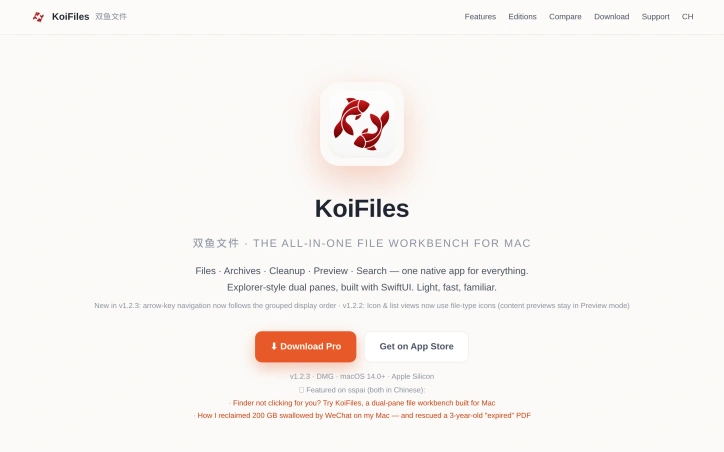
Mac users managing file organization typically navigate a fragmented toolscape—file browsers, compression utilities, and disk cleaning applications all operating independently. KoiFiles consolidates these three functions into a single native application built on SwiftUI, targeting Apple Silicon Macs on macOS 14.0 or later. The application addresses a genuine workflow inefficiency. Rather than maintain separate paid tools, users gain file browser capabilities, a built-in 7-Zip compression engine supporting encryption across 7z, zip, and tar formats, disk cleanup functionality, and multi-layer search within one interface. The dual-pane layout mirrors established patterns from professional file managers like Norton Commander, providing a familiar interaction model executed through native macOS frameworks. The design philosophy emphasizes restraint. The absence of subscription requirements, cloud uploads, or advertising sets it apart from competitors increasingly dependent on recurring revenue. The quick preview system, accessible via spacebar or middle-click, maintains visibility into the main file listing—solving a repeated complaint about preview panes that consume workspace or block ongoing navigation. Compression capabilities extend beyond basic archive extraction to include full format support with encryption and multi-volume handling. One feature reflects product-market fit with specific user bases. WeChat file management integrates timeline browsing of transferred files, recovery of documents marked expired within the messenger application if they remain locally stored, and categorized accounting of chat history storage consumption. This functionality targets pain points within popular communication patterns rather than generic file system tasks. The monetization model merits attention given market trends. The Pro version downloads free from the official website with complete feature access. The App Store distributes a Standard edition sold as a one-time purchase that unlocks capabilities across both versions. This dual-distribution creates purchase optionality while establishing a legitimate revenue channel. Pricing positions competitively against competitors charging annually for individual capabilities—the compression engine alone, storage cleanup utilities, and file management tools often require separate subscriptions. The creator frames this as consolidation by necessity. Rather than pursuing specialized excellence in one domain, KoiFiles bundles capabilities that most macOS users require occasionally but rarely need in premium depth. For users managing substantial local file systems and confronting repeated cleanup cycles, the value concentrates on cost efficiency and operational simplicity rather than advanced capabilities or integration breadth.
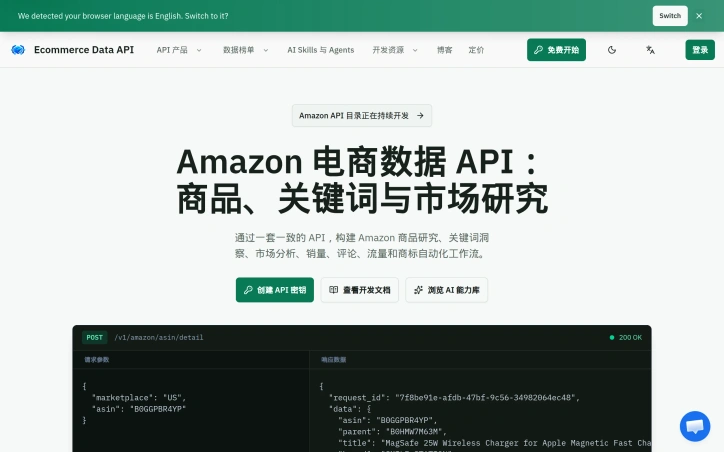
Understanding Amazon's competitive landscape requires access to reliable product, keyword, and market data that most sellers can't gather manually. Ecommerce Data API addresses this gap by providing developers, Amazon sellers, and AI agents with structured access to product listings, search trends, sales estimates, customer reviews, and traffic patterns through a unified REST API and alternative integration methods. The platform organizes 45 distinct API endpoints across six functional categories, each designed to support specific business workflows. The product research suite enables ASIN lookups with detailed specifications, seller information, pricing, ratings, and competitive variant data. The keyword research set targets search volume analysis, traffic attribution, and ranking metrics. Market analysis tools quantify category size, product concentration, and demand trends. Traffic analysis reveals keyword sources and related product associations. The trademark module covers global intellectual property searches across multiple countries and registering bodies. A text recognition API rounds out the offering, handling optical character recognition for both Chinese and Latin scripts across image URLs, Base64, and file uploads. The architecture reflects thoughtful product design. API endpoints are grouped by business scenario rather than alphabetical listing, making navigation intuitive for users building specific research workflows. Request examples in the documentation include actual ASIN values and response payloads, reducing friction between signup and first API call. The platform supports not just traditional REST integration but also deployment as a remote Model Context Protocol server and as a reusable Agent Skill for AI-driven automation, broadening accessibility to non-traditional development environments. Transparency emerges as another distinguishing characteristic. The documentation explicitly acknowledges that coverage varies by operation and that sales figures represent estimates rather than confirmed data. This honesty about data quality limitations distinguishes the product from competitors that oversell accuracy. The user experience centers on self-service. Customers register independently, generate API keys through a secure dashboard, and monitor consumption metrics and error rates in real time. The platform supports key rotation for security management. For Amazon sellers building competitive intelligence workflows, cross-border sellers executing market research at scale, or developers integrating ecommerce research into larger applications, the breadth of accessible data points and flexible deployment options position this as a compelling alternative to building custom scraping infrastructure. The explicit acknowledgment of data limitations separates it from vendors making assured-accuracy claims they can't defend.

Creating viral short-form video content requires the right tools—and the right moment. OzilAI exists to solve a specific problem: democratizing one of social media's most recognizable moments. The product lets any creator grab a single portrait photo and insert themselves into Mesut Özil's celebrated 2016 Champions League solo goal, complete with authentic match commentary and stadium audio. The appeal is straightforward. Rather than wrestling with video editing software or relying on face-pasting tools that leave visible seams, OzilAI reconstructs the creator's identity and clothing across the entire 15-second sequence—shirt, posture, and all. The result ships pre-synced with genuine English match commentary, eliminating the post-production work that typically eats up creator time. Vertical and landscape formats launch directly to TikTok, Reels, and YouTube Shorts without additional editing. What sets OzilAI apart is its narrow focus. By constraining itself to a single iconic moment rather than attempting broad video generation, the product delivers consistent, polished output from minimal input. A casual hoodie selfie, an office suit, or a formal jersey all map convincingly onto the attacking player, maintaining visual coherence throughout the chip, the defender slides, and the finish. Early creators report viral traction—one mentioned over 200,000 TikTok views within hours of posting. The technical execution merits attention. The system maps facial features while reconstructing clothing and body posture into a complex, multi-second sequence. This isn't simple face-swapping; the AI must understand pose, perspective, and continuity. The automatic match commentary sync removes a friction point that typically confounds creators without audio engineering experience. Pricing follows a credit system. A 15-second 720P generation costs 10 credits, while 2K Ultra HD versions range from 18 to 27 credits depending on length. The platform offers one-time credit packs or monthly subscriptions, with credits refunded automatically if generation fails or delivery exceeds 20 minutes. This model aligns incentives: the platform has every reason to deliver quickly and reliably. OzilAI operates within a tight design constraint—one iconic moment, single-photo input, vertical and landscape output. But within those boundaries, it executes with polish. For short-form creators chasing viral potential, the frictionless journey from portrait to post-ready video represents genuine utility.


Event planning typically unfolds across a frustrating divide: hosts envision an aesthetic in their minds, but vendors and planners struggle to translate that vision into concrete orders and purchases. Eventscape.ai addresses this friction directly by converting text descriptions into photorealistic room and table designs within minutes. The tool's core strength lies in collapsing the gap between concept and execution. A user describes an event in natural language—"anniversary dinner for 16, burgundy and gold, candlelight"—and receives a photorealistic visualization in two to three minutes. This removes the traditional bottleneck where Pinterest boards and mood boards never quite match the intended outcome, and where planners waste hours building these materials manually. What distinguishes the product is the Designer Brief accompanying each visualization. Rather than stopping at aesthetics, the tool generates an itemized shopping list that breaks down every element—linens, vases, candles—with quantities calibrated to the specific guest count. This transforms the service from a visualization tool into a planning and procurement asset. A user can immediately share this brief with vendors or use it for self-shopping, eliminating the manual work of building lists from scratch. The product targets event hosts and planners seeking to see their vision materialized before committing to purchases. This is particularly valuable for occasions where budget and aesthetic alignment matter significantly, such as weddings, anniversaries, and milestone celebrations. The founder's background running a boutique event studio suggests the product emerges from direct experience with these operational pain points. Regarding business model, the product offers the first design free, lowering the barrier to entry and allowing users to experience the core value proposition before any financial commitment. Beyond this freemium hook, no pricing structure is publicly disclosed, suggesting either an early-stage approach or intentional simplicity focused on conversion through first-use value. The offering is deliberately narrow in scope. Rather than attempting to solve every aspect of event planning, the tool concentrates on the visualization-to-procurement pipeline, where friction creates the most operational waste for planners and hosts alike.


Event photographers face a familiar dilemma: guests want the photos they appeared in, but finding and buying them individually from hundreds of shots becomes friction for everyone. Sellphotos.online addresses this by combining face recognition with a commission-free sales model designed for photographers, schools, colleges, and sports clubs. The platform inverts the typical photo marketplace dynamic. Rather than guests scrolling through entire galleries, they upload a selfie and the system shows only photos containing their face. Payment flows directly to the photographer through their chosen method, whether Interac e-Transfer, UPI, or any payment detail the photographer specifies. Crucially, the platform takes no commission and handles no money itself, eliminating both transaction fees and identity verification requirements that plague competing services. The workflow is streamlined. Photographers upload an event's full shoot, which gets watermarked with one of 27 designs that display their branding. They share a single link or QR code with guests, who need neither app nor account to browse. Once a guest confirms their photos and payment clears, the photographer approves the order and watermarks automatically strip from downloads. What distinguishes this approach is its focus on removing friction. The face search works from watermarked previews only, and the selfie used for matching is never stored permanently, expiring after 24 hours. Photographers can disable face search per event if preferred. The pricing flexibility accommodates different sales strategies: per-photo pricing, all-photos bundles, volume discounts, and prices in any of 47 currencies. Email notifications reach buyers at each transaction step, and unpaid orders trigger reminders. The business model mirrors this simplicity. Photographers pay a yearly subscription starting at $99, scaled by upload volume and order approvals rather than per-transaction. This shifts incentives away from the platform capturing value and toward photographers maximizing revenue directly. The platform assumes photographers already have relationships with their customers and payment methods in place. It's less a marketplace and more infrastructure that moves the sales transaction off-platform entirely. This lean approach trades feature richness for directness, making it suitable for high-volume event work where photographers already have audience access and want to eliminate middlemen.


Online shopping for overseas Chinese consumers involves navigating fragmented deal listings across multiple platforms, wasting time searching for genuine discounts. DealGather tackles this friction by aggregating verified discounts, coupons, and limited-time sales from Amazon and other e-commerce marketplaces into a single interface designed specifically for this demographic. The platform's core strength is consolidation of curated deals rather than serving as a raw deal feed. Rather than promoting unvetted offers, DealGather emphasizes verification, which addresses a real pain point: most deal platforms fail to filter out false claims and expired promotions. This curation approach distinguishes it from simply scraping sales across the internet. The target audience is well-defined and specific. Overseas Chinese shoppers face distinct challenges when purchasing from US-based platforms: language barriers, regional pricing complexity, and the sheer time investment required to find worthwhile discounts. For this demographic, a localized deal aggregator eliminates both the friction of comparison shopping and the cognitive load of sorting through irrelevant offers. While Amazon serves as a primary source, integration with other e-commerce platforms extends DealGather beyond a single-retailer tool. This broader approach positions it as a comprehensive savings resource rather than a niche Amazon-only solution. The platform enables price comparison across multiple sources without requiring users to visit each site independently. From a strategic standpoint, DealGather operates in a crowded category—deal aggregation and couponing—but differentiates through linguistic and cultural specificity. Rather than competing directly with generalist deal platforms, it pursues a focused niche strategy. This approach reduces competition while building deeper loyalty with a community for whom existing solutions often feel misaligned. Meaningful limitations emerge from the available information. The extent of real-time deal coverage, verification methodology, notification systems, and the overall user experience remain unclear. No details about business model, pricing, or monetization strategy are apparent, which raises questions about long-term sustainability. DealGather addresses a legitimate problem—fragmented deal discovery and information asymmetry—for an underserved demographic. Its success hinges on execution fundamentals: whether deals remain fresh, how rigorously verification is enforced, the quality of the user interface, and whether the platform can maintain an active community of engaged deal hunters. The foundation is solid, but product-market fit depends entirely on these execution details.


Chrome extension users managing affiliate marketing campaigns face a friction point: turning a promising product deal into publishable content across multiple platforms demands time-consuming manual work. The process typically involves extracting product details, writing promotional copy, appending affiliate tags, and then reformatting the same content for different platforms like Telegram, WhatsApp, Reddit, X, and Facebook. Deals Copier addresses this by automating the workflow with a single-click extraction and AI-assisted post generation. The tool targets affiliate marketers and deal aggregators who distribute across multiple channels. Rather than building yet another dashboard, the creator embedded the functionality directly into users' browsing experience. When a user encounters a product on Amazon, eBay, Walmart, Woot, or Flipkart—across 30 regional sites—they trigger the extraction from the extension popup. The system captures pricing data, discounts, bank offers, and product images without requiring manual input. What distinguishes this approach is its focus on privacy and user control. Deal data extraction runs entirely in the browser, never routing through company servers. This design choice reduces latency and eliminates data transmission concerns. Users can preview affiliate links before saving them, with support for multiple affiliate networks including Amazon Associates, eBay Partner Network, and Rakuten. The AI component handles title shortening, pitch writing, and translation into twelve languages. Rather than replacing manual creativity, the tool handles the mechanical work—formatting text for platform constraints, creating image collages, or generating square carousel videos. Users toggle which features they want for each deal. The commercial structure operates as a freemium model. The free tier provides ten monthly AI-powered writing requests, sufficient for users experimenting with the workflow. A Pro plan unlocks unlimited AI writing and translation services. This pricing approach avoids forcing users to commit to a subscription before understanding the product's fit for their workflow. The extension supports regional Amazon marketplaces (22 total) alongside other storefronts, recognizing that affiliate marketers operate across geographies. Built-in compliance features include optional affiliate disclosure tags and price disclaimer appended to exports. For affiliate marketers drowning in formatting overhead, the value proposition centers on reclaiming time. The tool's strength lies not in discovering deals—users retain that responsibility—but in mechanizing the post creation, allowing rapid distribution once a worthwhile deal is identified. Whether the time savings justify adoption depends on deal volume and platform diversity in individual workflows.


Juggling notes from lectures, client calls, and PDFs across different apps wastes time and fragments context. Claro consolidates these into a single workspace where an AI assistant can search, summarize, and extract actionable insights from everything captured. The product targets anyone managing multiple conversational contexts—students reviewing lectures, consultants comparing discovery calls, and professionals drowning in back-to-back meetings. Where competitors like Granola and Otter excel in narrow lanes (transcription or meeting notes), Claro spans all of them by starting with a unifying principle: the same raw capture should reshape into whatever format serves the moment. This flexibility drives the core appeal. A lecture recording becomes a study guide with flashcards; a discovery call becomes a concise summary; a team meeting yields structured decisions and action items, all from the same underlying transcript. The interface does more than file notes—it interprets them. The AI chat layer lets users query across their entire capture history with natural language, cite specific passages, and compare meetings or pull themes from weeks of input. Search relies on the user's own words rather than generic retrieval, a deliberate choice that grounds results in authentic context. The technical foundation handles the mechanics smoothly. Live transcription works alongside pause-and-resume Quick Note recording. PDFs and YouTube videos feed directly into the note system. Team collaboration surfaces design reviews and shared research alongside individual notes. All of this runs in a single dashboard where users can ask Claro to summarize recent notes, surface action items, or generate quizzes on the fly. Pricing follows a straightforward ladder. The free plan covers basic note creation. Paid tiers unlock unlimited standard-accuracy transcription, with Pro+ and Pro Ultra offering higher-accuracy hours for users who need studio-quality output. The full workflow—Quick Note recording, PDF and video processing, structured note generation, and cross-note chat—lives on all Pro plans, eliminating friction from feature fragmentation across tiers. The product solves a genuine problem without overselling. The team built this deliberately for people who inhabit multiple contexts rather than designing for one persona and hoping it generalizes. The assertion that founders spent six months testing this across their own use cases carries weight. The remaining question is whether the reshaping and AI chat deliver sustained value at scale; the interface suggests they do, but independent user outcomes would strengthen the claim.


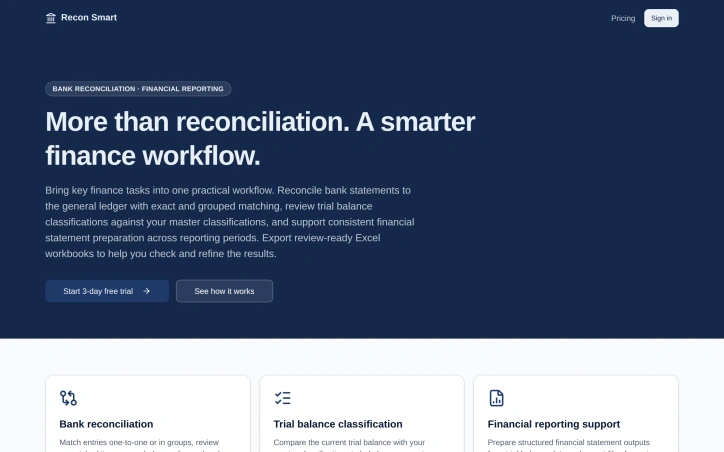
Finance teams spend substantial time on reconciliation work, transaction matching, and financial reporting—tasks that demand accuracy but often consume disproportionate resources. Recon Smart tackles this challenge by consolidating multiple accounting workflows into a single platform. The product targets accountants and finance professionals who handle routine reconciliation tasks. Rather than jumping between different tools for bank reconciliation, trial balance review, and statement preparation, users manage these core functions from one interface. The founder built this solution from personal experience in accounting operations, addressing the frustration of repetitive manual processes that detract from higher-value analysis work. What distinguishes Recon Smart is its integration of transaction matching intelligence into the reconciliation workflow. The platform suggests matches between bank transactions and recorded entries, reducing the manual effort required to identify discrepancies. This capability pairs with trial balance classification, allowing finance teams to organize accounts efficiently, and extends through financial statement preparation and reporting. The feature set covers the full cycle of monthly close and financial management work that teams typically fragment across spreadsheets and specialized tools. Development draws from practical accounting workflows. The founder validated Recon Smart using real financial data, demonstrating the interface and features address genuine operational challenges rather than theoretical process improvements. This grounding reduces the typical startup risk of building tools that look elegant but struggle with messy, real-world data. The positioning emphasizes efficiency gains and time savings rather than fundamental transformation. The founder frames the solution as a way to handle necessary financial work more quickly, freeing professionals to focus on analysis and strategy. That's a realistic promise in an industry where many new tools oversell their impact. The consolidation alone—reducing tool switching and duplicate data entry—delivers tangible benefits even before considering the matching intelligence features. One constraint worth noting: the publicly available information contains no mention of pricing, deployment options, or integration capabilities. For finance teams considering adoption, these details matter significantly and remain undisclosed. Similarly, the extent to which Recon Smart handles complex scenarios—multi-currency transactions, intercompany reconciliations, or regulatory-specific reporting—isn't addressed in available materials. Recon Smart addresses a clear operational pain point in accounting departments with a product built on authentic domain expertise. For teams handling manual reconciliation at scale, the consolidated workflow and matching intelligence offer legitimate efficiency improvements worth evaluating.

In a landscape where AI tool announcements arrive faster than most can evaluate them, AI Generators addresses a genuine bottleneck in discovery and comparison. The platform curates tools across nine categories—text, image, video, voice, music, code, and 3D—positioning itself as a reference point for creators and developers navigating an overwhelmingly crowded market. The directory currently catalogs 98 tools and combines them with structured filtering: search functionality, an "Editor's picks" section, and toggles for open weights and free tier options. This lets users narrow choices by licensing model or budget constraints, a practical approach to tools that vary significantly in accessibility and cost. What distinguishes the platform is its commitment to timeliness. The "What's new" section documents significant releases with functional specifics—not just announcements, but concrete capability updates. Recent entries detail Kling 4.0's extended 30-second clips guided by up to 15 image, video, and audio references, Gemini 4 Argon's gradual availability shift from vetted cyber defenders to public API, and Meta's paid-API-only approach to Muse Wonder. This level of detail transforms the list from static inventory into something closer to a release tracking tool, capturing nuance that generic listicles miss. The recency of updates is notable. As of October 16, 2026, the platform tracks launches from just days prior, including Mistral Large 4's entry into preview and Nano Banana 2.1's improvements to multi-part prompt handling. For a space defined by constant iteration, this freshness matters—stale comparisons mislead users into evaluating outdated model versions. The platform's scope is disciplined. It doesn't attempt to cover every conceivable AI application or niche tool, staying within generators explicitly designed for creation tasks. This bounded focus makes the curation manageable and keeps the directory functional rather than encyclopedic. One notable gap: the content reveals no pricing or business model information, leaving open questions about monetization and whether access is free or gated. The curator's acknowledgment of tracking "hundreds of new models launching monthly" suggests substantial resource commitment, yet this dependency on ongoing attention isn't transparent from the public surface.


Breaking news moves fast in AI. By the time coverage hits major tech publications, key announcements have already rippled through social media, shaped discourse, and influenced funding and hiring decisions. AI News Daily solves the latency problem by capturing trending stories directly from X and Threads as they accumulate engagement, then verifying and contextualizing them before they become traditional news. The platform targets engineers, researchers, and product teams who track AI releases and industry movements—people building with Claude, ChatGPT, or competing tools who cannot afford to miss announcements. The service operates at two speeds. On a regular cadence, it publishes twice-daily digests featuring posts that have crossed the 100-like threshold, each validated against official sources to filter signal from hype. A dedicated breaking-news crawler runs every 30 minutes to flag major developments immediately. What distinguishes AI News Daily is its dual focus. Beyond headlines, it curates practical tips for Claude Code, Codex, and ChatGPT—environmental variable settings, plugin configurations, capability tips—each checked against official documentation. These notes pair with plain-language explanations that lower friction for developers adopting new features. The product spans multiple channels. A web interface delivers stories in Korean and English. Native mobile apps for iPhone and Android send push notifications for breaking stories. Integration options include a Slack bot for team feeds and an MCP server for developers building agent systems. This distribution strategy recognizes that AI professionals consume information across platforms and prefer not to centralize on a single feed. The creator built the entire system solo using Claude Code, which speaks to both the efficiency of current AI tooling and the market demand for this type of curation. Rather than attempting to compete with general-interest tech news sites, AI News Daily fills a specific niche: it moves faster than traditional media, covers the social-media dimension that shapes perception and decisions, and provides verification that separates genuine announcements from speculation. For teams evaluating which AI tools to adopt or monitor, or for individual developers maintaining awareness of competitive releases and capability updates, the service delivers real-time signal without noise.


Engagement on social platforms like X and LinkedIn hinges on consistent, thoughtful replies, yet many users struggle to maintain this cadence while preserving their authentic voice. A Chrome extension addresses this friction by generating contextual reply suggestions tailored to a user's established writing style. The product distinguishes itself through its constraint-based design philosophy. Rather than offering generic conversational AI that produces robot-like responses, it reads both the individual post and the surrounding thread, then generates three distinct reply options that mimic how the user actually writes. The tool learns from replies users have previously composed, extracting patterns in tone, length, and vocabulary to inform future suggestions. Users remain in complete control: they select one of the three suggestions, edit it if needed, and manually post. The system never auto-posts on their behalf. The feature set reflects a laser focus on solving one problem well. Seven tonal variations span from Friendly to Smart, with toggles for brevity, length, and informality. The tool supports six languages, including Hinglish, a mix of Hindi and English common in South Asian professional networks. It explicitly refuses to invent facts, instead using only personal details users voluntarily provide during setup. A data privacy stance rounds out the value proposition: the service does not sell user data. Technical implementation is straightforward. The extension integrates directly into X and LinkedIn's reply interfaces, activated by a single button click. It runs on Chromium-based browsers including Chrome, Edge, and Brave. The free tier offers fifteen reply suggestions daily without requiring a credit card, lowering the barrier to trial. A paid annual plan costs ninety dollars with two months free, suggesting the free tier serves casual users adequately. The positioning targets creators and entrepreneurs who recognize that social engagement accelerates growth but who lack the daily bandwidth to craft personalized, context-aware responses at scale. For professionals already maintaining an active social presence, this tool compresses the time investment required to write replies that feel authentically theirs rather than algorithmically generated. The core insight—that AI replies fail when they sound like AI—is sound. The execution through pattern matching against a user's existing voice, combined with thread awareness and user control, demonstrates product thinking that respects both user autonomy and authenticity. Whether the writing style learning is sufficiently sophisticated to handle nuance remains a question for users, but the product's transparency about constraints and capabilities builds credibility.


Visual organization tools have long required choosing between simplicity and capability. This all-in-one editor targets the friction point where ideas need structure—whether for project planning, team collaboration, or classroom instruction—by letting users describe what they want built and having AI generate the full layout in seconds. The platform combines six core capabilities within a single interface: mind mapping, flowcharting, task management, templates, collaborative features, and export options. Users input a description of their project or idea, and the system generates a structured visualization including nodes, branches, and hierarchy. From there, refinement is immediate; additional AI prompts can restructure, add, remove, or rename elements while preserving user-applied notes, icons, and colors. Eleven prebuilt templates cover common scenarios: project plans, study guides, SWOT analyses, product roadmaps, sprint planning, blog outlines, OKRs, and client onboarding flows. What distinguishes this offering is its self-contained architecture. The AI runs on the company's own servers rather than depending on third-party services like ChatGPT, Claude, or Gemini. Users need no API keys, no external accounts, and no browser extensions—the entire experience happens in the browser across desktop, tablet, and phone. This eliminates friction common to competing tools and means the service is private by default. The flowcharting capability includes a full shape library: ovals for start and end points, diamonds for decisions, parallelograms for input/output, plus document, hexagon, and cylinder shapes. Task tracking layers the same tree layout onto checkpoint management, with checkboxes, side-panel lists, filters, and a live completion bar to track remaining work. Collaboration happens two ways. Read-only sharing generates a single URL or QR code for viewers requiring no account or install. Editable sharing lets collaborators make changes directly in the browser while the original owner retains control; each save is versioned, stale tabs refresh cleanly, and the sharing link can be revoked at any time. The system prevents collisions by restricting simultaneous editing to one user at a time. Export flexibility covers PNG, JPEG, PDF, SVG, JSON, and Markdown formats, with watermarks absent from paid plans. JSON export integrates with an Android app, enabling seamless cross-device transfers. The product accepts cryptocurrency as payment, a signal of positioning toward digitally native users. Free and paid tiers exist, though specific pricing is not publicly detailed.


AI-powered image generation and editing have become increasingly commoditized, but many tools still require specialized knowledge or produce generic results. NeoPhoto.ai addresses this gap by combining text-to-image generation with a suite of 20+ editing tools, designed specifically for creators, e-commerce businesses, and anyone needing professional-quality visuals without the overhead of equipment or design expertise. The platform's core strength lies in its task-specific approach. Rather than using a single generalized model for all image work, NeoPhoto routes different jobs to specialized models optimized for their particular purpose. This architecture means a portrait generation request uses a different engine than product staging or group photo creation, theoretically yielding higher-quality results for each use case. The editing toolkit reflects similar specialization, with dedicated tools for background removal, object erasure, content fill, image restoration, and upscaling to 4MP print-ready resolution. The feature set covers the full lifecycle of image creation and refinement. Users can generate images from text descriptions or reference photos, then refine them using tools like Magic Fill to add or replace elements, Magic Eraser for seamless object removal, and a "Reshoot" function that transforms snapshots into more cinematic versions. The ability to export illustrations and designs as clean SVG or PDF vectors adds utility for graphic design workflows that typically require manual conversion steps. NeoPhoto offers free access to start, positioning itself as low-friction for trial users. Premium plans unlock faster processing speeds, simultaneous job execution, commercial licensing, and dedicated support. The commercial licensing component matters for e-commerce sellers and creators monetizing their work, addressing a common pain point with other generative tools. The 80+ art styles and breadth of creation templates—ranging from professional headshots and group photos to virtual clothing try-ons and wedding photography—indicate a product designed to serve multiple verticals rather than a single use case. This horizontal approach broadens the addressable market but also creates execution risk across so many distinct workflows. What remains unclear from the available information is how the platform's output quality compares to competitors, the latency of different generation and editing operations at scale, and the specific architectural decisions underpinning the task-routing system. Pricing details beyond "free to start" and the existence of "Pro Plans" are not specified. For creators evaluating the tool, these specifics would factor heavily into adoption decisions.