Image

Hacking A Cat Litter Box

[Joseph DiGiovanni] is the owner of a Litter Robot 4. It’s a convenient mechanized litter box for cats that can clean itself to reduce unwelcome odors inside the home. He wanted to run automations based on the operation of the litter box, but was not eager to use the manufacturer’s cloud service to do it. Instead, he set about reverse engineering the device for his own ends.

Since the Litter Robot 4 relies on an ESP32 microcontroller for external connectivity, it was entirely possible for [Joseph] to whip up a custom firmware for the device instead. He started with ESPHome as a base, which is a popular firmware used for building smarthome devices based on Espressif hardware. The architecture of the Litter Robot 4 helped in this regard. It uses a PIC microcontroller to handle the low level hardware control, while the ESP32 is responsible for connecting to the cloud over WiFi. This allowed [Joseph] to mess with the connectivity features and get the device hooked up to Home Assistant without compromising the basic mechancial functionality of the device or any of the safety features.

All [Joseph] had to do was figure out how the original hardware’s ESP32 talked to the PIC and emulate that in his own firmware, which was achieved with some snooping and data capture and processing with an LLM. This was used as a basis to whip up an ESPHome firmware that could integrate the hardware neatly with Home Assistant.

Files are on Codeberg for those eager to tinker. It’s not the first time we’ve looked at cat litter management, and it won’t be the last. Video after the break.
Continue reading “Hacking A Cat Litter Box”

Image

Get Statistical About Your Pet With This Cat Tracking Dashboard

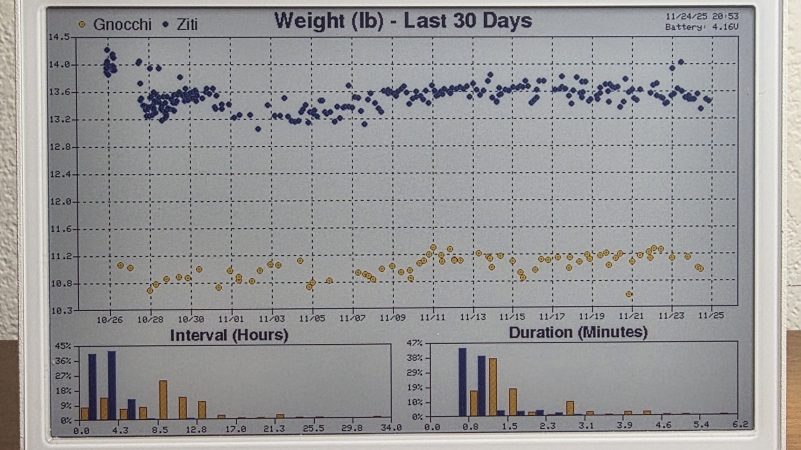
Cats can be wonderful companions, but they can also be aloof and boring to hang out with. If you want to get a little more out of the relationship, consider obsessively tracking your cat’s basic statistics with this display from [Matthew Sylvester].

The build is based around the Seeedstudio ReTerminal E1001/E1002 devices—basically an e-paper display with a programmable ESP32-S3 built right in. It’s upon this display that you will see all kinds of feline statistics being logged and graphed. The data itself comes from smart litterboxes, with [Matthew] figuring out how to grab data on weight and litterbox usage via APIs. In particular, he’s got the system working with PetKit gear as well as the Whisker Litter Robot 4. His dashboard can separately track data for four cats and merely needs the right account details to start pulling in data from the relevant cat cloud service.

For [Matthew], the build wasn’t just a bit of fun—it also proved very useful. When one of his cats had a medical issue recently, he was quickly able to pick up that something was wrong and seek the help required. That’s a pretty great result for any homebrew project. It’s unrelated, too, but Gnocci is a great name for a cat, so hats off for that one.

We’ve featured some other fun cat-tracking projects over the years, too. If you’re whipping up your own neat hardware to commune with, entertain, or otherwise interact with your cat, don’t hesitate to let us know on the tipsline.

Image

LoRa Repeater Lasts 5 Years On PVC Pipe And D Cells

Sometimes it makes sense to go with plain old batteries and off-the-shelf PVC pipe. That’s the thinking behind [Bertrand Selva]’s clever LoRaTube project.

Image
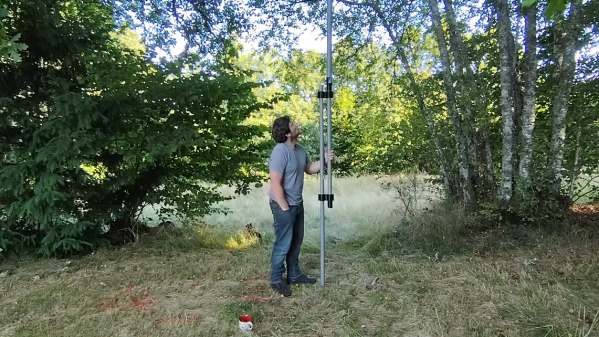
PVC pipe houses a self-contained LoRa repeater, complete with a big stack of D-size alkaline cells.

LoRa is a fantastic solution for long-range and low-power wireless communication (and popular, judging by the number of projects built around it) and LoRaTube provides an autonomous repeater, contained entirely in a length of PVC pipe. Out the top comes the antenna and inside is all the necessary hardware, along with a stack of good old D-sized alkaline cells feeding a supercap-buffered power supply of his own design. It’s weatherproof, inexpensive, self-contained, and thanks to extremely low standby current should last a good five years by [Bertrand]’s reckoning.

One can make a quick LoRa repeater in about an hour but while the core hardware can be inexpensive, supporting electronics and components (not to mention enclosure) for off-grid deployment can quickly add significant cost. Solar panels, charge controllers, and a rechargeable power supply also add potential points of failure. Sometimes it makes more sense to go cheap, simple, and rugged. Eighteen D-sized alkaline cells stacked in a PVC tube is as rugged as it is affordable, especially if one gets several years’ worth of operation out of it.

You can watch [Bertrand] raise a LoRaTube repeater and do a range test in the video (French), embedded below. Source code and CAD files are on the project page. Black outdoor helper cat not included.

Continue reading “LoRa Repeater Lasts 5 Years On PVC Pipe And D Cells”

Image

Automatically Serving Up Canned Cat Food

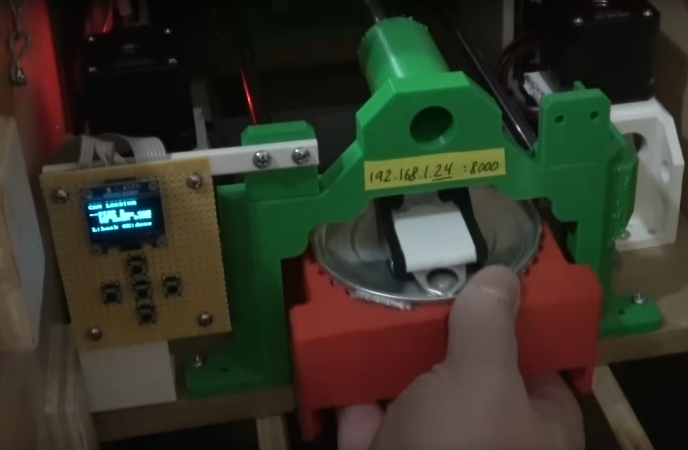
If there’s any one benefit to having a cat as a pet instead of a dog, it’s that they’re a bit more independent and able to care for themselves for many days without human intervention. The only thing that’s really needed is a way to make sure they get food and water at regular intervals, but there are plenty of off-the-shelf options for these tasks. Assuming your cat can be fed dry food, that is. [Ben Heck]’s cat has a health problem that requires a special canned wet food, and since there aren’t automatic feeders for this he built his own cat-feeding robot.

Unlike dry food that can dispense a measured amount from a hopper full of food, the wet food needs to be opened and dispensed every day. To accomplish this, his robot has a mechanism that slowly slides a wedge under the pull tab on the can, punctures the can with it, and then pulls it back to remove the lid. From there the food is ejected from the feeder down a ramp to a waiting (and sometimes startled) cat. The cans are loaded into 3D-printed cartridges and then stacked into the machine on top of each other, so the machine can dispense food cans until it runs out. This design has space for six cans.

Although there are many benefits to having pets of any sort, one of the fun side quests of pet ownership is building fun things for them to enjoy or to make caring for them easier. We even had an entire Hackaday contest based on this premise. And, if biological life forms aren’t your cup of tea, there are always virtual pets to care for as well.

Thanks to [Michael C] for the tip!

Continue reading “Automatically Serving Up Canned Cat Food”

Image

2025 Pet Hacks Contest: Keep The Prey At Bay With The Cat Valve

Some cats are what you might call indoor cats, happy to stretch out in the lap of indoor luxury and never bother themselves with the inclement outdoors again. Others however are fully in touch with their Inner Cat, and venture forth frequently in search of whatever prey they can find.

[Rkramer] has a cat of this nature,sadly one with a propensity for returning with live prey. To avoid this problem a solution is called for, and it comes in the shape of the Cat Valve, an automated cat door which enforces a buffer zone in their cellar to prevent unwanted gifts.

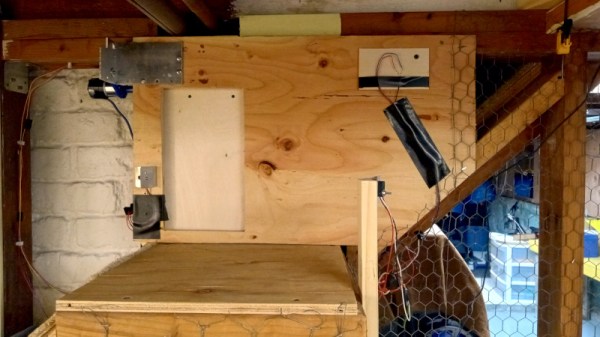
It’s a simple enough idea, when an IR sensor connected to a Raspberry Pi 4 detects the cat heading out into the world through the exterior cat flap, the computer fires up a motor connected to a lead screw which closes the flap between buffer zone and house. The cat then has the safety of the buffer zone, but can’t bring the prey fully inside.

If you’re a cat lover you’ll forgive them anything, but we have to admit to being on [Rkramer]’s side with this one. A useful way to keep the prey at bay is something we could have used a few times in the past, too. This project is part of the 2025 Pet Hacks contest. Done something similar for your cat? Why not make it an entry!

Image

Exercise Wheel Tracker Confirms Suspicions About Cats

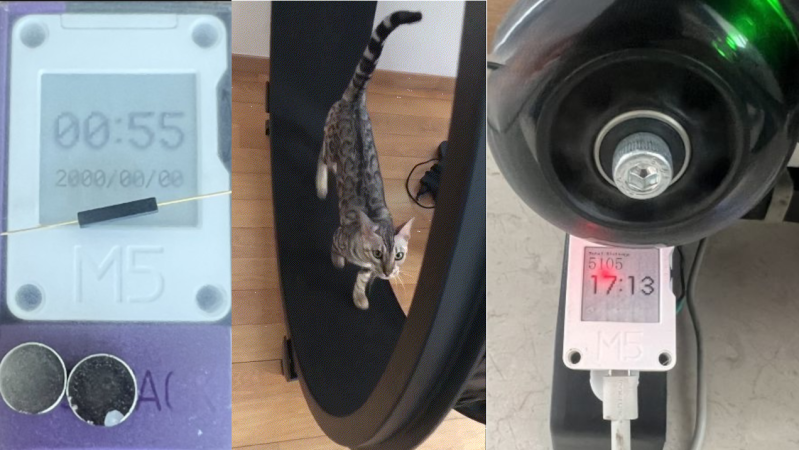
What do cats get up to in the 30 minutes or so a day that they’re awake? Being jerks, at least in our experience. But like many hackers, [Brent] wanted to quantify the activity of his cat, and this instrumented cat exercise wheel was the result.

To pull this off, [Brent] used what he had on hand, which was an M5Stack ESP32 module, a magnetic reed switch, and of course, the cat exercise wheel [Luna] seemed to be in the habit of using at about 4:00 AM daily. The wheel was adorned with a couple of neodymium magnets to trip the reed switch twice per revolution, with the pulse stream measured on one of the GPIOs. The code does a little debouncing of the switch and calculates the cat’s time and distance stats, uploading the data to OpenSearch for analysis and visualization. [Brent] kindly includes the code and the OpenSearch setup in case you want to duplicate this project.

As for results, they’re pretty consistent with what we’ve seen with similar cat-tracking efforts. A histogram of [Luna]’s activity shows that she does indeed hop on the wheel at oh-dark-thirty every day, no doubt in an effort to assassinate [Brent] via sleep deprivation. There’s also another burst of “zoomies” around 6:00 PM. But the rest of the day? Pretty much sleeping.

Image

An Automatic Cat Feeder Built With A 4060 Binary Counter

We’ve seen a great many cat feeders over the years. Some rely on the Internet of Things, and some rely on fancy microcontrollers. [Larry Cook], on the other hand, built his using a simple 4060 binary counter chip.

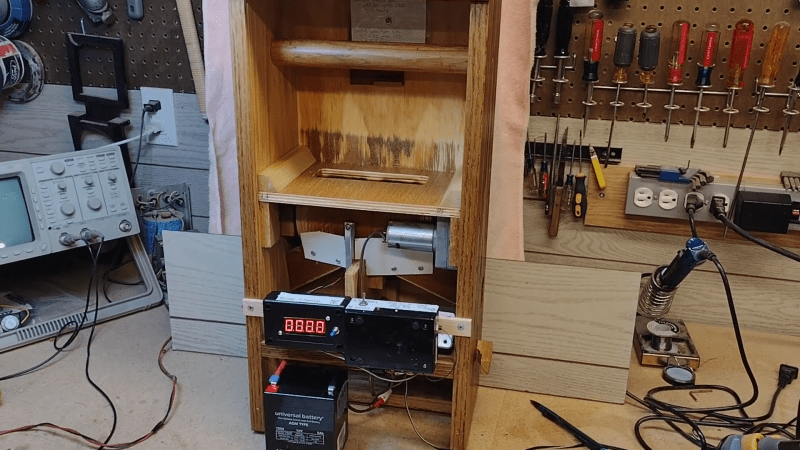
The feeder is built out of old plywood, and the whole thing runs off an old 12-volt DC wall wart and a lead-acid battery to keep it going in a power outage. The dry cat food is stored in hopper above a drum, with the drum  rotated by a 12-volt DC gearmotor. The gearmotor is activated on a schedule—either every 4 hours, or every 5.5 hours, depending on setting. There’s then a four-digit 7-segment display for counting the total number of feedings.

The manner of operation is simple. The 4060 binary counter slowly counts up to 8,196 on a 1.11 Hz or 0.83 Hz clock, for four hour or 5.5 hour operation respectively. When it hits that threshold, it fires the gear motor. The gear motor then rotates the drum for one revolution, dumping a preset amount of food. At the end of a revolution, it triggers a hall sensor which resets the circuit.

The best thing about this design? It’s been in service for ten years. [Larry’s] original video is a big contrast to his latest one, but it shows the same feeder doing the same job, all this time.

We love a good cat feeder, and it’s great to see one built with simple old-school parts, too. Video after the break.

Continue reading “An Automatic Cat Feeder Built With A 4060 Binary Counter”