Image

This Week In Security: Baked-in Malware, Freezers Not Freezing, Zoom Snoops Clipboards, And AI Makes Things Worse, Faster

The AI platform ServiceNow which offers both hosted and on-premises versions just patched a trifecta of CVSS-10 vulnerabilities.

CVSS rankings are determined by the severity of a flaw, the ease of exploiting the bug, if authentication is required for exploitation, if the vulnerability exposes confidential data, and other criteria. A CVSS of 10 is as bad as it gets, and having three of them at once is certainly attention-getting. Of the three vulnerabilities fixed, one allowed unauthenticated modification of data in the hosted instance, a second allowed arbitrary code execution via the GraphQL interface, and the third allowed arbitrary SQL commands that could modify the database.

ServiceNow claims Adobe, Lenovo, Fedex, and Fujitsu among their high-profile customers. With luck, the vulnerabilities were patched before significant public exploitation could happen.

Router Malware

Previously in 2026 the US Government warned against embedded malware found in consumer routers, which may be linked to the FCC enacting bans against certification and import of foreign-made consumer devices. This week, the NVD (National Vulnerability Database) reported specific embedded malware in the Zbtlink and MoreQuick brands of devices.

Multiple versions of the firmware, for multiple lines of products, contain a backdoor service that uses unencrypted UDP to connect to a command and control (C2) service. The service, or anyone able to intercept the network traffic, since it’s unencrypted, can execute commands as root, allowing them to change configurations, open tunnels, or steal ISP credentials.

The malware is baked into the firmware, so removing it is impossible for most users: a factory reset wouldn’t do. In theory if third-party firmware like OpenWRT supports these devices, the hardware could be made safer with a custom install.

Given how commonly the same device is marketed under dozens of names, likely the same devices and firmware have yet to be identified under other brands. Continue reading “This Week In Security: Baked-in Malware, Freezers Not Freezing, Zoom Snoops Clipboards, And AI Makes Things Worse, Faster”
Image

Control Your HTPC With Scavenged IR Parts

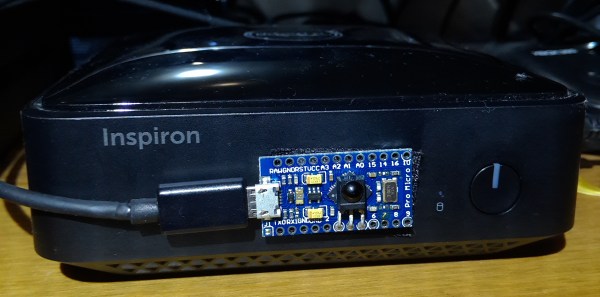
If you’ve built yourself a home theater PC, one of your highest priorities is probably coming up with a convenient control solution. The easiest way to do this is to simply use something like a wireless keyboard and mouse. But, that’s not very conducive to an enjoyable home theater experience, and it feels pretty clunky. However, if you’ve got the right components lying around, [Sebastian Goscik] has instructions and an Arduino sketch that will let you control your HTPC with any IR remote control.

There are a number of ways you could control your HTPC, and we’ve featured more than one build specifically for controlling XBMC over the years. Unfortunately, most of those methods require that you spend your hard earned money (which is better spent on popcorn). [Sebastian’s] setup can be replicated with things you probably have on hand: an Arduino, an IR remote, and a scavenged IR receiver. The IR receiver can be found in many devices, like old stereos or TVs that themselves were controlled via an IR remote.

It starts with an Arduino Sketch that lets you can see on the serial monitor what code is being generated by the button presses on your remote. These are then scripted to perform any task or function you like when those buttons are pushed. The most obvious use here is simple directional control for selecting your movies, but much more complex tasks are possible. Maybe someone can program a T9 script to type using the number buttons on most remotes?

Image

Plex Hack Runs Apple TV Without A Jailbreak

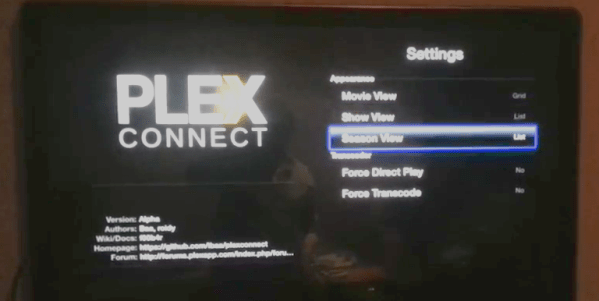
Apple has been keeping a tight leash on the third generation of their Apple TV hardware. Not only has it stood up to every attempt at a Jailbreak, but they don’t allow 3rd party applications through the app store like the other iOS hardware does. The second generation hardware was a popular platform for XBMC. It required a jailbreak to load the home media software which is why it can’t be done on the newest box. But here’s an alternative. This hack uses DNS redirects to make Apple TV 3 a Plex frontend.

Instead of putting new software on the Apple TV this uses a separate computer to intercept its web traffic. You aim your Apple TV DNS at the computer running the script, then use the native Movie Trailer app, which will be populated with movies and TV shows from your Plex backend. All other functionality will be retained, making for a near-perfect solution. For more info on the system check out this forum.

Continue reading “Plex Hack Runs Apple TV Without A Jailbreak”

Hackit: Boxee Now On Windows

Image

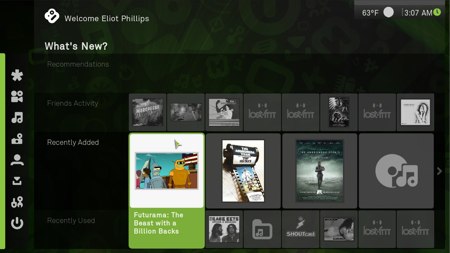
Boxee, the free media center management and streaming application, is now available for Windows platforms. We’ve been following the developments of Boxee since we first announced its alpha this time last year. At that time, it was only available for OSX with promised Ubuntu support. We were a bit skeptical about the interface noting, “Unfortunately all the dynamic resizing, animated, sliding, floating info boxes make it behave like the zooming user interface’s retarded cousin”. Our interest in Boxee was almost entirely based on it being a fork of XBMC, the media center project developed for initially for hacked Xboxes. It was interesting to see Boxee become the interface of choice for hacked Apple TVs and then go mainstream with a big push at CES.

Have you been using Boxee as your media center? What do you love/hate? What about alternatives like XBMC, Plex, or MythTV?

How-to: Windows Media Center On A Leopard Network

Image

We’ve been using Microsoft’s Media Center for a few years now and have grown to like it a lot. We’ve also noticed that more and more Apple computers have shown up on our home network and decided it was time to get everything working together smoothly. Follow along as we walk you through the hoops we jumped through to get everything cooperating. Continue reading “How-to: Windows Media Center On A Leopard Network”

XBMC Cross Platform Beta Released

Image

It’s been a big week for the XBMC team. They announced the release of their first cross platform beta in preparation for a full release in October. XBMC started as a media center project for the original Xbox, but has expanded a lot since then. The new beta works on Linux, OSX (Leopard and Tiger), Windows, and Xbox. They’ve created XBMC Live, so you can get XBMC up and running quickly either by booting from the CD, from a flash drive, or using it to install to a disk. People have been writing add on apps too, like the XBMC Remote for iPhones.

This summer we covered both Boxee, a social version of XBMC, and Plex, the original XBMC OSX fork.