Hackaday Links Column Banner

Hackaday Links: August 30, 2026

The big news today is, of course, the successful launch and deployment of NASA’s Nancy Grace Roman Space Telescope earlier this morning. The space agency’s latest observatory lifted off at 7:26 AM Eastern from Launch Complex 39A at Kennedy Space Center aboard a SpaceX Falcon Heavy, and by 8:00 AM it was separated from the rocket’s upper stage and flying on its own.

ImageWhile the sound and fury of launch is exciting, it’s just the beginning of the journey for Roman. It will take several months for the spacecraft to complete its roughly 1.5 million-kilometer trek out to Earth’s second Lagrange point (L2), where it will set up shop near — in cosmic terms, anyway — the James Webb Space Telescope (JWST). Along the way, it will switch on and test various systems and components, with its primary 300 megapixel infrared camera scheduled to power up in three weeks or so.

There’s a lot to cover about the Roman Space Telescope. Built from spy satellite spare parts donated by the National Reconnaissance Office and featuring a field of view 100 times greater than that of Hubble, its launch is widely considered to be one of the most important scientific milestones of the decade. We’ll be bringing you more about the past, present, and future of this flagship mission as it progresses.

Continue reading “Hackaday Links: August 30, 2026”

Image

Core Devs Say A Fond But Firm Farewell To Python 2

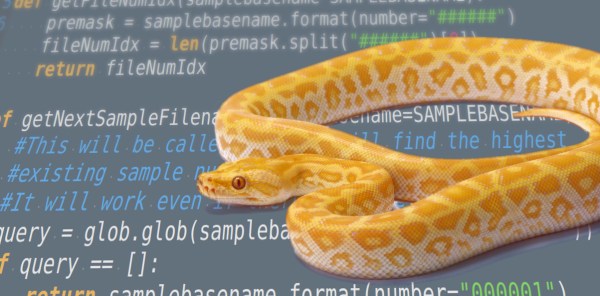
Saying that it was finally time for the community to bid a “fond but firm farewell to Python 2”, core developer Benjamin Peterson marked the release of Python 2.7.18 on April 20th; officially ending support for the 2.x branch of the popular programming language. It was hardly a snap decision. Python 3.0 was released all the way back in December 2008, and it was never a secret that the newer branch was not only incompatible with the earlier version, but that it would eventually superseded it to become the standard.

But migrating the incredible amount of Python code in the wild over to the latest and greatest was easier said than done. Millions upon millions of lines of code used in everything from Linux distributions to virtually every major web service needed to be reviewed and migrated over to Python 3. In many cases the changes were relatively minor, but when code is being used in mission critical applications, even the smallest of changes are often avoided unless it’s absolutely necessary. The voluntary migration took far longer than expected, and the end-of-life (EOL) for Python 2 was pushed back by years to accommodate developers who hadn’t made the necessary changes yet.

Given the somewhat fluid nature of the Python 2 EOL date, it seems fitting that this last final release would come several months after the “official” January 2020 deadline. The intention was for it to coincide with PyCon 2020, but just like so many of the events planned for the first half of the year, the in-person conference had to be canceled in favor of a virtual one due to the COVID-19 epidemic. That might have stymied the celebration somewhat, but the release of Python 2.7.18 will still be looked on as a special moment for everyone involved.

Continue reading “Core Devs Say A Fond But Firm Farewell To Python 2”

Image

Stop Using Python 2: What You Need To Know About Python 3

Though Python 3 was released in 2008, many projects are still stuck on Python 2.

It’s understandable that porting large existing codebases to a new version is a prospect which sends a shiver down many a developer’s spine. But code inevitably needs to be maintained, and so when all the shiny new features that would fix everything are in a new version, is it really worth staying rooted in the past?

We’ll take you through some of the features that Python 2 programs are missing out on, not only from 3.0 but up to the current release (3.7).

Continue reading “Stop Using Python 2: What You Need To Know About Python 3”