
Explorer Session Saver
Windows users juggling multiple project folders and research sets know the friction of rebuilding the same File Explorer...
Recently Listed
799 launches
Premium
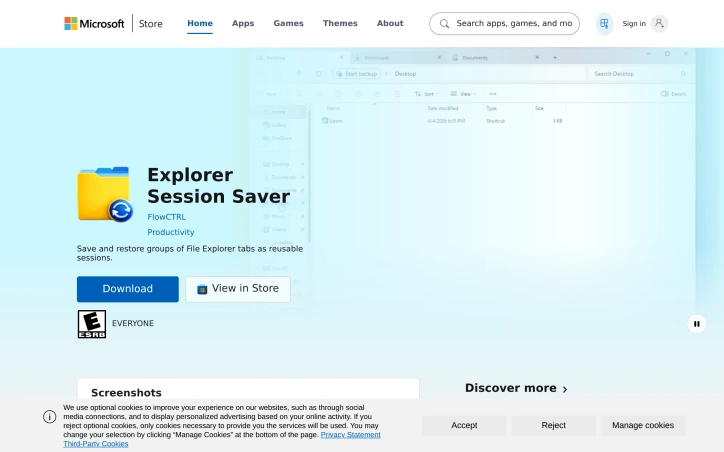
Windows users juggling multiple project folders and research sets know the friction of rebuilding the same File Explorer workspaces every time they start their day. Explorer Session Saver addresses this by capturing entire File Explorer configurations and restoring them on demand, eliminating the repetitive task of manually reopening tabs and navigating to the same directories. The tool works within Windows 11's native Explorer tabs, treating the entire window state as a snapshot. Users name and save their current workspace, then restore it later with a single action from any of three entry points: the ESS Manager interface, the system tray, or the command line. This multi-path access acknowledges that users work differently—some prefer GUI interfaces while others benefit from automation through scripting. What distinguishes Explorer Session Saver is its deliberate simplicity. Rather than attempting to be a comprehensive productivity suite, it solves one specific friction point in the daily workflow. The decision to operate as a local utility rather than a cloud-based service means workspace data stays on the user's machine and restoration happens instantly without network latency. For professionals working with sensitive files or restrictive internet conditions, this local-first architecture is a practical advantage. The free distribution model removes barriers to adoption, making it accessible to individual developers, researchers, and knowledge workers who manage complex folder hierarchies. The Windows 11 focus reflects platform-specific design rather than attempting cross-platform compatibility, suggesting the developer understood where the actual pain point lives. The application assumes users have established workspace patterns—it works best for those with consistent session layouts rather than those opening different folders each day. It targets the developer who returns to the same project folders, the researcher maintaining consistent research datasets, the analyst with a standard folder layout. For this audience, the ability to restore entire workspaces in seconds transforms a daily five-minute overhead into a one-click operation. The command-line access point opens possibilities for scripting and automation, though basic manual restoration through the GUI or system tray covers the primary use case. Explorer Session Saver delivers functional value without unnecessary complexity or monetization friction.
Browser-based video generation has become more accessible with FSG AI, a third-party platform that wraps Grok Imagine technology for creators, marketers, designers, and developers. The service addresses a fundamental content production challenge: generating short AI videos without requiring specialized equipment, expensive production crews, or extensive technical expertise. The platform operates through a straightforward web interface where users describe videos through text prompts or animate existing images. The system produces synchronized video and audio output, with customization options for aspect ratio, resolution, video duration, and creative mode. Users begin with free credits to test the workflow before committing additional resources. What distinguishes FSG AI from simpler video generators is the evident sophistication of its demonstrated outputs. The gallery examples reveal capabilities well beyond basic video synthesis. Complex camera choreography appears across multiple demos, including push, pull, pan, and tilt movements applied to subjects. The platform executes multi-character scenarios with nuanced storytelling and object interaction, such as a character experiencing guilt and exchanging items with another actor. Documentary-style narratives, fashion sequences with multiple outfit changes, lifestyle videos, and branded advertising scenarios all demonstrate that the system responds to relatively detailed directorial instructions rather than simply animating static images. FSG AI operates on a dual-business model. For individual creators and teams, it provides a consumer-facing workspace with free starter credits. For developers and organizations, it offers an API that integrates Grok Imagine capabilities into custom applications, SaaS products, internal tools, and automated workflows. This developer-tier access positions the platform beyond a simple creative tool, targeting institutional adoption within product ecosystems and content pipelines. A clarification worth noting appears in the founder's description: FSG AI remains independent and unaffiliated with xAI or X Corp, despite leveraging their Grok Imagine technology. This distinction carries weight for users evaluating long-term reliability and understanding the relationship between platform provider and underlying model owner. The most significant gap in available information concerns pricing structure beyond the mention of free credits. Potential users must visit the platform directly to understand costs for sustained or high-volume usage. For teams seeking cost-effective video generation without specialized production infrastructure, the combination of free trials, web-based accessibility, and demonstrated output quality makes FSG AI a candidate worth testing.


Professionals who network actively know the problem well: you exchange contact information with dozens of people, take notes frantically during conversations, and within weeks, you've forgotten why that particular connection mattered. ConnectMachine addresses this friction by building a digital business card system designed around memory and context rather than just contact exchange. The product sits at the intersection of three common workplace problems. First, it replaces the logistical hassle of physical cards with digital alternatives that recipients access by scanning a QR code or clicking a share link, requiring no app download on their end. Second, it automates the drudgery of manual data entry by using computer vision to scan physical business cards and extract contact information instantly. Third, and most distinctively, it adds AI-powered note-taking and optional conversation recording directly to contacts, turning the address book into something closer to a lightweight CRM indexed by human relationships rather than just names and numbers. What stands out is the control layer built into card sharing. Rather than maintaining a single digital identity, users create context-specific cards and choose precisely which details appear on each one. This granularity appeals to professionals who network across very different audiences—a consultant might share different information with a client versus an investor versus a peer at a conference. The AI Concierge feature pushes further into automation, offering integration with calendars and contact lists to handle scheduling and search queries conversationally. For team use, ConnectMachine adds centralized billing, seat management, and analytics alongside the individual premium features. The company's traction metrics warrant attention. With 22,000 users across 91 countries and a 4.7-star rating, the product has cleared the threshold of demonstrated demand. The claim that 15,000 smart cards are shared monthly suggests meaningful engagement, not just installations. The team also cites shipping 26 features in two weeks based on user feedback, indicating a product development pace and responsiveness to the market. Pricing aligns with freemium SaaS norms. The free tier provides essential functionality, while the $5.99 monthly individual plan unlocks unlimited card scans, CRM integration, and the AI features. Teams pay the same per-seat rate with added administrative oversight. The structure removes friction for single users while offering path-to-revenue through both individual upgrades and team licensing. The product addresses a real inefficiency in how professionals manage relationships, and its feature set—combining card exchange, memory augmentation, and workflow automation—is cohesive rather than scattered. Whether it becomes a networking essential depends on execution and whether teams adopt it as standard infrastructure rather than individual tools.


Logic puzzle enthusiasts tired of endless Sudoku variations have found a worthy alternative in this cat-themed deduction game. The product addresses a genuine gap in the puzzle market: the demand for fresh logic challenges that maintain the satisfaction of pure deduction without demanding pen-and-paper play or complex software installations. The core mechanic combines three familiar puzzle principles into something cohesive. Players place exactly one cat in every row, column, and colored region while enforcing a no-touching constraint—cats cannot sit adjacent to each other, even diagonally. Unlike many logic puzzles that force guessing when logic stalls, every puzzle here guarantees a single solution reachable through deduction alone. This elimination of guesswork distinguishes it from more forgiving puzzle games and appeals to purists who want intellectual rigor alongside entertainment. What sets the product apart is its accessibility layer. It requires no account, no installation, and no payment—simply load the browser and start playing immediately. The hand-drawn art style presents cats as charming visual anchors rather than generic grid symbols, making puzzle-solving feel less clinical and more playful. The three-fish-cracker lives system adds gentle pressure without harsh penalties, while the aggressive use of the no-touching rule creates natural cascades of deduction that make progress feel inevitable rather than arbitrary. The controls distill puzzle interaction to essential gestures: tap to mark empty squares with an X, double-tap to place a cat, and tap again to remove it. This simplicity reduces friction between intention and execution. The game generates a live board on page load and begins the puzzle the moment you interact with it, eliminating startup friction that plagues many similar offerings. The product also extends beyond browser play. Free mobile applications for iOS and Android allow players to maintain solving streaks offline and play during commutes. This multi-platform availability transforms the experience from a casual browser time-waster into a genuine substitute for traditional puzzle books. The no-cost model combined with zero friction to entry positions this squarely in the accessible puzzle category, competing against free Sudoku apps and newspaper logic puzzles rather than premium puzzle software. For logic enthusiasts seeking something beyond Sudoku or Queens that respects their deductive reasoning, this fills a concrete need.


Word games traditionally test how much you know. Krillion Infinite inverts that formula, rewarding players not for recalling correct answers but for finding answers that few others think to type. The game serves a specific audience: people fatigued by vocabulary-based competition who seek a daily mental challenge centered on originality and lateral thinking. The core mechanic sets it apart instantly. Each day at UTC midnight, Krillion presents the same seven prompts to its entire player base. Answer "Cheddar" to "name a cheese" and you score 10 points—a correct answer worth almost nothing. Answer "Taleggio" and you earn 85 points, reflecting that fewer players reached the same conclusion. The spread between common and uncommon correct answers drives the entire game. A player's first dive often yields 70 points from seven correct answers simply because all seven were the answers everyone gives. A complete round takes four minutes. Each prompt appears with a 25-second countdown, creating pressure that prevents overthinking while allowing educated guesses. Missing a prompt doesn't end the round—it merely consumes time, making strategic guessing valid play. The game accepts spelling variations, accent marks, doubled letters, and British-American spelling differences, prioritizing what a player conceived over execution under pressure. The experience requires no installation, no account, and no payment. There is no advertising. Players receive one free dive per day, and practice prompts cost nothing. Results are shareable via emoji strips and depth scores, encouraging community discussion without built-in social infrastructure. What elevates Krillion beyond novelty is the consistency of the central idea. The reverse-scoring mechanic isn't a gimmick layered onto word-game conventions—it is the entire foundation. Every design choice follows from it: the global simultaneity ensures everyone plays from the same answer pool, the timer prevents endless deliberation, the loose matching shifts the challenge from execution to conception. The strategy guidance acknowledges the emotional weight of low opening scores by reframing them as a solvable problem requiring habit change rather than more knowledge. The product succeeds because it asks a genuinely harder question than traditional word games. It doesn't ask what you know. It asks what you thought of.


Automated photo enhancement has typically demanded either technical prowess or a willingness to accept mediocre results. PixelBoost AI addresses this friction by offering one-click image restoration for anyone who has accumulated a backlog of disappointing photographs—blurry snapshots, noisy phone photos, faded scans, pixelated screenshots, or time-worn family prints that deserve better. The product operates on a no-configuration philosophy. Users upload an image and receive an enhanced version back within seconds, with no sliders to adjust, presets to choose, or settings to learn. The underlying engine runs three automatic processing passes: a sharpness recovery stage that retrieves lost detail without introducing halos or grain, a noise reduction pass that eliminates compression artifacts and grain while preserving edges and texture, and a color correction phase that fixes white balance and lifts contrast. This pipeline targets the most common photo problems directly—the grainy ISO-boosted shot, the over-compressed JPEG, the severely faded original, the slightly out-of-focus moment. What distinguishes PixelBoost from similar tools is both simplicity and breadth. The service handles restoration work that typically appeals to a specific use case: scanned family photos, old wedding albums, water-damaged prints. It also processes contemporary problems like camera grain and export compression artifacts. The implementation supports drag-and-drop uploads, accepts PNG, JPG, and WebP files up to 24MB, and requires no account creation or payment information. The product operates entirely at no cost. No freemium upsell, no trial period, no signup requirement. A batch enhancement feature is available for processing multiple photos, though the content provided does not detail whether this remains free or introduces limitations. The service has accumulated ratings on mainstream review platforms—4.8 stars on G2, 4.9 on Product Hunt, and 4.5 on Trustpilot—suggesting user satisfaction has reached a measurable baseline. The core limitation remains one that affects most automated enhancement tools: severe blur or very poor image quality presents a ceiling. PixelBoost can lift mild to moderate focus issues but makes no claim to recover substantially out-of-focus shots. For everyday photo maintenance—clarifying smartphone images, restoring inherited prints, cleaning up screenshots and recordings—it removes a significant friction point. The ability to process these photos without opening design software or learning enhancement techniques addresses a real gap between photo quality standards and actual user capabilities.

Accessibility sits at the core of what ReelMuse does: democratizing professional-grade video and image production through an all-in-one AI platform. The service targets creators of all skill levels, from casual content makers to aspiring producers, eliminating the technical expertise traditionally required to produce polished multimedia content. The platform consolidates several AI-powered creative tools under one roof. Users can generate original videos from scratch, produce high-quality images, and integrate AI-generated audio without specialized technical knowledge. The tool palette includes face-swap functionality and lip-sync capabilities, allowing creators to explore effects typically reserved for advanced editing software. These features signal a focus on trendy, shareable content formats that perform well on social media platforms. What distinguishes ReelMuse in a crowded AI creative tools space is its positioning as a comprehensive ecosystem rather than a point solution. The company has invested heavily in building a partner network, with verified listings across 22 different startup directories and AI tool aggregators. This breadth of third-party verification suggests institutional confidence in the platform. The company reports reaching over 50,000 active creators, indicating meaningful adoption. The partners page reveals deliberate strategy around link equity and domain authority, specifically mentioning dofollow backlinks and quick review cycles for partner exchanges. This demonstrates the company understands SEO fundamentals and is building visibility through quality partnerships rather than paid advertising alone. The curated nature of their partner list, emphasizing platforms serving AI enthusiasts and productivity-focused users, indicates targeted positioning toward creator communities. ReelMuse occupies interesting ground between consumer-friendly video editing tools and professional creative suites. The feature set prioritizes fast, template-based content creation focused on speed and shareability over cinematic sophistication. No pricing information is publicly disclosed. The aggregation strategy across directories and the emphasis on creator reach demonstrate that ReelMuse is betting on network effects and organic discovery. The company has built a foundation of accessible tooling and a thoughtful partner ecosystem, positioning themselves for growth in the rapidly expanding AI video generation category.


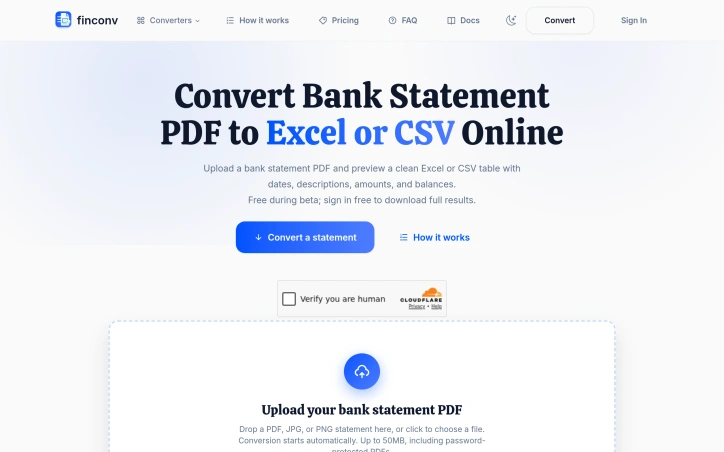
Automating the extraction of bank transaction data from PDFs addresses a genuine friction point for accountants, bookkeepers, and anyone managing business finances. FinConv tackles this by accepting PDF statements—along with scanned images and JPG/PNG photos—and transforming them into structured spreadsheets ready for analysis or import into accounting software. The product's core strength lies in its low barrier to entry. There's no software to install, no complex setup, and initial access requires no account creation. Users can upload a file, preview the extracted data immediately, then decide whether to sign in before downloading. This frictionless preview mechanism signals confidence in accuracy and removes the anxiety of committing to a conversion blind. The platform promises to read dates, descriptions, debits, credits, and running balances—the fundamental columns any accountant needs—and presents them in a clean table format. FinConv's feature set is deliberately broad in format support. Beyond standard PDFs, it handles scanned statements and password-protected files up to 50MB, eliminating the preparatory step of unlocking and re-saving documents before conversion. The export options span Excel, CSV, and JSON, catering to different workflows: Excel for spreadsheet manipulation, CSV for raw data entry into accounting systems, and JSON for developers integrating the output into applications or scripts. Credit card statements receive the same treatment as bank statements, extending utility across financial document types. The privacy stance warrants attention. The company is explicit that uploaded files aren't stored on its servers—data is sent only to an AI provider for extraction. For users handling financial documents containing sensitive account information, this claim of non-persistence is a significant differentiator in a space where data handling practices are often opaque. The business model remains straightforward. FinConv operates under a free beta with free sign-in gated to downloads, suggesting monetization will arrive once the service moves beyond beta testing. This approach buys credibility while the product proves its accuracy and reliability. The product doesn't reinvent the wheel—PDF-to-spreadsheet conversion has existed for years—but it narrows the focus to bank statements specifically and wraps the solution in a modern, user-friendly interface. For the intended audience, that combination of focused scope and accessible design likely translates to genuine time savings over manual entry or wrestling with generic conversion tools.

Merchants worldwide struggle with payment friction. Traditional systems extract high fees, impose multi-day settlement delays, and create friction for customers who hold stablecoins. Millions are ready to pay with digital dollars like USDC and USDT, yet most businesses lack the infrastructure to accept them. Cray addresses this gap directly. The platform operates as a non-custodial payment processor designed for merchants across restaurants, ecommerce, travel, retail, and services. Customers scan a QR code, pay from their existing wallet in supported stablecoins, and funds arrive in the merchant's account instantly. Merchants can then withdraw to local bank accounts whenever needed, converting stablecoin settlements to their home currency on demand. What distinguishes Cray from traditional payment processors is its core architecture. By removing intermediaries from the settlement flow, the service claims to cut transaction fees by up to 40% compared to conventional systems. Payments arrive instantly rather than waiting three business days. The platform operates globally, accepting payments from over 180 countries through a single integration that doesn't require new hardware or modifications to existing point-of-sale systems. The user experience is deliberately simplified. No blockchain knowledge is required. Merchants create an account in minutes with no manual technical setup. The payment flow itself is transparent and auditable—every transaction records on-chain, creating an immutable settlement record. This combination of transparency and non-custodial design means merchants never expose themselves to counterparty risk; funds move directly from customer wallet to merchant account. The target audience is clear: any business accepting payments from global customers, whether selling across borders or serving tourists and travelers. Ecommerce stores eliminate traditional payment barriers for customers in stablecoin-rich markets. Service providers receive instant payment without currency conversion delays. Restaurants in tourism-dependent regions tap into a customer base carrying digital dollars. Cray's positioning reflects a genuine market opportunity. The stablecoin ecosystem processes over $33 trillion in annual volume, yet merchant adoption remains minimal. By focusing on the merchant-customer payment gap rather than speculation or trading, the platform identifies where stablecoin utility runs highest. The emphasis on compliance and non-custodial operation suggests regulatory awareness in a space where many competitors have attracted scrutiny. The main friction point is implicit: success depends on widespread stablecoin adoption among customers in target markets. In regions where fiat payment systems dominate and digital wallets remain rare, adoption obstacles work both directions. But for merchants targeting crypto-forward customers or operating in markets with currency instability, the value proposition is immediate.


In an increasingly crowded password manager market, this zero-knowledge Chrome extension positions itself around a core privacy promise: the company behind it cannot access user passwords, period. By executing all encryption and decryption operations on the user's device rather than on servers, Spassword ensures that the backend infrastructure stores only encrypted data. This architectural approach appeals to users who prioritize cryptographic guarantees over convenience and who have grown skeptical of centralized password vaults. The product targets privacy-conscious individuals and those who prefer browser-based solutions over standalone applications or cloud-dependent services. By leveraging Cloudflare infrastructure, the service promises reliable storage while maintaining the zero-knowledge property that defines its value proposition. This combination addresses a specific market gap: users who want password management without trusting a third party with their actual credentials. The feature set covers essential password manager needs. Users can autofill passwords into web forms, generate new passwords, and synchronize credentials across multiple devices. The extension also supports storing reminders and related tasks, positioning itself as a feature-complete alternative to mainstream competitors rather than a bare-bones security tool. What distinguishes Spassword is its deliberate architectural choice to make password decryption client-side only. This means the company literally cannot comply with requests to reveal user passwords, whether from law enforcement, corporate data requests, or internal security breaches. In an era of repeated data breaches affecting major password managers, this zero-knowledge guarantee represents meaningful technical differentiation. The reliance on Cloudflare also signals infrastructure choices aligned with the privacy positioning. The product operates as a Chrome extension, which limits its addressable market compared to cross-platform competitors but allows for tighter browser integration and faster adoption cycles. The decision to focus on a single browser environment rather than supporting multiple platforms represents a deliberate scope choice that prioritizes depth over breadth. For users evaluating password managers, Spassword presents a clear trade-off: zero-knowledge assurance and client-side encryption in exchange for a narrower platform footprint and less mature ecosystem compared to established players. The value proposition hinges entirely on whether the zero-knowledge architecture matters to the user and whether the feature set meets their actual needs.


YouTube's pervasive advertising ecosystem has long frustrated viewers who simply want uninterrupted content consumption. SkipPlay directly addresses this frustration by offering an ad-light alternative that requires no account creation or browser extensions for basic use. The core value proposition centers on simplicity and accessibility. Users paste any YouTube link into the web player or, for enhanced functionality, integrate the Chrome extension and watch without commercial interruptions. The extension further automates sponsor skipping through SponsorBlock integration, a community-driven database that identifies and removes sponsored segments, intros, and subscription reminders from videos. This appeals strongly to viewers who consume substantial video content and grow weary of both platform-inserted ads and creator-embedded sponsor interruptions. What distinguishes SkipPlay from competing solutions involves its layered approach to functionality and device coverage. The free web player works seamlessly across desktop, mobile, and smart TV browsers without requiring installation or authentication, significantly lowering barriers to entry. Mobile users gain background audio playback, a feature enabling listening with the screen locked or while using other applications—functionality that YouTube Premium typically reserves for paying subscribers. For power users seeking additional features, the platform includes a DJ Dual Mixer Deck for mixing tracks side-by-side and offers optional cloud synchronization that persists playlists, favorites, and viewing progress across devices. The business model reveals deliberate positioning within the ad-blocking market. The free web player remains entirely free, monetizing through an optional $9 lifetime extension that enables one-click playback directly from YouTube and automatically skips ads on the native platform itself. This pricing sits significantly below YouTube Premium's $15.99 monthly subscription, positioning SkipPlay as a permanent alternative to recurring fees. The feature comparison presented prominently on the site directly acknowledges YouTube Premium, suggesting confidence in competitive positioning. Beyond standard ad removal, SkipPlay differentiates through SponsorBlock integration and free mobile background play—capabilities that even YouTube Premium and traditional ad-blockers do not consistently deliver. SkipPlay targets viewers frustrated by YouTube's aggressive monetization rather than those seeking premium content access or exclusive features. Its design emphasis on reducing friction through simple URL pasting and one-click extension deployment reveals focus on a specific, well-defined pain point. For viewers averse to advertising and subscription costs, the combination of free web access and affordable permanent licensing presents a genuine alternative to traditional premium models.


I built StackLedge because most software directories are filled with spam and abandoned projects. I wanted a clean, hand-curated platform dedicated strictly to APIs, developer tools, and AI agents. Every submission is manually reviewed. We do not accept low-effort wrappers or thin content. We also run a badge-trade program to help early-stage founders build their domain authority while growing our community.


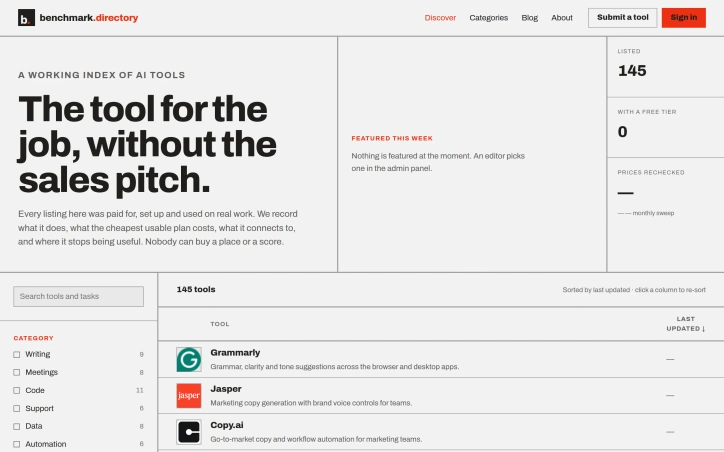
An editorial index of AI tools solves a growing discovery problem in a crowded market. Benchmark.directory addresses the challenge many organizations face when evaluating software: vendor marketing obscures real capabilities and limitations. The directory catalogs 145 tools organized by the practical work they perform rather than technological category, making it genuinely useful for matching problems to solutions. What distinguishes this project is its hands-on editorial approach. Every tool must pass a validation threshold: setup and active use on genuine projects for at least one week before earning inclusion. This practical testing replaces sales collateral with direct experience. The founders document concrete information that typically remains hidden: the actual cost of the cheapest functional plan, what free tiers genuinely permit, which integrations work after setup, and crucially, where each tool's utility boundaries lie. The directory maintains editorial integrity through transparent rejection of pay-to-play arrangements. Listings are completely free, and tools offering payment for placement are documented and declined. This structural decision eliminates the perverse incentive that corrupts most software directories, where prominent positioning correlates with marketing budget rather than usefulness. In 2026 alone, the project rejected 71 submissions and delisted 12 tools, indicating active curation rather than passive accumulation. The categorization strategy reflects how people actually hire software. Rather than grouping by AI methodology or technical architecture, tools appear under practical functions like writing, code, data analysis, and design. This mirrors genuine workflow organization and decision-making patterns. Current coverage spans categories including writing, meetings, code, support, data, automation, design, research, sales, finance, marketing, and specialized domains like legal operations and people management. The interface offers filtering by pricing model and free tier availability, accommodating both individual exploration and organizational procurement processes. The project captures information typically scattered or hidden: training data policies, integration requirements, and usage ceilings. For organizations concerned about whether tools train on proprietary work or evaluating integration feasibility before vendor conversations, this transparency provides tangible value. The regularly updated sort indicates active maintenance of the directory, though opportunity exists for expanded editorial features.

Fluoverse is an AI-powered social platform for discovering events, meeting new people, and learning languages through real conversations. Connect with people around you, join experiences, and practice languages naturally through real-time conversational interaction. With 10,000+ users, Fluoverse turns language learning into a social experience that helps people connect, communicate, and build confidence in the real world.


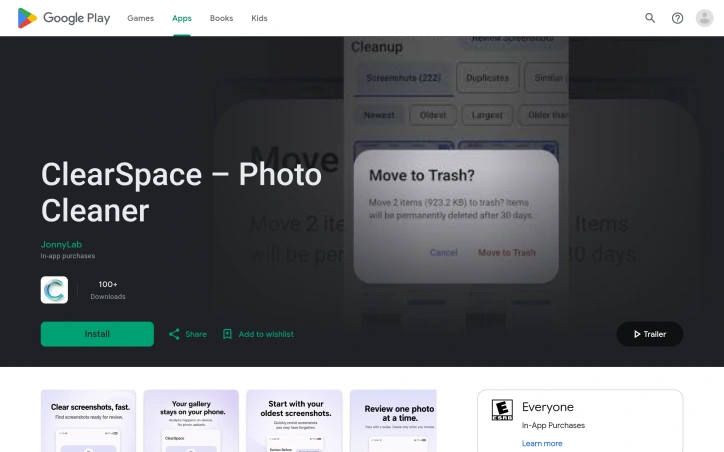
Android users drowning in screenshots and duplicate photos now have a privacy-conscious alternative to cloud-based cleanup services. ClearSpace is a photo cleaner that prioritizes manual control and on-device processing, letting users decide exactly what gets deleted rather than trusting automated systems. The core problem is straightforward: screenshots, similar photos, quality failures, and large media files accumulate quickly, wasting device storage without meaningful impact. ClearSpace addresses this by scanning for these categories and presenting them for review, but crucially, it never deletes anything without explicit user confirmation. This separation between detection and deletion sets it apart from auto-cleanup competitors that operate behind the scenes. What makes ClearSpace distinctive is its privacy-first architecture. All analysis happens locally on the device—no account creation, no cloud upload, no data transmission to third parties. This eliminates the privacy trade-off common in cloud-based photo tools and appeals to users who find traditional services too invasive. The app also integrates with Android's Trash system, meaning deleted items remain recoverable until permanently purged, adding a safeguard against accidental loss. The feature set focuses on intentional cleanup workflows. A dedicated screenshot scanner lets users start with focused cleanup instead of analyzing the entire library. The Swipe Review interface moves through photos one at a time, allowing detailed inspection of duplicates and similar-photo groups. Recent versions added a Screenshot Inbox feature that organizes captures by age, with a Swipe Oldest function for tackling older content first. The app also flags large videos and quality issues, then displays cleanup results showing items removed and storage freed. ClearSpace operates on a freemium model. The free tier offers unlimited scanning and review but caps deletions at 50 per month. ClearSpace Pro unlocks unlimited deletion and full access to Swipe Review, with monthly, annual, and lifetime purchase options. The app targets privacy-conscious Android users who want control over their photo libraries without surrendering personal data. It trades the convenience of automatic deletion for transparency and user agency, positioning photo cleanup as a deliberate process rather than a background task.

International freight forwarding from Pakistan traditionally has relied on a fragmented network of agents with varying service standards. XCORE Freight addresses this gap by offering consolidated logistics infrastructure that caters to both individual shippers and commercial operations moving goods from Pakistan to major English-speaking destinations. The company targets a specific but significant market: the Pakistani diaspora spread across the UK, USA, Canada, and Australia, alongside Pakistani businesses requiring reliable international cargo transport. The company's core value proposition rests on operational consistency backed by 18 years in the logistics sector. Where many freight forwarders fragment responsibilities across multiple vendors, XCORE coordinates the entire shipment lifecycle—pickup, documentation, transportation, and final-mile delivery—under one operational umbrella. This end-to-end model removes coordination friction that typically lengthens transit times and complicates tracking for customers. XCORE's service portfolio spans the transportation methods essential for different cargo profiles. Air freight handles time-sensitive shipments, while ocean freight through FCL and LCL options accommodates larger, less time-critical loads. The company explicitly manages customs coordination internally, a critical pain point that many smaller forwarders delegate to third parties, creating delays and miscommunication. Door-to-door delivery options extend beyond traditional port-to-port arrangements, appealing to customers without established infrastructure at destination points. The cargo types handled signal pragmatic positioning: commercial merchandise, household goods, and personal effects. This breadth reflects understanding of the diaspora use case—many shipments are relocations or family parcels rather than industrial supply chain operations. The willingness to handle mixed cargo (business goods alongside personal items in a single shipment) differentiates from carriers that enforce separation by category. Geographically, the company's network reaches beyond the primary diaspora destinations into Europe, Africa, and the Middle East, suggesting infrastructure or partnerships that enable more than point-to-point routing. A notable gap in XCORE's public positioning is transparent pricing. The website mentions rate options but provides no actual rate cards or pricing methodology. This opacity reflects industry norms for forwarders targeting enterprise clients who expect custom quotes rather than published rates, though it may frustrate smaller shippers seeking competitive benchmarking. The company's marketing consistently emphasizes trust and reliability—language that signals the business serves cost-conscious shippers for whom service failure carries significant personal or business consequences. This positioning trades on reputation as a defensible moat in a crowded logistics market where price competition alone proves insufficient.


Property agents have long extracted commissions from renters searching for shared housing in the UAE, managing listings that are often outdated or inflated in their representations. A new platform challenges this model by connecting renters directly with verified room owners. Find Rooms operates across Dubai, Sharjah, Abu Dhabi, and Ajman, offering bed spaces, partition rooms, and studios for workers, students, and young professionals. The service maintains a catalog of over 2,400 verified listings and charges zero commission to users. What distinguishes this platform is not just the elimination of fees but the enforcement of quality through weekly verification. Renters browsing property sites in the UAE quickly discover that many listings are for units already rented months prior. By requiring active verification of availability, Find Rooms reduces wasted searches and addresses a genuine friction point in the market. The platform's multilingual interface across 10 languages reflects a deliberate design choice rooted in geography. Blue-collar workers and students—the primary audience for shared housing—do not always search in English or Arabic alone. By offering more language options, the platform removes a barrier to access for a segment of the market that existing platforms have historically overlooked or underserved. The business model is intentionally simple. There are no subscription tiers, hidden fees, or promised features that don't yet exist. The zero-commission model creates clarity for renters but introduces a dependency: the platform's viability rests entirely on attracting sufficient owner participation. Property owners must list their spaces and commit to verifying availability weekly. This requirement serves renters well but imposes an ongoing cost on owners—time spent confirming that beds remain available. The platform succeeds by addressing a specific problem without overcomplicating the solution. It eliminates an unnecessary intermediary and the associated commission structure. Unlike many startups in the housing market, Find Rooms avoids growth narratives that prioritize scale over unit economics or platform integrity. Whether the platform can sustain owner participation at scale is the critical question. A zero-commission model works only if supply remains sufficient to attract renters and if owners view weekly verification as a reasonable investment in reaching pre-filtered customers. For now, the 2,400 verified listings across four emirates demonstrate the model has gained initial traction. The test ahead is not innovation or feature complexity but consistent execution and retention of the owners who power the network.


Personal trainers typically sell training sessions. This startup reversed the equation by building assessment first, making it free, and stripping away friction entirely. Catalyst Healthspan Audit addresses a straightforward problem: most people lack a structured way to understand their fitness across multiple dimensions, and those who do often face high friction barriers to entry. The product is a 12-question browser-based questionnaire that scores healthspan on a 0 to 10 scale across four pillars: body composition, cardiorespiratory fitness, stability, and strength. It completes in roughly two minutes on mobile without requiring measuring tape or account creation. Results arrive immediately as a downloadable PDF report emailed to the user, with their composite score, pillar breakdowns, identification of weakness areas, and personalized next steps. The scoring algorithm is deterministic, but a language model generates personalized narrative around the numbers, making results feel tailored rather than template-driven. Users with Apple Watch, Garmin, or Oura devices can feed in actual biometric data for greater precision, though this is entirely optional. What distinguishes this is its position at the top of a measurement funnel. The Catalyst Healthspan Audit serves as a gateway to a full 60-minute in-studio assessment at Catalyst Performance, a personal training studio in Singapore's Manulife Tower. This positioning is deliberate: founders operate the studio, so the audit genuinely reflects how they pre-screen every client before discussing training. That authenticity cuts through typical fitness marketing noise. The product extends beyond the audit itself. The team publishes eleven free calculators alongside it, each grounded in published research and built to run entirely in the browser. These cover VO2 max estimation, fitness age, grip strength benchmarks, waist-to-height ratio, and protein intake guidelines. They embed via single-line code snippets, lowering the bar for publishers to add them to websites. This approach treats measurement infrastructure as a public good rather than proprietary advantage. Pricing is absent by design: the audit is free with no sign-up friction. The business model sits in the background, functioning as a lead generator for a physical training business rather than a standalone SaaS product. For users, this eliminates risk when trying the product. For anyone building fitness or wellness software, the open calculators and transparent research citations offer a template worth studying.


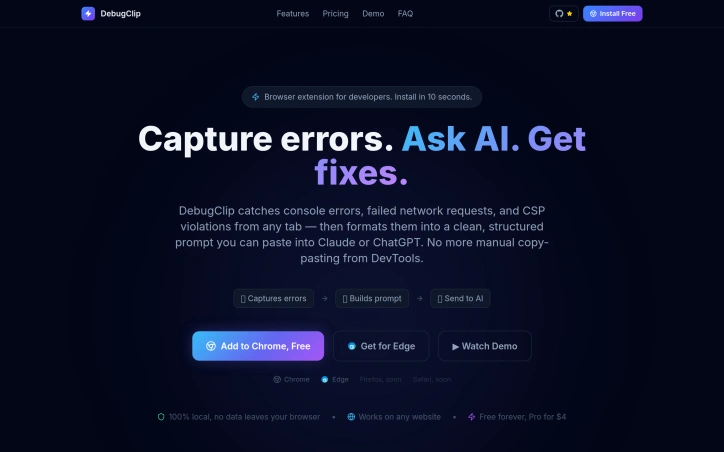
Debugging consumes far more time than it should, and developers have gotten used to it. The typical workflow involves spotting an error in the browser console, manually opening Chrome DevTools to gather context, copying fragments into ChatGPT or Claude, re-explaining the problem when the AI's first response falls flat, then repeating the cycle dozens of times per day. Each context switch costs focus and momentum. DebugClip addresses this friction by automating the bridge between where errors happen and where developers get help. The Chrome extension captures console errors, network failures, and security violations as they occur, then compiles them into a structured prompt ready to send to Claude or ChatGPT with a single click. Rather than manual transcription, developers get stack traces, request headers, response bodies, and HTTP status codes included automatically. What sets this approach apart is elimination of context switching. The extension runs silently in the background and notifies developers when issues occur, presenting everything alongside the problems themselves in a clean dashboard. The promised result is moving from discovery to actionable fix in under ten seconds, replacing workflows that consume five to ten minutes per error. The feature set mirrors what DevTools already exposes but streamlines access and AI integration. It captures every console error and warning, unhandled promise rejections, failed API calls with network details, broken resource loads, and CORS or CSP violations. This breadth ensures developers rarely need to jump back into DevTools to gather missing context. The business model is straightforward. The extension is free to use indefinitely on all websites, with a paid tier at four dollars monthly for presumably enhanced functionality. The developer emphasizes local processing, meaning captured errors remain on device and do not transmit to DebugClip servers. For developers who spend significant time debugging or testing in the browser, the extension removes a well-documented source of wasted motion. The positioning is narrow and focused, targeting a single pain point without attempting to replace DevTools or become an all-in-one solution. Chrome and Edge support is available now, with Firefox and Safari compatibility planned. The free tier makes adoption frictionless.

Fragmented workflows plague service and production businesses of all sizes. Quotations live in emails, approvals happen over chat, job progress gets tracked in spreadsheets, and payment records scatter across multiple systems. The result is data re-entered countless times, customers left guessing about status, and team members wasting hours searching for information instead of doing actual work. QUFO addresses this coordination problem by creating a single workspace where the entire customer journey flows from initial quotation through final payment. The product's core strength is its simplification of a genuinely complex process. Rather than asking businesses to adopt yet another tool, QUFO consolidates five critical functions—customer management, quotations, approvals, job tracking, and payment monitoring—into one connected system. This consolidation matters because it eliminates handoffs where information gets lost or requires manual re-entry. Several features stand out for their practical design. The online approval system lets customers review quotations and request changes from a secure link without needing an account, removing friction from the approval stage. The automatic payment balance calculation keeps financial tracking current without manual math errors. Customer tracking links provide visibility without exposing internal notes, solving a genuine tension between transparency and business privacy. The dashboard approach offers business owners a unified view of active work, payment status, and outstanding balances—information typically scattered across spreadsheets and separate accounting tools. Job progress moves automatically to customer-facing tracking pages as the team updates production status, reducing the need for repeated status update messages. The onboarding experience appears intentionally low-friction. A free 30-day trial requires no credit card, and the marketing language emphasizes "quick setup," suggesting the founders designed for businesses that want results without lengthy implementation. The three-minute demo video is positioned as watchable without signup, lowering the barrier to evaluation. No detailed pricing information is disclosed on the homepage, which is typical for early-stage SaaS but limits assessment of the business model's competitiveness. The free trial structure suggests a freemium or conversion-based model, though this remains unstated. QUFO targets a real inefficiency in small-to-medium service businesses, where operations currently depend on mixing purpose-built tools with improvisation. Its workflow-centric design and emphasis on reducing repeated data entry address genuine pain points. Whether the execution delivers on this promise requires direct experience with the product, but the problem is legitimate and the positioning is clear.