Summary: in this tutorial, you’ll learn about the Python unittest Mock class and how to use it to mock other classes.
Introduction to Python unittest Mock class #
Mocks simulate the behaviors of real objects. To test an object that depends on other objects in an isolated manner, you use mock objects to mock the real objects.
To mock objects, you use the unittest.mock module. The unittest.mock module provides the Mock class that allows you to mock other objects.
It also provides the MagicMock class that is a subclass of the Mock class. Besides the methods and properties of the Mock class, the MagicMock class has the implementations of all the dunder methods e.g., __str__ and __repr__.
See the following example:
from unittest.mock import Mock
# create a new mock object
mock = Mock()
# mock the api function
mock.api.return_value = {
'id': 1,
'message': 'hello'
}
# call the api function
print(mock.api())Output:
{'id': 1, 'message': 'hello'}How it works.
First, import the Mock class from the unittest.mock module:
from unittest.mock import MockSecond, create a new instance of the Mock class:
mock = Mock()Third, mock the api() function and assign its return value to a dictionary:
mock.api.return_value = {
'id': 1,
'message': 'hello'
}Finally, call the api() from the mock object. It’ll return the assigned value:
print(mock.api())In this example, we have two mock objects: mock & mock.api.
Let’s add the print() statement to the program to see how it works:
from unittest.mock import Mock
# create a new mock object
mock = Mock()
print(mock)
# mock the api function
mock.api.return_value = {
'id': 1,
'message': 'hello'
}
print(mock.api)
# call the api
print(mock.api())Output:
<Mock id='1830094470496'>
<Mock name='mock.api' id='1830100086416'>
{'id': 1, 'message': 'hello'}The output shows two Mock objects.
In short, if you assign a property that doesn’t exist on the Mock object, Python will return a new mock object. Because of this dynamic, you can use the Mock class to mock any objects that you want.
When to use mock #
These are cases that you may consider using mocks:
- System calls
- Networking
- I/O operation
- Clocks & time, timezones
- Or other cases whose results are unpredictable
Why using mocks #
The following are benefits of mocks:
- Speed up the test
- Exclude external redundancies
- Make unpredictable results predictable
Python Unittest Mock example #
Suppose you have a module called odometer.py:
from random import randint
def speed():
return randint(40, 120)
def alert():
s = speed()
if s < 60 or s > 100:
return True
return FalseIn the sensor.py module:
- The
speed()returns the current speed of a vehicle. It returns a random value between 40 and 120. In the real world, the function would read the data from the odometer. - The
alert()alert()speed()function to get the current speed.

It’ll be difficult to test the alert() function because the value returned by the speed() function is varied. To resolve it, you can use Mock class.
The following creates a test_odometer.py test module that tests the alert() function:
test_alert_normal (test_odometer.TestOdometer) ... ok
----------------------------------------------------------------------
Ran 1 test in 0.000s
OKHow it works.
First, assign a Mock object to the odometer.speed function:
odometer.speed = Mock()Second, set the return value of the speed() function to 70:
odometer.speed.return_value = 70Third, call the alert()alert()speed() function.
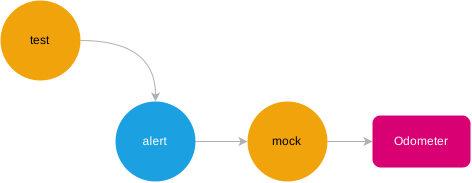
The following picture illustrates how the test works with mock objects:
Run the test:
python -m unittest test_odometer.py -vOutput:
test_alert_normal (test_odometer.TestOdometer) ... ok
----------------------------------------------------------------------
Ran 1 test in 0.000s
OKThe following adds the test cases that are over and under speed:
import unittest
from unittest.mock import Mock
import odometer
class TestOdometer(unittest.TestCase):
def test_alert_normal(self):
odometer.speed = Mock()
odometer.speed.return_value = 70
self.assertFalse(odometer.alert())
def test_alert_overspeed(self):
odometer.speed = Mock()
odometer.speed.return_value = 100
self.assertFalse(odometer.alert())
def test_alert_underspeed(self):
odometer.speed = Mock()
odometer.speed.return_value = 59
self.assertTrue(odometer.alert())Run the test:
python -m unittest test_odometer.py -vOutput:
test_alert_normal (test_odometer.TestOdometer) ... ok
test_alert_overspeed (test_odometer.TestOdometer) ... ok
test_alert_underspeed (test_odometer.TestOdometer) ... ok
----------------------------------------------------------------------
Ran 3 tests in 0.001s
OKSummary #
- Use the
Mockclass of theunittest.mockclass to mock other objects.
Thank you for your feedback!
