Log inSign up
Databases Papers
12.1K posts
Databases Papers profile banner
@UFCS

Databases Papers

@UFCS
New Databases papers from arxiv.org: database management, datamining, and data processing. Thank you to arXiv for use of its open access interoperability.
Worldwide
arxiv.org/list/cs.DB/new
Joined November 2010
1
Following
258
Followers
RepliesRepliesRepostsRepostsMediaMedia

Log in or sign up for X

See what’s happening and join the conversation

Continue with phone
or
Log in with username or email
Terms·Privacy·Cookies·Accessibility·Ads Info·© 2026 X Corp.
  • @UFCS
    Databases Papers
    @UFCS
    14h
    CAT-LDP: Cloud-edge Adaptive Taxonomy under Local Differential Privacy Junzhe Yang, Chang Xia, Xiyun Wang, Anren Sun, Wenbo Ding, Xinye Chen arxiv.org/abs/2609.05095 [𝚌𝚜.𝙳𝙱]
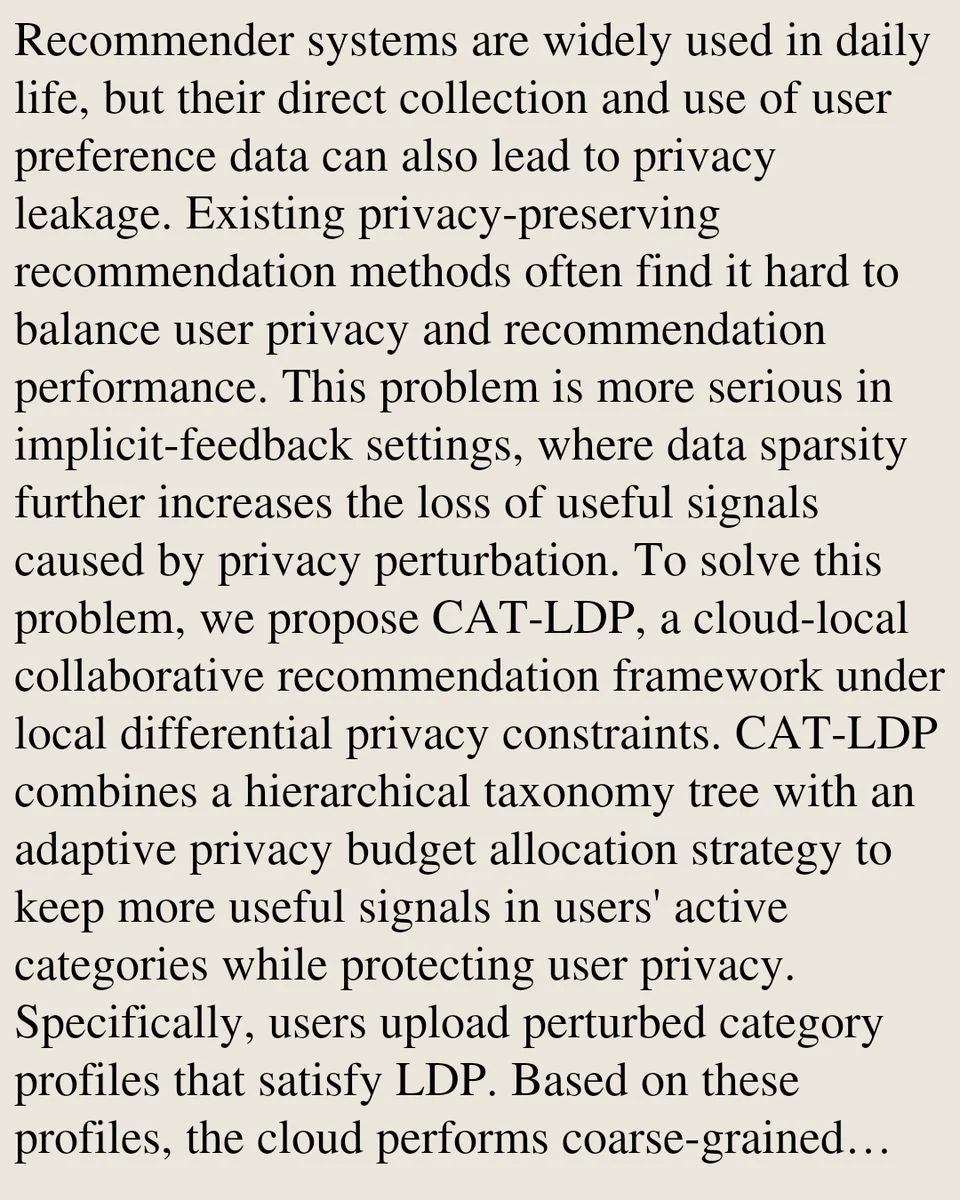
    Recommender systems are widely used in daily life, but their direct collection and use of user preference data can also lead to privacy leakage. Existing privacy-preserving recommendation methods often find it hard to balance user privacy and recommendation performance. This problem is more serious in implicit-feedback settings, where data sparsity further increases the loss of useful signals caused by privacy perturbation. To solve this problem, we propose CAT-LDP, a cloud-local collaborative recommendation framework under local differential privacy constraints. CAT-LDP combines a hierarchical taxonomy tree with an adaptive privacy budget allocation strategy to keep more useful signals in users' active categories while protecting user privacy. Specifically, users upload perturbed category profiles that satisfy LDP. Based on these profiles, the cloud performs coarse-grained candidate generation, and the local device then carries out fine-grained reranking by using unperturbed local his
  • @UFCS
    Databases Papers
    @UFCS
    15h
    Reducing the Cross-Model Tax: Query Optimization over Multi-Model Data Jáchym Bártík, Filip Štrobl, Irena Holubová arxiv.org/abs/2609.05014 [𝚌𝚜.𝙳𝙱]
    Querying across heterogeneous data models incurs substantial overhead from query decomposition, data transfer, and processing outside the underlying database systems. We show that, in the evaluated decomposition-based architecture, a substantial part of this cross-model tax is not inherent to heterogeneity itself, but results from avoidable decisions made by the unifying query processor. We present a mapping- and capability-aware optimization approach that systematically moves processing closer to the data. It combines model-aware predicate pushdown, cross-model dependent joins, and non-redundant query-part construction within a unified optimization pipeline applicable across relational, document, and graph databases. The approach is implemented in MM-quecat and evaluated over PostgreSQL, MongoDB, Neo4j, and their heterogeneous combination. It reduces query latency by up to two orders of magnitude, eliminates all out-of-memory failures observed in the original single-DBMS experiments,
  • @UFCS
    Databases Papers
    @UFCS
    16h
    A Semantic Model of Genetic Evidence: A Step Toward Bridging the Basic-Science-Clinic Gap Michael Bouzinier, Dmitry Etin arxiv.org/abs/2609.04509 [𝚌𝚜.𝙳𝙱 𝚌𝚜.𝙰𝙸 𝚚-𝚋𝚒𝚘.𝙶𝙽] 💬Code: github.com/ForomePlatform…
    Scientific and clinical decision-making depends on evidence from the primary literature, but existing standards for representing that evidence (FHIR Evidence, ECO, SEPIO, and the GA4GH Genomic Knowledge Standards) are oriented toward clinical-trial workflows, evidence codes, or single-variant assertions, and do not capture the fine-grained, domain-specific structure of claims in basic and pre-clinical research. We introduce a semantic model for scientific evidence with three core classes, specialize it for genetics, align it structurally to FHIR Evidence with a SEPIO-anchored credibility decomposition, and attach a compact dimensional vocabulary whose conditional-activation rules are validated by a SHACL schema for the implemented constraints. Using clinical variant interpretation as the driving use case, we evaluate the model through a human-AI annotation pilot over six genetics papers, yielding 28 evidence items and 95 source-anchored assertions, with a workflow that keeps curator-au
  • @UFCS
    Databases Papers
    @UFCS
    16h
    Corporate-Family Resolution Is Not a String-Matching Problem: A Public Benchmark Stratified by Name Visibility Harshit Gupta arxiv.org/abs/2609.04269 [𝚌𝚜.𝙳𝙱 𝚌𝚜.𝙸𝚁 𝚌𝚜.𝙻𝙶] 💬Code: github.com/harshitg93/cor…
    Deciding whether two supplier records belong to the same corporate family is a prerequisite for spend consolidation, credit exposure aggregation and sanctions screening. It is usually treated as entity matching, but the tasks differ: a family link connects records that are deliberately different entities, and the evidence often appears in neither record. We introduce CorpFam, a public benchmark of 54,864 candidate pairs over 10,307 corporate families, derived from 6,638,350 US federal award records in which every supplier self-reports its ultimate parent to a government registry. Pairs are stratified by name visibility: whether the names are identical after normalisation, share a distinctive token, or share none. Because strata have positive rates from 10.2% to 97.3%, we report per-stratum recall, base-rate invariant, rather than F1, which is not. The strongest of 5 matchers recovers 100.0% of identical pairs and 4.2% of invisible ones; no method exceeds 4.7% on the latter. The failure
  • @UFCS
    Databases Papers
    @UFCS
    Sep 4
    Property Testing for Recursive Query Languages Isolde Adler, Carsten Lutz, Quentin Manière, Marcin Przybyłko, Lukas Schulze arxiv.org/abs/2609.03908 [𝚌𝚜.𝙳𝙱 𝚌𝚜.𝙻𝙾]
    In the context of database querying, property testing provides a framework for testing query answers with high confidence while inspecting only a sublinear part of the database, through completion queries and size queries. A fundamental result of Chen and Yoshida (2019) states that non-satisfaction of a Boolean conjunctive query q is testable with a constant number of such queries and one-sided error if and only if q is equivalent to an α-acyclic query. In this article, we initiate the study of property testing for recursive query languages, focusing on two-way regular path queries (2RPQs) and monadic Datalog. One of our main results is positive: non-answers to any 2RPQ are constant query testable with one-sided error. We extend this slightly to a certain class of monadic Datalog programs in which recursion is restricted to be linear and rule bodies must be α-acyclic. Turning towards unrestricted monadic Datalog, we next show that if a monadic Datalog program Π is not equivalent to an
Advertisement
Advertisement