Journal 3271 Links 10887 Articles 87 Notes 8244
Tuesday, September 29th, 2026
Justice for CSS | WIRED
In defense of the girliest programming language.
I was pleasantly surprised to find a blog post of mine quoted in this article.
Friday, September 25th, 2026
Think local
If you’re anything like me, you’re sick of hearing about so-called “AI”. We are not a fringe. The majority consensus amongst actual regular people is that this is being forced down our throats and stuffed into our eyes and ears.
That’s why it pains me that I’m about to add more fecal matter onto the ever-growing pile of shit by writing yet another hot take related to large language models.
If you stop reading now, I don’t blame you. In fact, I applaud you.
Anyway…
The last time I made the mistake of writing about large language models, I set out my stall thusly:
Software is almost certainly the killer app for large language models.
I think the artists, writers, and musicians will be okay, or at least as okay as they ever were. It turns out that humans like things made by other humans.
And y’know what? If I had to choose which endeavour I’d rather see automated away—programming or art—it’s no competition.
I stand by that. But it doesn’t mean that software development gets a free pass to use exploitative extractive tools with a clear conscience.
You can use these tools in a thoughtless way or you can use them thoughtfully. I really like Robin Sloan’s approach:
The consensus vision seems to involve AI working for you day-to-day, a constant ambient presence, sparkles in everything; even cautious Apple has succumbed. I’m not interested in that.
My alternative: get your wish, then stuff the genie back into the lamp.
He’s got a set of rules:
- You must actually and consistently use anything you build for two months before posting about it.
- Ideally, never post about it. (I know I am breaking this rule, but my purpose is pedagogical, and anyway, I’ve got more apps I didn’t tell you about.)
- Don’t let the AI agent name the app. You pick the name.
- Don’t distribute the app, not even for free. Don’t post the code on GitHub. This is not software for glory; it is software for you.
For most of my career, I’ve wanted web development to become something that anyone could do. I really like the World Wide Web and I think it would be great if more people had their own websites. But I totally get that most people have no interest in learning HTML.
One of my biggest fears for the web was that it would become the domain of professionals only; a gatekeeping priesthood who get to make stuff while everyone else goes without.
The efficacy of large language models for coding would seem to lessen that possibility. Especially if you apply Robin’s approach.
The Session has an API. There are also weekly data dumps of everything on the site. The idea is that other people can use these to build other useful tools for themselves.
Lately, there’s been a big uptick of these kinds of tools, mostly made by someone with the help of large language models. Often they have no previous experience of making software.
This is good. But I get uneasy when I see people selling these tools to other people. Call me old-fashioned but I feel that if you’re going to ask people to pay for a thing, you should understand that thing. I think that’s why Robin’s list of suggestions resonates with me.
But…
To build software with large language models today, you pretty much have to pay some money to the absolute worst sort of people, the ones pedalling tokens to their “hyperscale” products. You can’t avoid being complicit because there isn’t really an alternative.
I think that might change.
I’m not going to make predictions. That’s a mug’s game. But I might attempt a gentle unspooling of one potential future…
First off, there’s a crash coming. That’s pretty much inevitable at this point. The only question is how much collatoral damage it’s going to do to the world.
Right now, tokens are subsidised. The hyperscalers lose money when people use their products. It’s possible that we are now living through a golden age of making software relatively cheaply with large language models. That will change when the hyperscalers start charging for the true cost of tokens.
Not for everyone though. I believe that enterprise software companies will happily pay the true price for tokens. It’ll be like Google Glass; that was an absolute disaster for the consumer market but went on to have a productive second life in factories.
You know when you’re in an airport and you see advertisements that are not for you, but for faceless corporations? You know the ones. They’re all “cloud” this and “sap” that. Now they’re all about “AI”. It’s not for us. It’s for them.
Does this spell the end of making home-cooked apps with large language models?
I don’t think so.
The hyperscalers might become unaffordable to most people, but keep an eye on open models. And keep your other eye on local models.
Right now, open local models aren’t as good as the large language models that require data centres of computation and energy. But they aren’t massively far behind. And if the recent history of large language models has taught us anything, it’s that “good enough” is fine.
Take Google Search. They decided to fuck it up by forcing generated summaries into your eyeballs above the actual search results. These summaries aren’t 100% accurate. Let’s be generous and say they’re accurate more than 90% of the time. According to Google, that’s good enough.
So, sure, local open models may never reach the levels of data-centre-powered large language models. But they don’t need to. They just need to be good enough.
I’m really looking forward to that.
My issue with large language models has never been the actual technology, which is genuinely fascinating. My issue is with the power dynamics, of being robbed of agency, of the over-inflated hype and criti-hype being used to convince us of an inevitable future where a small group of very rich men are masters over our lives.
I’d love to see the technology decoupled from the current depressing narrative. I’d love to see a thousand homemade software flowers bloom from open local language models.
Is AI ruining my brain?
I am an AI skeptic/hater/slow adopter, due to a combination of concerns about the ethics and environmental impact of AI and the fact that I like doing things myself. I knit my own socks, I built a swing for my porch this summer, and every Thanksgiving I make pies from scratch — even the crust (do you like my handmade em dash?).
[this is aaronland] it’s a funny way to tell a story
Aaron’s talk at Papercamp opened with this:
Fun fact: Alex and I first met 19 years ago at a conference in Paris where, coincidentally, I was speaking about something I referred to as the “Papernet”. Amazingly there are no photographs, that I could find online, of either of us speaking. This is a nice passage that Jeremy Keith wrote about the event at the time.
Thursday, September 24th, 2026

Thursday session
The summer of ’26
It was the autumnal equinox a few days ago. For a moment our planet was balanced perfectly, with everyone experience twelve hours of daylight and twelve hours of darkness. Here in the northern hemisphere, the days will get shorter and the nights will get longer until the winter solstice.
Summer is officially over.
I saw it out with my now-annual trip to Spain for the Cáceres Irish Fleadh. It was, as always, great fun. Nothing beats playing loads of tunes into the early hours while sitting outdoors in a beautiful old town.
I visited some lovely places this summer. A trip to Greece. A trip to Italy. Even my trip to Cork was blessed with bright sunshine.
But I think the highlight was the three weeks I spent in the north of Ireland. It helped that being there meant I escaped the worst of the heatwave here in England.
All in all, it was a thoroughly enjoyable summer filled with travel, music, good food, and sunshine. Now it’s time to hunker down at home.
Tuesday, September 22nd, 2026

Back from Spain with a good haul…
Monday, September 21st, 2026

Monday session in Madrid.
Sunday, September 20th, 2026


On stage in Cáceres.
Saturday, September 19th, 2026


More street sessions in Cáceres.

Made a nice salad for lunch in Cáceres. 🥗

Last night’s fun.
Friday, September 18th, 2026

Rooftop apartment.


Street session in Cáceres.
Thursday, September 17th, 2026


Enjoying a nice tapas crawl through Madrid.
Going to Madrid. brb
Wednesday, September 16th, 2026

Wednesday session
Tuesday, September 15th, 2026
Even a stopped watch is right twice a day.
Related: this week Don Trump said he’d like a united Ireland, and that all this talk of humanity-ending AI is bollocks.
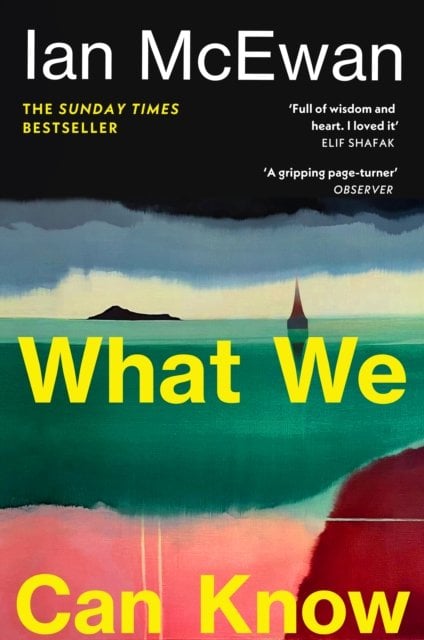
What We Can Know by Ian McEwan
This is Ian McEwan’s second foray into science fiction after his alternative history novel, Machines Like Me. I enjoyed that book but it was far too eager to show off its worldbuilding—at one point a character practically looks at the camera like Tim in The Office.
There’s a bit of that in What We Can Know with its expository passages explaining what’s been happening in the 21st and 22nd centuries, but it mostly works.
As with all McEwan’s work, it’s extremely English. He just has to have some clashing of the classes in there.
The book has an unusual structure, switching between the present day and a climate-ravaged future one hundred years from now. A future scholar is obsessed with a poem from our time period that was never published. At times the book feels like a whodunnit, complete with all the suspects assembled together in a country house.
If the structure is unusual, the tonal swings are really something. We go from high-brow pondering of the utility of art in the face of catastrophe to downright schlocky soap-opera shenanigans. My eyebrows may have gotten whiplash.
But I guess it all worked somehow because I found myself turning the pages, eager to reach the final revelations.
Still, there was one thing that really bothered me. In order for the plot to work, our future scholar needs to have access to emails, chats, and other digital artificats from today. We get an explanation of how the cryptography has been cracked by quantum computers, but it’s simply taken as given that the files themselves would be available, having survived in “The Cloud”.
I can’t really blame Ian McEwan here; here’s just repeating the oft-retold advice that you should be careful what you put online because it’ll be there forever. But that warning simply isn’t true. The Cloud dissolves very, very quickly. Just ask the folks at the Internet Archive.
But if your credulity can stretch to accept the naïvely optimistic depiction of digital preservation in What We Can Know, it’s an enjoyable romp.