I’m currently available for new design exploration / direction projects. Please drop me a line.
Journal
Eno on AI
All my misgivings about AI really are to do with the fact that it’s owned by a group of people that I don’t trust at all. I don’t trust their taste, I don’t trust their morals, and I don’t trust their politics, and that’s a problem for me—that the whole technology is in the hands of the wrong people.
Reflecting on a summer of sound

A funding award enabled me to dedicate three months solely to developing my artistic practice — something I’ve been reflecting on these past few weeks.
The hunt
A potent reminder from Naz that friction has a purpose; to grow, we must hunt.
We lost something along the way in pursuit of efficiency and this idea of saving time for productivity. We lost something in the helicopter parenting that we ourselves didn’t have but want for our own children. We lost something in the blandness of homogenized sameness and conformity. We lost something when everything became instantly accessible. And now we’re losing the most in favor of automation and agents that are the fever dream of AI hype cycles and an industry propping it up to create an “inevitability” because humans aren’t worth investing in.
Jenny Saville: The Anatomy of Painting

Realising this exhibition was closing soon, I popped down to London’s National Portrait Gallery to see the work of a painter whose technical ability I’ve admired since art school.
Rob’s expanded edition
I knew Rob Weychert’s v7 redesign was torturing him but didn’t know why; I now realise it was all about the rebuild. If, like me, you’re obsessively compelled to document your life, his expanded edition is a whole new level of inspiration.
There’s something really beautiful about using your life as raw material and making it into something that, if you do it right, it’s like a thing that’s there forever and people can access it and it will do something for them.
This Is What You Get

Radiohead’s music and art are inseparable, and a constant source of inspiration for me. I couldn’t miss this exhibition at The Ashmolean in Oxford.
Andy Goldsworthy: Fifty Years
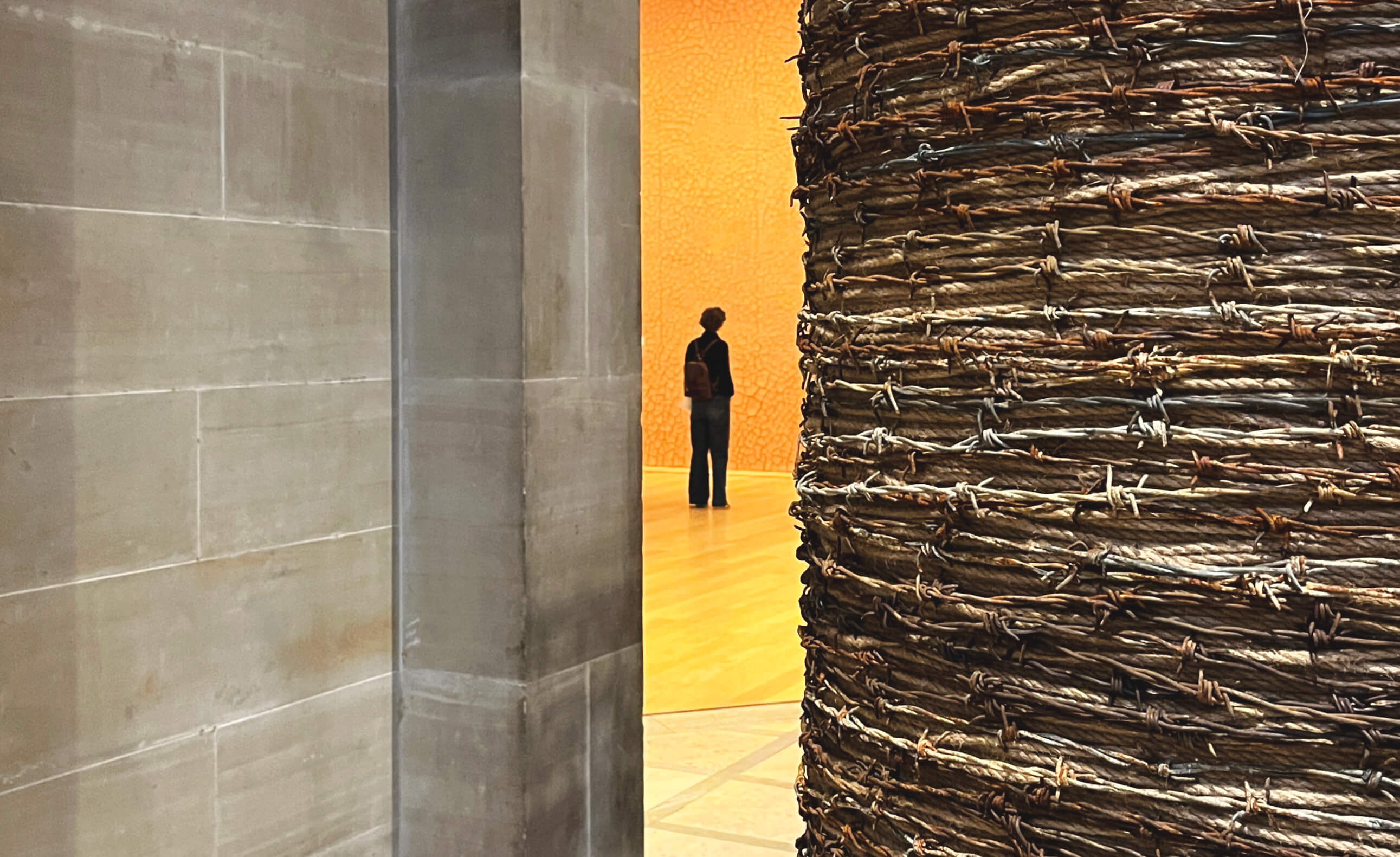
Ways of seeing and feeling that I first learned from land artists have remained invaluable. This extensive show offered a chance to reconnect with one of my favourites.
Eighty years

Today marks eighty years since the devastating atomic bombing of Hiroshima. My song Paper Cranes documents an emotional visit to the peace museum and my encounter with a survivor. Every August 6th, I donate any Bandcamp profits to a Hibakusha charity.
Last year, Tokyo-born, Berlin-based artist Tot Onyx included Paper Cranes in her deeply moving Hiroshima/Nagasaki mix on NTS — an hour of “Nuclear Age” music remembering the devastating events of August 1945 while also contemplating the present.
Making this mix gave me a quality of time to reflect the ongoing genocide and atrocities that are taking place right now. It proved to me that sometimes music can tell stories better than the language.
A few more days up North

It’s becoming a habit that we head up North each Summer. This time we spent a few days in remote Northumberland, before heading to Edinburgh, Glasgow and Motherwell.
The Hazards of Duke
When it comes to walking, I tend to use my own legs. But yesterday we entrusted forward momentum to two huge animals with their own brains.

Neither of us had ridden before, and I found the experience unnerving at first. Duke is a big (16.3 hands) old Irish Cob, and from the saddle, the ground seemed very far away and his slightest movement made me feel as though I’d fall off. Initially, he seemed agitated by something (our guide kept looking for a fly, but it was probably me), shaking and twitching constantly, and I feared he might spook (hence this post’s silly title).
But gradually, we both relaxed. My posture improved and I learned how to use the reins to minimise his desire to dart for blackberries, and we settled into a pleasant walk along old bridleways.
Deep listening: an afternoon of advanced sound discovery

My recent session with a field recording expert was truly ear-opening. If you’re curious how Greenwich sounds through shotgun mics, hydrophones, electromagnets, anti-radios, bat detectors and binaural buds, listen on!
The new V&A East Storehouse

Another hot and sweaty weekend in London, with prolonged highs of 30°C. The temp settled around 27°C on Friday evening as we strolled by the Thames under sunset skies, our spirits lifting after a disappointing meal at Lambeth’s Garden Café. We decided to walk the tourist route past Parliament and along Whitehall to Trafalgar Square for late-night ice cream in Leicester Square, which we enjoyed sat opposite the big All Bar One where I’d worked in the ’90s.
On Saturday, we went to the new V&A East Storehouse in Olympic Park, and it’s interesting because it’s a different kind of museum, like you’re in that storage hangar at the end of Raiders of the Lost Ark and someone opened up all the boxes. Highlights are the hanging chunk of Robin Hood Gardens social housing estate, an enormous Picasso reproduction, and Frank Lloyd Wright’s Kaufmann Office, all seemingly permanent and benefitting from prominent info panels.
But everything else is, apparently, in flux, and that’s an excuse not to label things. It’s refreshing to amble around without being bombarded with information, but also quite a shallow experience in terms of actually learning anything; if an item sparks curiosity, you need to tap numbers into your phone to find out more (a hit-and-miss experience as some items are omitted).
One serious gripe: I get that everyone must leave their bags, but the lockers are embarrassingly problematic. It’s a very cramped space packed with confused people and no in/out flow. The actual locks require a series of twists and presses to set a temporary four-digit combination and it’s so complex that staff have to talk people through moves which could pose issues for visitors with arthritis, long nails, poor vision, etc. The lockers lack privacy (they have large windows) and aren’t particularly secure (we imagined several ways one might acquire someone else’s stuff through observation or deception). This frustrating user experience needs reconsidering, as there are many better alternatives.
In better news, Jon Hicks designed the new V&A icon system and it’s great. And I’ll definitely return, because The David Bowie Centre is opening here soon.
My main reason for this latest trip to London was an afternoon of advanced field recording tuition in Greenwich, and I’ll write about that in a separate post.
Delia’s sixth

Back to beautiful St. John’s in Carrington, where I played my second live show last summer. Delia’s sixth featured the wonderful Torn Sail (the new album, Steady Weather, is excellent) and Hexaphonic, a psychedelic experiment steered by Martin Cooper. The headline set came from Origamibiro, which is the alias of Tom Hill, formerly of Wauvenfold and now a regular soundtrack composer for BBC and Netflix docs. His performance featured looped cello and clarinet woven into electronic textures, and I loved it.
I enjoy these happenings as they’re an opportunity to hang out with friends both old and new, all united by the wonderful work the Delia team is doing for local music and community.
Another week in Edale

We returned to the tiny cottage in Barber Booth we’d enjoyed for a few days last summer. I’d intended a week of field work, but the weather had other ideas.
Inglorious

On our wild uplands, birds of prey continue to be killed in appalling ways or disappear in mysterious circumstances. In recent years, I’ve made a significant effort to understand why these crimes occur, as they cause me frequent distress.
The primary reason is that rich landowners view these birds as a threat to lucrative field sports. Tomorrow, MPs will debate the urgent call for licensing of grouse shoots, which will supposedly make prosecution easier.
I believe that driven grouse shooting (where the birds are forced to fly over people with shotguns in fixed positions) should be banned entirely. Our uplands — which are drained and burned to support one species that wealthy people shoot in huge numbers — should be returned to a healthy state that supports our planet. Decades of work to find solutions have failed, so perhaps licensing is worth trying.
But killing birds of prey has long been illegal, and so I’d expect gamekeepers would continue to destroy them. I’ll likely never see a Hen Harrier when walking the high moorlands of the Peak District, and this breaks my heart.
If you’re interested in this topic, I strongly recommend Mark Avery’s excellent and thorough book, Inglorious.
Hot in the city
Spent a couple of days taking it easy in sunny London. On Monday evening, we met up with several friends I’d made during last month’s Camp residency. I joined Ryan, Claire, Christoph and Daniel in the shady garden at the lovely Scolt Head pub in Dalston. After food and drinks, we made for nearby Café Oto where we caught up with Greg, and also Lukas who was performing as part of a Shape+ showcase. I really like these folks and hope to see them again.
On Tuesday, we visited Yamaha’s flagship store on Wardour Street and tried out a couple of basic pianos — if we ever find a serious buyer for my late Mam’s house, a simple upright might be my one significant purchase. In the evening, we enjoyed a meal at Rotunda, outside in the shade next to Regent’s Canal.
Your Ears Later Will Know to Listen
I was in town for an appointment and was then supposed to meet a friend for lunch, but they texted to postpone. So, I embarked on an unplanned mini-explore day and went along to the new Your Ears Later Will Know to Listen exhibition at Nottingham Contemporary, which explores “how sound connects us with histories, places and identities”.


The photos above show work by John Peffer (1), Simnikiwe Buhlungu (2 & 7), Satch Hoyt (3), Hong-Kai Wang (4 & 5) and Yee I-Lann (6).
I couldn’t have wished for a show more appropriate to my ACE-funded Summer of sound activity. I spent time with every work, notably Satch Hoyt’s 17-track sound installation, Simnikiwe Buhlungu’s gallery-length tape loop, Nguyễn Trinh Thi’s three-channel video and Hong-Kai Wang’s multimedia display. A timely and inspiring way to lose a few hours.
I may return to this post and write more about the show and my responses later. For now, take a look at the website and I recommend the accompanying two-hour NTS show featuring most of the exhibiting artists.

Swiftwatch
I heard and saw my first Swifts of 2025 on Friday, 9th May. I’d been back from southern France a day or two but not really been outside in daylight hours, so can’t pinpoint exactly when they arrived. But I’ve already been spoiled this year, watching the aerodynamics of Common and Alpine Swifts, House Martins, Crag Martins and Swallows around Aulus-les-Bains.
Previously: 2024, 7th; 2023, 7th; 2022, 11th; 2021, 16th; 2020, 5th; 2019, 9th; 2018, 7th; 2017, 11th.
Seeing sound and feeling things
This is the final post about my Camp residency. Sincere thanks to those who sent messages of appreciation for my nightly updates. You inspired me to preserve a little time each day to reflect and write, and I enjoyed doing so. Thanks!
I woke to a cold, bright, sunny morning. There was snow overnight but I didn’t see it, and it’s only dusted the higher slopes. I wrapped up and went out after breakfast for a last stroll around the village. I found a sprawling ramshackle house with perhaps a dozen cats of all ages and styles knocking around, and we all watched each other as I enjoyed my coffee on a nearby bench.

It started to rain, so I made my way back, popping in to the modest Tourist Information Centre (I always remember Syndicat d'Initiative from GCSE French) and had a good chat with the friendly chap. I mentioned the blocked woodland path to Coumebière and he pledged to “get the team up there”.
Returning to the house, I only made it as far as the covered veranda on the first floor, where I sat in the cool air for an hour. It seemed important somehow; being alone, listening to a Chaffinch sing over the distant static of the river; here is a final opportunity for meditation and reflection, do take it. And so I did.
I spent most of the afternoon working on another new song. It unintentionally evolved into a sort of Sigur Rós post-rock thing, and although it’s rough and I couldn’t keep to time properly, I think it could be beautiful.
After an early dinner, we gathered in the main studio to witness the very first Monopoly of Bells show. The trio consists of Clément Vercelletto on modular and bagpipe, Charles Dubois on percussion and Lukas De Clerck on self-designed aulos. They only formed this week as part of a funded initiative, and have been busy learning and rehearsing how to work together. I think they have further shows lined up for Summer. If you’re the sort of curious music person who reads The Wire and they come to your town, you must go see them.


Then, it was up to the attic stage for an intimate candle-lit performance from saxophonist Laura Misch, percussionist Gregory White and artist Daniel Jones. Most of us have already witnessed the trio exploring and rehearsing over the last week, and it was a treat to receive an uninterrupted 35-minute glimpse into their collaboration with each other and the earth. And while they performed, artist Carine Figueras was action painting using natural pigments.
And then, I retired to pack, because this has been my last full day at Camp. I’ll jump in the van tomorrow morning and head to Toulouse. A week was always gonna fly by.
So what just happened, and what next?
Well, I’ve paused all existing projects, including my album, because this Spring and Summer is all about research, development and trying stuff. It’s also about putting myself in interesting or unusual situations and making new discoveries. This first week, here in Aulus-les-Bains has been the perfect start.

I came here to feel things, to focus, and to gather. And I’m taking a lot of material back home with me, notably hundreds of field recordings and several promising sketches. I didn’t set any goals for my time here, but I am leaving with a few good demos made in response to the place, and there might be a little interim EP to work on. But also, I’ve collected inspiration in many forms, from watching and listening to others, seeing sound being made, engaging in conversations, hiking, reading, and all the stuff that comes into your head when you just let go of everything for a little while to absorb the world around you, look and listen, and follow your thoughts.
Being in this environment has reconnected me to a time when I felt completely at home in a residency situation, as an artist before design became my career. And I’ve achieved lots as a designer, but I’m still not quite sure how I feel about that as a measure of personal or creative success — and anyway, success in one field counts for nothing in another. Sharing music gave me an inferiority complex. That’s diminished as time has passed, but I became very nervous about coming here to work alongside professionals — after all, one current guest has performed at The Barbican, another helped engineer one of my favourite albums, and I could list plenty more of their impressive achievements.
Yet being at Camp has actually helped me shed any remaining feelings of inadequacy. I now feel like I too am a legitimate musician, with absolutely nothing to apologise for or doubt.
In a way, this has been something like a one-week meditation. Camp is a facilitator for whatever each person needs. And it’s so bloody beautiful here. I can see why everyone keeps coming back, and why many extend their stay for several weeks. Why would anyone ever want to leave?
