
Business energy broker commissions: what is hidden in your unit rate
Broker Commission
The number that matters is the one nobody quotes you: the commission is inside your p/kWh, not on a separate line.
A broker who tells you their service is free to you is usually telling the truth about the invoice and not about the cost. The supplier pays them, and the supplier recovers it by adding an uplift to the unit rate you were quoted. You pay it every kilowatt hour for the length of the contract, and on a three-year deal at ordinary consumption that is a four-figure sum.
This piece sets out what has to be disclosed, what does not, and the arithmetic.
The arithmetic first
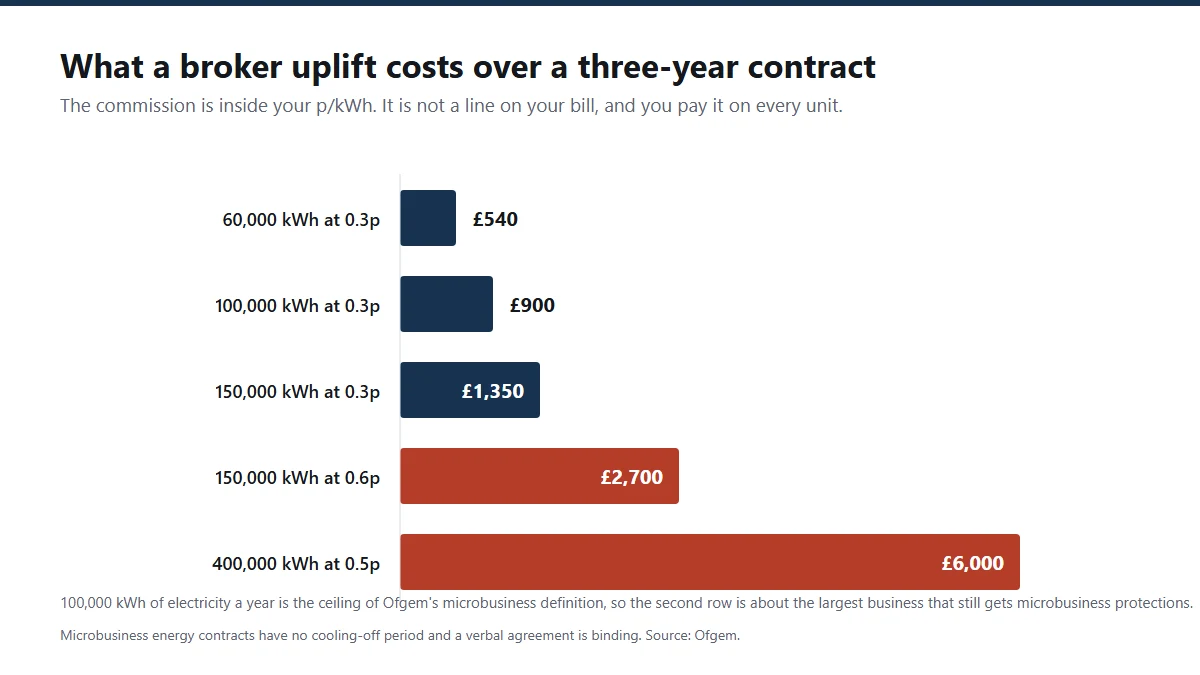
An uplift is quoted to the broker in pence per kilowatt hour. It is invisible on your bill because it is not a line on your bill; it is part of the rate.
| Annual consumption | Uplift | Cost a year | Cost over 3 years |
|---|---|---|---|
| 60,000 kWh | 0.3p/kWh | £180.00 | £540.00 |
| 100,000 kWh | 0.3p/kWh | £300.00 | £900.00 |
| 150,000 kWh | 0.3p/kWh | £450.00 | £1,350.00 |
| 150,000 kWh | 0.6p/kWh | £900.00 | £2,700.00 |
| 400,000 kWh | 0.5p/kWh | £2,000.00 | £6,000.00 |
100,000 kWh of electricity is the ceiling of Ofgem’s microbusiness definition, so the second row is roughly the largest business that still gets microbusiness protections.
The conclusion this site is willing to reach: a broker who finds you a genuinely better rate can be worth an uplift, and one who does not is charging you four figures for a phone call. The point is that you currently have no way of telling which you have without asking a specific question, and most businesses do not know the question exists.
What Ofgem actually requires
The rules are narrower than the reassurance implies.
The disclosure rule. Ofgem states that information on third party intermediary costs that will be included in the bill the supplier sends you “must be provided to all businesses via the Principal Terms and upon request.” So the number exists, in a document, and you can ask for it.
The gap in the rule. Where a broker is paid directly by the business rather than through costs added by the supplier, it does not have to appear in the supplier’s Principal Terms at all. That is the honest reading: the disclosure attaches to the supplier’s document, not to the broker’s relationship with you.
Who counts as a microbusiness. Meeting any one of these is enough:
- fewer than 10 full-time equivalent employees and turnover or balance sheet total no more than £2 million
- no more than 100,000 kWh of electricity a year
- no more than 293,000 kWh of gas a year
Most single-site businesses qualify on the consumption test alone, and a great many do not know it.
The part that catches people
Two features of microbusiness energy contracts that have no equivalent in consumer law.
There is no cooling-off period. Ofgem’s guidance is unambiguous: there is no cooling-off period after you agree the contract, even where the agreement was made on the telephone rather than in writing.
A verbal agreement is binding. Saying yes on a recorded call is the contract. Not a step towards a contract.
Put those together with an uplift you cannot see and a three-year term and you have the structure of the complaints that prompted Ofgem’s misselling rules. A twenty-minute call can commit a business to several thousand pounds of commission with no right to reconsider the next morning.
What is changing
Ofgem published a market review of third party intermediaries on 4 June 2026, with responses closing on 16 July. It is a call for input rather than a rulebook, and it says what direction the sector is moving in.
Three things in it are worth a business owner’s attention:
- Government intends to appoint Ofgem as the regulator of TPIs, with powers to set rules, monitor, investigate companies and require brokers to be authorised. Brokers are currently outside direct regulation in a way suppliers are not, and the TPI programme page tracks where that has reached.
- The separate-disclosure requirement is proposed to extend from microbusinesses to all business consumers. Today a mid-sized firm has fewer disclosure rights than a corner shop.
- A code of practice is proposed requiring brokers to be clear about their fees, the contracts they offer, and which suppliers they actually represent. “Whole of market” is currently a marketing phrase rather than a defined one.
None of that is in force. A contract signed this week is signed under the existing rules.
The four questions to ask before you sign
Ask them in writing, and keep the answer.
- “What is the commission, in pence per kilowatt hour, on this quote?” Not “do you charge me”, not “is this free”. The p/kWh figure.
- “Send me the Principal Terms showing the third party costs.” You are entitled to this and asking for it is not an unusual request.
- “Which suppliers do you have agreements with?” This establishes whether “the best deal available” means the best deal available to them.
- “Is the commission the same across every supplier you quoted?” If it is not, the ranking you were shown is not purely a price ranking.
A broker who answers all four plainly is probably worth using. One who redirects to how much they will save you has told you something.
Where to complain
Disputes with a broker go to a Qualifying Dispute Settlement Scheme, which offers independent resolution between brokers and businesses. The free Citizens Advice consumer service is 0808 223 1133.
Note what this is not: microbusinesses do not have the Energy Ombudsman route in the way domestic customers do, and the QDSS a given broker belongs to is worth checking before you need it rather than after.
The counterweight
The case for brokers, stated properly, because this is not an argument that they should not exist.
Business energy procurement is genuinely opaque. Rates move daily, contracts are not comparable line for line, and a business that lets a contract roll over onto deemed rates will pay substantially more than one that did nothing else right. A broker who runs a real tender, times the purchase and stops the rollover is doing work that has value, and the uplift is how that work is paid for.
The objection is not to the payment. It is to the payment being expressed in a unit the customer cannot see, on a contract they cannot exit, agreed in a call they cannot undo. Those are three separate design choices and none of them is necessary for the broker to be paid.
Frequently asked questions
Is my broker’s commission on my bill? Not as a line. It is added into the unit rate. Information on third party costs that the supplier includes in your bill must be provided in the Principal Terms and on request.
Am I a microbusiness? If you use no more than 100,000 kWh of electricity a year, or no more than 293,000 kWh of gas, or have fewer than 10 full-time equivalent staff and turnover or a balance sheet total of no more than £2 million, then yes on any one of those.
Can I cancel if I change my mind? No. Microbusiness energy contracts have no cooling-off period and a verbal agreement, including on the telephone, is binding.
Is any of this about to change? Ofgem ran a market review from 4 June to 16 July 2026 and the government intends to make Ofgem the regulator of brokers. Nothing is in force yet.
Updated on 15 September 2026.
Sources
- Ofgem, third party intermediaries: what your microbusiness needs to know
- Ofgem, third-party intermediaries (TPIs) market review, published 4 June 2026
- Ofgem, third party intermediaries programme
- Ofgem, new rules for suppliers and brokers to protect businesses from misselling
Entropy Business Energy analyses published rules and arithmetic. It is not legal or financial advice and it does not sell or recommend energy contracts.…
