Image

A 7-Segment Clock Built With No Digital Electronics

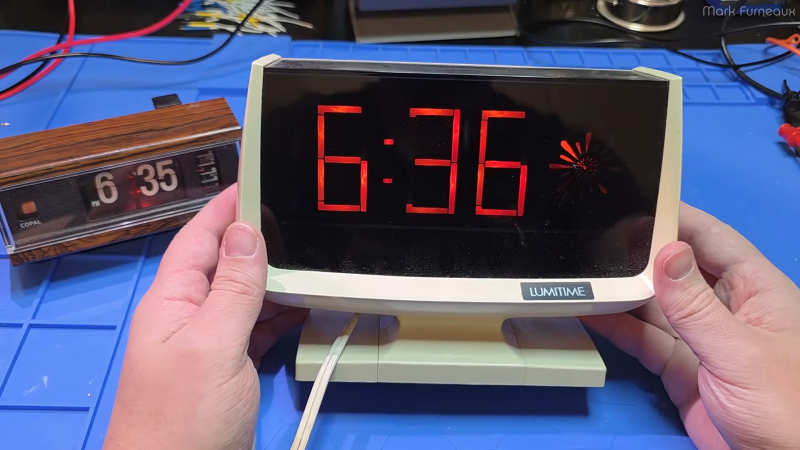
If you wanted to build a clock with a 7-segment display, there are a wide variety of ways you might go about it. You could grab some 74-series logic chips and create a whole bunch of counters and decoders to drive the display, or you could wire up a microcontroller with an RTC and have it do the hard work. Or, as a Japanese company once did… you could create a “digital” looking clock with no digital electronics whatsoever.
Image
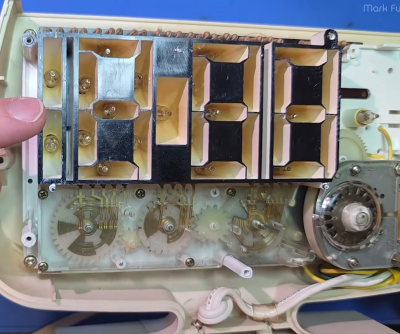
The geared mechanism and switch contacts are visible; they switch the neons of the various segments on and off at the correct times. Credit: YouTube video

[Mark Furneaux] set about tearing down a Lumitime clock, built by the Japanese company Tamura. From the outside, it appears to be a rather stylish digital clock, with a bold red 7-segment display lit with neons. And in some regards, it is. Only, the secret of this clock is that it doesn’t use digital electronics to do the job. There are no counters inside, no real-time clock module, no transistor-based logic chips doing the counting with the output of a 32.768 KHz crystal. Instead, a motor drives a series of gears that turn metal plates that move under sliding finger contacts. The gear train and the metal plates are designed such that the contacts turn the various segment neons on in the correct sequence to display the current time. It’s like a player piano, only instead of playing a tune, it’s switching the segments of a display on and off to display the right numerals at the right time.

It’s a neat way to do a “digital” clock from an era when proper digital electronics were still very expensive. We’ve seen all kinds of whacky 7-segment clocks before, too, like this amusing water-based build. Video after the break.

Continue reading “A 7-Segment Clock Built With No Digital Electronics” →
Image

Smart Clock Helps With Medication Management

There are all kinds of smart devices on the market these days, but if you want one to solve a particular personal problem, sometimes it’s easiest to just build your own. That’s precisely what [hvermaak.projects] did when it came to the Ouma Ria Smart Clock.

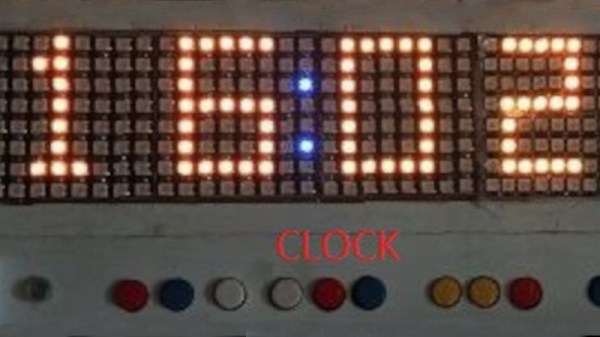
The clock was primarily intended to act as a useful tool for providing medication reminders, before some extra useful home functionality was folded in. The heart of the build is an ESP32-WROOM-32 hooked up to four 8×8 WS2812B addressable LED panels acting as a display. A further 30 WS2812Bs in a strip act as a status indicator. A DS3231 real-time-clock module ensures the clock keeps accurate time, while a BH1750 ambient light sensor makes sure the clock is responsive to current lighting conditions. There’s also a DFPlayer Mini audio module for spoken announcements and chimes, while there are inputs for AM312 passive infrared motion sensors that allow the clock to act as a rudimentary security monitor. There’s even a web interface for control and scheduling.

The device ultimately evolved into something that helped with daily live, handling everything from medication management to remembering birthdays, and even helping out with kitchen timing tasks.  We’ve featured some other innovative builds in this space in recent years, too, like this explosively loud alarm clock.

Image

Time Never Moves Slowly With This Clock

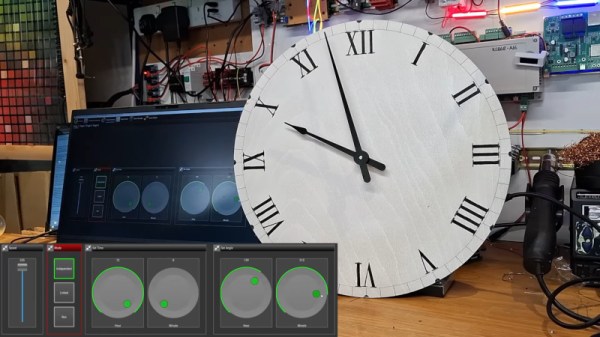
A clock is by its very nature a device for measuring time, and thus it moves forward at a constant rate. But how about in a theatrical setting, where time runs at the whim of the director? For the stage, a clock with more flexibility is required. To this endeavor [Playful Technology] has you covered, with a larger than life stage clock whose hands are independently controllable by DMX.

Behind the clock is a very unusual part, not the modified clock mechanism one might expect, but a dual stepper motor with a concentric shaft. This is driven by an Arduino with a stepper driver shield more familiar from the world of 3D printers, and an RS485 interface for DMX interfacing. The hands are built in OpenSCAD, and 3D printed to be an interference fit on the shafts. The DMX controller software has a handy rotating knob style interface, allowing easy hand manipulation.

You can see the results in the video below, complete with an exhaustive dissection of the Arduino code. Meanwhile DMX is itself a fascinating subject, and in the past we’ve taken a deep dive into RS485.

Continue reading “Time Never Moves Slowly With This Clock” →

Image

VFD Clock Runs On A Single AA

There are lots of different ways to build a clock. [Sciter_] came into the possession of some old calculator parts, and decided to reuse them for just such a project.

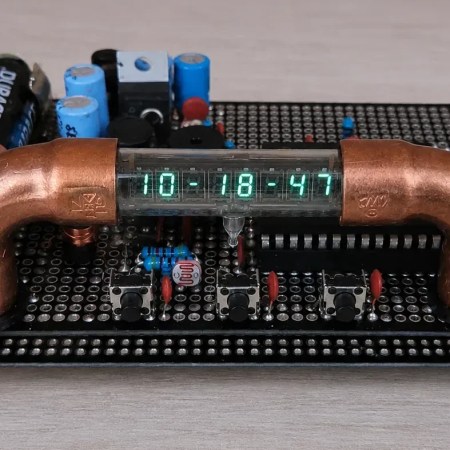
The heart of the build is an ATmega328P microcontroller, running off of a 32.768 kHz crystal. This allows the chip’s counters to neatly divide down the frequency to get a steady 1 Hz pulse for accurate timekeeping. Time is displayed on a vacuum fluorescent display (VFD) harvested from an old calculator. These displays need rather high voltages to run, which in this case are produced by a HV5812 driver chip and supporting circuitry. The display itself is neatly cradled in a pair of copper pipe elbows for a stylish look, with some addressable RGB LEDs present to provide some charming underglow.

Power for the device comes from a single AA battery, using a transformer-based low voltage converter. Alternatively, it can run off a USB 5 V power supply, which also charges the NiMH AA cell while available with the aid of an LM2576-ADJ buck converter.

Overall, it’s a neat homebrew clock that taught [Sciter_] plenty during its construction, and not the first time we’ve seen somebody put together a clock with second-hand VFDs. If you’re finding fun ways to reuse old display tech, don’t hesitate to let us know on the tipsline.

Image

Building An Analog Meter Watch

Most conventional analog watches have two or three hands, covering hours, minutes, and seconds (where present). [Sahko] has built a different kind of analog watch that creatively displays the time with just one. 

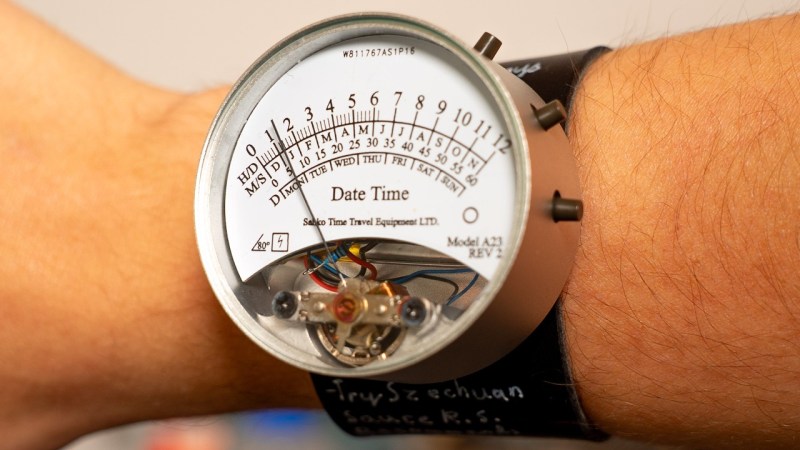
The build is based around a simple analog coil meter, which, at its heart, just sweeps its needle across a scale based on the voltage input to the device. A Raspberry Pi Pico is employed to drive the meter through a digital-to-analog converter. Pressing the buttons on the outside of the device tells the watch to display hours, minutes/seconds, or the current month or day of the week. With a single needle, only one parameter can be displayed at a time, but that’s just a compromise you accept for having a cool unique analog dial watch.

Another cool touch in the design is that the dial backer isn’t just a printed piece of paper—it’s a custom PCB, which has a much nicer, hardier finish. The case of the watch is also CNC milled out of aluminum and bead blasted for a quality surface finish, adding a nice industrial touch to the build.

This is a great example of a custom watch with quality fit and finish. The attention to detail really pays off in terms of feel. We’ve seen other watch projects use similar construction techniques before, too.

Continue reading “Building An Analog Meter Watch” →

Image

Voltmeter Clock Has The Time Dialled In

You could make a clock with three hands spinning about nested central shafts. If you did that, we probably wouldn’t publish it on Hackaday unless you really found a way to make it interesting. Make a clock out of voltmeters, however, and that usually catches our eye. [lcamtuf] has done just that.

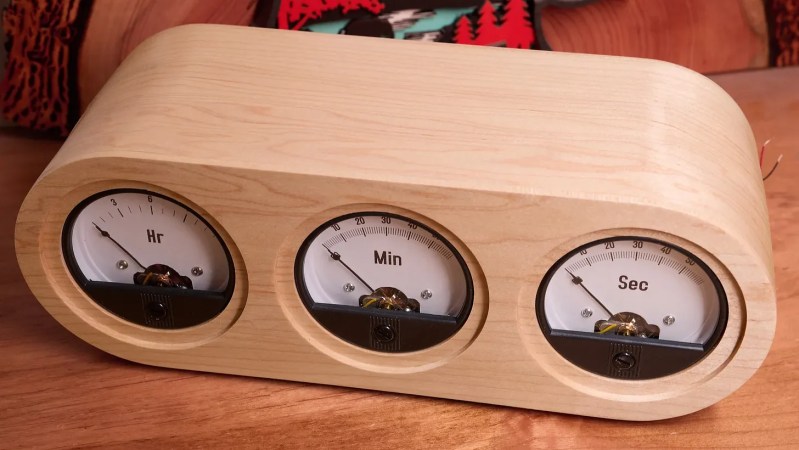
The heart of the build is an AVR128DB28 microcontroller, an 8-bit microcontroller that is still currently in production. It runs at 8MHz, and drives a series of three Baomain 65C5 voltmeters to display hours, minutes, and seconds. Each has a custom printed face with the correct number of 13 or 61 divisions as needed. The voltmeters are driven by a continuous stream of 1-bit pulses with a software-controlled duty cycle determining exactly how far the needle moves. Yes, it’s using simple pulse width modulation, coded by hand by [lcamtuf] to do the job. All the components are wrapped up in a beautiful wooden case, with delicately kerf-bent panels to create the attractive curved lines.

We’ve featured similar builds before, too. As it turns out, hackers just really love clocks and old-school dials. Video after the break, which is worth watching for the rollover behaviour alone.

Continue reading “Voltmeter Clock Has The Time Dialled In” →

Image

Salvaged VFDs In Nixie-Like Clock

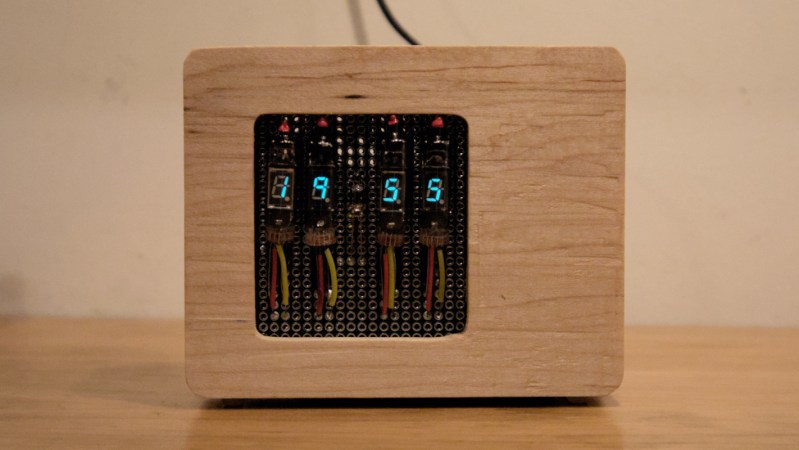
In between the Nixie tube era of the 50s and 60s and the advent of multi-digit vacuum fluorescent displays (VFDs) common in 80s and 90s consumer technology, there was a brief time in the early 70s where single-digit VFDs were commonplace. Superficially these devices look like Nixie tubes, but have a number of advantages to them including lower voltage, lower power requirements, and lower cost. [maurycyz] recently found a number of these salvaged from old calculators and used them to build a retro-themed clock.

[maurycyz] was not able to find datasheets for this display, but was able to reverse-engineer each of the digits. Similar to vacuum tubes there is a heater which has a few ohms of resistance, and from there each of the segments of the digit can be deduced by probing the 13 signal wires. These are analog devices in some respects, so a lot of experimentation had to go into driving the displays to find their optimal conditions. A quartz crystal was used for timekeeping with an AVR128DA28 microcontroller chosen to provide control for the digits, using seven pins as segment drivers and four as grid drivers. Each digit uses around 0.14 watts, so with all four digits on it can consume a little over half a watt. A simple wood enclosure rounds out the build.

As Nixie supply wears thin, VFDs like this can be an excellent stopgap or replacement while still building retro-themed displays like this clock or this calculator which uses similar VFDs for each digit.