
Earl Grey is a much better vehicle for sweets than coffee.
There, I said it.
Earl Grey is a much better vehicle for sweets than coffee.
There, I said it.
I participated in yet another writing contest called 1Picture1000Words:
They say a picture is worth a thousand words. Look at this picture.
Write 1,000 words about it by August 31st, 2026. You can write whatever you want, so long as you connect it to the photo. Creative nonfiction. Sci-fi. A joke. Something else. It’s up to you.
No prize-winning places for me, but it was a good exercise. I published my piece in my blog, as usual: Little Charlie, 1Picture1000Words
Little Charlie was born under an unlucky star, and though he wasn’t so little anymore, he did indeed come into the world at night.
The moon was surprisingly bright that evening, its light glinting in the windows of nearby houses, flashing from road signs caught at just the right angle, and flickering in the rearview mirrors of cars speeding up and down Atwater Avenue, while beneath the deck at number 1900, the newborn puppies saw none of it, their eyes still closed as they huddled against their malnourished mother. Charlie was among them.
He took after his mother, though not in size, because she ended up much smaller than him, and not in colour, because she was black all over while Charlie was whitish, with black fur only on his ears and face. He took after his mother in that he was constantly underfed and hungry.
But Charlie’s mother wasn’t the one to blame. On the contrary, she did her best to provide enough milk for her puppies to grow, given that scraps and leftovers and occasional handouts were all she could find, and little by little, they became strong and big enough to crawl out of their shelter and play in the yard nearby.
It didn’t take long for their family to be noticed, first by passersby and then by someone who called Animal Care & Control, and two people were dispatched for what should have been a routine task, with everything going according to plan until suddenly it came: a shot, a bang, a crack.
And while the Animal Control people managed to catch his mother, brother, and sister, Charlie himself, the biggest of them all, was caught off guard by what turned out to be a car backfiring.
He ran fast, and he didn’t even know why; it was just instinct, the same instinct that makes people afraid of spiders, but he ran with all his might, his floppy ears jumping up and down, up and down, up and down.
The fact that it was late fall and a cold Indiana winter was approaching might have been the worst news for Charlie at that point, except that something worse had already happened: it was the last time Charlie would see his mother and siblings because by the time Animal Control finally caught him, they had all been adopted. Even the shelter staff were surprised by how fast it happened. Not the catching part. The adoption.
Days passed, then weeks, and Charlie learned which porches kept out the wind, which bins sometimes held food, and that people were on the lookout for him, but by then, in his mind, every person he saw had become inseparable from that shot, that bang, that crack, so he kept his distance until one day Lady Luck, wearing an Animal Control uniform, finally caught up with him.
By then, he had grown used to sleeping in cold, hard places, so used to them that he would choose the floor even when there was something softer nearby, and the habit had left a dark pressure callus on his right elbow, still visible years later.
As chance would have it, they put him in the same kennel his siblings had occupied before him, partly because the Animal Care & Control Center was not very large, despite having requested expansion funding several times already, and although there shouldn’t have been any scent left because the kennel had been properly cleaned, Charlie sensed something dear and familiar there, and it wasn’t the warm blanket they had given him to sleep on.
The uniform still frightened him, but the woman wearing it gave him a name; it was almost a gift, the first in his life, only instead of wrapping it, she diligently wrote “Charlie” in chalk on the little blackboard sign attached to his kennel and drew a small paw print on either side. Every day, to a chorus of barks from the neighbouring kennels, she fed him pieces of kibble one by one, as if trying to get him used to the smell of a human hand that meant him no harm.
To Charlie, that kindness smelled edible.
Like the lives of famous artists, the lives of homeless dogs can also be divided into periods, although canine periods are rarely associated with colours, not because dogs can’t distinguish them, but because they are marked by collars.
For Charlie, it all began on a starry night beneath the wooden deck, when his neck was bare and he was free to roam the little yard behind their home. Then came the shelter period, when something stung him between his shoulder blades, his freedom collapsed to the size of a kennel that seemed to grow smaller as Charlie grew bigger, and the barking of lonely dogs rose around him into one long scream. But still, no collar. Finally, when Dad adopted him, the forever-home period began, bringing with it a collar of his own and long afternoons beside the blue pool, where every leap made a bigger splash than the one before.
The pool, as it turned out, became Charlie’s second-favourite thing in the whole world, right after food, and why wouldn’t it be, when the water was cool without being cold, held him without trapping him, and every swim carried him a little farther from winter? He was still always hungry, of course, but now he was always fed.
All the misfortunes that had happened to Charlie before today were gone from his mind, and he wasn’t even angry with that unlucky star, or with the car whose terrible bang had sent him running, or with the Animal Control people, or with anything, really, because dogs aren’t resentful like that and can forgive and live in the moment, so his whole world had narrowed to the rattan couch he was sitting on, the sparkling pool just beyond the fence, and Dad’s terrible words: “No more swimming today.”
For the goodest boy, it was the greatest disappointment he could remember.

Brent Simmons, the creator of the NetNewsWire, on Mac toolbars:
I am in particular not a fan of how Mac toolbars look. I don’t like the full-height sidebars and I especially don’t like the Liquid Glass buttons.
I'm with Brent on this one. Those bubbly buttons in the toolbars may look okay-ish on iOS and iPhone Duo, but they feel completely alien on Mac.
Before Denis Villeneuve brought the world of Dune to the big screen, before Frank Herbert wrote his famous book, there was another book called Erewhon, written by Samuel Butler in 1872. The Butlerian Jihad, a crusade led by free humans against thinking machines in the world of Dune, owes its name to him.
Here is what Samuel writes in his essay published a little before the book:
Day by day, however, the machines are gaining ground upon us; day by day we are becoming more subservient to them; more men are daily bound down as slaves to tend them, more men are daily devoting the energies of their whole lives to the development of mechanical life. The upshot is simply a question of time, but that the time will come when the machines will hold the real supremacy over the world and its inhabitants is what no person of a truly philosophic mind can for a moment question.
He was referring to the impact of industrialization on Victorian society, but I think it’s hard to find more fitting words for what’s happening around us today:
How many men at this hour are living in a state of bondage to the machines? How many spend their whole lives, from the cradle to the grave, in tending them by night and day? Is it not plain that the machines are gaining ground upon us, when we reflect on the increasing number of those who are bound down to them as slaves, and of those who devote their whole souls to the advancement of the mechanical kingdom?
But that book is widely known, you only have to check the list of pop-culture references on its Wikipedia page to see just how widely. I want to draw your attention to other people and other quotes, from a different era and a different country.
The bourgeois press has widely publicized a new science—cybernetics. This fashionable pseudotheory, put forward by a small group of American “scientists,” claims to solve all the central problems of science and save humanity from all social calamities. The cybernetics craze has spread into various fields of knowledge: physiology, psychology, sociology, psychiatry, linguistics, and others. According to the cyberneticists, the impetus for the creation of their pseudoscience was the resemblance between the human brain and complex modern machines.
— M. Yaroshevsky, “Cybernetics—the ‘Science’ of Obscurantists.” Literary Gazette, 5 April 1952
But nothing offered a solution to the main problem: the metal monsters remained nothing more than machines requiring human control.
And that was when a new “science” emerged, so-called “cybernetics.” If it is impossible to realize the “dream” in practice, could it not at least be made to serve the purposes of propaganda? If it is impossible to give a robot the qualities of the human mind, could people themselves not be convinced that they can be replaced by robots?
In the United States, there is now a whole range of the most “precise” definitions of the meaning and aims of the notorious field of cybernetics. In essence, however, their purpose has always been—and remains—to conceal the failures of the creators of “thinking” machines, pass off wishful thinking as reality, and exploit the actual achievements of modern technology for the most unbridled and mendacious imperialist propaganda.
— K. Gladkov, engineer and Stalin Prize laureate, “Cybernetics, or Longing for Mechanical Soldiers.” Technology for the Youth, August 1952.
Of course, we should take these quotes with a grain of salt, given the anti-Americanism that was so widespread in the USSR back then, but it’s still interesting how well they fit the current AI bubble we’re living in, and how the main players are once again, surprise, coming from the US.
I have no doubt the future will bring more quotes like these, and many others, but what fascinates me is that, amid all these breakthroughs by machines (in science, programming, society, you name it), the most compelling stories still revolve around the most human traits of all: greed, ambition, vanity, and the fear of being left behind.
Looking at you, Navier–Stokes drama.
Every app that lets you post to the various twitters these days has useful tools for composing threads: you know, those chains of posts linked to one another.
Yet the platforms themselves (X, Mastodon, Bluesky, even the one literally called Threads) don’t offer a decent way to read them. This problem is as old as the original Twitter, and it has spawned an entire category of websites, browser extensions, and bots. Just search for “thread reader” or “thread unroll.”
I like learning from Derek Guy, but reading his long threads is always a pain.
Why can’t they give us a clean, beautiful way to read threads? Why? I don’t know.
The greatest mystery of our lifetime.
The Audio Intelligence part of Apple’s latest presentation gave me the ick.
Apple has published a privacy overview, but privacy isn’t really what rubs me the wrong way here, although I’m still uncomfortable with devices that listen throughout the day.
It’s the premise behind these features. They seem to be solving problems that don’t exist.
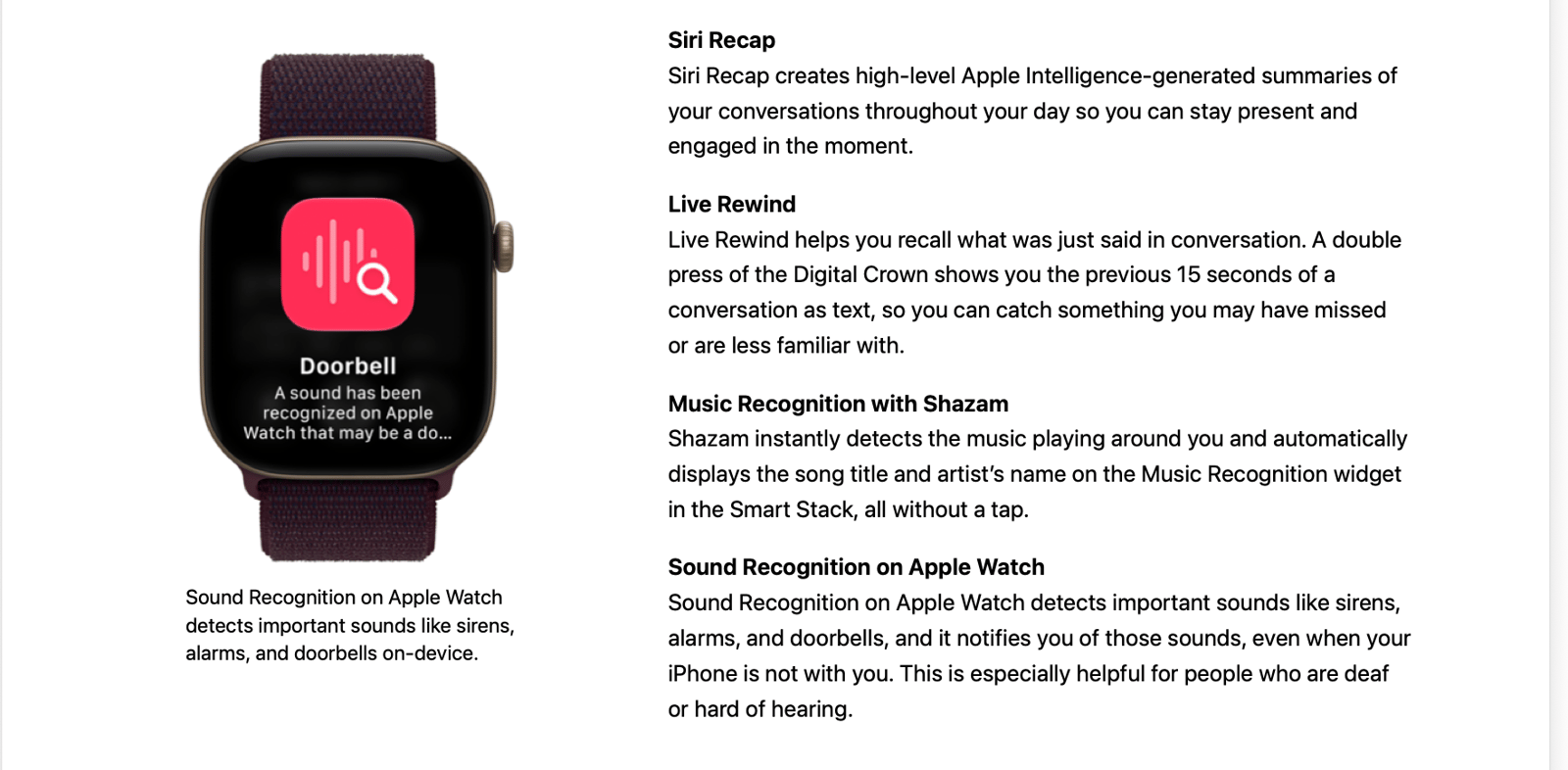
I have no beef with Sound Recognition as an accessibility feature. But the rest?
If I’m present and engaged in the moment, why would I want a Siri Recap at the end of the day? We don’t have to archive everything, and some things are supposed to fade.
If I miss something someone says, I’d rather ask them to repeat it. That feels more natural, and more polite, than shifting my attention to my Apple Watch to check what they’ve just said.
Shazam is great as it is. When I’m curious about a song, I ask it to identify it. I don’t want it constantly identifying the music around me.
It all feels like a technical feat looking for a use case.
Mark Gurman just tweeted out the entire Apple presentation the night before the event.
At what point does an exciting scoop become a senseless spoiler that sucks all of the fun from the new releases?
I’ve always been a folder guy, not a tag guy.
Tag-based organization has never stuck with me, not in Bear, Obsidian, or iA Writer. I understand the appeal, but I’ve never known what to do with them. I do remember Tana having an interesting idea called Supertags before pivoting to yet another AI-meeting note-taking app.
So, with Daymark, I wanted to repurpose tags for my own tracking needs. I combined checkboxes and tags to keep track of anything I can count: push-ups, swims, pages read, etc. It’s interesting to see how these things stack up over time.
I’m still testing it (I pushed out a performance update today) and getting into the groove of keeping daily notes, but here’s my tally for August:
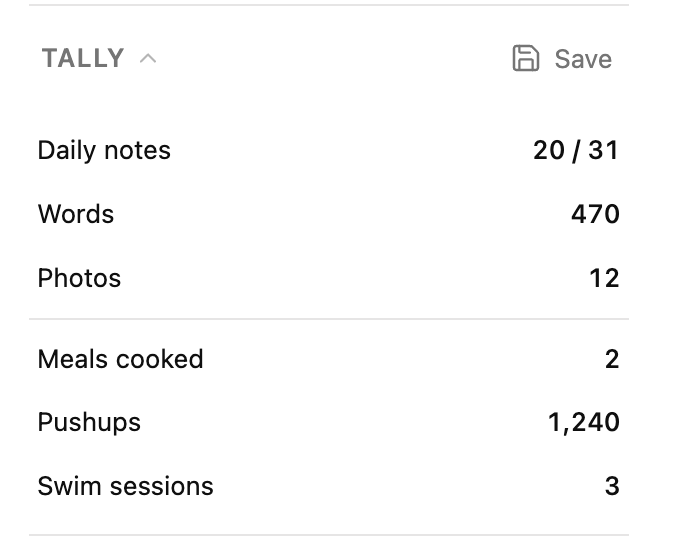
I’m still a folder guy. But I’ve finally found a use for tags.
Speaking of “Like Them, But Better” services, the “Three Twitters” all compare themselves to the Twitter of the good old days. Each sees the other two as inferior, without realizing that all three fall short of the original.
Mastodon is too focused on itself (its servers, federation, and culture) to notice how confusing it all looks from the outside. I’m not the most tech-savvy person out there, but I’m not a complete novice either. Still, I could never bring myself to get into it.
Bluesky is so preoccupied with how its protocol works that it seems to have forgotten about the actual product. The current Bluesky app is almost like Twitter, only still worse. And some of its own users have serious attitude problems.
Ironically enough, Threads has the most interesting interface and product ideas of the three right now. It builds upon old Twitter’s ideas, but the content on Meta’s platforms is so dehumanizing that I don’t want to spend even a minute of my time there.
Each understands something Twitter got wrong, but none understands what made it work.
I wonder what came first: did social media algorithms train us to become more radical in our opinions, or are they simply reflecting something that was already happening?
In times of uncertainty, and ours are certainly uncertain, our minds cling to simple answers. It’s easier to see everything in black and white and ignore the nuances. But reality isn’t like that. Reality is gray.
And yet, black-and-white thinking seems to be everywhere, and some kind of milkshake-ducking is being applied frivolously to everything in sight. If you don’t support Democrats, you’re MAGA. If you post on X, you’re a fascist. Kagi is suddenly bad for using the Yandex index to improve its search. If you use AI in any shape or form, you’re destroying the planet. You know how it goes. There are countless versions of this story, and now that we have three Twitters, the fire is being stoked all over again.
I urge you to stop doing that. You don’t know the whole story. You don’t know the context. And if you still feel the need, remember your own imperfect choices before you do.
I joined Basecamp/37signals after the company’s internal policy fallout. Does that make me bad? Do I deserve to be milkshake-ducked too? Then again, does being laid off after just under two years there absolve me? You do you, but working there doesn’t mean I share every opinion held by the people there. And that’s completely okay. That’s how it should be.
It was also an experience I never took for granted: a little guy from a small Siberian town getting to work with and be inspired by people whose books he had read.
So I’m happy for you if you’re privileged enough to be this picky about your software and everything else. But I’m just trying to get through life with the hand I was dealt.
Oura faces lawsuit accusing it of misleading consumers about sleep-tracking accuracy:
“To capitalize on consumers’ desire for a tracker that could actually track sleep and monitor their sleep cycles, Oura sold expensive tracking rings, priced at $300 and up, advertising exactly that: that Oura rings are capable of seeing what only a hospital sleep lab can see, including the four different stages of sleep,” the complaint reads. “Oura did not just claim to measure a heartbeat or a temperature, but the exact stage of sleep the wearer is in—which in reality requires electrodes in the scalp and sensors on the eyes, as only a hospital or other clinical setting can do.”
Tracking accuracy aside, I’ve always wondered about the usefulness and actionability of the information these smart rings provide. You wake up broken after a bad night’s sleep, and your ring tells you, “Your sleep score was bad. Try to sleep better next time.” What do I do with this information? I already know I had a bad night. Stress measurement? Same. I don’t need an app to tell me I’m stressed out after a doomscrolling session.
I don’t wear my Apple Watch to bed because I find it too chunky and uncomfortable, but I tried it for ten days to see if it would tell me anything interesting. At the end, it reported that my sleep score and vitals were “typical.” Well, thank you very much for this valuable information.
The measurements from a smart ring end up on yet another dashboard I need to check, and I already have enough of those in my life. Plus, those dashboards need to give me insights, a synthesis of separate data points that gives me something I can act on, not an endless stream of measurements about my health.
I wonder if this is exactly what’s stopping Apple from releasing such a device.
I’m very curious about how languages will evolve because of the LLMs.
If people start avoiding the language’s whole sentence structures and em dashes and god knows what else just because the AI uses them, what will happen to the language?
Will LLMs borrow the new commonly used structures? Will people stop using them then again?
Fascinating.
The box-office performance of Spider-Man: Brand New Day shows that I miscalculated: spandex is still as trendy as it was a decade ago. The disinterest in superheroes was all mine.
Which makes me wonder: if superhero fatigue is really my problem, why do I still enjoy Reacher so much? Reacher is basically a superhero too. He can’t shoot webs from his hands or see 14,000,605 possible futures. He’s just a strong guy with a moral compass, but he’s every bit as invincible as those guys. So how come Reacher is so much more enjoyable than any superhero flick out there?
Where does the fine line between superheroes and characters like Reacher lie? Where is the line between a superhero and, let’s say, an extraordinary person? Is Sherlock Holmes a superhero? Is James Bond? Or does someone become a superhero only once the story admits that what they can do is impossible?
I was contemplating this while watching the latest season of Reacher, and I think the main difference lies not in what these characters can do, but in how their stories ask us to believe in them. Superheroes are openly impossible: radioactive spiders, multiple timelines, time travel, blah-blah-blah. Reacher, Holmes, and Bond merely stretch the possible without openly breaking it. Their superpowers are called strength, intelligence, and training, allowing us, the viewers, to pretend that, under extraordinary circumstances, we might be able to do the same.
Reacher’s world also remains stubbornly small. There is a corrupt sheriff, a missing person, a drug operation, a town that needs fixing. Nobody has to punch a hole through the sky to save several timelines at once. Reacher walks into a bad situation, figures out who deserves to be hit, and hits them. The fantasy is ridiculous, but it is concrete. Like a wall.
That made me realize that perhaps I’m not tired of superheroes, but of the way their scale has inflated. When every threat concerns the universe, the multiverse, or the fabric of reality itself, none of it feels particularly threatening or enchanting.
I’m getting older, and perhaps I no longer need every new threat to be bigger than the last (looking at you, Avengers: Doomsday). There is nothing wrong with saving one person, fixing one town, and leaving the rest of the universe alone.
